
A Rondo Patungan story from Romeo Esparrago
Central Texas, January
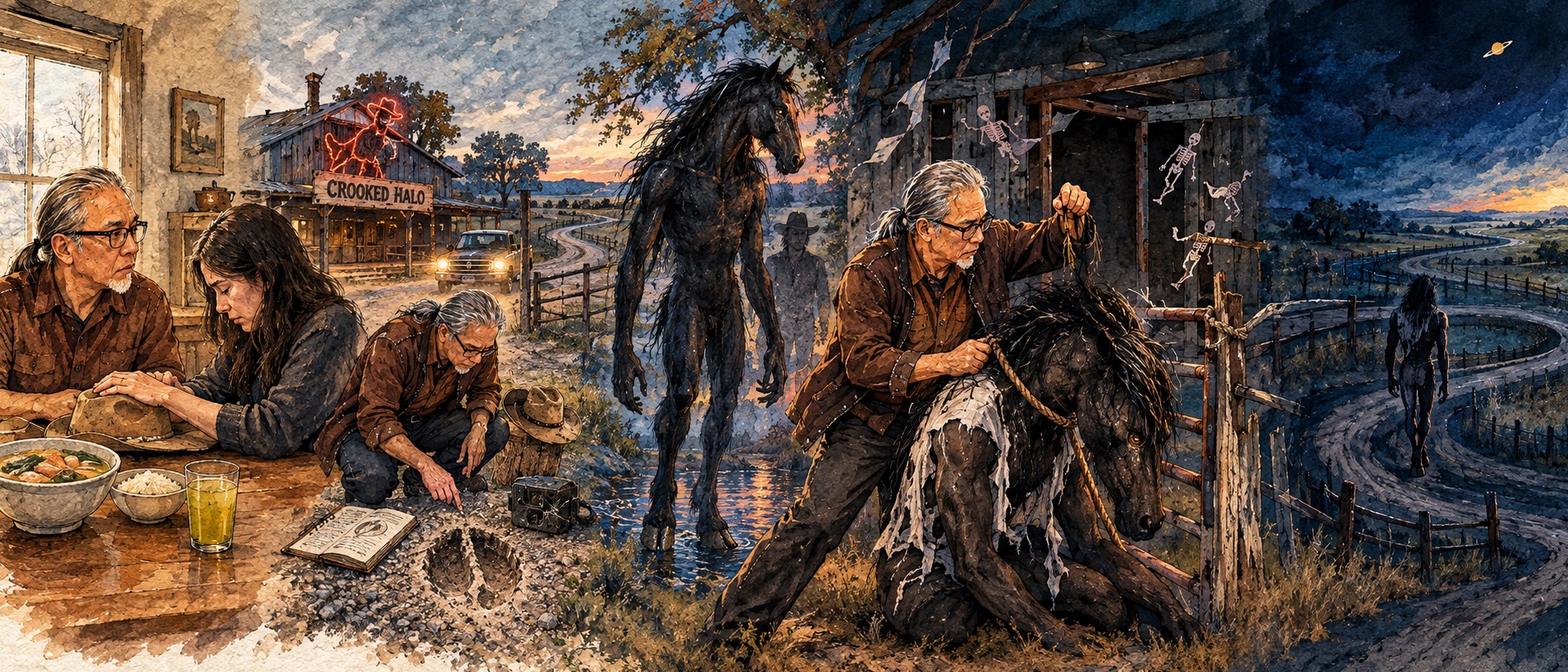
2026 was sixteen days old when Emma brought her husband’s hat to my kitchen table in Austin while I was eating my bowl of sinigang stew & rice from Lil Mama’s in Round Rock. She put it beside my kalamansi juice and kept her hands on the brim.
“Rondo, they found Colt outside the Crooked Halo,” she said. “Him and Eddie Salazar. They worked horses together.”
I knew the place. Country bar and dance hall outside Taylor, on a piece of frontage carved off Mercy Creek Horse Ranch, not too far from the Samsung campus’ construction area.
“I’m retired,” I told her. “County sheriff has people.”
“The sheriff thinks somebody killed them with a machine.” She turned the hat a quarter turn. “One woman says she saw the machine dancing.”
I left my sinigang and kalamansi unfinished. That was how it started.
The photographs were bad. Colt and Eddie lay behind the dance hall, their boots pointing one way and their faces another. Each had a deep crescent driven into his breastbone. Each had bruises beneath his jaw that looked like a handprint, if you allowed a hand to be nearly a foot across.
No robbery. No knife wounds. No horse missing from the ranch.
The sheriff called it homicide and meant it. The newspaper called it a probable livestock incident, which sounded better beside the advertisements for riding lessons.
I drove out the following afternoon. A norther had pressed the grass flat, and the Halo’s unlit neon cowboy hung above the door with one boot missing.
Nell Tatum, the owner, showed me the gravel behind the building. Someone had washed it, but there are things a hose only spreads around.
“A woman said she saw a dancer,” I told her. “Something wrong with his costume.”
“Horse mask,” Nell said. “Big fellow. Head nearly touched the Christmas lights.”
“In January?” I asked. “That strike you as unusual?”
“Honey, I sell liquor.” She folded her arms. “What struck me was the mask chewing.”
Another witness had tried to drive away during the screaming. He swore he took the ranch lane straight to the County 79 highway, three times. Each time, his headlights came around onto the Halo’s back door.
The lane had no loop. I walked it myself.
Cal Mercer brought me coffee while I was looking at the gate. He trained horses at Mercy Creek, a narrow man in a pearl-snap shirt, with a pleasant face I found difficult to remember once he turned away. He looked mestizo.
“Bad business,” he said. “Colt had a little girl.”
His right boot landed oddly, weight rolling along its outside edge. When he crouched to straighten a loose gate latch, his knees came up almost to his ears.
“You hurt your foot?” I asked. “You’re favoring it.”
“Horse stepped on me.” He smiled into his coffee. “They don’t always appreciate what we do for them.”
On January twenty-ninth, a third Mercy Creek cowboy was found outside the Halo. Luis Ortega had made it as far as his truck.
Same chest wound. Same enormous grip under the jaw.
His keys were still between his fingers. That detail kept me awake longer than the photographs.
February through June
I worked the case the old way first. Payroll, grudges, debts, women, insurance.
The ranch owner had enough unpaid bills to wallpaper his house. The farrier had threatened Eddie over eight hundred dollars of unpaid equine hoof care. Neither lead survived being looked at carefully, which was more consideration than most lies deserved.
The three dead men had one other thing in common. A week before the first murders, they had spent an afternoon trying to catch an unbranded black horse in the north pasture.
There was no black horse on the ranch inventory. There was no record of anyone hauling one away.
I kept coming back to the witness who couldn’t find the highway. He had been drunk, but his pickup’s dashcam had been sober.
The footage showed him following the same hundred yards of fence again and again. He cursed, cried, called his wife, and passed the same torn feed sack six times.
That was not a man lying to cover a hit-and-run. That was a man being played with.
By April I was sleeping badly and rereading notebooks I had meant to leave shut. The oldest pages carried things Dindo the Dawendi had taught me when I was still young enough to confuse being lucky with being good.
Dindo had been supernaturally murdered in 2011. I had settled that account, but settling an account doesn’t put anybody back in his chair.
In June, I went to the north pasture alone. Something unnatural moved beside the creek after sunset, tall enough that I first took it for a rider.
I followed it through a gate. Ten minutes later, I passed the gate again.
I stopped, turned around, and walked back the way I had come. The same gate waited in front of me.
Something laughed behind the cottonwoods. It was a low, breathy sound, almost a horse blowing through its nose.
I took off my shirt. Turned it inside out. Put it back on. Kind of a Filipino and Texas thing.
The fence shifted sideways without moving. Suddenly I was standing three feet from the creek bank, looking down at water I had been walking toward for half an hour.
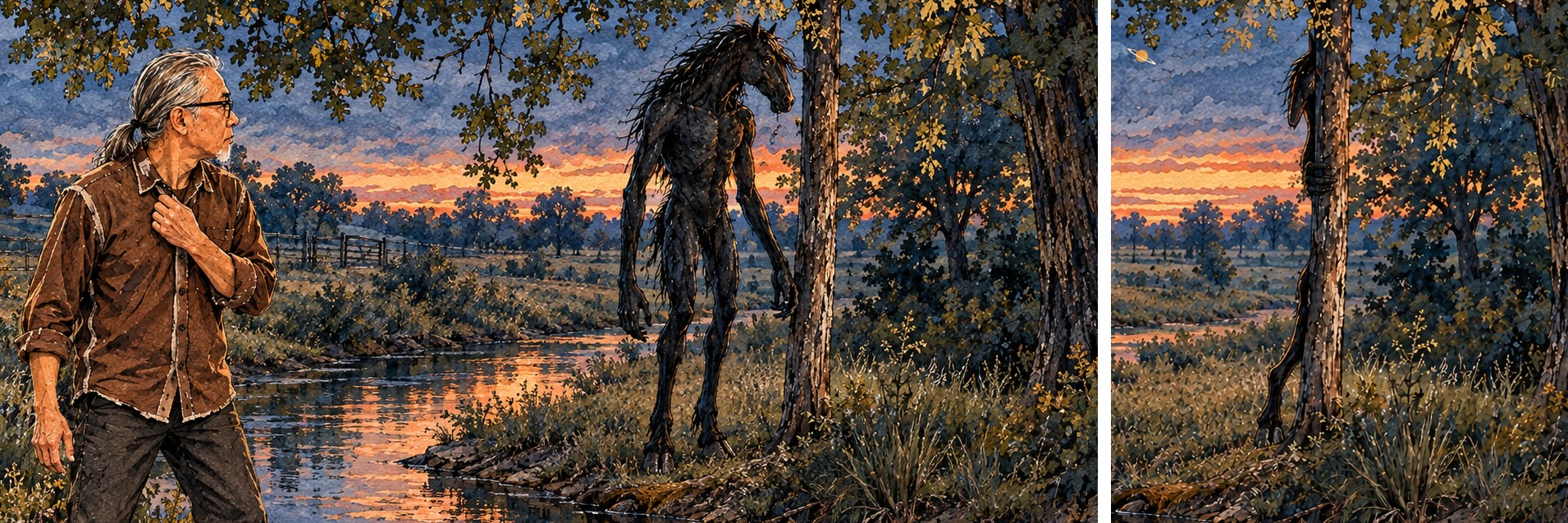
Across the creek, something unfolded from the trees. It stood on two hooves. Its arms hung nearly to the ground, and its horse’s head was blacker than the brush behind it. When it bent, its knees rose beside its jaw.
For a moment the evening held still. Then it stepped behind a trunk too narrow to hide a man and disappeared.
“Tikbalang,” I said. The word tasted like the country I had left as a boy.
Not every one of them was a murderer. Neither was every man who drank at the Crooked Halo.
But this one had learned something worse than how to make a traveler lose his way. It had learned how long a frightened man would keep running before he stopped trying.
July through October
Knowing the species didn’t give me the face. I still had to do the work.
I spent July watching the ranch and August wearing out the patience of people who had already told their stories. I listened to the Halo’s parking-lot recordings until a certain bass line began following me into my sleep.
The killer had left hoof marks at all three scenes. One hoof had a narrow split in its outer edge.
The bodies told me the rest. A hand under the jaw, a hoof planted against the chest, then a twist. No machinery. Just leverage and a strength the men had never stood a chance against.
In September, Emma finally opened Colt’s work locker. She called me from the ranch and said she had found something I ought to see.
It was a cheap trail camera, cracked where somebody had struck it. Colt had used it to watch a mare that kept getting through the fence. The memory card survived.
I didn’t get a movie of a monster turning into a man. Life seldom hands you evidence that considerate.
I got four blurred pictures of the black horse caught in wire. Its right rear hoof was split along the outside edge. In the fifth picture, Colt and Eddie were approaching with cutters.
In the sixth, there was no horse. There was a man standing beyond the fence, his face turned away, blood running down his right hand.
I went back to January’s photographs. Cal Mercer had brought me coffee in his left hand. There had been a fresh bandage around his right.
I asked Nell for her oldest dance-floor recordings. Cal danced every Friday, and he always turned on the outside edge of his right boot.
That was not proof a prosecutor could use. It was enough to tell me which door to knock on.
Cal was gone. The ranch owner said he had quit two days after Emma opened the locker. His bunk was stripped, his employment references disconnected, his driver’s license number stolen from a dead man.
Under the mattress I found a strip of Colt’s work shirt. It had been tied around a little bundle of horsehair.
A keepsake. Some killers liked photographs.
I sat on Cal’s empty bunk until I trusted my hands again. Then I went home and opened the notebook to the page I had been avoiding.
Three stiff hairs hidden in the mane. A prepared cord. Get onto its back, hold until it yields, and take one of the three. Then you could command it.
Dindo had also written down a particular punishment for a creature that made false roads. You could order it to walk one of its own roads forever, with every turning bringing it back to the start.
I had spent years learning how to survive. Apparently the last lesson involved riding bareback.
I practiced knots until my fingers cramped. I put the old binding cord inside a new ranch rope and worked the loop until I could throw it without looking. At the free end I tied a second loop, big enough to fit over a gatepost.
Then I let Nell spread a rumor. Rondo Patungan had the killer’s picture, and on Halloween night he would show it on the Halo’s big screen. Cal called me on October thirtieth.
“Burn the camera,” he said. “Go back to being old.”
“Those men cut you loose,” I said. “You killed them for helping you.”
“They saw me change.” His breathing rasped against the phone. “Then they thought they could put a rope on me.”
“So you followed them to the bar.” I waited. “You made the roads bring them back.”
“You know so much, Patungan.” Something hard clicked against his receiver. “Let’s see what it buys you.”
He hung up before I could tell him. It wasn’t going to buy either of us much.
Halloween Night, October 31, 2026
On October thirty-first, I persuaded Nell to cancel the party. She refunded tickets and told people the wiring was dangerous, which became truer as the evening wore on.
By ten, the dance hall was empty. I had moved the ranch horses to a pasture well away from the building, then parked my truck across the entrance.
No deputies in the brush. No friend waiting with a rifle. I would not put another person on a road Cal could bend.
Inside the Halo, paper skeletons turned in the draft. I sat under them with my shirt inside out beneath my coat, the rope beside my chair, and my old revolver on the table.
At eleven fifty-four, the back door opened. Cal wore a black hat and a clean white shirt. He looked at the empty floor, then at me.
“Where’s everybody?” he asked. His right heel clicked against the boards.
“Home,” I said. “I didn’t care for your costume.”
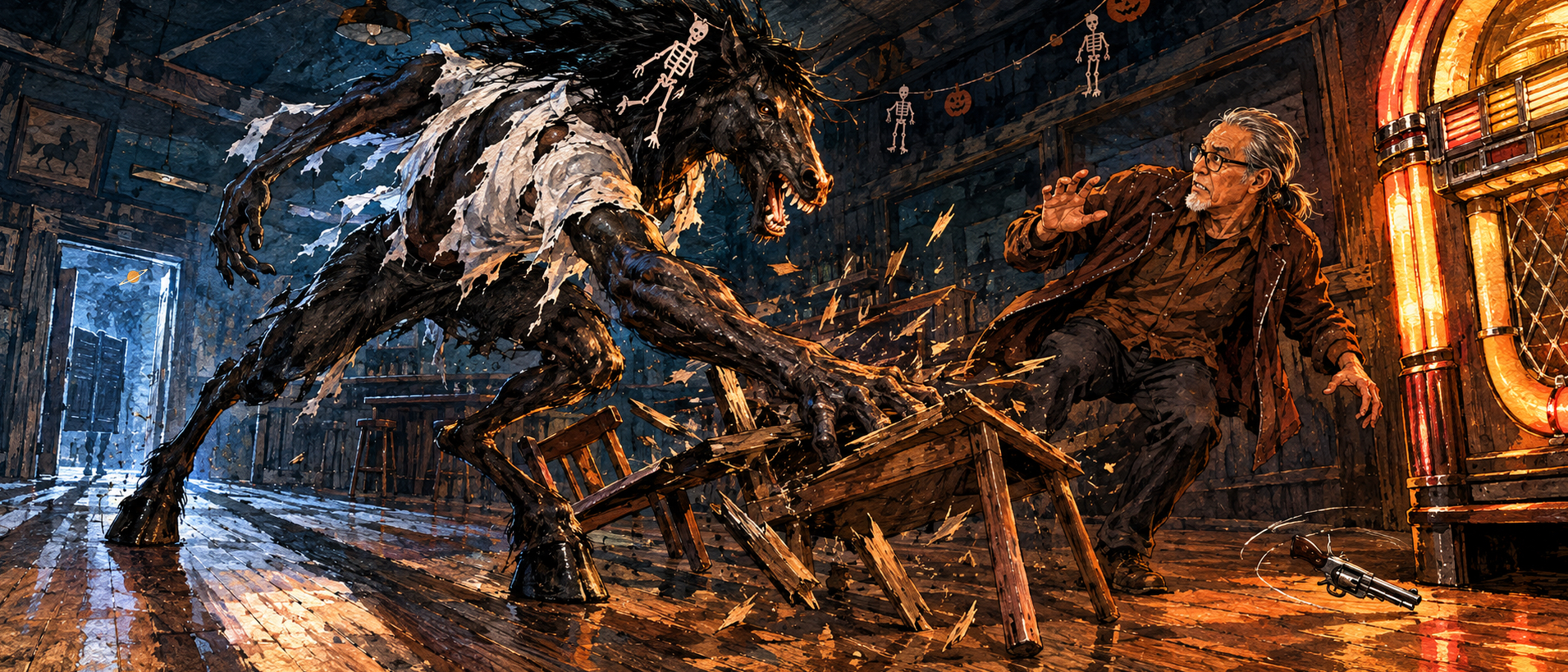
His face lengthened. It wasn’t a mask coming off. The bones moved under the skin, and the mouth pushed forward until his teeth caught the light. His shoulders rose. His knees bent the wrong distance.
The white shirt tore down the back. He unfolded until his head struck a paper skeleton and left it hanging from one ear.
I fired twice. The first bullet knocked him against the doorframe. The second made him shriek, but neither kept him there.
He came across the dance floor faster than I could lift the barrel again. His arm struck the table, and the revolver went spinning beneath the jukebox.
I threw the loop. It caught his neck. The cord tightened, and his next scream came from somewhere behind the horse’s voice, “Putanginamo!”
He dragged me off my feet. I hit the floor chest-first and slid through broken glass. Before he could turn, I scrambled up the rope and got one leg across his back.
I had imagined doing that with more dignity. I had also imagined it hurting less.
He went through the back doors with me hanging on. The lintel struck my shoulder. For a few seconds my right arm belonged to somebody else, somebody who had dropped it and walked away.
We hit the gravel behind the Halo. He bucked, twisted, and slammed me against a parked stock trailer.
One rib went. I heard it clearly.
The parking lot stretched into a black road lined with trees I had not seen in Texas. Narra trees from the Philippines. I shut my eyes, pressed my cheek into the mane, and held the cord.
When I opened them, my inside-out shirt had done its work. We were still behind the bar, circling the same wrecked picnic table.
He could make a mile out of a yard. He could not make the cord let go.
At eleven fifty-six, he reached over his shoulder and caught my left wrist. I heard the small bones grinding. The three stiff hairs stood inches beyond my fingers, dark at their bases and bright as brass at the tips.
“Let go,” he said. “I can give you what you lost.”
There was a small figure beside the fence. A straw hat, a cigar ember, a face I had not seen in fifteen years.
For one ugly second I wanted to believe him. Then I remembered Dindo’s grave. I remembered doing the digging.
“You should’ve offered me a new knee,” I told Cal. “I might have listened.”
I drove my forehead into the back of his skull. Pain burst white behind my eyes. His grip loosened enough for me to wrench my wrist free, but he caught the rope with both hands. The outer strands began to part.
I knew then I wasn’t going to outlast him. Sixty-odd years had left me with plenty of stubbornness and very little else he couldn’t break.
But I knew the parking lot. I pulled the rope toward the loading pen. Cal charged where I pointed, certain he could scrape me off against its steel gate.
That was what I was counting on. I dropped the spare loop over the gatepost and threw myself sideways. The loop caught.
His own speed jerked his head back and drove him to one knee. The post bent, concrete cracked, and I landed under his reaching hand.
He caught my jaw. His hoof rose toward my chest.
For a moment I understood exactly what the three cowboys had seen. I understood how little time there had been.
I put my left forearm between his hoof and my breastbone. Something broke, but it bought me the inches I needed.
With my right hand, I caught the center hair. He pulled my head backward. I pulled harder.
The midnight alarm on my Apple watch began to sound. At the stroke of twelve, as October thirty-first ended, the hair came free with a little wet snap. The hoof stopped against my coat. Cal’s fingers opened.
He fell forward onto both knees, shaking so violently that the broken gate rattled behind him. I stayed on the gravel because there wasn’t much choice.
“Yield,” I said. It came out through blood.
The horse’s head lowered. Behind him, the little figure by the fence went out like a cigarette. There was only the empty pasture.
Midnight
He offered money first. Then years. Then service.
“I can work for you,” he whispered. “You will never be helpless again.”
I looked at the patch of gravel where Colt had died. I thought of Emma’s hands on the hat.
“You’re going to take the road you made here tonight,” I said. “Every turn will bring you back to its beginning. You will never leave it, and you will never touch another living thing.”
His head came up. For the first time, I saw something in his eyes I recognized from the dashcam.
Fear. The kind with nowhere to go.
“Walk,” I told him. “Keep walking.”
He took a step. The dark folded around him. His next hoofbeat sounded farther away; the one after that came from behind me, and then the sounds dwindled into a distance the parking lot did not contain.
The gate stood crooked. Beyond it was a plain strip of ranch lane, leading where it was supposed to lead.
Halloween was over. So was Cal Mercer. I’m guessing his real name must be Kal, short for Kalayaan, meaning freedom in Filipino culture. Being free was no longer his fate.
I lay there long enough to hear a truck on the highway, traveling in an ordinary straight line. Then I used my good hand to call an ambulance.
At dawn, from a hospital bed, I called Emma. “He won’t hurt anyone else,” I told her. “I’m certain.”
She didn’t thank me. She asked whether Colt had been afraid, and I told her the only useful lie I had left.
Outside my window, Texas was turning gray. Somewhere near Taylor, people were getting up to feed their horses.
I asked the nurse to close the blinds. I had seen enough roads for a while. *

About the folklore
The story adapts Tikbalang Filipino traditions involving misdirection, human disguises, inside-out clothing, and subduing the creature through a special mane hair and a prepared cord (Tikbalang folklore). Tikbalang traditions vary, and their familiar horse-headed appearance and behavior are discussed in The Aswang Project’s historical overview.
Rondo Patungan’s first story appeared in Planet Magazine Issue 5, March 1995.
About Romeo Esparrago : Maligayang Halloween!


