
A Rondo Patungan story from Romeo Esparrago, continued from Part 1: The Invitation.
PART 2 OF 2 : THE RECKONING.
The Uninvited Guest
Maria did not step through the opening. When Rondo missed the call, she had telephoned the police as agreed, reporting an overdue investigator and the woman he had gone to meet. She then left the diner to meet Dindo in the courtyard. A crash upstairs had ended their argument about whether she would wait below.
She had heard the impact against the furniture from the hall. Now she could see Rondo’s shirt through the bedroom doorway and one of his hands held at an unnatural angle.
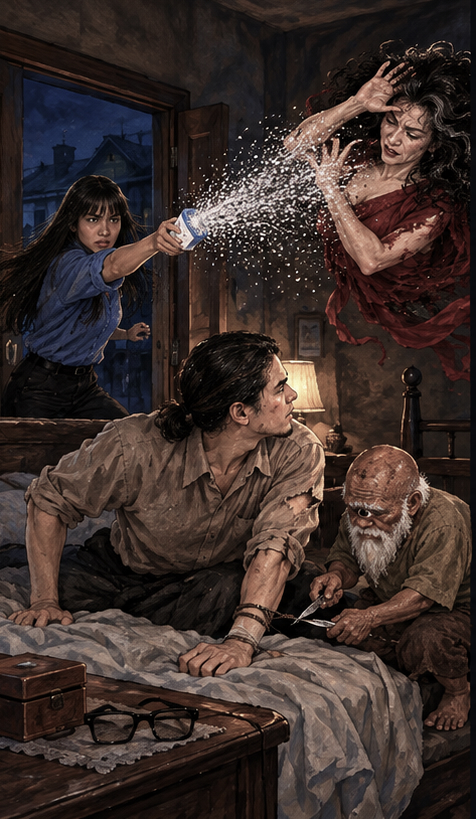
She flung a handful of salt through the gap.
Alarena shrieked. The door flew wide, struck something that was not visible, and stopped before it could hit the wall.
Dindo came through low and fast. He had abandoned invisibility by the time he reached the bed, his small knife already sawing at the cord.
“You were supposed to telephone,” Dindo snapped.
“I got held up.”
“Save it.”
Maria backed toward the kitchen, keeping the carton raised. Alarena followed her above the floor, one arm across her face. A thin, lashing movement cut the carton from Maria’s hand.
Salt scattered across the tiles. Maria stumbled into the counter but stayed on her feet.
Rondo’s left wrist came free. He caught Dindo’s knife and cut the other cord while the Dawendi dragged the bedspread over Alarena’s head.
It held her for less than a second. She tore through it, and the little man disappeared into the wardrobe with a crash.
Rondo rolled off the bed. His glasses were still on the dressing table. He snatched them and the dropped salt packets as Alarena swung toward him.
“Maria, behind me!”
“Your knife.”
She kicked it across the floor. He put his foot on the handle before Alarena could reach it.
For a moment they faced one another across the torn bedspread. Her beauty remained. That was going to be difficult to forget.
Maria looked from the gray-streaked hair to the familiar mouth.
“Her face,” she said. “Rondo, she’s older.”
“I saw it happen.”
“You think she will stay with you?” Alarena asked.
Rondo tore a salt packet open with his teeth.
“I think you’re standing too close.”
He flung it.
She recoiled toward the dressing screen, where the lower half of her body waited in the red skirt. Maria saw what she was trying to reach. Before Rondo could stop her, she seized the fallen carton and emptied the remaining salt over the abandoned waist.
Alarena’s scream shook the window.
She tried to descend. Something stopped her. She tried again, violently, and the dressing screen toppled.
Rondo caught Maria by the arm and drew her back. Dindo emerged from the wardrobe, dragging the long canvas bag he had left just inside the front door.
Alarena looked at the bag. She knew what was in it.
The window burst outward. She went through it in a rush of red cloth and broken glass.
Rondo reached the sill in time to see her pass over the courtyard wall. Dindo was already beside him, his single eye wide.
“She cannot come back into this,” he said, nodding at the shape behind the screen. “But she can find somewhere dark. And another person to feed on.”
“Her face changed when she split,” Rondo said. “Will it stay that way?”
“While she is parted,” Dindo said. “She would have to join again to look young.”
Rondo turned to Maria. There was a shallow cut across her hand. She had not noticed it yet.
“Did you call?”
“From the diner. I’ll tell them what’s happened.”
She used Alarena’s telephone, giving the address again and describing their injuries. Rondo could hear the effort it took to answer the dispatcher’s questions without turning toward the shape behind the screen.
Dindo carried the unused equipment bag down to their car, then went to watch the courtyard wall. Neither of them touched the open box on the dressing table.
He took a towel and folded it over her hand. His own fingers were shaking now.
“You shouldn’t have come upstairs.”
“Would you like me to go back down and try again?”
He looked at her, then gave a short, helpless laugh. She did not.
“Did she say Danielo’s name?”
Rondo nodded. “She killed him.”
“And Boyet?”
“Both.”
Maria looked toward the broken window. When she spoke, her voice was steady.
“Then don’t lose her.”
Names, Not Trophies
The first officer stopped Rondo from approaching the doorway. He wanted to see both hands, and he wanted to know where the knife on the floor had come from.
“Mine,” Rondo said. “I brought it.”
“Leave it where it is.”
His partner checked the rooms for anyone still inside while the first officer called for medical assistance. Rondo gave them Alarena’s description, the direction she had gone, and the address of the Blue Lantern. He distinguished her appearance at dinner, a woman in her late twenties, from the woman who had escaped: apparently in her early sixties, very pale, with long black hair and a few gray streaks. He insisted they were the same person. The officer recorded both descriptions and radioed the appearance Rondo had seen last.
Whatever they thought about the broken window, they did not treat the woman who had gone through it as imaginary.
Behind the screen, the lower half had collapsed within the skirt. In the flashlight beam it looked less like a body than something a fire had failed to finish. The officer stopped short of it.
“Anybody move that?”
“The screen fell,” Rondo said. “We’ve kept away from what’s behind it.”
They were taken downstairs by separate routes. Maria was seated near a patrol car; Rondo was placed on the opposite side of the courtyard while an ambulance attendant examined and dressed his wrists. A third officer kept the building’s owner from going up to inspect his damaged property.
The attendant wanted him taken to the hospital for further checks. Rondo declined the ride after hearing the reasons he should not, signed the refusal, and remained for the interviews. When treatment allowed it, a technician photographed the injuries and the damaged shirt.
Rondo could hear Maria answering questions but not the answers themselves. For the first time since the bed, he could do nothing useful for her.
“I need your account,” the officer told him. “Not what you think she’s saying.”
Rondo started with the invitation. The officer wrote down the time, asked when he had drawn the knife, and made him go through the sequence again. Rondo told him about the cord, the admission, and the window. When he reached the part that could not be mistaken for an ordinary assault, the pencil stopped.
“You’re telling me she separated.”
“I’m telling you what I saw.”
The officer looked at his injuries, then continued writing. He did not promise to believe him.
Maria gave her own account. She had not been present for Alarena’s confession and said so. She described the doorway, the bound hands, the salt, and the thing that had moved above the floor.
“I know how it sounds,” Rondo heard her say.
“Then let me get it down accurately,” the other officer answered.
When a sergeant arrived, Rondo gave him Evarita’s number and the Sunnyvale detective’s name. He also told him about the lacquered box. The sergeant did not invite either witness upstairs to identify its contents.
“Describe what you saw. We’ll deal with the property.”
The rooms were held while the investigator taking over the case arranged a search warrant. An officer remained at the stairs and kept a record of who entered. The first officers noted what they had seen while checking for injuries and anyone still inside. Nobody offered the owners a broom.
The delay angered Rondo until he saw Maria watching the door. She was afraid somebody would open the box, recognize its importance, and then somehow lose it anyway.
“She told me the inscription before we came to California,” he said to the investigator. “It’s in my notebook. Evarita has a copy.”
The investigator asked Maria to write the words down. He took that page before showing her anything.
Evarita answered her telephone on the fourth ring. By the time Rondo explained where he was, her voice had become extremely awake.
“Tell them exactly what you did,” she said. “Especially the parts you wish you hadn’t done. We can deal with facts. I can’t help you repair a version.”
She spoke to the investigator next. Later, a fax arrived with the ring description from the agency file, the case references she had gathered, and the names of the people who had supplied them. Each murder still belonged to the department investigating it. She had made the connections traceable rather than merely persuasive.
Hours passed. Once the search was authorized, the rooms were photographed and sketched: the broken headboard, the cords, the knives, the window, the dark material behind the screen. The opened box and its contents were recorded where they stood before anything was lifted from the dressing table.
When the investigator came back downstairs, he had Maria’s written description in one hand.
“The inscription matches,” he said.
She put a hand over her mouth. Rondo moved toward her, then stopped when the investigator continued.
“That identifies the ring. We still have to establish how it got here.”
The watch and lighter would need confirmation from the other investigations. The items went into separate marked packages, and the collector’s name, time, and location were entered on the record. Danielo’s ring had a place in that record now. Maria asked for the incident number and wrote it on the back of her postcard.
Rondo promised Maria he would go to the hospital when it was over. The sergeant took their contact details, told them they would be needed again, and made it plain that leaving the scene was not permission to hunt the suspect.
“If you learn where she is, call. Don’t make us find another room like this.”
By the time they were allowed to return to their car, the sky had begun to pale. Rondo knew the sergeant was giving him good advice, and wished it were going to be sufficient.
Dindo waited in the courtyard, invisible again. He had been following the roofs and returning while the humans talked.
“Toward the old town,” he murmured beside Rondo’s knee. “She kept circling back to watch this place. Now she has gone where she can last through the day.”
Maria stood close enough to hear.
“Can she survive like that?”
“Long enough to make tonight somebody else’s problem.”
“She knows you’ll follow,” Maria said.
Dindo nodded, although neither of them could see it. His voice came from beside the open car door.
“She has found shadows and a narrow passage. She intends to choose how you reach her.”
Rondo unzipped the canvas bag. The sharpened bamboo looked embarrassingly ordinary.
“You stay here,” he told Maria.
“I’ll stay out of reach. That is not the same thing.”
“Maria.”
“I’m not going to chase her with a knife. But I can drive. You can barely close your hand.”
He flexed his fingers and discovered that she was right.
They settled it without pretending the arrangement was safe. Maria would drive, remain with the car, and call for help if they did not return. Dindo would lead Rondo the last part on foot.
Before they left, Maria stopped him beside the car.
“Did you want her?”
He could have hidden behind the investigation. The lie was ready, smooth and useful.
“Yes.”
Her face changed, but she did not look away.
“Did you stop?”
“Before the box. Before I knew what she would admit.” He swallowed. “I thought about you.”
Maria took a moment with that.
“Then remember me alive,” she said. “Not just standing next to two graves.”
He put his uninjured hand against her cheek. She leaned into it, briefly, before opening the driver’s door.
“And don’t tell me it was only work,” she added.
“It wasn’t.”
She let go of his wrist. It was not forgiveness for something he had not done; it was the harder business of deciding whether to trust what he had told her.
“All right,” she said. “We’ll talk about it when there’s time.”
He was grateful that she had said when.
Under the City
Dindo found Alarena’s trail where the buildings grew older and the streets emptied. He followed by scent, stopping at corners with his head raised. Once he pressed both hands against a brick wall and listened.
They reached the pedestrian underpass between the old town and the shopping area while the streetlights were still burning. From the pavement, Rondo could see a shallow ramp descending to a long passage, a handrail along one side, and a dark recess beneath the stairs at the far end. The morning light would reach the mouths of the tunnel without reaching everything inside.
“She can stay there all day,” he said.
“Or leave before the sun gets high,” Dindo answered. “The city is about to bring her breakfast.”
Maria parked near a pay phone. While Dindo watched the entrance, she called the number the officers had given them, supplied the incident number, and reported where they believed Alarena had gone. Rondo added his name and warned the dispatcher that the woman was dangerous.
He did not want a uniformed officer turning the corner unaware. He also knew he was already doing what the sergeant had told him not to do.
They were told to wait for a unit. Rondo intended to watch the mouth of the passage, no closer, until Dindo stiffened beside him.
“She is going through to the other side.”
Rondo could hear a cart rattling somewhere beyond the far entrance. He took the bamboo out of its sleeve.
Maria caught his arm.
“Not because she made a fool of you.”
He looked at her. The rebuke reached something the bandages had not.
“No,” he said. “Not for that.”
He left her the jar and the equipment bag. Dindo checked the bamboo’s sharpened end with a thumb, then touched the back of Rondo’s shirt.
“Here. She knows where you need to stand. She will keep you in front of her.”
“Then make her turn.”
“That is the difficult part.”
Maria held the jar while Dindo inspected the lid. Her hands had stopped shaking.
“If it comes out,” he told her, “you keep your face away. Do not let it make you curious.”
“You’ve managed that already,” she said.
Rondo squeezed her uninjured hand once. He did not make another promise.
Inside, the passage smelled of damp concrete. Water from somewhere above had gathered in a shallow gutter beneath the handrail. Two lamps were burning, with an unlit stretch between them. Rondo could see how a person would lose the thing he was watching in that darkness.
He kept the bamboo close to his side instead of pointing it ahead. Dindo moved along the opposite wall. Something scraped overhead and stopped when they stopped.
Alarena drifted into the light.
Her hair was loose, the gray streaks catching the light among its black waves. Her face remained the older one he had watched emerge above the bed; separation had given her no way to put those years aside. The red fabric had torn at one shoulder, but she had arranged it with care. Even now, she wanted to decide how she would be seen.
“You’ve made such a mess of me, Rondo.”
He held the bamboo across his body. “You could have stopped.”
She smiled without humor.
“Could you?”
He did not answer quickly enough to please himself.
“You wanted me before you wanted to be a good man,” she said. “I was there. Don’t tell me a story about it now.”
“I’m not.”
Something changed in her expression. Perhaps she had expected a denial.
“I could leave,” she said. “There are other cities. Other countries. You take the widow home. Tell her you won.”
Dindo shifted at Rondo’s side. His bare feet made almost no sound.
“Was the cabin real?” Rondo asked.
For the first time, her eyes left the point of the bamboo.
“Yes.”
“The blue cups?”
“Yes.”
He had wanted the question to expose a lie. Her answer was worse.
“You think that room would make you different?”
“I thought I would like the room.” She glanced toward the brightening entrance. “Not everything I wanted was about killing someone.”
“Enough of it was.”
She looked at him for a long moment, and then at the place on his cuff where the button was missing.
“I could still let you go,” she said. “You could keep what was pleasant and forget the rest. People do it every day.”
“And the next family?” Rondo asked.
“You won’t know them.”
She said it reasonably. That was the clearest thing he had heard from her all night.
Alarena moved nearer. “I hate waking hungry. I hate what it makes me do.”
Rondo saw, for one instant, something weary behind her face. Then her gaze dropped to the pulse at his throat.
“But you like doing it,” he said.
Her smile returned.
“Sometimes.”
She struck before the word had quite ended.
Dindo shoved Rondo sideways. The tongue snapped past his ear and hit the wall with a sound like a thrown nail. Alarena withdrew into the unlit stretch before he could bring the bamboo around.
He heard the fabric of her dress brush concrete to his left. Then he heard it behind him.
She had no footsteps to follow.
“Not the sound,” Dindo said. “The shadow.”
At the edge of the working lamp, something moved along the ceiling. Rondo turned with it, keeping the point low enough that she would have to come within reach.
She reached for his injured wrist instead.
He pulled back just in time. Her nails caught the bandage, and the white strip unwound between them. She had held that same wrist at dinner while examining his loose button.
“You favor it before you notice,” she said.
He began to understand that she had been studying him with more attention than he had given her.
Dindo threw a pinch of salt against the wall behind her. She recoiled from the scattering grains and turned her shoulder toward Rondo. He lunged, but his shoe slid in the water beside the railing. The point struck concrete instead of her back.
Alarena caught the shaft.
Rondo let one hand slide, trying to shorten his grip. She was stronger, but the bamboo gave him a little distance, and distance was the only advantage he had left.
“Let go,” Dindo shouted.
Alarena pulled him toward her with a suddenness that bent his injured arm. He held on one instant too long.
She whipped him into the railing, tore the weapon free, and broke it across the concrete edge. The sharpened section skittered into the dry strip near the opposite wall. The rest fell at his feet.
Dindo sprang onto her back before she could knock the point into the gutter. For a moment the two creatures turned together in the air, snarling. He clawed at her face, trying to hold her where Rondo could reach her.
She changed direction instead of fighting his grip. His shoulder struck the low ceiling. When his hands opened, she caught his arm and flung him against the wall.
The Dawendi fell beside the railing and did not move.
Rondo reached for him. Alarena struck him before he got there.
He slammed against the opposite wall. Hard.
Lights blinked across his vision. The broken point was only a few paces away, but Alarena hung between him and it. Dindo’s hat rolled once in the gutter and settled.
She advanced slowly now.
“There,” she said softly. “No uncle. No knife. No sensible woman telling you what you ought to want.”
Rondo pulled himself upright. His injured shoulder would not rise.
At the mouth of the passage, a car horn sounded.
Alarena turned.
Maria stood in the first gray light of morning. She had seen Dindo fall and had sounded the horn, hoping to bring whoever was coming more quickly. Now she held Rondo’s canvas bag in one hand and the jar in the other.
“I brought it,” she said.
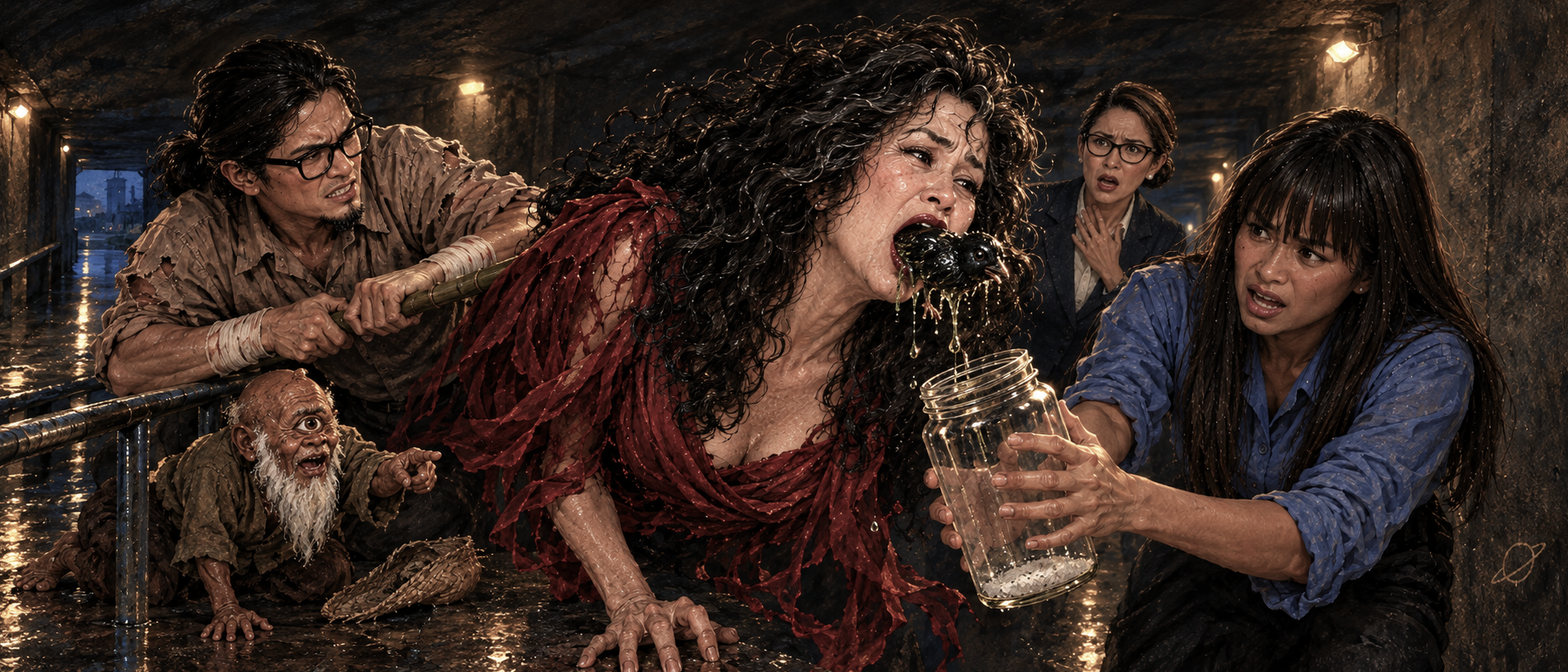
The Last Mouthful
“Stay back!” Rondo shouted.
Maria put the jar in the angle between a rail post and the wall, where it would not roll, then set the bag beside it. She did not run toward Dindo. Alarena had placed herself to catch anyone who did.
Alarena watched her with open dislike.
“You have made yourself troublesome.”
“I’m beginning to understand how.”
Maria’s gaze moved to the broken bamboo. She could not reach it without going past Alarena. Rondo saw her measure the distance and shake her head slightly.
Maria looked once at the water beneath the railing, then at Rondo’s feet. She had seen the mark where he had slipped.
“Dry side,” she said.
He nodded. She was not asking him to be stronger than he was.
He pushed away from the wall.
“You want me,” he said.
Alarena looked back at him. “I did.”
“Then finish what you started.”
He picked up the blunt remainder of the bamboo shaft. It was a poor weapon, but holding it gave her something to watch.
She came at him low.
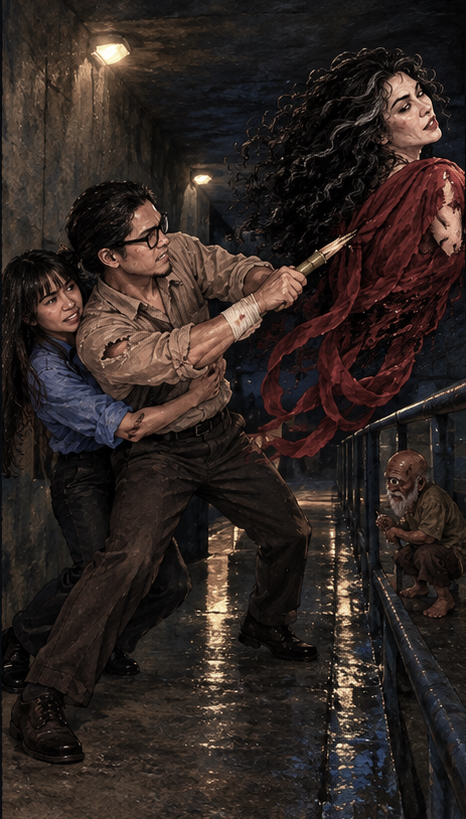
Rondo drove the blunt end against her shoulder and turned with the impact, keeping his feet on the dry strip. Her fingers raked his sleeve. The cloth tore, and he felt the warmth of blood, but he kept her moving away from the sharpened piece.
She caught the stub of bamboo and began to pull it out of his hands. This time he yielded a step deliberately. It drew her just beyond the weapon on the floor.
“Maria. Now.”
Maria ran to it.
Alarena heard her and spun. Rondo caught a handful of red fabric, trying to hold her back. She hauled him off his feet and threw him into the railing.
The bamboo point was in Maria’s hands.
For a moment Alarena hung between them, deciding which one to kill first.
Maria slid the weapon along the dry strip, butt first. Rondo dropped the blunt shaft and reached for the sharpened section.
He caught it on one knee. Alarena’s tongue lashed across his hand before he could lift it, knocking the point against the railing.
He cried out. Alarena’s eyes followed the blood on his hand.
Then, with the same quickness with which she had changed the subject at dinner, she looked at Maria.
“He told you about his wife,” Alarena said. “Did he tell you what he left out for me?”
Maria took a step back, not toward Rondo but toward the canvas bag.
“Ask me later,” Rondo said.
“I intend to.”
Maria caught the bag by its long shoulder strap. Alarena’s expression hardened; the little opening she had expected between them had not appeared.
Alarena lunged after her.
Maria swung the bag between them. Its strap caught the lashing tongue, and she dragged the loop across the railing. It held for an instant, no more. Alarena tore through it so violently that Maria stumbled to her knees.
But she had turned her back on Rondo.
He drove the sharpened bamboo forward with both hands.
The point struck beneath her shoulder blade. There was resistance, then a sudden yielding, and a sound from Alarena that seemed too large for the passage.
Rondo drove with his legs rather than the hand that would no longer close properly. The bamboo scraped against the rail, giving him a brace. He had her back at last, but he could feel how little strength he had left to hold it.
She rose with him hanging onto the shaft.
Rondo’s feet left the floor. His injured hand began to slip.
“Hold it!” Dindo croaked.
Maria caught Rondo around the waist and braced herself against the railing. He brought one foot down, then the other. Together they kept the bamboo where it was.
Alarena twisted toward him. Her lined face passed close enough that he could see the tiny flecks of gold in her eyes.
“You wanted me,” she said.
“Yes.”
He did not look away.
“You don’t get to have everybody who does.”
She caught his hand. For one terrible second her grip was almost gentle.
“You can stop,” she said.
He remembered the worn clipping in her purse. He remembered Danielo’s ring falling into the box.
“So could you.”
Her grip tightened until his fingers began to numb. She clawed at the concrete with her free hand, trying to drag them deeper into the dark. Rondo felt Maria’s arms tighten around him. Dindo crawled to the foot of the railing and raised his head.
“The jar,” he said.
Alarena’s mouth opened.
The first sound was a small, sharp peeping.
Rondo nearly loosened his hands. Of all the noises he had expected, that was the worst: something helpless and young coming from the woman who had left those men dead.
A little black head pushed between her lips.
“Maria!”
She let go of his waist and snatched up the jar. Rondo planted his feet and leaned his full weight against the bamboo as Alarena convulsed.
The thing dropped from her mouth.
Maria pulled the lid off. The little creature turned toward the gutter, and she stamped one shoe in its path before bringing the jar down over it. Salt scattered across the floor.
The thing struck the glass hard enough to ring. She could feel its movements through her hand.
The lid would not go under the rim. A chip in the concrete held it.
Behind her, Rondo made a sound she had not heard from him before. He was losing his grip.
She forced herself to look at what her hands were doing. Tilt the jar only enough to clear the chip. Keep the opening away from her face.
The black shape struck toward the gap. She flattened the lid against it, lifted both pieces together, and turned the jar upright. Some of the spilled salt came with it.
Salt whitened the black shape inside.
“Close it,” Dindo said. “Close it all the way.”
Maria tightened the lid. The threads caught crookedly.
She stopped herself from forcing it, turned it back, and began again. This time it seated all the way down.
Alarena sagged. Without the thing inside her, the borrowed strength was leaving.
Rondo lowered her toward the ground without withdrawing the point. He could hear traffic above them now. The day was beginning for people who had slept through all of this.
She looked past him toward Maria.
“They wanted me,” she whispered.
Maria stood with the jar held away from her body.
“Danielo tried to help you,” she said. “Boyet trusted you.”
Alarena’s eyes moved back to Rondo. He could no longer tell whether she was furious or afraid.
“Their names,” he said, “were Danielo and Boyet.”
At the entrance, sunlight touched the upper end of the ramp. It had not yet reached where they stood.
Dindo pointed with a trembling hand. Maria started toward it with the jar held at arm’s length.
Alarena saw where she was going. The last effort she made nearly took Rondo with her.
He turned his shoulder against the rail post and trapped the bamboo between his forearm and his ribs. Pain ran through him so fiercely that the passage disappeared for a moment.
He held on.
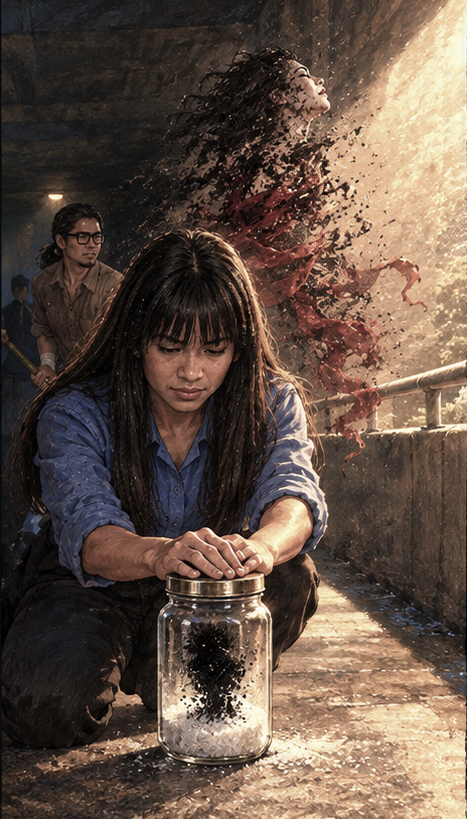
Maria climbed the ramp. At the top, she put the jar down where the full light could reach it and kept both hands on the lid.
The small shape inside threw itself against the glass once. There was a dry flutter, a brief smudge of darkness, and nothing left above the salt.
Behind her, Alarena came apart like burned paper.
Rondo held the bamboo until he was certain there was nothing pulling against it. Then he let it fall.
The torn red silk lay where she had been. The woman who had worn it was gone.
Rondo stared at the patch of floor. He remembered Alarena looking at the crease in her palm, thinking too late of buying flowers.
He would not be able to decide that every word she had spoken was a lie. It would have been easier if he could.
Maria came back carrying the jar. She saw his face and did not ask him to rejoice.
Nobody spoke for a while. Then Maria knelt beside Dindo, who had become invisible again but was doing a poor job of hiding his wheezing.
“Can you stand?” she asked the empty air.
“I can complain,” he said. “It is usually a good sign.”
Rondo sat down against the wall. His glasses had survived. He considered this a small, insulting miracle.
Maria came back to him and placed her forehead against his. He put his good arm around her.
Neither of them called it happiness. For the moment, being alive was enough to manage.
What Could Be Returned
The arriving officers found them where Maria had told the dispatcher they would be. Rondo set the broken bamboo on the ground before anyone had to ask, and kept his hands where they could be seen.
“I used that,” he said. “She was attacking us.”
The officer looked at the sharpened end, then at the red cloth.
“Where is she?”
Rondo answered. The officer asked again, more slowly, but the answer did not improve.
They were separated for treatment and questions. Maria told an officer where she had picked up the jar, what she had put inside it, and where she had carried it. She set it down instead of passing it from one curious hand to another.
The bamboo, the jar, and the cloth were photographed before collection. Rondo watched the collector mark the packages and write down the places they had come from. He could not make the residue inside the jar become a thing the officer would recognize, but he could keep its history from disappearing with it.
He gave his account of the strike to Alarena’s back without trying to make it sound less deliberate. After that, he asked to speak to Evarita before a further interview. She arranged for a California lawyer to help him through the questions that an injured man with a sharpened weapon was not going to avoid.
The hospital kept Rondo longer than he liked and less time than Maria wanted. He acquired stitches, a sling, and several instructions he listened to with unusual attention.
With his permission, the damaged shirt went into a separate evidence package. Maria was interviewed again while he was being treated. She described what she had seen, not what he had told her afterward; their accounts agreed in the important places without becoming identical.
Dindo had watched the rooms above the dress shop from the courtyard after daylight. Nothing remained of the lower body but ash and ruined clothes. He told Rondo there was no living trace to follow, and no second escape to fear.
That was something the police could not enter as a laboratory finding. They had scene photographs, injuries, recovered property, samples, and accounts of a suspect whose disappearance nobody could explain. The medical treatment and the interviews took most of the day; no one announced that the case was solved.
Evarita made no promises about what a prosecutor could prove. She sent the agencies copies of the material she held, with the dates and names attached, and kept a record of what each had received. She did not let one department’s interest become another department’s assumed responsibility.
“We put what we know on paper,” she told Rondo. “We don’t have to manufacture the part they’ll believe.”
The police retained Danielo’s ring. Maria could request its return, but it was evidence in an investigation that was not finished. Evarita asked for the request to be recorded and for Maria to be notified when a release could be considered.
What came back to Colorado first was a photograph of the inscription and a written acknowledgment that the ring had been recovered.
Rondo was there when she opened the envelope.
Maria ran a finger along the photograph. The handwriting she had chosen for the engraving was sharper in the enlarged image than it had ever looked on the ring.
“I want it back,” she said.
“I know.”
He did not tell her that a picture was just as good. He stayed beside her until she folded it and put it away.
They had dinners after that. Quiet ones, sometimes happy. Maria kissed him without asking permission from her grief. Rondo learned that she disliked being interrupted when she was reading and that she could make him laugh simply by imitating Evarita saying his name.
She also discovered that he called everything “fine” until somebody asked a second time. One evening she made him sit down while she fastened the cuff of a clean shirt; his bandaged fingers had failed at it three times. His arm was out of the sling for a few minutes, and he could not decide whether her closeness made it hurt more or less.
“Alarena kept a button from the other shirt,” he said.
Maria stopped with her fingers against his wrist.
He wished the sentence back immediately. It remained between them.
“You liked something about her,” she said.
“Yes.”
“Not only how she looked.”
“Not only that.”
She let go of the cuff and sat back.
“I can hear that. I don’t want to pretend you walked into an empty room and a monster happened.”
He looked at her. She was not offering him the comfort of having said nothing wrong.
“But I don’t want her to be in every room we’re in now.”
“I’m sorry.”
“Tell me when you mean to tell me. Don’t let her keep interrupting.”
He nodded. After a moment, she took his hand again and turned it so he would not have to.
“You shouldn’t have to be my nurse,” he said.
“I’m doing up a button, Rondo. Don’t make it a calling.”
He laughed, and the laugh hurt his ribs. She looked pleased with herself and finished with the cuff.
That night, she stayed. There was no confession that made everything simple, and neither of them asked for one. When they kissed, she touched the uninjured side of his face; he learned to ask what she wanted and to believe the answer.
In the morning, he woke to find her reading at the kitchen table in one of his shirts. She had put the radio on, then turned it off when he came into the room.
He made coffee with his good hand. She pretended not to notice how carefully he carried the two cups.
Later, he found the lurid Sacramento postcard propped against his kitchen clock. She had written on the back, beneath the police incident number: Breakfast, finally.
He began imagining the ordinary arrangements he had described to Alarena. Which cup belonged to whom. A paperback left open on the table. Someone annoyed that he was late, with a right to be annoyed.
He nearly asked Maria for all of it before she had finished the coffee.
Instead, he asked what she wanted to do that day. She said she wanted to go somewhere with trees and no forms to sign.
They did. He remembered more of that afternoon afterward than of dinners he had tried much harder to make memorable.
Several days later, Maria told him she was going home. She was holding a letter about the house in the Philippines, and he could see that she had already read it many times.
He was quiet so long that she put it down.
“It’s not because I don’t want you,” she said.
He had been preparing to make that explanation on her behalf. Hearing her refuse it left him with the more difficult truth.
“I know.”
“I haven’t bought the ticket yet.”
For a moment he heard an invitation to persuade her. Then he saw how hard she was trying to give him room to be hurt without making him responsible for her decision.
“When you do,” he said, “I’ll take you to the airport.”
Postscript: Departures
They went to the airport three weeks after Sacramento. Maria had a suitcase, a carry-on bag, and the photograph of Danielo’s ring in an envelope. Evarita had the forwarding address and written instructions for the property request.
Rondo carried the suitcase with his good arm. He had tied his hair back carefully and put on a clean shirt. The effort made him feel younger than twenty-nine in a way he did not enjoy.
The fresh columbine behind Maria’s right ear had come from her mother’s garden. Rondo had remembered to ask for one that morning. When he gave it to her, she had smiled and reached for a hairpin, pleased that he had remembered something that had nothing to do with the case.
They stopped before the point where saying goodbye would become unavoidable.
“I could ask you to stay,” he said.
Maria nodded. “I know.”
“Would it help?”
“Not if I stayed because I couldn’t bear to hurt you.”
He looked down at the handle of her suitcase.
“That was a very good answer.”
“I’ve been trying to find a worse one all week.”
She touched his cheek. He turned into her hand before he could stop himself.
“I have a house to put in order,” she said. “A grave I’ve been afraid to visit. People I want to see without having to explain why I’m hiding.”
“And a terrible green chair to buy.”
She laughed, then had to look away. He waited until she could look back.
“There are things over there, too.”
“I know. I met one here.”
He smiled despite himself. Maria took his hand.
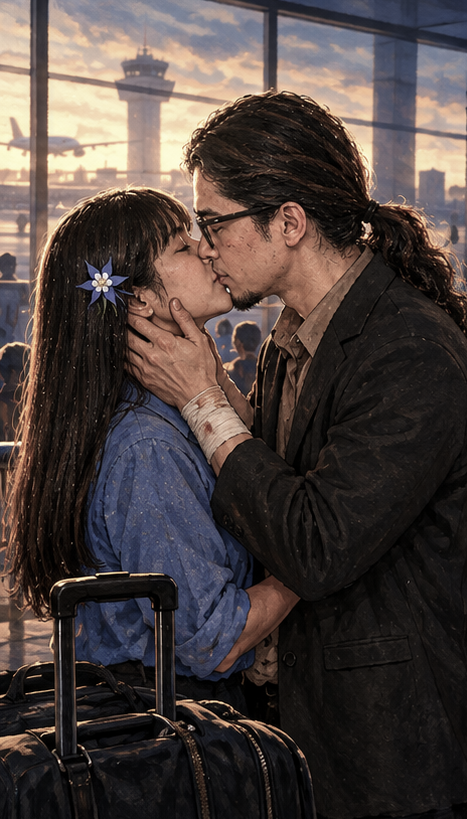
“I don’t want the rest of my life to begin with what happened to Danielo and Boyet. And I don’t want what happened between us to be only the way I survived it.”
“It wasn’t,” he said.
“No.” Her voice caught. “It wasn’t.”
They kissed for a long time, quietly, among people checking tickets and looking for signs.
When they parted, Rondo wanted to ask for a promise. A date. A return flight. Something he could put on a calendar and call a plan.
Instead, he said, “Write when you get there.”
“I will.”
“Tell me about the chair.”
“You’ll get a photograph.”
It was not the promise he wanted. It was a real one, and he let it be enough to say goodbye.
She picked up her bag. At the turn in the corridor, she looked back and lifted her hand.
He stood until he could no longer see her.
A small weight settled against his leg. To anyone watching, Rondo was alone.
“Well,” Dindo said invisibly, “you look terrible.”
“Thank you.”
“I thought you would prefer an honest friend.”
Rondo sat on a bench. The cushion beside him depressed under a weight nobody else could see.
“Did I do the right thing?”
“Which thing? You have done several. Some were remarkably stupid.”
“Letting her go.”
Dindo was quiet long enough that Rondo turned toward the empty place beside him.
“You wanted her alive,” the Dawendi said at last. “Alive people go places.”
Rondo looked down the corridor again. He rubbed his hands over his face, taking care around the healing cuts.
“Come on,” Dindo said. “I am too old to sit here pretending not to worry about you.”
Evarita was waiting in her office when Rondo returned. She looked at his face, then at the clock.
“How was the airport?”
“Efficient.”
“That bad.”
She poured him coffee and moved a folder away from the visitor’s chair. For once, she did not offer him a case.
“I was going to finish the expense report,” he said.
“It’s finished.”
“The invoices?”
“Filed.”
“You’re making it difficult to be useful.”
Evarita sat on the edge of her desk.
“Take tomorrow off. Paid. You can be useful Thursday.”
He stared at the coffee.
“Is this professional advice?”
“Absolutely. I refuse to charge clients for you staring through their walls.”
He laughed, not very strongly. She let him have it without adding anything.
After a while, she said, “You helped her get her life back, Rondo. It was never going to be something you could invoice her for.”
“I know.”
“Knowing doesn’t make it pleasant.”
She rose and returned to her chair, giving him the dignity of something ordinary to look at. Somewhere near the open window, an unseen old man cleared his throat.
Rondo drank the coffee while Evarita worked. He did not have to tell either of them that he was not ready to go home to an empty house.
When he finally stood, she looked up.
“Thursday, Ronnie.”
He managed a proper smile this time.
“Toodles, boss.”
The small, invisible footsteps followed him out.
The Postcard Again, Round Rock 2026
His spoon touched the bottom of the bowl. Rondo looked down at the last piece of chicken and the little broth remaining around it.
He finished the last of his tinola chicken stew, gathering the broth with his spoon before setting it down. Then he lifted the glass and gulped down the last of his kalamansi juice.
The postcard was still beside his glass. He picked it up and read the message again, slowly this time.
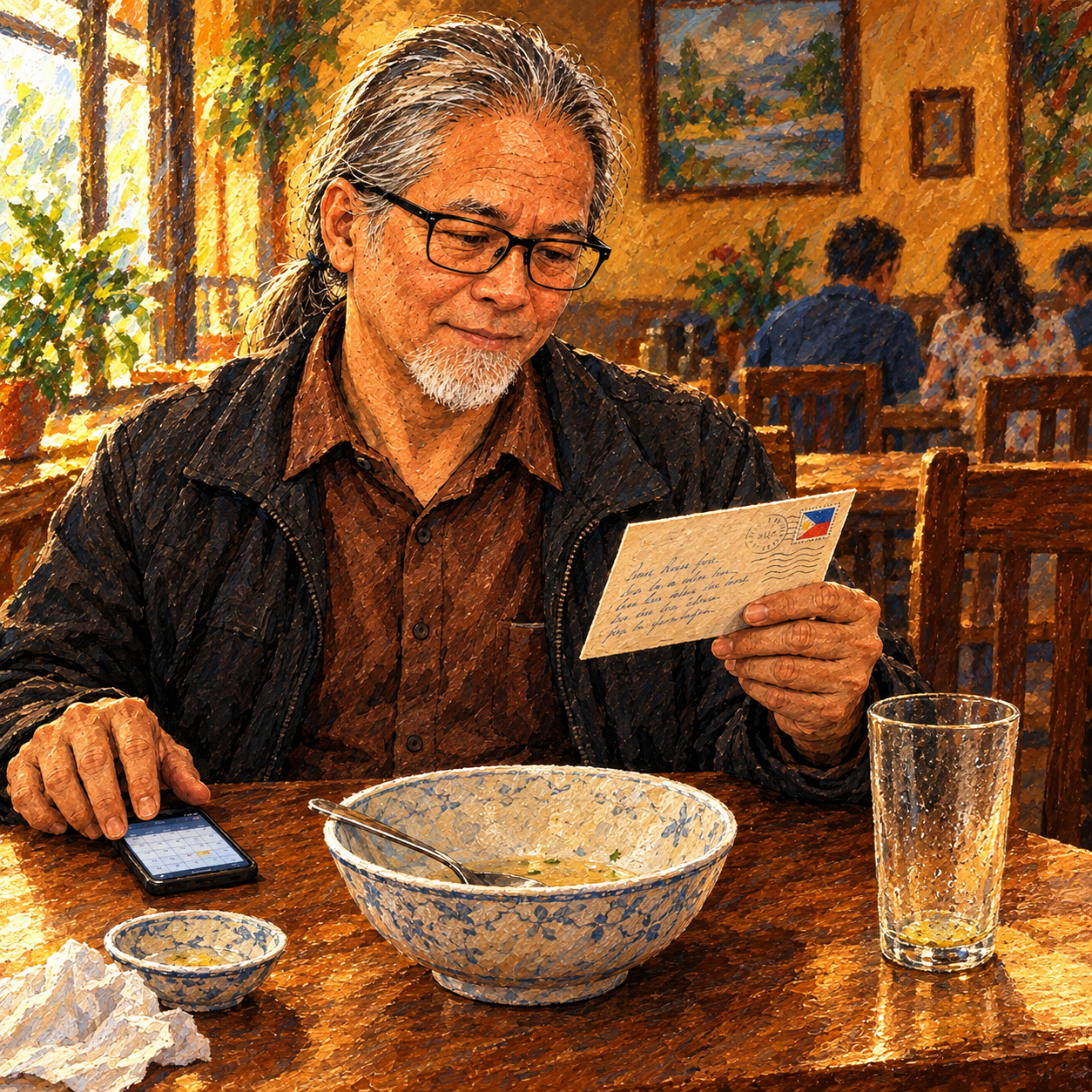
“Rondo, I’ll be visiting Texas next week. If you have a morning free, I’d like to have breakfast with you.”
Below that was her name. No police incident number, no request for help, nothing he had to solve before he could answer.
He sat for another moment with the card in his hand, smiling at a table set for one. He wondered what flower she would choose for Texas.
Then he read the words next week once more. He took out his phone and opened the calendar.
🪐
Author’s Note : This story was started in 1995 but remained unfinished until this year 2026 including the addition of the opening & ending narrative frame of the central story. The character of Alarena was first introduced in the poem “Alarena the Aswang”, Planet Magazine Issue #4, December 1994. Dindo the Dawendi was introduced in Planet Magazine Issue #5, March 1995. Posted last month was Part 1 of this story. Lil Mama’s is a real Filipino restaurant in Round Rock, Texas.
About the Author : Romeo Esparrago says if you see any resemblance to any of his past paranormal encounters, actual humans, or actual mythical creatures, it’s completely coincidental & not eligible for any supernatural liability lawsuits.


