
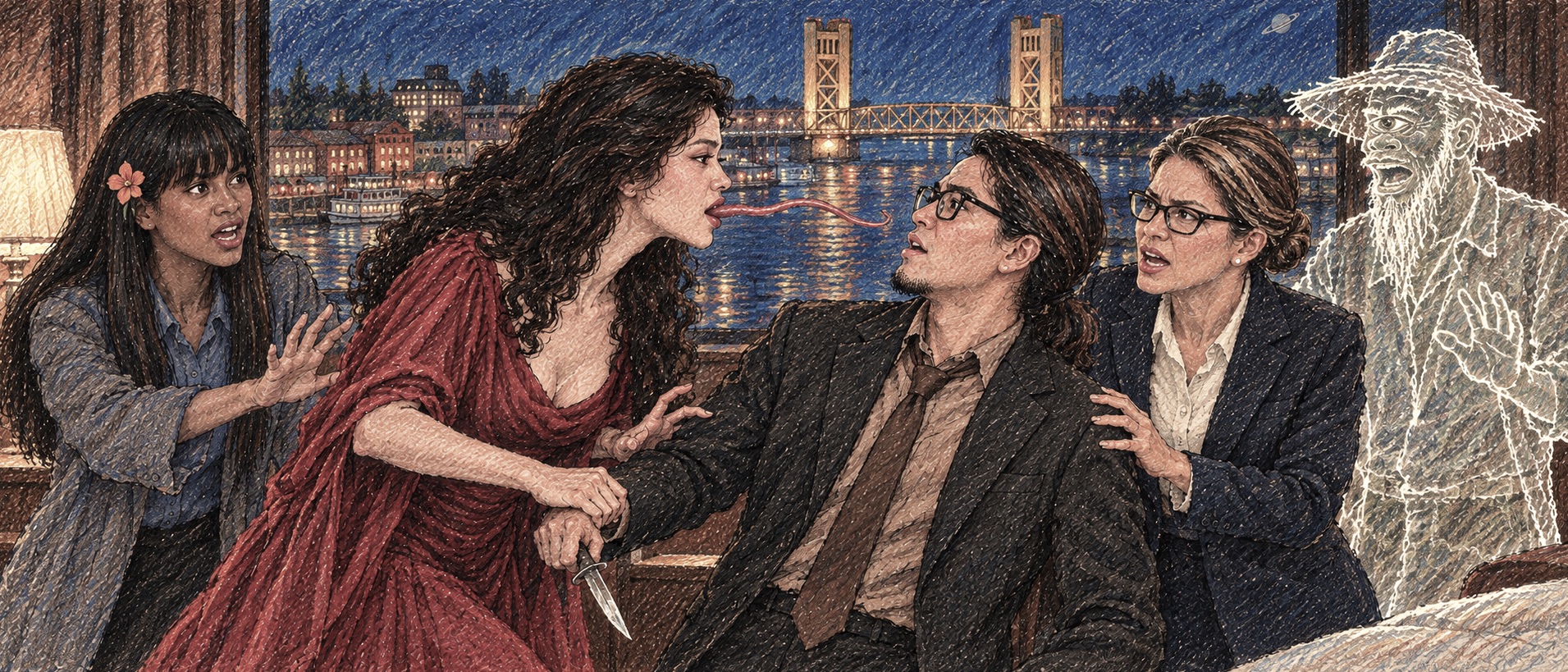
A Rondo Patungan story from Romeo Esparrago.
PART 1 OF 2 : THE INVITATION.
A Postcard at Lunch, Round Rock 2026
Rondo Patungan was sixty-two and three spoonfuls into his bowl of tinola chicken stew that had a squirt of patis and a squeeze of lemon at Lil Mama’s in Round Rock, Texas, when he remembered the postcard in his jacket. Beside the bowl, a glass of kalamansi juice had left a damp ring on the napkin he had placed it on.
He took a drink before putting down his spoon. The food was good, and for once there was no reason to hurry over it.
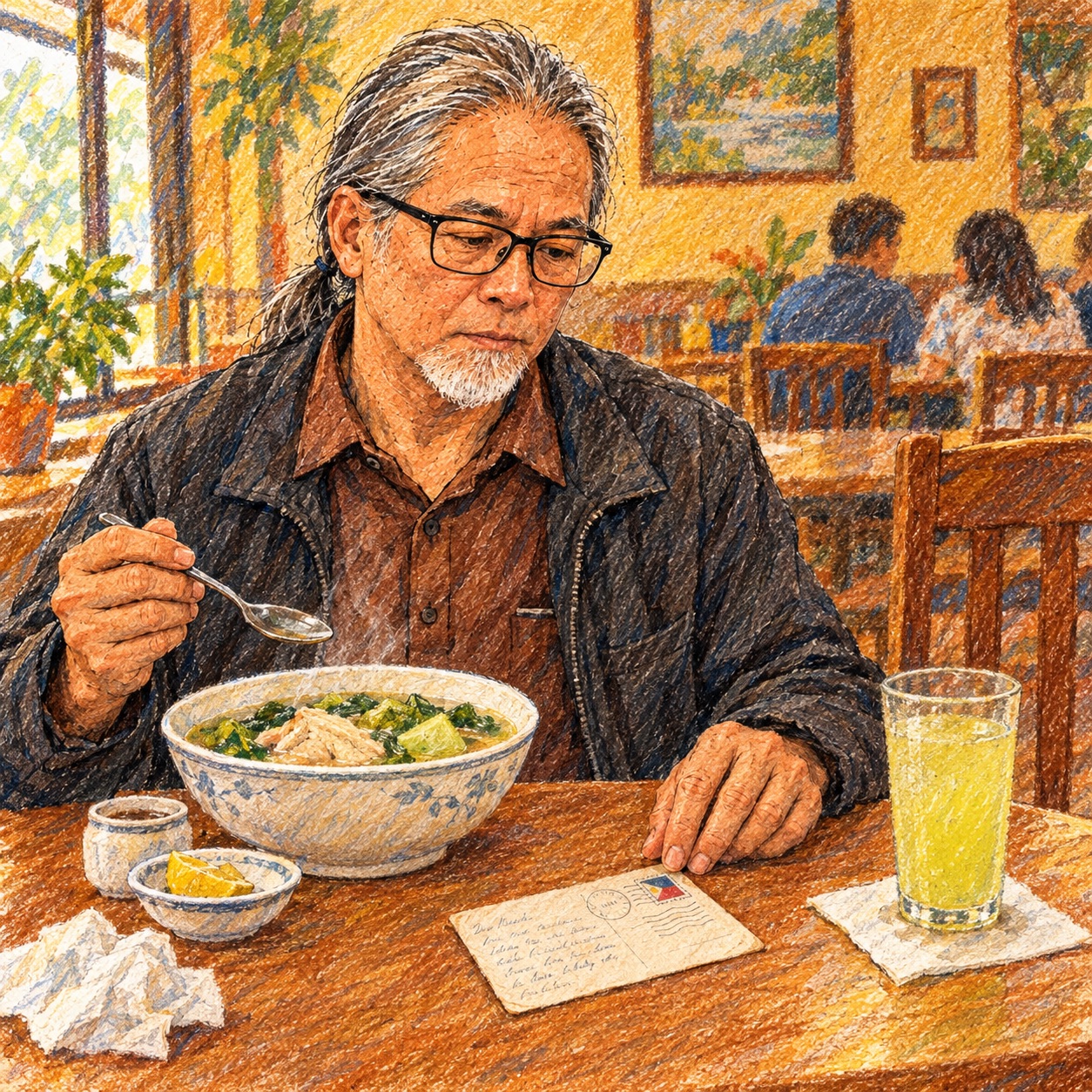
He wiped his fingers on a napkin and took out the card. It had come from the Philippines; the corners had softened on the journey, but the handwriting on the back was clear.
Maria Magdalang. He knew the handwriting before he read the name.
He had once watched that same hand write a police incident number on the back of a postcard. Later, she had found room beneath it for something that had mattered to him much more.
He read her message once, then moved his glass aside and laid the card where it would stay dry. Around him, people went on talking over their lunches.
Thirty-three years. He could still see the flower behind her right ear, blue and white against her dark hair, and the care she took to ease open a petal folded by the rain.
He picked up his spoon again. In his memory, the table was smaller, the drink was coffee, and Maria was about to sit down across from him.
Coffee During a Thunderstorm, Colorado Springs 1993
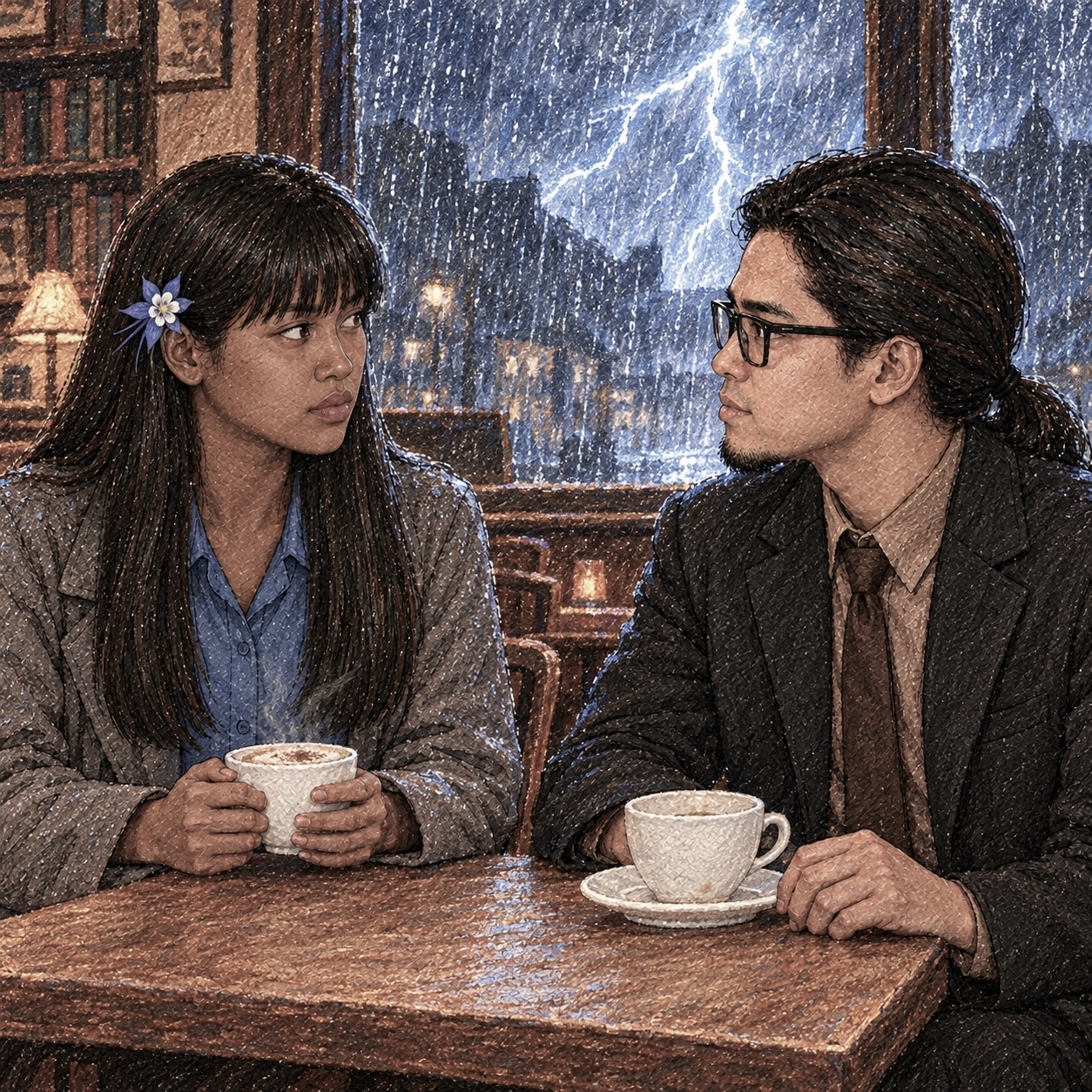
By the time Maria Magdalang arrived at Poor Richard’s, the hail had turned back into rain. Rondo Patungan had finished one café latte and was considering whether a second would improve his judgment. At twenty-nine, he still believed some of his problems could be solved with more coffee.
Maria took the chair opposite him. She kept her coat on and rested her hands around the cappuccino he brought her.
A blue-and-white columbine was tucked behind her right ear, its stem held by a small hairpin. One of the petals had folded in the rain. She eased it open with a fingertip before looking at him.
“I don’t know where to start, Mr. Patungan.”
“Rondo,” he said. “And I can start, if you like.”
She gave him a tired, suspicious look. He had seen the same look on witnesses who expected a policeman to explain why nothing could be done.
“Do you believe in the supernatural?” he asked. “Do you believe in Dawendi?”
Outside, lightning turned the window white. Maria looked toward it, then back at him.
“I grew up hearing those stories. Believing them is another matter.”
“I grew up being beaten up by one,” Rondo said. “That settled the question for me.”
He told her enough about Dindo to sound either honest or unemployable: the mound in the Philippines, the quarrel, the riddle, the unlikely friendship. He left out the manner in which they had sealed their bond. There were limits to what a woman should have to hear over her first cup of coffee.
Maria listened without interrupting. When he finished, she opened her handbag.
“My husband didn’t die in a golf accident.”
Rondo set down his cup. That was the explanation her family had given the agency.
“They don’t know how else to tell people,” she said. “Neither did I.”
She placed a folded newspaper clipping between them. The photograph had reproduced badly, but the headline was legible. A businessman found dead near a provincial resort. Police investigating an animal attack.
His name was Danielo Magdalang.
“We were married nine months,” she said. “I was allowed to see his face. They wouldn’t let me see anything else.”
“And you think the same thing happened to Boyet?”
“I know what I found in my brother’s apartment.”
He waited. She looked at his hands rather than his face.
“He had put out two glasses. There was music playing. He’d been telling me about someone he wanted me to meet.” She drew a breath that did not seem to reach her lungs. “The police kept asking whether he’d owed money. As if that would make it easier.”
Rondo had read enough of the report to understand what she was not saying. He did not ask her to describe the room.
Maria took out two photographs. In the first, Danielo stood among colleagues at an outdoor reception. A woman in a pale dress was visible behind his shoulder. In the second, Boyet grinned beside a woman whose dark hair fell across one eye.
Different dresses. Different islands. The same face.
“Boyet called her … Alarena,” Maria said. “I found the older picture after the funeral.”
Rondo moved the photographs under the light. The woman was beautiful in a way that made the surrounding people seem badly arranged.
“May I borrow these?”
“You believe me?”
“I believe these two women look enough alike to ask questions.”
Maria withdrew her hands from her cup. It was not quite the answer she wanted, but he saw her accept it.
“Good,” she said. “Ask questions. Everybody else keeps telling me to rest.”
When they stood to leave, he helped her into her coat. Her fingers touched his wrist, deliberately this time.
“And when you find her?” Maria asked. “What will you do?”
Rondo glanced at the photographs. He could feel how badly she needed a promise, and how easily he might give her one he couldn’t keep.
“First I find out who did this,” he said. “Then I make sure she doesn’t do it again.”
Maria held his gaze. “Don’t let her become somebody else’s accident.”
A Woman in Two Photographs
Evarita Kurimao spread the photographs across her desk the next morning. She studied them, then studied her only investigator.
“Ronnie, tell me you have something besides an attractive suspect.”
“Two dead men.”
“We had those yesterday.”
“Now we have somebody who knew both of them.”
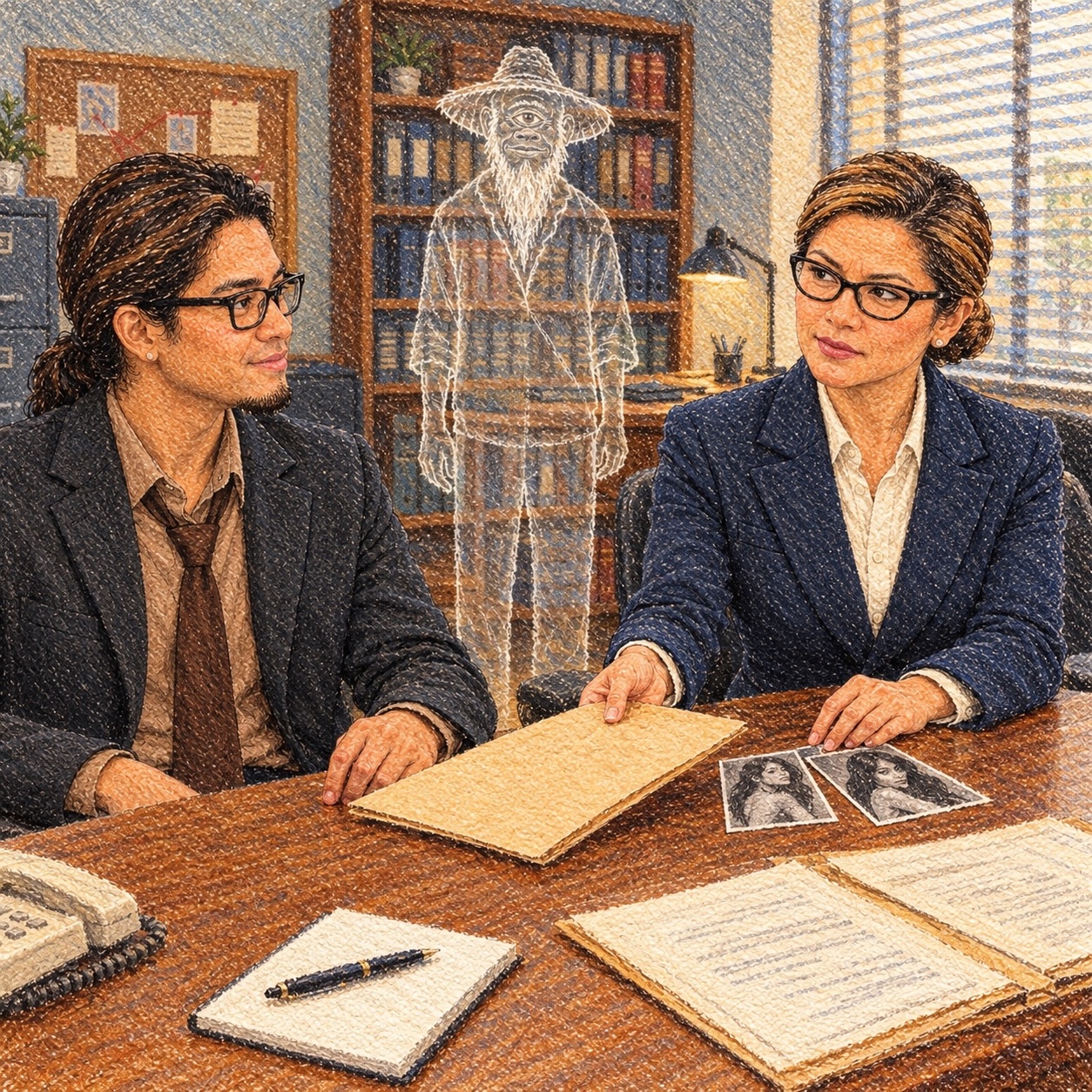
“Better.” She pushed a folder toward him. “And possibly a third.”
The folder contained copies of records from Sunnyvale. Cats Martinez had been found dead under circumstances unpleasantly similar to Boyet’s. A neighbor remembered a glamorous girlfriend, irregular visits, and a woman who did not like being photographed.
Evarita had requested the material while Rondo was drinking coffee. She took visible pleasure in that fact.
“A detective there in California is willing to talk,” she said. “You will listen, take notes, and avoid explaining your theory about flying vampires.”
“Aswang.”
“Even less helpful.”
He grinned at her. Evarita had represented him in his divorce years earlier and had subsequently hired him, a sequence Rondo considered proof that guilt could survive a legal education.
“One more thing,” she said. “Mrs. Magdalang is a client. She is also newly bereaved. You can be kind without making promises you haven’t thought through.”
“I know.”
“Then astonish me by behaving as if you know.”
That evening, Dindo sat on Rondo’s kitchen counter, examining the photographs with his single eye. His cigar remained unlit under protest. Rondo had opened the window anyway.
“This one likes the camera,” the Dawendi said.
“Witness says she doesn’t.”
“She likes being admired. She dislikes being remembered accurately.”
Dindo tapped Alarena’s face with a crooked fingernail. His flat nose wrinkled.
“You know her?”
“No. I just know the family business.”
Rondo put two cups of coffee on the counter. Dindo regarded his as an inadequate offering but drank it.
“Tell me,” Rondo said.
The little man’s manner changed. His jokes usually ended before the important part.
“Some carry a thing inside them. Black. Small. It looks like a chick, if you do not look too closely. A dying one can pass it to another mouth.”
“And that makes the next Aswang?”
“It can. The woman and the thing have lived together long enough that you may not be able to tell which is hungry.”
Rondo glanced at the photographs. Alarena’s smile looked no different.
“Salt hurts her,” Dindo continued. “Ashes, too. If she leaves the lower body behind, salt will prevent her from joining it again. It will not stop the upper half from killing you.”
“Useful distinction.”
“I thought so. Bamboo through the back can finish her. The growing end, sharpened. Do not grab the wrong end in a panic.”
“You have a great deal of confidence in me.”
“I have known you since you were a boy.”
Dindo reached for the empty glass coffee jar beside the sink.
“Take this. Put salt in it. If the black thing comes out, shut it inside. Once the bearer is dying, daylight can finish what she carried. Until then, keep the lid on.”
Rondo looked from the jar to the old creature. “You’re giving me a shopping list.”
“I am trying to prevent an obituary.”
Before they left for California, Rondo visited Maria at her parents’ home. She supplied letters, dates, and the telephone number of Danielo’s former colleague. By the second cup of coffee, she was correcting his chronology and had found a mistake in the resort’s address.
“You should come work for Evarita,” he said.
“Would she call me Ronnie?”
He laughed. Maria smiled at having caused it.
When the papers were in order, he began gathering the cups. Maria stopped him with a hand on the saucer.
“You don’t have to find another job to do,” she said. “You can sit.”
He sat. Through the kitchen window, he could see her parents working together over something in the garden, making a careful business of not looking toward the house.
“They’ve been very kind,” Maria said. “I’m beginning to dread it.”
“Kindness?”
“The way they stop talking when I enter a room. I’m still the person who used to argue about the electric bill.”
“Were you right?”
“Usually. That was part of my charm.”
She told him about the house she and Danielo had intended to repair in the Philippines. There was a back room with a window onto an unpromising patch of weeds. She had wanted a reading chair there and shelves that reached the ceiling.
“Danielo wanted to put a television in it.”
“A serious difference.”
“We had negotiations. He offered a smaller television.”
Rondo laughed, then caught himself. Maria saw him do it.
“It’s all right. He could be funny without permission.”
She described the chair she had wanted: green, ugly, comfortable enough that no visitor would ever leave. For a few minutes, Rondo could see the room as she saw it, unfinished rather than empty.
“And now?” he asked.
“Now people keep offering to help sell the house.”
He knew the temptation to find a useful answer. He managed not to.
“I think you should get the chair,” he said.
Maria looked at him for a long time. Then she reached for the photographs again, but with less reluctance than before.
She told him Danielo’s wedding ring had never been returned. Inside the band she had engraved five words: M to D. Always yours.
“It isn’t valuable,” she said. “Not to anyone else.”
Rondo wrote the inscription down. This promise, at least, he could make carefully.
“I’ll look for it.”
The Woman in Red
The Sunnyvale detective gave them a forwarding address, a dry-cleaning receipt, and the name of a nurse who remembered Alarena’s immaculate clothes better than her work. The trail led to Sacramento. Evarita coordinated the calls from Colorado while Rondo worked the pavement, keeping a separate sheet for every department and report number. Similar murders were not yet one case, however certain he felt.
Alarena had left a travel bag in her former Sunnyvale rooms. A photograph of its contents showed the bag was Boyet’s, missing since the night he died in Honolulu. Evarita arranged the identification through the investigating officers and booked Maria into a separate room at Rondo’s motel.
“Separate,” Evarita repeated on the telephone.
“The connection’s fine, boss.”
“Your hearing has never been my principal concern.”
Alarena was using furnished rooms above a closed dress shop. The building’s owner knew where she liked to spend her evenings. Rondo passed the address to the detective in Sunnyvale, who promised to contact Sacramento. He could supply observations, the detective told him, but he could not turn resemblance and suspicion into an arrest by wanting one badly enough.
That night, Rondo found her at the Blue Lantern.
He saw the red dress before he saw her face. Then she turned, and the rest of the room became an inconvenience.
She looked twenty-seven, a little younger than he was, with very pale skin and long, abundant waves of dark hair. Her composure suggested she had never needed to hurry anyone into looking at her.
It irritated him that the photographs had not exaggerated.
Her gaze moved over his black glasses, the dark hair tied at his neck, the light brown shirt he had ironed badly. She smiled at the shirt.
“Long day?”
“You can tell?”
“You look as if someone made you wear a collar.”
He took the stool beside hers. “Cruel woman. Signs my checks.”
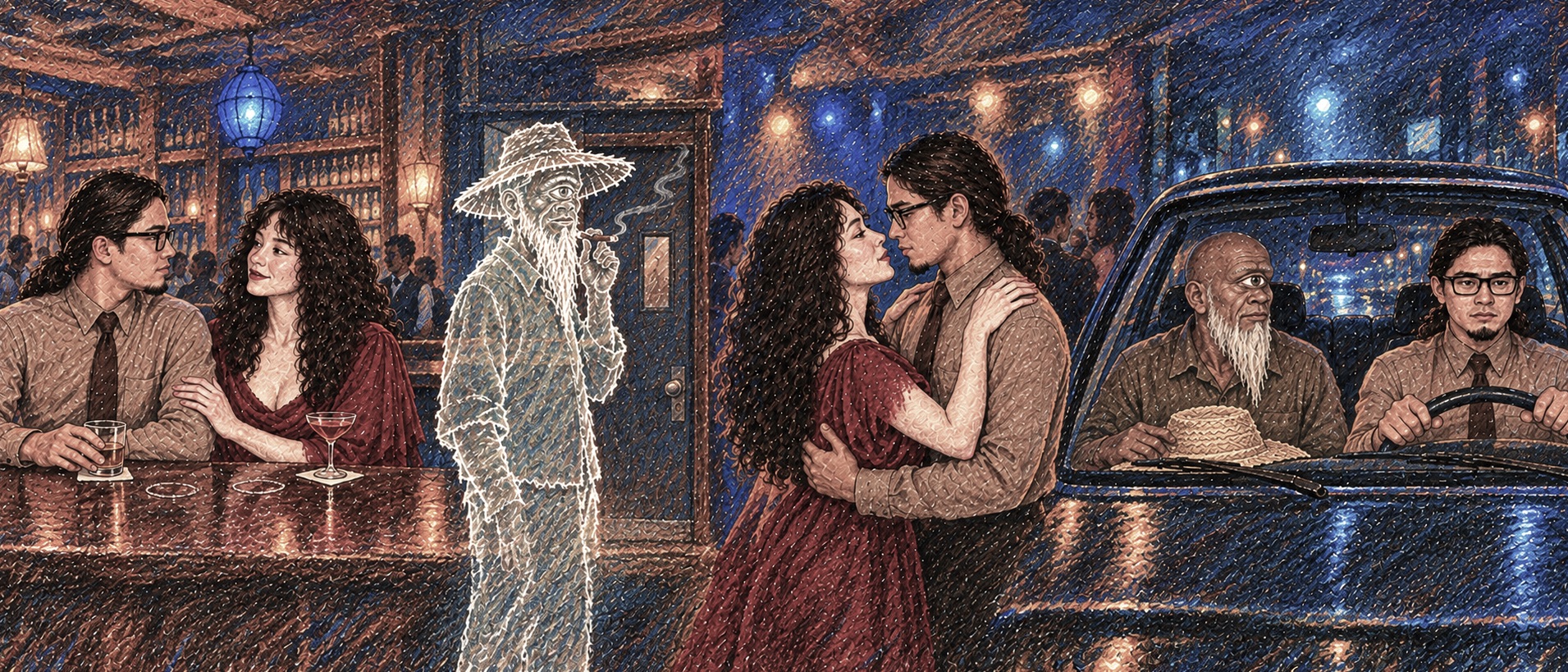
Alarena laughed and asked his name. He gave her his real first name and a harmless account of being in town on business. She told him she was a nurse considering a move to Lake Tahoe.
She was easy to talk to. That was worse than being beautiful.
She listened when he spoke. She noticed when he tried to turn a question aside. Her hand touched his sleeve, then stayed there as though they had already settled something.
“You’ve been on a ship,” she said.
He looked at her. “What makes you say that?”
“You called the hallway a passageway when you asked the waiter where the telephone was. And you put your glass where an elbow can’t reach it.”
“Navy. A while ago.”
“Did you like it?”
He gave the answer he usually gave. Some of it.
“Which part?”
He was meant to be asking about her. Instead, he found himself telling her about the peculiar relief of leaving a harbor, the moment when everything ashore became somebody else’s problem.
She nodded without congratulating him for being honest.
“People say they want to travel. Often they only want to be impossible to find for a little while.”
“Is that what you’re doing?”
“Tonight? I’m sitting beside a man who hasn’t decided whether to enjoy himself.”
She moved her glass so its wet base left a second ring on the bar. He noticed that she had placed it where his elbow could not reach it.
When the waiter returned, she thanked him by name. She had heard it once, when another customer complained about a drink. The ease with which she retained such things made Rondo wonder what she had already stored away about him.
Across the room, Dindo stood invisible beside the service door. Rondo could not see him, but he caught the faint smell of his cigar.
Alarena’s nostrils stirred. Her hand went still.
“Someone’s smoking something dreadful.”
Rondo glanced toward the bar. “You should meet my uncle.”
“I would rather dance with you.”
On the dance floor, she came close without asking him to pull her there. He felt the warmth of her through the thin fabric of his shirt. When she lifted her face, he knew exactly how little effort it would take to kiss her.
He wanted to.
Two photographs. A ring. The empty spaces in a police report.
“You’re thinking too hard,” she said.
“Occupational disease.”
“What is it you do?”
“Find things.”
Her smile changed so slightly that he might have imagined it.
“Then perhaps you’ll find me again.”
Outside, Dindo materialized in the passenger seat of the rental car and slammed the door.
“She smelled me.”
“I noticed.”
“Did you? From where I stood, you were busy noticing other things.”
Rondo started the engine. His hands were steady, which seemed like an unfair reward.
“I need to know what she did. Not just whose things ended up in her room.”
“You need that,” Dindo agreed. “You also want to go back.”
Rondo could have argued with him. Instead, he drove.
What the Dead Leave Behind
The next afternoon Maria identified Boyet’s travel bag, his wallet, and a shirt she remembered teasing him about. The detective asked her to describe the missing belongings before showing her the property photographs. A split seam she had repaired with the wrong color thread was visible on the bag.
Rondo waited outside the interview room. When Maria emerged, she was carrying a copy of her statement, not her brother’s belongings.
She did not cry until they reached the car. When she did, he stayed quiet and passed her the packet of tissues from the glove compartment.
“I bought him that shirt,” she said. “He said it made him look respectable.”
“Did it?”
“Not remotely.”
She laughed once, unexpectedly, and then cried harder. Rondo looked away long enough to let her recover some privacy.
On the way back to the motel, she asked him to stop at a drugstore. She came out with tissues, a paperback, and a postcard of Sacramento so extravagantly blue that the river seemed to have been painted by someone who had never seen water.
“A souvenir?”
“Proof I went somewhere besides a police station.”
She put the card on the rental car’s dashboard. Neither of them mentioned that he had been about to ask whether she needed anything else, as though she were a patient.
Back at the motel, the woman watering the courtyard let Maria choose a California poppy from one of her pots. Maria tucked the orange flower behind her right ear and stayed to ask about the others.
“A different flower,” Rondo said when she joined him.
“A different city. I like to wear something native to wherever I am.”
“How do you know what belongs?”
“I ask someone who gardens. People like being asked about something they know.”
She said it without making a lesson of it. He had been learning the city by its police stations; she had found a woman who was pleased to talk to her. He liked that she had wanted the conversation as much as the flower.
Later they ate noodles out of cartons in the motel courtyard. Rondo’s had gone soggy & cold while he reviewed his notes. Maria took the notebook out of his hand.
“Ten minutes,” she said. “You may be a detective again afterward.”
“What am I supposed to be until then?”
“That’s what I’m trying to find out.”
He told her about his first apartment after the divorce: two chairs, one plate, and a kitchen clock he kept forgetting to wind. He had worked late even when there was no work, because coming home seemed less conspicuous after midnight.
“Do you still do that?”
“Sometimes.”
“I turn the radio on before I take my coat off,” she said. “I don’t even like the station.”
He looked at her. Neither of them smiled at the recognition.
Then she asked about Alarena.
“Does she look like her photograph?”
“Yes.”
“That wasn’t quite what I asked.”
He set his carton down. “She’s very beautiful.”
Maria watched him for a moment. “And she knows what to do with it.”
“Yes.”
“You don’t have to pretend otherwise for my benefit.”
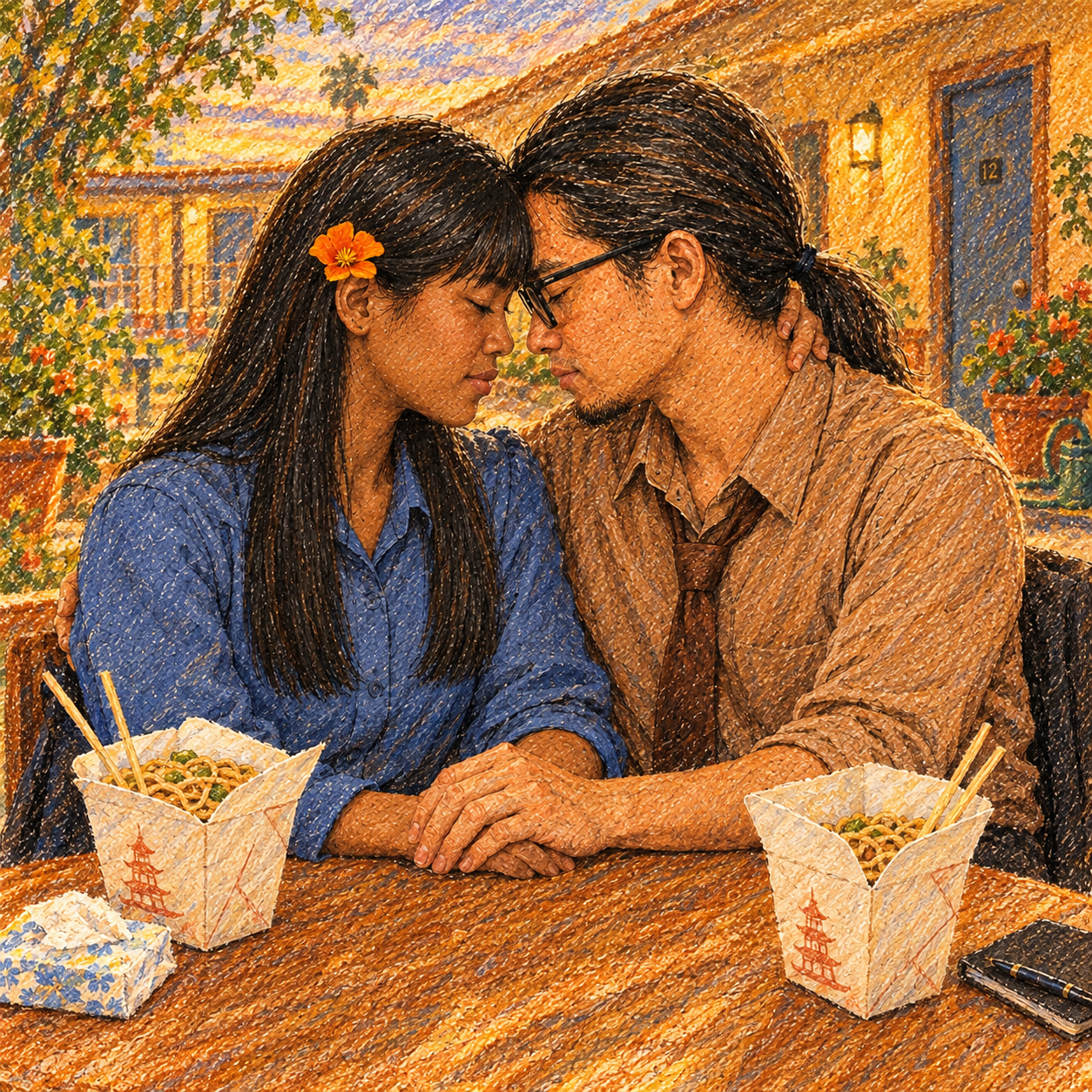
He had been prepared to defend his professional judgment. Her answer left him without a useful speech.
Maria reached across the table and straightened the cuff of his sleeve. There was nothing accidental about the gesture. She leaned forward and kissed him.
It was not a grateful kiss. He felt the distinction immediately.
When she drew back, he kept his hand over hers.
“Maria.”
“I know,” she said. “I know all the sensible things.”
“So do I. Evarita gave me a list.”
She smiled, but her hand tightened.
“I wanted to do something that wasn’t about how they died.”
He kissed her again, gently this time. Then she rested her forehead against his and closed her eyes.
He felt her fingers at the back of his neck. She was shaking a little, but when he began to draw away, she held him there.
“Don’t decide for me,” she said.
“I was trying to be careful.”
“Then ask.”
He asked if she wanted him to stop. She answered by kissing him again, and this time he let himself be the man she was kissing rather than the man responsible for what happened next.
With a hand gently placed on her back, he walked her to her door. She unlocked it, then stood with the key in her fingers.
“Not tonight,” she said. “But don’t leave thinking I didn’t want you to.”
“I won’t.”
He stayed on the step beside her until the motel’s ice machine rattled itself into silence. They chatted about bad coffee and the books she abandoned halfway through because she disliked the people in them. She asked him to breakfast the next morning.
“No notebooks,” she said.
“What about newspapers?”
“Only the part with the comics.”
For a little while, he let breakfast be enough.
Alarena telephoned him at the motel that evening. He had given her the number at the club, and she sounded pleased that he had answered.
“Dinner tomorrow,” she purred. “Somewhere quieter afterward.”
“Your place?”
“You are good at finding things.”
He wrote the time down while Maria sat across from him. When he replaced the receiver, the pleasure of hearing Alarena’s voice embarrassed him more than he wanted to admit.
Maria did not ask him to explain his expression. That made him want to explain it, which was worse.
“The detective has her address,” she said. “What are you still trying to get?”
“Something she can’t explain away. Something she says herself.”
“Then be sure that’s what you’re going for.”
He looked at the telephone. She had not accused him of anything he could comfortably deny.
“Don’t go alone,” Maria said.
“Dindo will be nearby.”
“Then don’t go without telling him when to come in.”
They agreed on a check-in at midnight. Maria would wait in an all-night diner across the street, where he could telephone her. If he did not call, she would contact the police and Dindo would enter the building. Rondo showed her the back stairs, the room number, and the jar of salt in his equipment bag. He gave her a carton of salt to keep with her. Dindo made him repeat the part about the bamboo until Rondo threatened to write it on his hand.
“I cannot stand behind you,” Dindo warned. “She can smell me. I will stay at the far end of the courtyard until the appointed time.”
Rondo carried two packets of salt, a small knife, and his usual confidence. He left the bamboo with Dindo rather than explain a five-foot gardening implement over dinner.
Before he went, Maria straightened his collar. The intimacy of it was harder to bear than a warning.
“Breakfast,” she said.
“I remember.”
The confidence would prove the least useful item he took with him.
A Kiss Before the Feast
At dinner Alarena asked about his divorce. He had mentioned it at the club without meaning to, and she remembered the smallest details.
She had chosen a table against the wall. When he arrived, she offered him the chair facing the room without making a performance of noticing that he wanted it.
“Aren’t you going to ask how my day was?” he said.
“You look as though you’ve spent it answering questions carefully. I thought I’d give you a rest.”
He laughed. It felt unpleasantly like being relieved of a weight.
“Did she make you feel guilty for wanting things?” she asked.
“We managed that for each other.”
“How exhausting.”
She asked whether he missed being married. Not his wife, she clarified. The small arrangements. Knowing which cup belonged to whom.
“Sometimes,” he admitted.
“I couldn’t stand it.”
“Marriage?”
“Being expected.” She turned her wineglass between her fingers. “Somebody knowing when I was late. Asking where I’d been.”
“You make it sound like police work.”
“Doesn’t everybody, eventually?”
“Not everybody.”
“Then you were unlucky.”
She did not ask what he had done wrong. He realized how eagerly he had been waiting not to be asked.
Later, she noticed a loose button on his cuff and caught it before it fell. She turned his wrist beneath the light to inspect the loose threads, then set the button beside his plate.
“A nurse’s reflex?” he asked.
“I hate losing small things.”
She told him about a bottle of perfume she had once saved for, then dropped on the floor the evening she bought it. For weeks afterward, she said, she had knelt beside that patch of wood to smell it.
Rondo laughed, and she laughed with him. He could picture her doing it, could imagine loving someone sufficiently foolish and stubborn to do it.
“Did you buy another?”
“Of course.”
“Same perfume?”
“No. It never smelled the way I remembered.”
For the first time that evening, she seemed to have forgotten to watch his reaction. Then she looked up and the closeness between them returned, more dangerous for having briefly felt unarranged.
“Where was the room?” he asked.
“Over a shop. You could hear the owner counting his money after he closed. He would begin again if somebody spoke.”
“Did you ever speak?”
“Often.”
He laughed. She smiled down at her plate, pleased with the memory rather than his approval.
Later she told him about an old woman she had nursed who asked every visitor whether it was Thursday. Alarena had finally asked what happened on Thursdays.
“Her husband brought her flowers. He had been dead for eleven years.”
“What did you tell her?”
“That I didn’t know what day it was.”
“Did that help?”
“She took my hand. She thought I was frightened, too.”
Alarena turned her own hand palm up on the table, studying it. Rondo had watched people invent sad stories for sympathy; they usually checked to see whether the story was working. She was looking at the pale crease below her thumb.
“I could have bought her flowers,” she said. “I didn’t think of it until after she died.”
He could not tell whether the regret was genuine. He wanted it to be, and that was information about himself he would have preferred not to acquire.
“Why Tahoe?” he asked.
“Water that stays in one place.”
“Lakes move.”
“Not where you can see it from the porch.”
She had a picture of a cabin folded into her purse. A magazine clipping, softened along the creases. There was a narrow porch, a room with a stone fireplace, and a window large enough to make Rondo think of mornings.
“I want blue cups,” she said. “Heavy ones. Nothing with a hotel’s name on it. And I want to leave a book open and know it will still be there when I come back.”
“You said you didn’t like being expected.”
“By people. Furniture is less demanding.”
He looked at the little room in the picture. She could not have known about Maria’s green chair.
“You’d hate it after a week,” he said.
“Then I’d leave. But I would like to have hated it for myself.”
She took the clipping back. Their fingers met over the table, and she did not withdraw hers.
“You’re always ready to be useful,” she said. “Even now. You’re deciding what I’m missing and what you might do about it.”
“Is that so terrible?”
“Only if you don’t believe anyone would keep you around without it.”
He felt the answer in his chest before he found words for it. Alarena spared him the words.
“Come upstairs,” she said. “You don’t have to fix anything.”
Alarena did not offer to improve him. She did not ask him to promise anything. By the time they climbed the stairs above the dress shop, Rondo understood how easily a man could mistake being wanted for being understood.
Her rooms smelled of perfume and expensive furniture polish. Beside the window stood a lacquered box with a brass catch. A man’s wristwatch lay on top.
She noticed him looking.
“Presents,” she said.
There were other things he had not expected: a cup with a chipped handle, a half-finished crossword, a sewing tin containing the black button from his cuff. She had carried it away from dinner.
She saw him notice the tin.
“You would have lost it.”
The little domestic arrangement was more effective than the perfume. He could imagine returning to this room. That frightened him enough that he began inventing reasons it was not what he was imagining.
He took off his glasses to clean them, buying a moment. She took them from him and set them on the dressing table.
“You won’t need those just now.”
Her kiss was slow and certain. She loosened his hair, letting the tie fall, and drew him closer by his collar. He answered before he could disguise it as part of the case.
He had meant to stay near the door. Now he was holding her, and she made a small sound of pleasure against his mouth that might have been genuine. He could not sort the performance from the woman, and his body had stopped caring about the distinction.
She drew back far enough to look at him. For once there was no clever observation ready.
“Stay,” she said.
For several seconds, it was not part of the case.
Then her hand moved toward the buttons of his shirt, and he caught it.
“Wait.”
She looked at him without withdrawing.
He could still feel the warmth of her mouth. Nothing had changed in her face. She had not become hideous or cold or conveniently monstrous.
“There’s someone else,” he said.
“A wife?”
“No.”
“Then this is not difficult.”
She touched the place where his hair had been tied. He felt the gesture all the way down his back.
“Does she know you want her?”
“Yes.”
“Does she know what she wants?”
He hesitated. Alarena’s thumb moved once against his neck.
“I do,” she said.
It was difficult. Maria had made him no promise. He had no right to turn their kiss into a claim on her, and part of him resented having to give up this certainty for a breakfast that might never become anything more.
He thought of the green chair, the radio switched on before a coat came off, the orange flower behind Maria’s right ear while she listened to the woman in the courtyard. Her voice at the motel door, telling him to ask rather than decide. Those things did not make Alarena less desirable. They made the excuse he was preparing sound smaller.
He wanted to be able to sit across from Maria without choosing which part of the evening to conceal. He wanted that even if she eventually went somewhere he could not follow.
He stepped back.
“I want to,” he said. “I’m not going to.”
Alarena’s hand remained in the air for a moment. When she lowered it, he understood that whatever had been genuine between them had made the refusal more insulting, not less.
Alarena looked at the space he had put between them. Then she followed his glance to the lacquered box.
“Perhaps you came for something else.”
She opened it herself.
Inside were watches, cuff links, a cigarette lighter, and several rings. She selected a plain gold band and held it up by the edge.
“This one? Or did the sister ask about the watch?”
Rondo no longer needed his glasses to see clearly.
“You knew.”
“You ask questions as if the answers owe you money.” Her fingers closed around the ring. “I wanted to know how long you would keep asking.”
He held out his hand. “Give it to me.”
“Danielo said much the same thing.”
She spoke his name casually. That was what made Rondo take the step.
“He wasn’t my lover,” she said. “If that makes it easier for the widow. He followed me because he thought someone needed help.”
Rondo stopped. Alarena watched the knowledge settle in him.
“And Boyet?”
“Boyet wanted to introduce me to his sister. Such a small world. I found it charming until she started keeping photographs.”
She let Danielo’s ring fall back into the open box. The little sound it made ended the last foolish possibility that he had misunderstood her.
He drew the knife. Alarena’s expression became almost tender.
“There you are,” she said. “The man who came to kill me.”
Her hand closed on his wrist before he could bring the blade up. The knife struck the floor. She drove him backward into the bedpost so hard that the room went white around its edges.
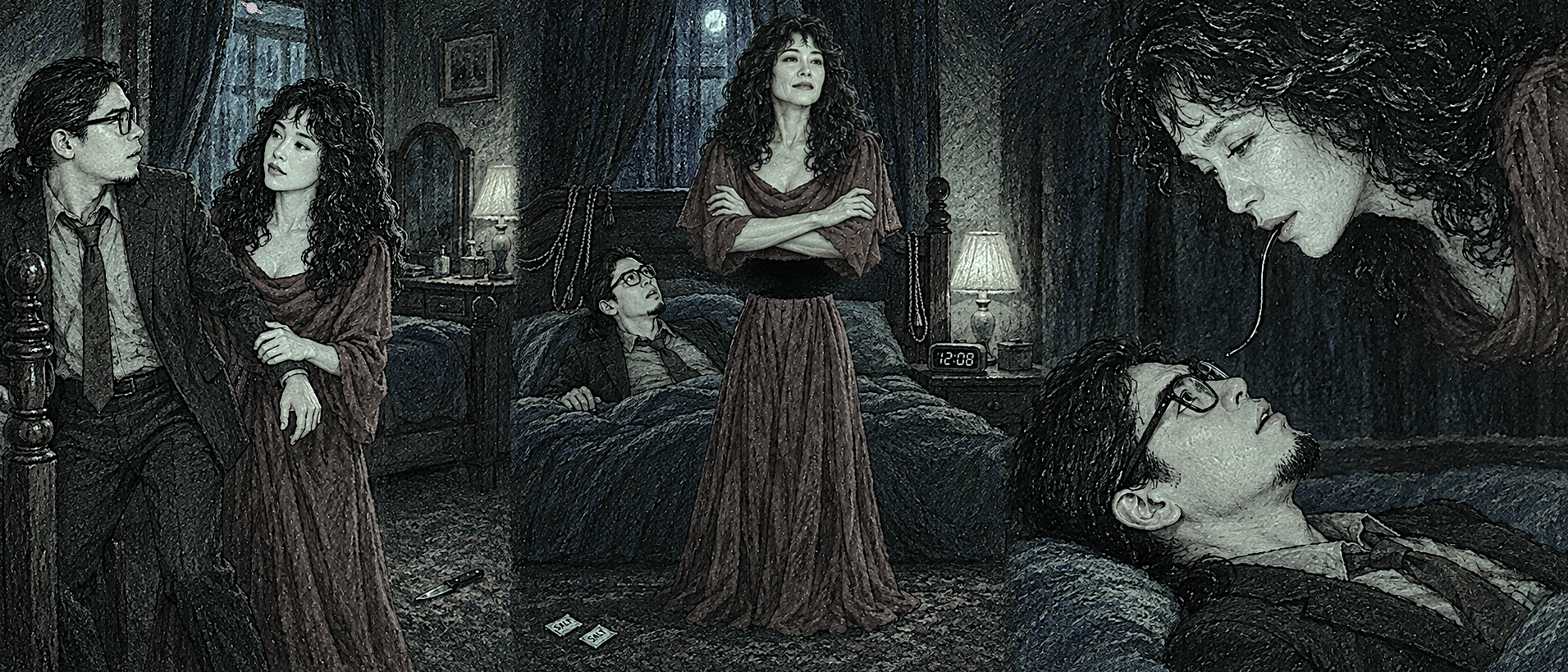
By the time he could breathe, one arm was caught behind him and a curtain cord was tightening around his wrist. She moved with a strength his body could not negotiate.
He kicked at her knee. She caught his ankle, turned him, and pinned him faceup against the bed. The second wrist followed the first to the headboard.
“You could have enjoyed the evening,” she said.
He reached for the salt in his trouser pocket. She saw the movement and pulled out both packets.
“You even brought seasoning.”
She dropped them beyond his reach.
His shoulder burned. He pulled once at the cords and felt the headboard hold. On the dressing table, the clock showed eight minutes past midnight.
He had missed the call.
Alarena stood at the foot of the bed. The red fabric around her waist shifted, then opened along a line that had no business being there.
Her feet remained on the carpet.
The rest of her rose.
Rondo stared at the dark interval between the two halves. His mind kept trying to put her back together.
Then he saw what the separation was doing to her face.
Fine lines gathered at the corners of her eyes and deepened beside her mouth. The skin beneath her jaw softened; her neck acquired the delicate creases of a much older woman. In the time it took him to draw a breath, twenty-seven had become sixty-two. Her hair kept its abundance and its waves, but the color deepened to jet-black, threaded now with a few streaks of gray.
It was still Alarena. The same eyes held him with the same intimate assurance. Her beauty had matured in front of him, and she watched him notice it without the slightest embarrassment.
She drifted over the bed, beautiful from the shoulders up. Her mouth opened. Something thin and wet extended from it, lengthening toward his throat.
Then somebody knocked.
“Rondo?” Maria called from the hallway. “Can you open the door?”
Alarena turned toward the sound. Her smile returned, wider than before.
“You should have told me,” she whispered. “I would have set another place.”
The chain slid free of the door.
End of Part One. 🪐
Author’s Note : This story was started in 1995 but remained unfinished until this year 2026 including adding the opening narrative frame of this story. The character of Alarena was first introduced in the poem “Alarena the Aswang”, Planet Magazine Issue #4, December 1994. Dindo the Dawendi was introduced in Planet Magazine Issue #5, March 1995. The return of Rondo Patungan as a retired 62 year old detective in Texas was earlier this month in this here story.
About the Author : Romeo Esparrago says any resemblance to any of his past supernatural occurrences, humans, or creatures, are completely & horrifyingly coincidental. Happy Halloween.


