

By Romeo Esparrago.
The Soviet Union detonates their first atomic test on August 29, 1949. Radioactive particles collected over the skies of Alaska confirm this. President Truman announces this to the world on September 23, 1949.
Massachusetts, 1953.
John V. “Jack” Herrentown had drawn an aircraft on the blackboard. Beneath it he had drawn a radar antenna, a telephone line, and a box.
The aircraft was unrecognizable. The antenna required some generosity. The box had no label.
“What is that?” someone asked.
“That? The man on the job has to decide what that is and what to do,” Herrentown said.
He tapped the telephone line with his chalk.
“He doesn’t see the airplane. The man doesn’t see what happened in the receiver. He sees what we manage to send him.”
François “Frank” Thanh Do watched Herrentown add a small interruption in the line. Beside him, his wife, Souzette “Suzy” Mansouri-Do, turned to a clean page in her notebook.
They had learned to pay attention when Jack simplified a problem. It generally meant he was about to make their part of it harder.
“You can detect an aircraft perfectly,” he said, “and still fail to deliver a warning.”
He put the chalk down and opened a folder.
For months, his radar-data engineering group had been occupied with the awkward passage between a target on a screen and information that could be transmitted, combined, and acted upon. A telephone circuit did not have room for everything a radar could see. Some of their work tried to extract the useful observations; other work reduced the picture to something a narrower channel could carry.
Frank liked the problems that could be reproduced on a bench. Suzy preferred the ones that appeared only after the equipment had been installed somewhere its designer had never visited.
Neither preference had made their working days shorter.
“The northern program needs people who understand the whole chain,” Herrentown said. “Some of you will be attached to it. Western Electric has its own organization, Bell has its own engineers, and the Air Force has a list of questions it wants answered. You are not going north to establish a competing laboratory.”
He looked around the table.
“You are going to find out where the measurements stop agreeing.”
Behind him hung a map with a line running across the top of North America. It was not yet a line of functioning stations. Much of it remained an intention.
Herrentown read from the roster.
“Miller. You stay with the Cape Cod work. Target data and the telephone circuits. If anyone borrows your test equipment, get it back.”
Miller made a small mark beside his name.
“Carver. Streator, on the agreed rotation. Automatic-alarm evaluation with the Western Electric people. Keep the flight observations separate from the artificial tracks. I don’t want a successful simulation reported as a successful detection.”
Carver looked up. “How long?”
“Long enough to tell us whether the failures belong to the alarm or the test.”
A few people smiled. Herrentown turned a page.
“Ellis. Northern link measurements. Bullen Point first, once the site can receive you. Your route and dates will come from the project office.”
He pointed to two marks on the map.
“There are staffed stations, and there are intermediate transmitters intended to operate unattended between them. The latter don’t become useful simply because someone has erected a tower. Their signals have to arrive where the receiving equipment expects them.”
Another name, another assignment: antenna measurements, then liaison with the team preparing the Canadian auxiliary. Someone asked whether the long links would use the same arrangement as the shorter ones.
“No,” Herrentown said. “Don’t write ‘radio’ on a drawing and imagine you’ve specified a system. The links between stations and the links carrying reports south have different problems.”
Suzy underlined something in her notebook.
Herrentown came to the last pair of names.
“François Thanh Do.”
Frank looked up.
“Souzette Mansouri-Do.”
Suzy stopped writing.
“Barter Island, Alaska. Both of you.”
For a moment Frank heard the room rather than the words: a chair moving, a pencil rolling against a folder, someone coughing into a hand.
Herrentown continued.
“You’ll join the installation effort under Markham Chearves’s construction oversight. Building Engineer, Western Electric. The electronics work will be coordinated with their technical people. You’ll stay into the evaluation period.”
“Which part of the equipment?” Suzy asked.
“The places where one part becomes someone else’s responsibility.”
She waited.
“Search radar to alarm. Alarm to report. Reports across the experimental links. The antenna and enclosure people will need measurements from you, and you’ll need installation records from them.”
Frank glanced at the map. He knew where Alaska was. Until that morning, he had never needed to distinguish Barter Island from the coast beside it.
“What is the completion date?” he asked.
“The prototype must be working before the end of the year.”
“This year?”
Herrentown looked at him.
“That’s the one we have.”
After the meeting, Suzy remained in front of the map. Frank stood beside her with their assignment papers.
“You asked for field work,” he said.
“I did.”
He followed the north coast with his finger.
“You could have been more specific.”
She took the papers from him and read them again.
“So could they.”
Barter Island, summer 1953
Markham Chearves met them near the airstrip with a folded list in one hand and wind pulling at his jacket.
Frank introduced himself. Suzy gave her full name, and Chearves checked both against the list.
“Herrentown’s people,” he said. “Welcome. Your luggage?”
Frank indicated the cases being brought down from the aircraft.
“Which ones are instruments?”
“Those two.”
“Keep those with you until we can put them somewhere dry. Everything else, we’ll find a place for.”
He led them toward the camp.
There was an existing weather station, the airstrip, and a quantity of new work that did not yet resemble the plans they had studied. Vehicles moved along gravel tracks. Men stopped to argue over a drawing pinned against the side of a crate. Beyond the activity, the land appeared almost level enough to have been ruled.
“Settle in first,” Chearves told them. “There are still people coming for your group. Once the last of you arrives, we’ll go through the work together.”
Suzy looked toward a line of stakes.
“The antenna foundations?”
“Some of them. Don’t rely on a stake until you’ve checked which drawing put it there.”
He said it without smiling.
Their quarters were temporary. So were many of the arrangements around them, although the labor going into those arrangements was anything but casual.
That evening, Frank wrote to his brother Guillaume.
He described the flight, the wind, and a horizon that seemed too far away. He wrote that Suzy had already found three questions in the installation drawings. He did not mention the purpose of the station.
Before sealing the letter, he added a question about his brother’s next posting.
The installation briefing
When the remaining members of their group had arrived, Chearves assembled them around a table covered with drawings.
A corner of one sheet had been held flat with a mug. Another disappeared beneath a stack of freight lists.
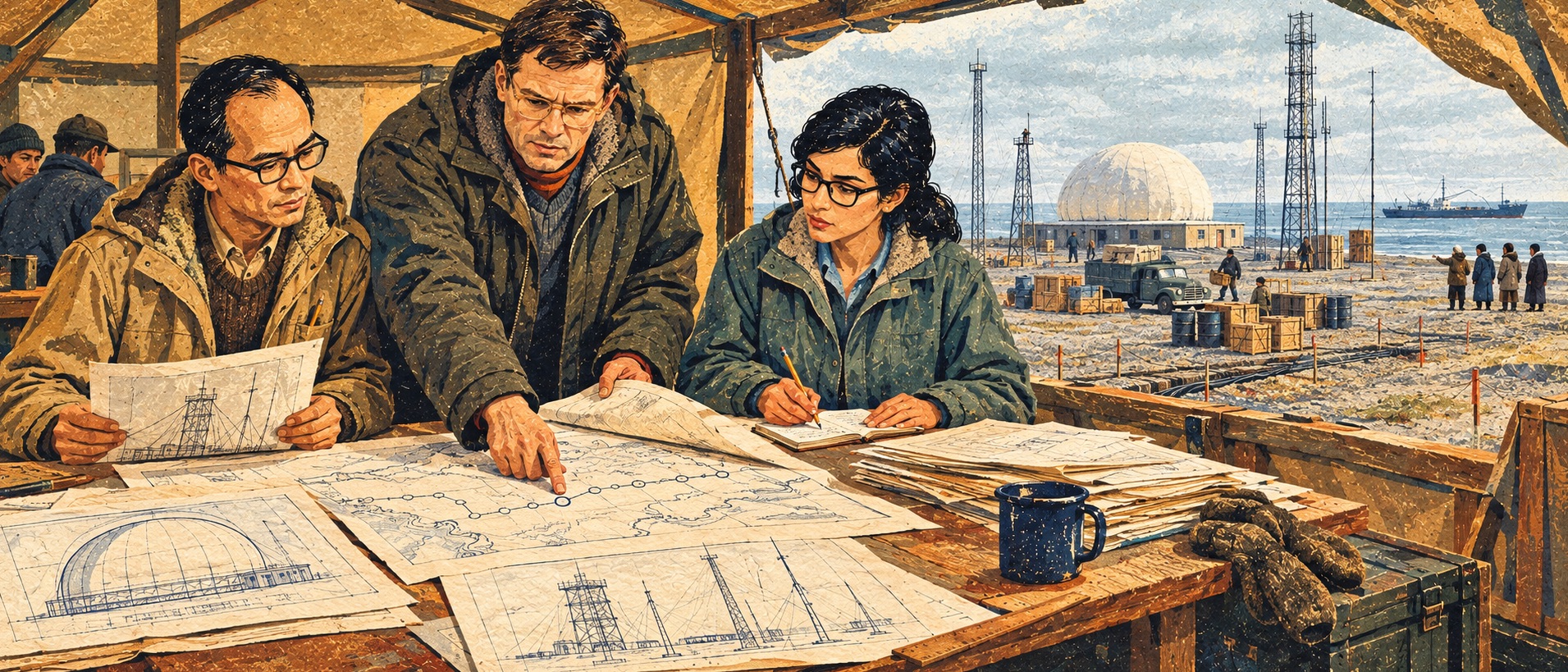
“Barter is the main station,” he began. “Bullen Point is roughly a hundred miles west. The other auxiliary is across the border in the Yukon. Four intermediate sites complete the experimental arrangement.”
He placed a finger on each mark.
“We have to build the sites, get the equipment into them, and leave them ready for people to test. Those are three different jobs. A completed building is not a completed station.”
One of the men asked about the sea lift.
“Expected at the beginning of August. The ground work has to be ready before the freight arrives. We cannot unload foundations from a ship and discover we have nowhere to put them.”
He shifted the top drawing.
The radar antenna sat inside an inflated enclosure. Other antennas rose on poles or towers assembled from scaffold sections.
“The radome is pneumatic. The poles are eighty feet. Some of the towers are a hundred and twenty. Those are not invitations to alter the design in the field because another arrangement looks easier.”
He looked at Frank and Suzy.
“Your group will work with the antenna and equipment people. Foundation positions, orientation, cable routes, power requirements. If the drawing and the installed arrangement disagree, we need to know before anyone decides the electronics are defective.”
“Will we take measurements with the enclosure both pressurized and unpressurized?” Suzy asked.
“Propose the sequence to the responsible engineers. Don’t perform a structural experiment because you need an electrical measurement.”
She nodded and wrote that down.
Chearves went through the other groups: power and distribution, fuel storage, accommodation, transport, equipment receiving. The meeting grew less dramatic as it became more detailed.
Frank found that reassuring.
There were buildings to heat and generators to keep running. There were parts that could be replaced from a shelf in Massachusetts and would be a serious problem here. There were boxes whose contents had to be known without opening them in bad weather.
Chearves paused over the freight lists.
“The people doing the testing must be able to tell what changed,” he said. “If you move a cable, write it down. If you replace a component, identify it. If you don’t know whether something is finished, don’t mark it finished.”
He folded back a drawing to expose the connections between sites.
“Later, the Air Force will ask whether this works as a warning system. Our job is to give them something they can evaluate honestly.”
Building the line
The summer became a succession of things that had to happen before other things could begin.
Gravel had to be placed before foundations could be completed. Structures had to be ready before equipment could be installed. Instruments had to be protected while the shelter intended to protect them was still being built.
Frank learned to recognize arriving freight by its markings. Suzy learned which questions could be answered from a drawing and which required finding the person who had actually done the work.
When the sea lift arrived, the beach became a temporary landscape of crates, drums, machinery, and men who could not afford to lose track of any of them. Chearves moved between the landing area and the construction sites with lists that seemed to multiply as work was completed.
The pale enclosure took shape above the radar antenna.
Poles and scaffold towers rose nearby. From a distance, the new installation looked more complete than it was.
Inside, cables ended beside equipment not yet connected. Labels awaited confirmation. A questionable measurement that had been straightforward in a workshop became an argument about whether the instrument, the installation, or the test arrangement itself was responsible.
One afternoon, Suzy found Frank outside with an installation sketch in his hand. He was looking beyond the work area.
A small group from Kaktovik stood at a distance, watching.
They had not come toward the engineers or called out to the crews. Against the movement of trucks and workers, their stillness was conspicuous.
One person pointed briefly toward the ground nearer the coast. Another followed the gesture, then looked back at the rising structures.
Their expressions seemed grim to Frank, though he knew he was too far away to read them well.
“Do they know what we’re building?” he asked.
“Have you asked them?”
“No.”
“Neither have I.”
Suzy stood beside him for a moment.
The project drawings showed foundations, service routes, antenna positions, and clearances. They had told the engineers very little about how the same ground appeared to the people who already lived there.
A truck passed between the two groups. When it had gone, the watchers were still there.
Frank had the uneasy impression that they knew something he did not.
He could not have said what.
The winter trials
By November, the station could begin doing the work for which it had been built.
Chearves’s construction responsibilities gave way to the routines of installation checks, operation, and evaluation. Frank and Suzy remained.
Instructions arrived by teletype. So did questions about answers they had already sent.
Some days were devoted to calibration. Others involved aircraft flown along planned routes so that the observers could compare a known flight with the radar’s report of it.
There were also artificial tracks introduced into the test arrangement. Suzy marked those records plainly. A system that handled invented information correctly had passed one kind of test, not every kind.
The alarm work proved especially absorbing.
A contact could appear on the display without producing the expected audible warning. An alarm could sound when the operators could find no corresponding aircraft. Each failure had to be reproduced if possible, described if not, and kept separate from the explanation someone hoped would dispose of it.
For the communications trials, Frank and Suzy compared messages sent with messages received, recorded interruptions, and noted changes in the receiving conditions. The shorter lateral links and the longer paths toward the south were not treated as interchangeable.
UHF tropospheric scatter offered one approach to communication between stations. VHF ionospheric scatter offered another for reaching farther beyond the northern chain.
The practical questions were often less imposing than the names: Had the message arrived? Could it be read? Was a missing report evidence of an empty sky, or merely a failed connection?
The first time Suzy saw the unfamiliar lights, in January, she was outside after an equipment check.
They stood apart from the lights she knew. She watched long enough to become uncertain whether they were moving, then went to find Frank.
He came without his gloves.
Afterward, they argued about distance.
April 20, 1954
By spring, their private observation notebook and the official test records had begun to refer to some of the same moments.
They were careful about that.
A visual light did not become an aircraft because a receiver had behaved strangely nearby. A brief disturbance on a communications circuit did not supply a range or a bearing. And a radar return that they could not explain did not, by itself, prove anything about who had caused it.
Nevertheless, the coincidences had become difficult to dismiss.
Frank suspected equipment they did not know the Soviets possessed. Suzy said that was an explanation, not a measurement.
He reminded her that the station had been built because Soviet aircraft were the problem.
“Then we should be especially careful about finding one whenever we need an answer,” she said.
Their assignment for April 20 was ordinary enough. It involved a controlled aircraft pass, an alarm check, comparison of transmitted reports, and an isolated bench test after the flight work.
Suzy prepared the working sheet.
BAR-M: engineering working record
Date: 20 April 1954
Observers: F. Thanh Do; S. Mansouri-Do
Purpose: Compare search-radar observations, automatic-alarm response, and delivery of the associated report. Investigate the separate intermittent receiver disturbance without treating it as an aircraft track.
Time reference: Station reference clock; verify agreement before coordinated observations.
Controls: Identify scheduled flights and artificial inputs separately. Record equipment settings before adjustment. Change one test condition at a time.
Follow-up: After the flight trial, isolate the local test transmitter and observe the receiver with no intentional local transmission.
Frank read the last line.
“You think we’re hearing ourselves.”
“We haven’t ruled it out.”
“We switched that transmitter off yesterday.”
“Today we disconnect its supply.”
He handed the sheet back.
“All right.”
The aircraft pass produced a contact, an alarm, and a report whose sequence they could account for.
That was useful. It established that the system could behave as expected without proving it would always do so.
Later, the intermittent disturbance returned on the separate receiver.
Suzy noted it, checked the flight information, and refused to put a target designation beside the entry.
Flight trial: Scheduled contact observed. Audible alarm and report sequence recorded. Retain the separate times; do not combine them into one event.
Report check: Received account compared with the local observation. No unexplained additional aircraft established by this trial.
Unscheduled receiver event: Intermittent signal heard. No reliable position obtained. Origin undetermined.
Next action: Repeat with the local test transmitter physically disconnected.
The evening light remained on the snow outside.
Frank brought the second notebook to the bench. He opened it to the page where Suzy had entered the latest sighting.
There were eleven sightings now, four uncertain instrument correlations, and a growing list of explanations crossed out in pencil. Suzy had insisted on pencil.
She checked the receiver settings while he copied the time.
“Ready?” she asked.
He put the pencil beside the paper.
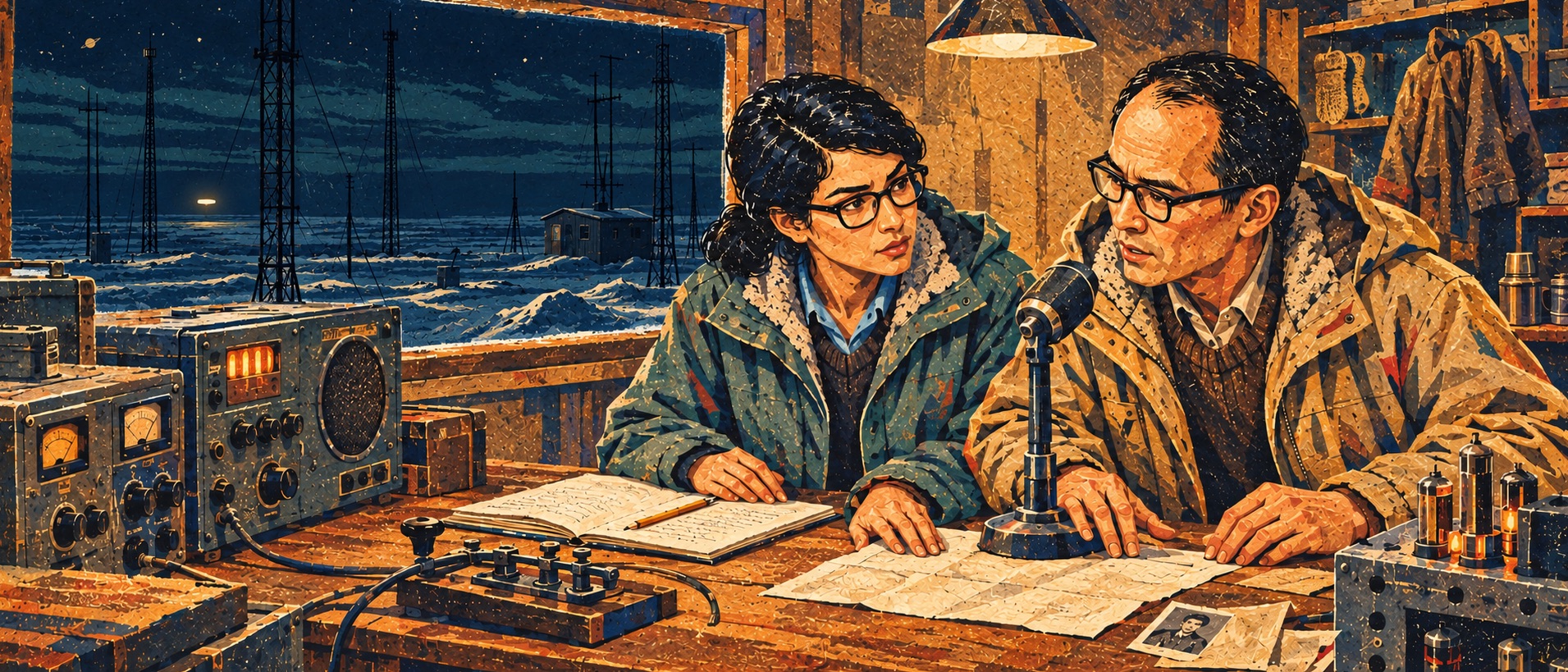
Suzy switched off the test transmitter and disconnected its supply.
For nearly a minute, they heard only the receiver’s irregular whisper.
First contact
Then came three pulses.
She looked at Frank. Neither spoke until the last pulse had faded.
“Again?” he asked.
“Not yet.” She checked the connections a second time. “First we give it something different.”
She restored power to the transmitter and tapped an uneven sequence with the key. Frank counted silently.
When she finished, she switched the transmitter off again.
The loudspeaker repeated the sequence. Its timing was uneven in exactly the same place: where she had hesitated, the reply had hesitated too.
Frank leaned toward the loudspeaker. “Someone is receiving us.”
“Someone is returning what they receive.” She switched the transmitter back on and took the microphone from its hook. “This is an equipment test. Identify your station.”
For several seconds there was only noise. Then a voice spoke, thin and almost buried beneath it.
“Please leave the receiver connected.”
Suzy looked through the window. A light had appeared beyond the outer row of equipment, low enough that it might have belonged to a vehicle.
“What station?” she repeated.
“We are near you.”
Frank reached for the gain control. Suzy caught his wrist before he touched it.
“Leave the settings,” she said. “We know what they are.”
The voice continued, more clearly now.
“You have been measuring us.”
Frank leaned toward the microphone. “Are you responsible for the aircraft lights we have observed?”
“Yes.”
“Who do you work for?”
There was a pause longer than the others.
“We do not belong to a government on your world.”
The statement was so large that for a moment it seemed merely badly phrased. Frank heard himself make a short, involuntary sound, almost a laugh.
Suzy put the microphone down without releasing its switch.
“That is a claim,” she said. “It is not an identification.”
“We understand.”
“Then start with something we can check.”
The light outside moved. It came slowly across the snow, passing behind one antenna support and then another, until Suzy could distinguish a pale curved body surrounding it. It stopped well short of the shelter.
There were no headlights. The light came from an opening in its side.
Frank went to the window. The object was larger than he had expected, yet low enough that the shelter roof cut across his view of its upper surface. He could not see wheels or a propeller. Snow moved beneath it in a shallow, uneven skirt.
He watched for long enough to become aware that he was holding his breath.
“We can remain here,” the voice said. “You do not have to approach.”
“How are you speaking English?” Suzy asked.
“We have listened to your transmissions. This speech is produced by an instrument.”
“And where are you?”
“Elsewhere. The vehicle is not occupied.”
That answer made Frank step back from the glass. He had been searching the opening for a face.
“You understand our radios,” he said.
“Some of them.”
“Well enough to do this.”
“Yes.”
He pointed at the test apparatus, although the speaker could not necessarily see him. “Then why answer us now?”
“Because you found us, and because you continued testing after your first explanation failed.”
Suzy folded her arms. “You have been listening to us.”
“When you used radio.”
She glanced at Frank. Their test traffic, their instructions to one another across the site, the exasperated discussions over signals that did not belong: they had thought of all of it as noise leaking into empty country.
“What do you want?” she asked.
“Assistance.”
Frank turned back toward the bench. “With what?”
“Your instruments. Your warning systems. The decisions made from them.”
He shook his head. “You can send that machine here, but you need help with equipment built from valves and wire?”
“We can receive a signal without knowing what you will do because of it.”
The reply was quiet enough that Suzy moved closer to the speaker.
“Your receivers do not all behave as their descriptions say,” the voice continued. “Some differences are faults. Some are alterations. Some are choices made by the people using them. We cannot always distinguish these.”
Frank thought of a relay that worked when the cabinet was open and failed when it was closed. Three days had gone into finding the reason. Nothing in its specification had mentioned the new length of cable routed beside it.
“You want someone to explain the mistakes,” he said.
“And the decisions.”
“You could steal the drawings.”
“Would the drawings tell us why you disregarded a warning yesterday?”
Suzy answered before Frank could.
“We did not disregard it. We isolated it from the other observations.”
“Why?”
“Because we could reproduce it with the equipment. We did not need an aircraft to cause it.”
“That is the kind of distinction we need.”
Frank pulled out the other chair. Until that moment, neither of them had sat down.
“For what purpose?”
This pause was longer still.
“We are concerned about your atomic weapons.”
The warm shelter seemed suddenly smaller. From another building came a muffled knock, followed by the ordinary scrape of something being dragged across a floor.
“Which country’s weapons?” Suzy asked.
“All of them.”
“You expect a war?”
“We cannot predict one. We consider it possible within the lives of people now living, or those who follow them.”
Frank rubbed the side of his face. “That does not make you different from us.”
“No.”
“Then what makes you qualified to watch us?”
The loudspeaker hissed. Suzy thought, for an instant, that the conversation had ended.
“Our ability to watch does not make us qualified,” the voice said. “That is one reason we are speaking to you.”
She looked at Frank. He was staring at the floor between his boots.
The voice told them there were other vehicles, other observers, places beyond human settlements where work was being carried out. Some installations were being moved beneath the ocean, into deep trenches. The details arrived reluctantly, in answers to questions rather than a prepared revelation.
Suzy asked whether the ocean would protect them from every consequence of a nuclear war.
“No,” came the reply. “It reduces some dangers. It does not remove our dependence on what happens above.”
“Our dependence?” she repeated.
“We are here too.”
Frank looked up.
“For how long?”
“Long enough that leaving would mean abandoning work we believe matters.”
“What work?”
“We can show you part of it. We would like you to help us.”
Suzy leaned forward, her elbows on her knees.
“Here?”
“At one of our placements.”
Frank had been listening with the frowning concentration he gave to an unfamiliar circuit. Now Suzy saw something else enter his face.
She knew before he reached into his pocket.
“Frank,” she said softly.
He took out the folded letter anyway. The paper had become soft along its creases.
“There is a man,” he said into the microphone. “In Indochina.”
He stopped and began again.
“My brother. Guillaume Phung Do. He is at Dien Bien Phu.”
The voice did not answer immediately.
Frank unfolded the letter on the bench. There was nothing in it that could help this conversation except a name, a military address, and evidence that his brother had been alive when he wrote it. He smoothed it with both hands.
“He fought in the last war. He survived that. Now he’s in another one, and they are closing around him.”
“We do not know his location.”
“I can give you his unit.”
“That may help.”
Frank’s voice sharpened. “May?”
Suzy put her hand on the letter, not on his arm.
“Let them answer.”
He looked at her, then sat back.
“If you can travel here without being seen,” he said, “if you can put installations under an ocean, can you get one man out of a valley?”
“Travel is not the only difficulty.”
“I know that.”
“We would have to identify him. Reach him without killing him. Avoid drawing fire toward people who would otherwise survive.”
Frank stared at the microphone.
“Then you have considered doing things like this.”
“We have considered many interventions. That does not mean we know how to make them safe.”
For the first time, he seemed to listen to the answer rather than wait through it.
“You don’t have to save an army,” he said. “I’m asking for Guillaume.”
Suzy withdrew her hand from the letter. She knew there were others in the same valley, each with someone who could have made the same appeal. Frank knew it too. The knowledge had not made him fold the paper away.
“We can begin looking,” the voice said.
“And if you find him?”
“We will attempt to bring him out alive.”
Frank closed his eyes. When he opened them, Suzy was still watching him.
“Is that conditional on our coming?” she asked.
“No.”
“Say it clearly.”
“If you decide not to come, we will still look for Guillaume Phung Do.”
Frank lowered his head over the letter. Suzy gave him a moment before speaking again.
“We need to talk privately.”
“Disconnect the radio.”
“And the vehicle?”
“We will withdraw it.”
Outside, the pale body moved back across the snow. Suzy pulled the receiver plug, watched the valves dim, and then pulled the transmitter supply again. She checked the window before turning to Frank.
“Do you believe them?” she asked.
“I believe there is something outside that I cannot explain.”
“That isn’t what I asked.”
He rubbed his eyes. “I want to.”
“So do I.”
That made him look at her.
She sat on the edge of the bench, beside the disconnected equipment.
“Not because of the machine. Not only because of it.” She searched for the words. “We have spent months finding reasons not to believe what we saw. Now we have something that answers questions. I want to keep asking.”
“They could lie about everything.”
“Yes.”
“About Guillaume.”
“Yes.”
He stood and crossed to the window. The vehicle had withdrawn far enough that it was once more a pale shape beyond the antennas.
“If we tell the station, we may lose any chance of going,” he said.
“And if we leave, we may never be able to explain it.”
There was no useful answer to that. Frank turned the letter over, although he knew the other side was blank.
“I don’t want you to come because I cannot leave him.”
“I know.”
“Do you?”
She stood in front of him.
“I saw the lights first, Frank. I brought you outside.”
He gave a small, weary smile.
“You did.”
“I am frightened. That is different from wanting to stay.”
They spent a long time making a list.
Some questions were embarrassingly simple. What would they breathe? What could they eat? Could they return to land? Others grew worse as they tried to make them precise. What would be done to them? What information would they be expected to supply? What did helping mean if they disagreed?
When Suzy restored power to the receiver, the voice was waiting. She reconnected the transmitter before answering.
They went through the list.
The first destination would be a nearby facility where they could remain in a separate compartment prepared for them. They would not enter the water themselves. No procedure would be performed without explanation and agreement. They could ask to return.
“Return here?” Suzy asked.
“To an accessible place on land. We cannot promise that every location will remain safe to approach.”
“And how long before we can ask?”
“You can ask before we depart.”
“Afterward?”
“At any time. Returning may require travel.”
Frank asked about journeys beyond Earth, and the voice said those were not required now. Suzy made it repeat that answer. Whatever extraordinary physics lay behind the craft, they were not agreeing to an unexplained journey whose consequences would be revealed after it began.
Then Frank asked again about his brother.
“We need his image, if you have one,” the voice said. “His unit. Anything that will help distinguish him from other men.”
Suzy touched the small packet Frank had already laid beside the letter.
“We have a photograph.”
They left a note in the shelter. It said they were leaving voluntarily and that neither should be presumed injured solely because they could not be found.
Frank read it twice.
“No one will believe this.”
“They may believe the handwriting.”
She signed Souzette Mansouri-Do. Beneath it he wrote François Thanh Do, slowly enough that the letters did not run together.
They switched off the transmitter and receiver. Their technical notebooks stayed on the bench.
Outside, the cold brought water to Frank’s eyes. He blinked hard, angry with himself for being unable to tell how much of it came from the air.
The vehicle had returned. At this distance its surface was not perfectly smooth; shallow changes in texture showed where the light struck it. He found that detail reassuring, then distrusted his own relief. A surface with seams could conceal as much as one without them.
The opening was a little taller than Suzy. Beyond it was a short enclosed compartment with two low seats and a second closed door. The light inside was ordinary enough to make the whole thing more disturbing.
Suzy stopped at the threshold.
“Keep this open,” she said.
The voice now came from within the compartment.
“Until you ask us to close it.”
She stepped inside and waited. Frank remained on the snow.
“Suzy?”
“I’m here.”
He could see her clearly. She took off one glove, touched the seat, and looked back at him. Nothing had seized her or changed her voice. She was his wife, examining something unfamiliar before deciding where to put her weight.
“Come and look,” she said.
He crossed the threshold.
For a few moments they stood together in the open doorway, looking out at the station. The antennas were still visible against the sky. Somewhere beyond the buildings were people who would finish their shifts, complain about the food, and eventually discover the note.
Frank held the photograph in his bare hand.
The voice asked, “Are both of you choosing to leave?”
“Yes,” Suzy said.
Frank looked at her before he answered.
“Yes.”
“May we close the entrance?”
Suzy sat down. Frank took the seat beside her, keeping the photograph where he could see it.
“Close it,” she said.
The opening narrowed. There was no flash, no loss of consciousness, only the gradual disappearance of the Arctic light.
Frank waited until the door had sealed.
“His name is Guillaume Phung Do,” he said.
“We have his name.”
He looked down at the photograph. Guillaume stood a little apart from the other men, caught in the act of turning toward whoever had called to him.
“Then let me tell you how to recognize him.”
Huguette 1, Dien Bien Phu: late April 1954
The man beside Guillaume had stopped asking for water.
For a while Guillaume had mistaken the silence for sleep. Then he had seen the flies settle near the man’s eye and had reached across to close it.
His own canteen held nothing. He put it back anyway, tightening the cap with the exaggerated care he gave to small tasks now that the larger ones had become impossible.
Somewhere beyond the bend, someone was calling for ammunition. The voice came twice and stopped.
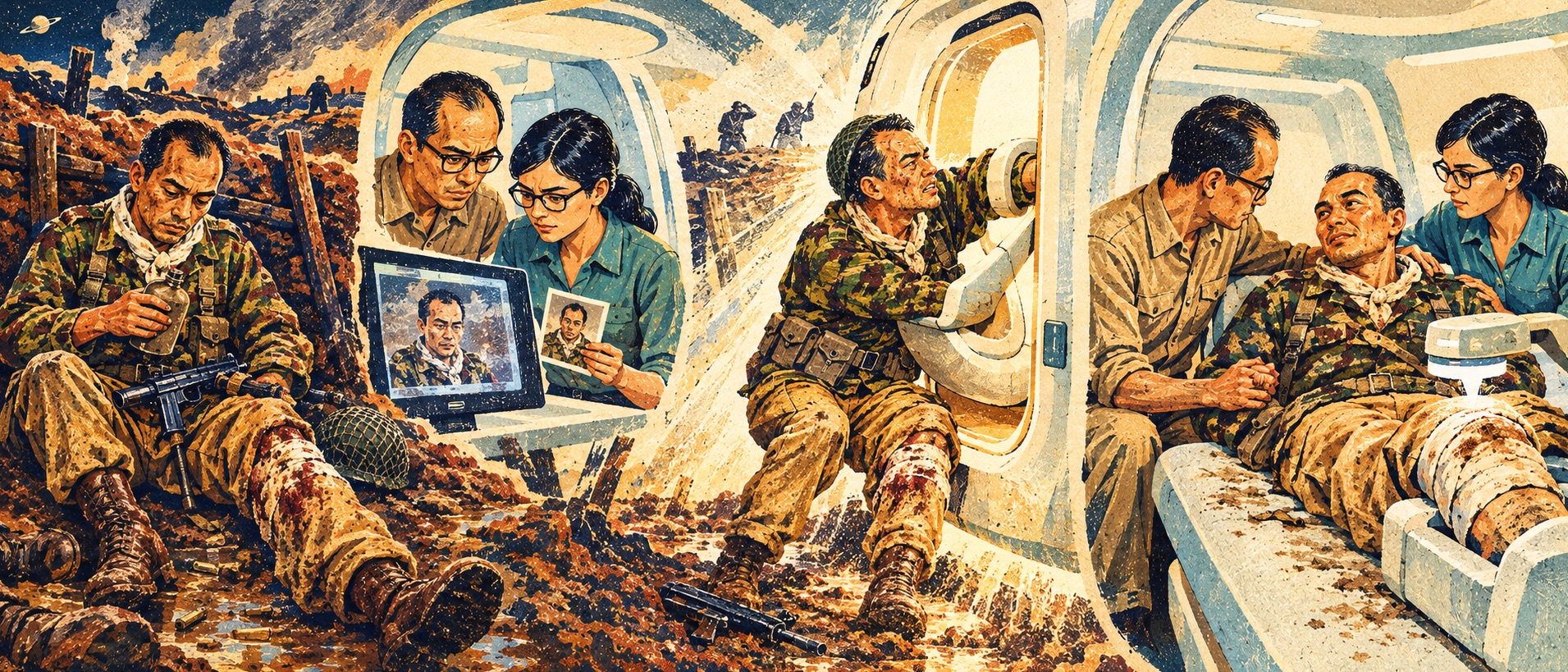
Guillaume pressed his back against the trench wall. His left trouser leg was stiff around the knee, and every attempt to straighten it brought a deep, sickening pain. He could move his foot. He had checked several times.
He had come into Strongpoint Huguette 1 carrying ammunition and a message. The return route had closed before he could leave.
At first he had kept explaining that he belonged to the 5eme BPVN, that is, the Fifth Vietnamese Parachute Battalion. A sergeant had listened, pointed toward an empty firing position, and told him where to stand.
That sergeant lay near the bend now.
Guillaume pulled the weapon from across his lap and checked it. He had already done so, but his hands remembered the sequence even when his thoughts wandered.
There were Frenchmen and Vietnamese in this length of trench. Yesterday there had been arguments about who should try to reach the next position, who still had water, who had heard an order correctly. A man Guillaume knew only as Perrin had offered half a cigarette in exchange for a match.
Guillaume had given him the match and refused the cigarette. He had wanted to save the smoke until there was something worth celebrating.
He could see Perrin’s boots.
A shell burst beyond the parapet. Earth struck his helmet and spilled down the back of his collar.
He lowered his head until the falling grit stopped. There had been a time when each explosion had seemed directed at him. Now he understood how little of the battle knew he existed.
He listened again for the ammunition call. Nothing came.
The trench ahead had been broken open where a blast had thrown down part of the wall. Through the gap he could see a strip of sky and the upper edge of a bank beyond it. A figure crossed that opening, low and quick.
Guillaume raised his weapon.
The figure disappeared before he could fire. He kept the sights on the gap, aware that his arms were beginning to tremble.
He thought of his brother’s last letter.
Frank had described the cold as if it were a mechanical defect that could eventually be corrected. He had written about Suzy, about equipment that failed for reasons its designers had never considered, about an island where the distance between lights was larger than Guillaume could readily imagine.
There had been no useful way to answer that from the valley. Guillaume had written that he was well.
He tried to remember whether he had asked about Suzy.
The figure appeared again. This time another followed it.
Guillaume fired a short burst. One man dropped below the broken wall; the other pulled back. He could not tell whether either had been hit.
He waited for the reply.
When it came, he flattened himself against the earth and held the weapon close. Dirt flicked across his sleeve. A sharp impact snapped a splinter from the timber above him.
His brother would receive the last letter after it had stopped being true.
The search
The first man the Visitors showed Frank was not Guillaume.
He had nearly said yes. The face had been turned away, and the angle of the shoulder beneath the helmet had awakened a recognition so fierce that he had mistaken it for evidence.
Suzy had asked for another view.
When the man looked up, the resemblance vanished.
Frank had gripped the edge of the display until his fingers hurt. After that, he stopped calling each new image closer.
They were aboard a larger vehicle now. After a brief stop at the installation the Visitors had promised, they had transferred from the craft that had collected them at Barter Island. A short passage connected their new compartment to an empty treatment bay. The Visitors had shown them that room before beginning the journey south.
Frank had asked how quickly they could reach the valley. Suzy had asked what would happen when they got there.
The second question had taken longer to answer.
The carrier could remain away from the fighting, but a smaller recovery vehicle would have to enter it. The men in the trenches were obscured by earth, roofs, smoke, and one another. A photograph could narrow the search; it could not make a covered face visible.
There were no convenient names attached to the moving figures.
The Visitors had followed fragments of military traffic and watched the routes between positions. Frank had supplied the name of Guillaume’s battalion, the address on his letter, and details he had never expected to offer as measurements.
His brother’s height, approximately.
The old damage to one ear.
A photograph in which half the face was in shadow.
Suzy had made the Visitors retain the first rejected identification beside the photograph. Frank had resented it for a moment, then understood.
Now another image lay before them.
A man was sitting against a trench wall. His helmet concealed his eyes. He held a weapon across his thighs, and one leg lay at an angle that made Suzy look toward the treatment bay.
“We need to see his face,” she said.
The image shifted. It did not pass through the wall; it moved along it, found an opening, and waited.
Frank watched the man’s hand close around a canteen.
“That may be him.”
The words came out almost level.
“What are you using?” the voice asked.
“His hand. The way he holds it.”
Suzy touched his sleeve. “That isn’t enough.”
“I know.”
The man put the canteen away. A burst of falling earth made him duck, and when he raised his head again, his helmet had shifted backward.
Frank leaned forward.
The face on the display was thinner than the face in the photograph. Dirt had settled in the lines beside the mouth. But the ear was visible, and then the man turned far enough for Frank to see the small unevenness of the nose.
“Guillaume.”
Suzy looked from the moving image to the photograph. She did not answer immediately.
“I believe it is,” she said at last. “Can you let him hear us?”
“At closer range.”
The view widened. Farther along the trench, several figures were moving toward the isolated man.
Frank pushed himself upright.
“Go closer.”
“The recovery vehicle is approaching.”
“How long?”
The Visitors put a marker on the display. It moved slowly enough that Frank wanted to strike it with his hand.
Suzy kept watching the trench.
“Tell us what to say,” she told the voice. “Only what he needs to do.”
The flash
Guillaume heard his name beneath the firing.
Not shouted from the next position. Spoken close to his ear, with a hesitation he knew.
“Guillaume. It’s François.”
He turned so abruptly that his injured leg dragged against the ground. Pain restored the trench in all its detail.
No one stood behind him.
He looked toward the dead man beside his shoulder. For an instant he could not remember closing the man’s eye.
“Guillaume, listen to me.”
He could not place the voice. A radio, perhaps, although there was no handset within reach.
Frank was in Alaska. Guillaume knew that with a certainty he had lost about almost everything else.
He pressed one hand against his helmet.
“Not now,” he said.
At the farther end of the trench, a man came over the broken bank and landed crouching. Another dropped behind him. Guillaume raised his weapon, but the first man had already vanished into the cover of the bend.
The voice spoke again.
“There will be an opening beside you. Put your arm inside. I am here.”
Guillaume thought this was what dying might do: make an ordinary sentence of something impossible.
A shadow crossed the strip of sky.
It was broad and quick, and for a moment he expected a load falling from an aircraft. He bent forward, protecting his head, while something pale descended into the torn space above the trench.
No parachute.
An edge touched the earth near his boot. Loose soil slumped beneath it.
He could not understand the shape. It was too smooth to belong among the timbers and sandbags, too deliberate in its movement to be falling wreckage.
An opening widened in its side.
“Here,” said Frank’s voice.
Guillaume stared at it. Warm, white light fell across his hand.
At the bend, someone shouted. He saw the muzzle of a weapon, then a face behind it.
He fired.
The burst ended sooner than he intended.
He pulled the trigger again and heard only the mechanism.
The face disappeared. More movement crowded the broken bank beyond it, men pressing forward, one reaching back to pull another down into the trench.
Guillaume tried to stand.
His left leg failed. He struck the wall with his shoulder and slid back into the shallow water at its base.
“Your right arm,” the voice said.
It was a woman’s voice now.
He knew that voice too, though he had heard it far less often.
“Guillaume, put your right arm through the opening.”
“Suzy?”
“Yes. Do it now.”
The bright interior was within reach.
He put his hand inside.
Something closed around his forearm, firm but not sharp. He tried to pull away, and it loosened.
“It will lift you,” Suzy said. “Let it.”
Beyond the bend, a soldier raised his weapon.
The flash struck.
For an instant the trench had no color and no depth. Every wet surface returned the same intolerable brightness.
Guillaume shut his eyes.
A shout became several shouts. The grip tightened again, and broad pressure came beneath his shoulders and hips.
His injured leg moved.
He cried out, opened his eyes into white, and felt himself being turned rather than pulled straight upward. Something supported the knee before it could strike the edge.
The weapon slipped from his hand.
He tried to recover it. His fingers closed on nothing.
Then there was a surface beneath his back.
He could still hear firing, but it had changed direction. It was above him, then outside him, then muffled as if someone had shut the door of a deep shelter.
He opened his eyes again.
The light was no longer blinding. A pale curve enclosed him, close enough to touch.
Something had taken hold of his boot. He kicked with the good leg.
“Don’t,” Suzy said. “It’s supporting you.”
He stopped because she sounded frightened.
Outside, two attacking soldiers had dropped behind the bend. One pressed a sleeve against his eyes while the other shouted a warning back along the trench.
“Phosphorus! Stay back!”
Dust hung where the white light had been. No one could see through it clearly.
A third man started forward, then checked himself when the warning was repeated. They kept their heads down and waited for the expected burning fragments.
By the time they advanced, the wounded defender was gone.
His empty weapon lay in the mud.
The treatment bay
Guillaume could not tell whether he was moving.
There was pressure across his chest and thighs, but no hand holding him down. When he pushed against it, the surface yielded a little and then resisted.
He tested it again.
“You are secured for travel,” Suzy said. “You can breathe normally.”
“Where are you?”
“Waiting for you.”
“Where?”
She did not answer at once.
Guillaume turned his head. The compartment held no recognizable controls, no hanging straps, no red-cross marking. A faint vibration came through the surface beneath him.
He remembered the flash and wondered whether he had been burned. He could not smell smoke.
“The men,” he said.
“Which men?”
“With me.”
For a few moments he heard only his own breathing.
“We saw no one else moving in that part of the trench,” Suzy said.
He closed his eyes.
He had checked them. He had known. Still, some small part of him had hoped for a correction.
He began to shake.
The movement hurt his leg, which made him try to stop, which made the shaking worse. He pressed his teeth together until he thought one might break.
“Guillaume,” Frank said.
“Stop saying my name.”
The voice fell silent.
He was grateful for that, and then immediately terrified that it would not return.
“Are you there?”
“Yes.”
“Don’t go.”
“I’m not going.”
Something changed in the vibration. There was a low sound, followed by the feeling of being set down with extraordinary care.
The pale wall beside him opened.
He saw Frank first.
Not on a screen, not in a photograph. His brother stood under a light with his sleeves rolled back, a hand lifted as if he had forgotten what he meant to do with it.
Guillaume stared at the hand.
Then he began to laugh.
It was a painful, breathless sound that made Frank’s face change.
“You were supposed to be in Alaska,” Guillaume said.
“I was.”
“You’re badly lost.”
Frank bent over him.
For a moment neither tried to speak. Guillaume gripped his brother’s sleeve with the strength he had been saving for a fight that was over.
Suzy stood on the other side of the platform.
“Hello, Guillaume.”
He turned toward her and tried to arrange his face into something that would not frighten her.
“I’m sorry,” he said.
“For what?”
He looked down at himself. Mud covered the pale surface beneath him. There was blood on Frank’s wrist now.
Suzy followed his glance.
“That can be cleaned.”
A voice from the compartment asked permission to examine his leg.
Guillaume’s grip tightened.
“Who is that?”
Frank looked at Suzy, and the glance told Guillaume more than either of them intended.
“We met someone,” Frank said.
“I gathered.”
“They brought us here. They brought you out.”
Guillaume looked past his brother into the passage beyond the treatment bay. He waited for a doctor, a pilot, any figure whose clothes would explain where he was.
No one appeared.
“What country?”
Frank shook his head.
Guillaume watched him for several seconds.
“Don’t tell me yet.”
“All right.”
“Tell me what they’re doing to my leg.”
Suzy moved closer to the voice pickup. “Explain it before you begin.”
The answer described an examination, removal of the damaged clothing, control of bleeding, and support for the injury. The voice offered relief from pain but did not claim that the damage had vanished.
Guillaume listened.
“Will I stay awake?”
“That is possible.”
“Then I stay awake.”
Frank waited until the examination had begun before speaking.
“I asked them to find you.”
Guillaume kept his eyes on the ceiling.
“How?”
“Your photograph. Your name. Your unit. We nearly chose the wrong man.”
That made Guillaume look at him.
Frank did not soften it.
“Suzy stopped me.”
Across the platform, Suzy was watching the device that had settled above the injured knee. She could not understand all it showed, but she was following every movement.
Guillaume breathed out.
“You should listen to your wife.”
“I do.”
“You always say that.”
The faint smile lasted only a moment. Then Guillaume’s face closed, and he turned away.
“Perrin,” he said.
Frank waited.
“There was a man called Perrin. I don’t know his first name.”
“All right.”
“He wanted a match.”
His voice had become thin.
“I gave him one.”
Frank moved his hand onto the uninjured shoulder.
“Tell me.”
“There are others. I should know their names.”
“Tell me what you remember.”
Guillaume shut his eyes. The examination continued around him with quiet movements and occasional questions.
Frank did not tell him he was lucky.
After a while Guillaume opened his eyes again and looked toward the passage.
“Will they send me back?”
“Not against your will,” Frank said. Then he looked up. “Is that understood?”
The voice answered.
“Yes.”
Guillaume considered that answer as carefully as he had considered the opening in the trench.
“And if I want to go?”
“We will discuss how to return you safely,” the voice said. “First we must treat your injury.”
He nodded once.
Suzy drew a seat beside the platform. Frank remained standing until Guillaume pulled weakly at his sleeve.
“Sit down. You make me think there’s an officer coming.”
Frank sat.
There was no sound of guns in the compartment. Guillaume listened to the absence, waiting for it to be broken.
It lasted.
He looked from Frank to Suzy.
“Where are we going?”
“Somewhere they can look after you,” Suzy said. “We’ll explain the rest together.”
Guillaume kept hold of his brother’s sleeve.
“Together,” he repeated.
This time, when he closed his eyes, he did not have to keep listening for men at the bend.
The Chiclet Incident
Pacific Ocean, between Hawaii and Midway
Mid-November 2004
The first explanation was that the radar could be lying.
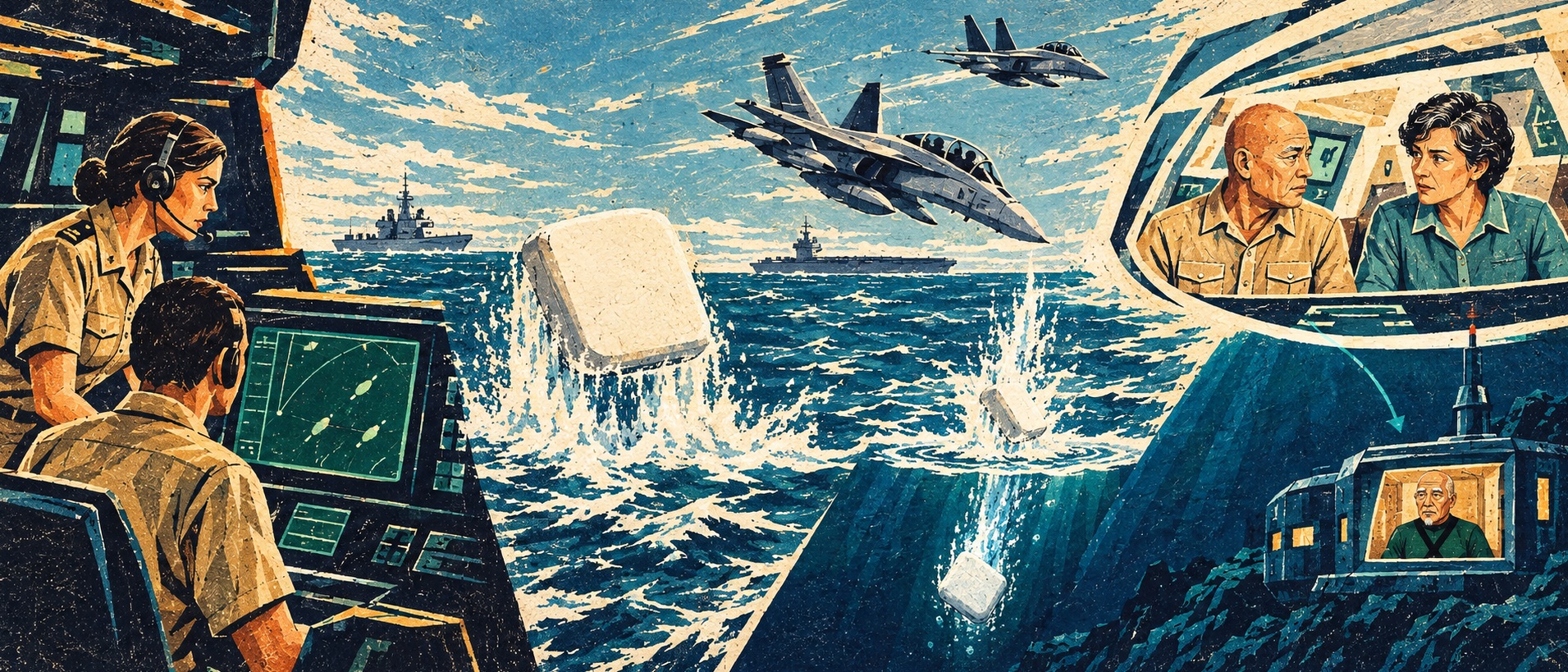
Lieutenant Rachel Mercer stood beside the air-search team in the combat information center of USS Princeton, studying three returns that had no business being where the system placed them. One persisted. Another disappeared whenever an operator tried to establish a dependable track. The third might have been the first, misplaced.
The cruiser was evaluating upgrades to its radar and combat systems. New equipment, new software, an ocean full of reflecting surfaces: there were several reasonable places to begin.
“Multipath?” Mercer asked.
“Possible.”
“Possible isn’t a result.”
The operator nodded. He had already asked maintenance to check the system.
A signal could travel directly to an object or arrive by a less convenient route, reflected from the sea. An extra path could produce an extra apparent target. The display did not label one echo true and another a reflection.
Princeton had known aircraft in the area, known ships, and the carrier’s schedule. The team compared those with the troublesome returns.
The checks did not make the returns go away.
On another display, two F/A-18F Super Hornets from USS Nimitz were approaching the end of their patrol leg. Nimitz, Princeton, and the other ships of Carrier Strike Group 12 occupied a broad stretch of the central Pacific.
Mercer spoke to the tactical action officer, listened to the answer, and selected the aircraft circuit.
“Kite One-One, Princeton. New tasking. Investigate an unidentified contact.”
The lead pilot answered promptly.
“Princeton, Kite One-One. Ready to copy.”
“Vector zero-four-zero. Contact twenty miles from your position. Altitude unreliable. Maintain angels fifteen until advised.”
“Zero-four-zero, angels fifteen. One-Two is with me.”
The second aircraft checked in.
“Kite One-Two.”
Mercer watched their symbols turn.
“This is an identification task,” she said. “Report what you see.”
The intercept
For the first several minutes, the pilots saw nothing unusual.
The sea below them carried a broken pattern of light and shadow. There was no cloud layer to hide an aircraft, no island in the assigned area, no obvious vessel beneath the position Princeton had given them.
“Princeton, One-One. Approaching your contact. No radar contact.”
“One-One, Princeton. Contact now ten miles, eleven o’clock from you. Intermittent. Search low.”
The lead pilot looked at his radar display, then outside.
Behind him, his weapons systems officer changed the search.
“Still nothing,” the back-seater said.
“Princeton, One-One. Negative radar contact. Confirm position.”
Mercer checked the operator beside her.
“Position confirmed on our display. We are not getting a dependable altitude.”
“One-Two, anything?”
“Negative. Nothing airborne.”
The lead pilot let his eyes travel down the projected line of sight.
There was white water below.
At first it resembled a breaking wave enlarged by distance, although the surrounding sea did not show the same disturbance. Then the patch spread outward.
“Princeton, One-One. We have a surface disturbance.”
Mercer leaned closer to the display.
“Describe it.”
“White water. Localized. No vessel visible.”
“One-Two, visual,” the wingman said. “Something below the surface.”
“You have an object?”
“Negative. Just the disturbance.”
The distinction lasted less than a second.
The center of the white patch rose.
Water lifted in a broad, ragged column and tore apart. Something pale came through it, shedding streams of water that separated into glittering fragments beneath the sun.
“Princeton, One-One! Object coming out of the water!”
The back-seater said something sharp over the intercom.
“One-Two, tally! I have it!”
Mercer watched a new return establish itself close to the surface disturbance.
“One-One, describe the object.”
“White. No wings. No visible exhaust.”
“Size?”
“Can’t give you a reliable size. No range.”
For an instant the thing turned broadside.
It was not cylindrical. It had a broad, slightly bowed face, rounded corners, and a short, thick edge. Sunlight ran across its pale surface as it rolled.
“It looks like a piece of square gum,” the lead pilot said.
Mercer glanced toward the operator, who was staring at his own screen.
“Say again?”
“A Chiclet. The old Adams gum. One of those white squares. Rounded edges.”
The wingman cut in.
“Second disturbance, farther west. Possible second object.”
“Keep your primary in sight,” Mercer said. “Do not split the section.”
Another pale shape flashed briefly above the distant white water, then dropped below the pilots’ line of sight. Neither crew could say what it had done.
The nearer object remained visible.
It rose toward them.
The pursuit
“One-Two, stay high. I’m going down for a look.”
“One-Two.”
The lead aircraft banked into a descending turn.
The white object moved sideways, apparently keeping its broad face toward the fighter. There was no bank corresponding to the change of direction, no visible control surface moving.
“Princeton, One-One. Object is climbing. Coming toward our altitude.”
“We have an ascending track,” Mercer said. “Maintain separation.”
The object stopped climbing.
Or appeared to.
With nothing beside it and no reliable range, the pilot could not distinguish a pause from a change in direction. He knew only that the image in front of him had become difficult to reconcile with the motion of his own aircraft.
Then it crossed his nose.
“There! Right to left!”
He rolled to follow, careful not to pull the wingman into the same patch of sky.
“One-Two, I have it below you,” the wingman said.
“No, it’s ahead.”
“It was below.”
On Princeton’s display, the return changed position between updates. The operator checked the track assignment, then looked at Mercer.
“Not the fighters,” he said. “Separate contact.”
The symbol moved again.
Mercer could see why the pilots’ voices had changed.
“Kite flight, confirm your recorders are running. HUD and targeting pod. Capture whatever you can.”
In the lead aircraft, the weapons systems officer checked the recorder and brought the targeting pod toward the object.
“Recording,” he told the pilot. “I’ve got it in the picture. Not holding it.”
“Princeton, One-One. Recording confirmed.”
The white shape shrank, then grew again as the geometry changed. It climbed above the fighter’s line of flight, dropped, and moved across the nose once more.
The pilot’s voice rose.
“It’s changing direction again. Up, now down. I can’t stay with that.”
“One-Two, tally. I’ll call it.”
The two aircraft were not matching its movements. They were turning through a much larger space, trying to keep it visible without following every abrupt change.
Mercer listened to the calls while the radar team tried to maintain a coherent track.
Near the contact, the screen showed the orderly paths of the two fighters. Around them, the unidentified return jumped from one position to another as the tracking system attempted to make sense of it.
“Princeton, One-One. Please advise.”
Mercer looked toward the tactical action officer. His answer was immediate.
She transmitted it.
“Kite flight, do not engage. Track and follow. Maintain safe separation. Do not pursue a maneuver you cannot safely match.”
“One-One copies. Do not engage.”
“One-Two copies.”
The object passed across the lead aircraft’s field of view, low enough that the pilot glimpsed the sea behind it.
The targeting image held for several seconds.
On the recording, a pale, rounded rectangle moved against the darker background. It was less distinct than the shape the pilot had seen through the canopy. The pod lost it, recovered it, and lost it again.
The recorder continued.
Then the object changed direction.
“Princeton, it’s going down!”
“One-Two, tally. Steep descent.”
The lead pilot pushed his nose down far enough to keep it in sight.
“No turn,” he said. “Straight toward the water.”
Mercer watched the reported altitude fall, distrustful of the numbers even as the aircrew confirmed the direction.
“Kite flight, remain clear of the surface.”
The white shape became a bright mark against the blue.
It vanished into the sea.
A plume of water rose where it had been.
“It went in,” the pilot said.
For a moment no one answered.
Then the wingman spoke, much more quietly.
“Princeton, One-Two. Confirm object entered the water. We have white water at the entry point.”
Mercer’s operator shook his head.
“Lost the track.”
“Kite flight, Princeton. No airborne contact. Maintain observation. Report any reappearance.”
The lead pilot leveled and climbed back toward his wingman.
Below them, the disturbed water began spreading into a widening oval.
What remained
They circled.
One aircraft watched the original entry point while the other searched the surrounding water. The second disturbance had disappeared. Nothing returned to the sky.
“Princeton, One-One. Any contacts?”
“Negative anomalous contacts in your area.”
“We still have the surface patch. Breaking up now.”
The wingman called his fuel state. They had enough for only a short continuation before reaching their prebriefed return threshold.
Mercer acknowledged. Other aircraft were being redirected toward the area.
The lead pilot made another circuit.
The water below him looked increasingly like the rest of the ocean.
“Princeton, One-One. Bingo. Returning Nimitz.”
“Kite flight, Princeton. Roger. Return to Nimitz. Preserve all recordings. Further aircraft are inbound, altitude separated.”
“One-One.”
As they turned toward the carrier, another pair of Super Hornets crossed on the assigned level, heading toward the place they had just left.
A second pair followed farther back.
The lead pilot watched them for a moment.
“Good luck,” he said, though his microphone was not transmitting.
On Princeton, the air-search team continued its checks.
Known aircraft remained where the system said they should be. Reports from the other ships agreed with them. The unidentified returns did not reappear.
Mercer asked for the event times to be checked against the voice recording.
“Keep the gaps,” she told the operator. “Don’t connect positions we didn’t observe.”
He looked up at her.
“What do I call it?”
“Unidentified.”
He waited.
She looked toward the empty portion of the display.
“That’s what we know.”
The video survived.
So did the radio traffic, the radar records, and the pilot’s improbable comparison with a piece of gum. In the classified account of the encounter, the comparison was less memorable than the uncertainties.
Later, when selected footage reached the public, the uncertainties would be harder to see.
The name would not.
The Chiclet Incident.
Below
The water closed above Frank and Suzy.
For several seconds neither spoke.
Their displays no longer showed the fighters directly. The craft had gone beneath the layer where its surface observations could be maintained, and the last received positions remained marked as old information.
Suzy checked the recovery status of the other vehicles.
“Both survey units are clear.”
Frank nodded.
One of the recorded voices played again in his earpiece.
Do not engage. Track and follow.
He stopped the playback.
The command had been meant for two pilots above the ocean. For the moment, it was the most reassuring thing he had heard.
“We got too close,” he said.
“We stayed too long.”
He turned toward her.
She was watching the last track history, not looking for an excuse.
Their assignment had been to take readings, record the carrier group’s emissions, and measure how its communications and detection systems worked together. They had approached expecting to observe without becoming the observation.
The ship’s radar had found them.
Then the aircraft had found them.
Frank looked at the stored intervals between detection, direction, and interception. The sequence was different in detail from the systems he had known in Massachusetts and Alaska, but he recognized what the engineers had accomplished.
An uncertain return had become a report.
A report had become a decision.
Two aircraft had arrived to look.
“Jack would have liked the timing,” he said.
Suzy looked at him.
“He would have asked where the missing observations were.”
Frank gave a brief, tired smile.
“Yes.”
The smile faded as she brought up the last visual image of the lead fighter.
A dark window showed beneath its fuselage.
“Was it recording?” he asked.
“We don’t know.”
“We heard her tell them to.”
“We heard them confirm. We don’t know what they captured.”
He looked at the image again, hoping for a reason to believe the distinction would matter.
There was none he could establish.
“Perhaps not enough,” he said.
Suzy did not answer.
The craft continued down.
The maneuvers above had not been a game. Each course change had opened another escape path or moved them away from a fighter that had turned toward them. From outside, the result had looked like a challenge.
Suzy had rejected the option that would have interfered with the aircraft’s instruments.
She had once helped build warning equipment for people who depended on it. She was not willing to take it away from two young pilots in the middle of the Pacific simply because they had done their jobs.
Frank knew that without asking.
On his display, the human aircraft were gone. Their recorded voices remained.
He wanted to believe the recordings aboard the fighters had failed.
He wanted, more strongly, to know that both crews would reach their carrier.
The communication link to the base established through the Visitors’ underwater relay network. A short interval passed.
Then Guillaume’s voice reached them.
“Frank? Suzy?”
“We’re here,” Suzy said.
“I lost your report.”
“We’re descending. The survey units are back below.”
“And you?”
Frank looked at Suzy.
She turned from the display to meet his eyes.
“They detected us this time,” he said.
There was a pause.
Far below them, Guillaume waited at the deepwater installation, in the sheltered cut of the seafloor they called the trench. He had been born in 1917. By the calendar above, he was about eighty-seven.
His body had aged to approximately sixty-two.
Frank and Suzy had accumulated the same difference. They were chronologically in their eighties, but the faces turned toward one another belonged to people in their late fifties.
There had been no frozen sleep, no missing decades, no journey that had stolen years from the rest of the world.
They remembered the years.
The Visitors’ medicine had worked continuously: measuring changes in the regulation of their cells, correcting selected drift, removing damaged cells that no longer served the tissues around them, and adjusting the next intervention to the results of the last. It had not returned them to youth.
Fifty years had passed. Their bodies had advanced by twenty-five.
Suzy had lines beside her eyes. There was gray in what little remained of Frank’s hair. Neither face was the face that had crossed the threshold at Barter Island.
Guillaume’s next words came quietly through the link.
“What’s going to happen now?”
Frank looked at Suzy again.
They had spent half a century watching for a warning that might come too late. Today, the people above had detected something they did not understand, sent others to look, and ordered them not to fire.
It was not an answer to Guillaume’s question.
But neither of them looked away.
*

Author’s Note : Inspired by the book “THE INVENTION THAT CHANGED THE WORLD” by Robert Buderi, ISBN: 0-684-81021-2, specifically Chapter 18 “The Sage Age” pp380-406, and the UAP “Tic Tac” Incident of 2004.
About the Author : Romeo Esparrago says “It’s not just a mint, it’s a Tic Tac.”


