
Originally published as Planet Magazine No. 41 (March 2004) on the classic Planet Magazine site.
Planet Magazine
March Quarter 2004 * Issue No. 41 (Vol. 11, No. 1)
10th Anniversary Issue!
Wild Science Fiction & Fantasy on the Web — Since 1994
Price: 1 Body Part
to creep up on this issue

Table of Contents
Editorial & Letters · About the Authors · About the Artists · About this Magazine · Featured Artist: Leo Lin (Gaia-Gear)
Stories
- Amanda by E.S. Strout
- Accidental Cover by Sheryl K. Lindsay
- The Ghosts of Tedjai by Tamara Wilhite
- Glossolalia by Matthew Aitkenhead
- Good Job by Christian R. Bonawandt
- The Iceman by Brian C. Petroziello
- Karen’s Last Game by Nathan J. Kailhofer
- The Larva at the End of a Barstool by R.A. St. Afarian
- Last Hope by Bob Wallace
- Mad Avenue by Keith Crews
- The Planets I Have Visited by Lee Beavington
- Second Chances by Arthur Sánchez
- Why Do We Grow Up? by Sasha Gorelik
Poems
- For Isaac by Daniel C. Smith
- Four SciFaiku by Cassie
- Steel Can by D. Nordling
Editorial & Letters
Ten Years Before the Masthead
Planet Magazine published its first issue ten years ago this month. The March 1994 issue launched in full color on America Online and some long-departed online services. Despite a modest start and more than a few stumbles along the way, we’ve managed to stay true to our primary goals. As we wrote in that first issue, we had three key aims:
Have fun.
Provide talented but unpublished or little-published authors with encouragement by printing their stories in a real periodical (however low-budget, sporadic, or narrowly circulated).
Help disseminate SF, fantasy, and horror stories.
We’ve also stayed true to our goal of remaining a free publication that carries no advertising. Despite the lack of revenue and profit, we believe quality has stayed high over the years. As stated in every masthead since our first issue, we do not pay writers or artists (or editors, for that matter), but we’ve let them keep the rights to their work and helped a number of them move up to paying markets by giving them some early exposure and, we think, additional confidence. We believe this is attractive to many emerging writers and artists, and by keeping the financials simple, we have been able to continue publishing.
So beyond confirming our foresight and wisdom, what else have we accomplished in a decade of publishing?
We’ve rocketed from obscurity to nascent cult-niche status in the realm of SF publishing.
Readership has soared from several friends and relatives per issue to thousands of SF-loving people who simply need to read a good story instead of doing work while at the office.
We’ve helped many writers, poets, and artists develop their craft and their confidence. We’ve provided brief-but-thoughtful critiques and rewrites over the years that most writers and poets have claimed they appreciated.
We’ve inspired at least a couple of other SF zines out there (or so the editors have told me).
No doubt there is more we could say. But “The Moire-Tongued Penta-Horned Star Skinks Who Rule” won’t let us. So we will leave the in-depth, objective analysis to the legions of future zine-ologists (pronounced “xenologists”) who one day will offer such courses as “Planet Magazine and the Early History of Non-Paying Illustrated SF Zines on the Internet: Part I”. Part II, of course, will cover the second decade of Planet Magazine and its transition into a political/media/security apparatus under the Star Skink Administration.
Time flies when you’re having fun!
Andrew G. McCann
March 2004
P.S. I want to thank every single writer, poet, and artist who has contributed over the years to Planet Magazine, especially the frequent contributors (and you know who you are). Special thanks to fellow Planet staffers Romeo Esparrago, Ray Dangel, and Tom Wagner.
Letters to the Editor
Dear Editor: Sci Fi Editor, at http://www.scifieditor.com, offers book-editing services and resources for writers and readers of science fiction, fantasy, and horror.
Blessings and happy new year,
Lynda Lotman
Dear Editor: The second Annual Wooden Rocket Awards — hosted by SFcrowsnest — opened for nominations to let you vote for your favourite science fiction and fantasy web sites on the internet. You can vote across 17 award categories for the online science fiction and fantasy genre. Please visit http://www.WoodenRocket.com to vote.
Stephen
Wooden Rocket Awards
Dear Editor: I find it difficult to find time to read when I have online access. After reading a few issues online, I decided that the quality of the writing made it well worth the effort to find a way to more comfortably read your eZine. My solution has been to make generic PalmDOC PDB files of all 40 issues of Planet Magazine for my personal use.
David W. Gangwisch
[Editor’s Note: These files, which were gratefully received, are now uploaded to Planet’s web site.]
Dear Editor: While there are countless web sites that list and review science-fiction and fantasy books, regrettably few of them hold the books they review to the same standards a serious book reviewer for a serious literary publication — say, The New York Times Book Review — would hold a mainstream book. We operate a site that tries to fill that gap: “Great Science-Fiction & Fantasy Works”, and we invite your readers to visit it (and to send us e-mail comments). The welcome page is at http://greatsfandf.comCordially,
Eric Walker, webmaster
Letters to Planet Magazine’s Financial Backers
Dear Bush/Soros World Government Working Group: Hey, I set up one of those X-10 networks, which can send computer commands via electric wiring, on my PAN (personal-area network), which is hard-wired into my Scott eVest. Now I can type a command into my “armboard” thirty minutes before arriving at a restaurant, and right on cue my jacket automatically unzips, amid swooshing sounds and flashing lights, as the maitre’d leads me and my blind date to our table. Invariably, she is absolutely repelled by this and leaves, but I don’t mind eating alone! And I’ve met some great guys this way who have similar interests (we’re just friends, of course!).
Automatically,
Doug A. Hohle
Dear Sombra Corp.: I see myself as Frodo and my best friend David as Sam, while he sees himself as Frodo and me as Sam. Given your experience with such tricky issues, we ask that you adjudicate on this matter and we pledge to stand by your ruling. By the way, we just saw LotR: Return of the King and it was awesome-tastic! We don’t want to give anything away to your readers who haven’t seen the film yet, but here’s just one little hint — Hey, Sauron, you got served! Oh, and one more thing, my research has uncovered the fact that former fashion icon Fabio in real life is a Wood Elf, just like me! (Although in my real, real life I’m a Hobbit!)
Straight From The Shire,
“Frodo” Jim
[Editor’s Ruling: Actually, I’m Frodo and my good friend Leo is Sam. You guys can be Pippin and Merry.]
Dear Short Gray/Tall Gray/Hybrid-Human Galactic Government Task Force: My name is Professor Elephant, and I’m director of NASA. I wanted your readers to be the first to know why we’ve had so many problems in communicating with our Mars probes over the years. Turns out that our communications network was using the wrong technology. Years earlier, to save money, we cobbled together a comm system for our Mars probes from a patchwork of personal T-Mobile, Cingular, and AT&T Wireless cell-phone contracts that various NASA employees here in Mars Control had signed up for. However, recently, after a cold call from a phone salesman to Control, we upgraded to Verizon Wireless and a single Motorola T730 phone. Everything has worked great since then! The little guys on Mars are coming in clear as a bell! It’s true what they say — Verizon Wireless has the densest network of wireless cells between Mercury and the Asteroid Belt (from Jupiter on out, though, you’d really have to go with Sprint PCS).
Astronomically,
Prof. Elephant
Dear Zeta Reticulan/Reptilian One-Universe Forum: I’ve been wondering whether Planet Magazine is too “gay” (not that anything’s wrong with that, as noted in the popular TV show “Seinfeld”, currently in syndication on second-tier broadcast networks). And by “too gay” I’m not talking about the content or even the staff. What I’m referring to very specifically is the magazine itself — I can’t help but notice the way Planet sort of “swishes” down into my Web browser whenever I access the site. It’s a very pronounced “sinuous” movement. And there also is something just too fastidiously “clean” and inappropriately “witty” in general about the look-and-feel of your magazine. Now I do realize that there are plenty of “straight-acting-in-the-browser” SF&Fantasy gay zines out there — closeted or not — so I’m really just talking about your basic “fem ” SF&F gay zines that, for example, load GIFs in a sashaying manner. Anyway, I haven’t seen any other supposedly hetero-male SF&F-oriented website act like yours. Of course, I’m assuming that Planet is in fact a “male” zine, which I think is a correct assessement given the high level of the male hormone Preposterone (similar to Testosterone, yet absurdly so) on display in your Editorial pages. So I think it’s time you got honest with your readers, and… yourselves.
Over and “Out”,
Bud I. M. Knott-Gaye
[Editor’s Note: Like Ambassador Ryan Seacrest from the planet Metrosex (who also hosts “Alien Idol” on TV), we prefer to dodge the question. However, we would argue that Planet Magazine itself is genderless, which, by the way, is trendy and therefore good. Even so, we can confirm that our web-host’s servers are gay — not that there’s anything wrong with that — which may account for the effects you see whenever you download our magazine. Maybe.]
Dear Howard Dean Bloggers Network: For those of you thinking seriously about inventing a time machine and traveling back to the distant past, I’d advise you to forget it. Seems like a romantic, exciting idea, but it’s very dirty and boring back in Ye Olden Times. I know whereof I speak, since I just returned from 1250 AD after inventing my Chrono-Sled and trying it out in Europe. The biggest problem, though, was that I couldn’t understand a single word they were saying. God knows what the language was supposed to be, but the drunken, guttural slurring of the local inhabitants made it impossible to comprehend. I was irritated constantly by their mumbling and general stink, and my mood grew foul as I tried to rent an apartment, shop for food, set up a wireless chronobroadband router, etc., and generally live the Dark Ages lifestyle with a bit of elegance. So I was all ready to give up on my time experiment when a crowd of white-lipped villagers surprised me and hacked me to death with crudely forged farming implements. Luckily, I had set up a 30-day auto-chrono-pluck to return me from the past just after I had arrived there. For my next venture, I plan to embark on an archeological expedition to France to dig up my very own splintered bones. What a conversation piece those will be at my dinner parties!
Chrono-Sincerely,
Ty M. Traffler
Dear Gates/Jobs/Torvald Unified-OS Strategy Center: I disagree with the premise stated in a letter published in your last issue that the trend of completely outsourcing white-collar Western jobs to developing nations is inevitable. Surely, the cost/benefit analysis of moving manual-labor jobs like streetsweepers — many of whom wear white, collared uniforms or jumpsuits — clearly shows that many, many “white collar” jobs simply cannot be outsourced, and never will be. I hope that puts everyone’s fears to rest.
Optimistically,
Hope I. Emright
Dear New Mordor Foundry Inc.: Having just read the letter above, I decided to quickly write in before this web page finishes “swish-ily” loading (and in that way get my letter published) and state that I disagree with another premise, which has been stated not in Planet Magazine (yet) but in various movies and TV shows over the years. And that premise is that you can take absolutely any actor at all, shave his head, and he can play Lex Luther. In my opinion, it’s just not possible, like total outsourcing. A true Lex does not “quip”, and he’s certainly not a “dreamboat”. He is in fact a sick genius, twisted by bitter resentment against his imagined persecutors into seeking horrific, perpetual vengeance. Believe me, I know what that’s like (so you’d better publish this letter). On the other hand, putting any actor into a white, collared jumpsuit can go a long way toward helping him portray Lex — and he’ll always have street-sweeping as a fallback career.
Acting Methodically,
Harry Reasoner
Dear Editor: In the last issue of Planet Magazine, you claimed to be from the future, but less than a picosecond or so. If that’s the case, then why haven’t you run into your past self, or physically and bizarrely overlapped him, or blown up in a matter/antimatter-like reaction to paradox that rips apart space and time (which I guess hasn’t happened), or appear to become twins, or something?
Needing to Know,
Jess Kyurius
[Editors’ Note: (Please observe the placement of the apostrophe in the initial word of this line.) They say that two heads are better than one, but what’s so much truer is that two head-editors are better than one. Going forward, writers and readers alike can expect every word in Planet to be edited not once, but twice!]
Planet — Read It or Leave It! That’s right, if you don’t like our stories, then why don’t you just go and read a North Korean sci-fi zine! See how much you like that! And get a haircut while you’re at it.
About the Authors
Matthew Aitkenhead (“Glossolalia“) was born in 1974 and lives in Aberdeen, Scotland. He has worked as barman, painter, kitchen porter, and university technician, and is currently a jack-of-all-trades scientist. His loves include beer, curry, and his wife Kris (not necessarily in that order!).
Lee Beavington (“The Planets I Have Visited“) is a Biology Lab Instructor at Kwantlen University College. His passions include writing, music, film, running, nature, and far too many others to pursue in one lifetime. Over the last few years, he has written thirty science-fiction stories and a fantasy novel, for which he is currently seeking publication. Lee currently resides on the west coast of Canada, on a little street called Zero Avenue.
Christian R. Bonawandt (“Good Job“) has had more than a dozen short stories published since 2002 — including the short story “Death By A Salesman” and “A Careful Plan,” which appeared in the September 2002 and 2003 issues of Planet Magazine, respectively. He is currently working to sell two completed novels.
Cassie (“Four SciFaiku“) is a Cyberwoman from Sweden. By night she writes poems and short stories.
Website: http://cybercassie.org
Keith Crews (“Mad Avenue“) is a 36-year-old CNC Machinist with four novels written and a fifth in progress. He has a story featured in September’s 2003 Issue of Planet Magazine. He likes his women fast, beer cold, and sci-fi that messes up his brain.
Ray Dangel (Associate Editor and Staff Robot) can control bees and plant growth through mind power. But not at the same time.
Sasha Gorelik (“Why Do We Have to Grow Up?“) has been writing and directing multicultural storytellings and original
plays for children at schools, libraries, and theaters across Colorado for a decade. He also has worked as a professional writer for major radio, newspapers, and online magazines for years. Previous publishing credits include: Enfuse Magazine, Hybrid Magazine, Fantasy Today, Muse Apprentice Guild, and Bewildering Stories. He is currently looking for representation for a science fiction novel about transnebular sparks and hackers called “The Sparks of Aion”.
Nathan J. Kailhofer (“Karen’s Last Game“) is 34 years old and happily married with three wonderful kids and three cats. He’s a third-generation union printer at a 124-year-old company in Kaukauna, Wisconsin. (Either he, his dad, and his grandpa just weren’t smart enough to get away, or maybe there’s something about printer’s ink that’s addictive.) Nathan owns a library of over 2,000 novels, mostly science fiction and mysteries, which he inherited. A love of good writing might be a family addiction, too.
R.A. St. Afarian (“The Larva at the End of a Barstool“), a Tanzanian author, is a Sagittarian by profession who refuses to settle down, or get married, despite his girlfriend’s and her parents’ wishes/request/pleas/blackmails/threats over the past twenty-six years.
Website: http://www.open-interfaces.org
Sheryl K. Lindsay (“Accidental Cover“) is a Scottish writer of horror, supernatural, and science fiction and has been published in Darkness Rising, Dark Corners, and Anotherealm.
Andrew G. McCann (Editor; “Editorial & Letters“) is the inventor of two new electronic/industrial convergence-gadget concepts: “The PDA Dishwasher”, which is a compact, rolling dishwasher with PIM functions and 8 MB of memory, and “The Digital-Camera Segway”, a converted Segway with a 0.3 megapixel camera built into the handlebars. Future PDA-Ds and Digi-Camways are expected to have 16-bit color screens, double the memory or image resolution, PC-synchronization capability (Mac support is planned), and sleek, metallic plastic trim.
editor@planetmag.com
D. Nordling (“Steel Can“) is a professional engineer with a major aerospace company in Los Angeles. Working for the military-industrial complex has been a rewarding service in the noble cause of progressive world domination, but not altogether satisfying. Poetry is his other love. He resides with his wife in L.A.
Brian C. Petroziello (“The Iceman“) is a 50-year-old lawyer living with his wife, Karan, and two youngest children in Clayton, Ohio. He recently has been able to get back to writing as his children started leaving the nest, and time started to become available. His last publication was in Pig Iron Press in 1982. Another story has been accepted by Black Petals.
Arthur Sánchez (“Second Chances“) is a writer from Peekskill, New York. He’s had more than 20 different professions in his life — from Actor to Night Watchman, from Web-Site Designer to Stained-Glass Craftsman. But the thing he enjoys most is trying to tell a good tale. His work has appeared in “2 AM Magazine,” “Fantasy Review,” “Anotherealm.com,” and “Chicken Soup for the Romantic Soul.” He is currently working on a series of fantasy novels.
Website: http://www.ArthurSanchez.com
Daniel C. Smith (“For Isaac“), in the arena of speculative fiction, has over thirty short stories and poems either published or awaiting publication with various small press and semi-professional magazines, both print and web, including Bare Bone, Black Petals, Lunatic Chameleon, Hadrosaur Tales, and The Leading Edge. In addition, he has published more mainstream poetry and creative non-fiction in such venues as Fresh Views, Inscape, and New Author’s Journal.
E.S. Strout (“Amanda“) has been published in small-press print magazines “Crossroads”, “Lovecraft’s Mystery Magazine”, “Fading Shadows”, “Mad Scientist”, and “Millennium Science Fiction and Fantasy Magazine”. In addition to Planet Magazine, his stories have appeared in Internet publications “Jackhammer”, “Beyond s-f”, “Millennium SF&F”, and “Demensions”. E.S. Strout is on the faculty of the U.C. Irvine Medical Center, where he teaches skin pathology to dermatology residents.
Thomas Wagner (Associate Editor) owes the editor a cup of coffee.
Bob Wallace (“Last Hope“) has a degree in Journalism and has been a newspaper reporter and editor. These days he’s an online columnist. He does not “write” stories; they come to him, complete, in his dreams, usually after a few beers. And that is the truth.
Tamara Wilhite (“The Ghosts of Tedjai“) is, gasp!, an engineer who can write! A science fiction writer who actually knows science! Horror! No, wait, she doesn’t write horror. But she does write practically everything else.
Please visit the newly reopened Planet Magazine/Dunkin Donuts/Pizza Hut branch office in Minas Tirith! More branches opening soon in The Paths of the Dead, Osgiliath, and Cirith Ungol!
About the Artists
Ehrad (art for “Four SciFaiku“, “Last Hope“, and “The Planets I Have Visited“) believes that through all the many wondrous inner and outer journeys we make, we begin to see, if we seize the moment, that out there and in here, are the same. Shier jamba yanna.
Romeo Esparrago (Chief Artist Emeritus; art for “Accidental Cover“, “The Ghosts of Tedjai“, “The Iceman“, and “The Larva at the End of a Barstool“) turns 40 this year. This is significant because not only is it one number below the number of this current issue of Planet Magazine but also because he is an alien Mestizar, having come from the loins of a Shortmo from the planet Dwarfaiea, whose average lifespans end at 39. Romeo would thus be considered particularly long-lived in Dwarfaiea. But being fathered by a spacefaring Livelongo (originally from the planet Andprospero) whose average lifespans end at 122, Romeo’s average lifespan should be between 70 and 90, thus ensuring that at 40, he departs the Mestizar planetary pre-pubescent years and now enters his galactic adolescent phase (Mestizars never grow up since the galactic adolescence phase lasts about 40 years).
Website: http://www.romedome.com/
Mike “Warble” Finucane (art for “Mad Avenue“) is an artist who works with fantasy art mostly, but can do science fiction, as well. He has been published in Christian Fantasy and Science Fiction Magazine, and can do futuristic formats in art. He has also been published in Psychology Art Journals.
Website: http://www.geocities.com/artofwarble/
Senthil GK (art for “Glossolalia“), having done his degree in Applied Art from Chitra Kala Parishat, Bangalore, realized that he needed to do something that interested him more, things like character design, comic illustration, and animation. For this to materialize, joining “National Institute of Design” India, became his dream. He was lucky and his hard work paid off. He completed his diploma at “National Institute of Design” with specialization in Animation Film Design. Currently, he works as a senior creative designer with Communication Design Group, Infosys Technologies Ltd. Involved in visualizing and developing graphics for in-house Multimedia presentations, product demos, simulation software, UI design for Web, Posters, animation, and video and for different media. He pursues his interest in creative work with dedication. Basically, his fields of interest are after-death phenomena, psychology, Pain, science fiction, and character design. There is no out-burst of happiness and well-being. Most of his works are an explosion of the internal pain which ultimately brings in the artistic pleasure through an intricate balance, and he likes to explore the other “ends” or the opposites.
Leo Lin, AKA Gaia-Gear (cover art and art for “Amanda“, “Karen’s Last Game“, and “Steel Can“), is a 30-ish human-small-potato mutant document-management software development hard-labourer with Asian heritage. Born during the dawn of Japanese robot animations, he was always fascinated with all sorts of things related to science fiction — essentially, a dreamer. He has been on and off building scale scifi models since his early teens, but he started collecting 1/6th action figures eight years ago. He regarded the figures as a population that dwelled on his orbital station orbiting planet Earth; they can be seen via the link below. His motto for each project, well, for every other thing in life too: Follow the flow, listen to your heart.
Website: http://members.rogers.com/gaiagear/main.htm
Robert Sorensen (art for “Why Do We Grow Up?“) was born in Summit, New Jersey, has lived in Paris, France, and currently resides in Colorado. His education includes studying painting at L’Academie des Beux Arts de Chaville and studying acting at the Lee Strasberg Institute in NYC, followed by professional work in a theatrical touring company and later, work in TV, films, and documentaries. Robert also wrote an SF screenplay about saving planet Earth from an alien invasion in the year 2059, with the title “QUANTEX-Z or ATOMIC VISIONS”. Robert is an avid international voyager whose passion is to visit, contact, and experience the cultures and peoples from all over Planet Earth and has visited most of Europe, Turkey, Israel, Egypt, Turkey, and most recently Mexico. Robert has exhibited his artwork extensively in Paris, once in London, and several times in the United States. In his artwork, Robert most often takes dream images and bites out of his own life and puts them on canvas, paper, or the computer screen. His themes include the hidden aura-energy within all living and non-living subjects and their surrounding environments.
Patrick Stacy (art for “Good Job” and “Second Chances“), like many before, started young. His main emphasis in childhood was in comics. Never content, the challenge was then to illustrate freehand — now that would be talent. Early influences are still inspirational today, such as the legendary Frazetta, Vallejo, and Parrish. Classical influences were Rubens and Caravaggio. Stacy was winner of the L.Ron Hubbard’s Illustrators of the Future contest in 1996 and has two illustrations within the volume.
Where have all the Dragon-Riders gone? Married and had babies, every one.
Featured Artist: Leo Lin (Gaia-Gear)

FEATURED ARTIST PROFILE: LEO LIN
BEHIND THE SCENES OF THE COVER: TALO-C
Fictional background
The creation of Talo-C was a blind fate to say the least. The upper torso was originally one of the second series prototype MCX –Multi-purpose Cybernetic eXperimental developed jointly by Japan Aerospace Administration, Tsukuba Advanced Robotics Laboratory and Kyoto Miura Institute of Artificial Intelligence. MCX cybernetics are developed with the purposes of operating in hazardous environments. Second series are in particular testbeds for advanced neuronetic governing nexus, capable of complex decision-making process. Lower torso was an experimental underterrain sentry probe manufactured by the now defunct CKC Consortium. Tsukuba Advanced Robotics Laboratory(TARL) absorbed the R&D section of CKC, and brought the remaining 5 examples to its main development labs outside Tsukuba city, Ibaraki prefecture for further studies. However, an unexplained explosion at one of the underground labs 5 months ago caused the neuronetic nexus of a lone MCX to malfunction. It started to merge with anything mechanical around it; including the sentry probe in the lab next door. Facility security teams proved to be hopelessly inadequate in dealing with the situation. Defence ministry then dispatched a specially trained retrieval team to disable and retrieve Talo-C. It was declared a high value runaway subject in ministry’s internal memo, and must be retrieved at all cost. Current whereabouts of both Talo-C & the retrieval team remain classified. However, our high-level sources within the ministry hinted that the team is closing in on the subject.
The project itself
Having grown up with Japanese animations in the 70s & 80s, most of my projects have been influenced by them, and this one is no exception. At the beginning, I had no idea it would turn out like this incarnation. It was going to be just another cyborg among the collection. However, the more I thought of it, the more I wanted it to be different from others.
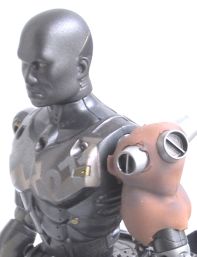
Back to the project itself, upper torso was from BBi cyborg Colossus; connection ring between the upper & lower torso is from the helmet ring of Cygirl Aurora, also by BBi. Originally it was planned to have a 4-legged spider type layout, but finding suitable parts proved to be a head-scratching dilemma until one day I spotted Mcfarlane Toys’s Matrix Reloaded Sentinel deluxe box set at a local comic shop. From the first sight, sentinel’s body seemed could be a nice alternative to the lower half of Talo-C. As usual, bought it first then figured out what to do next.
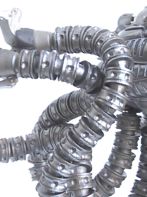
First step is to pull out and shortened all tentacles, then cut off all the attachment points on the back of the Sentinel.

Next was to add junk parts from other kits onto the body to create unique features. These junk parts mainly came from other scifi, and motocycle scale model kits. The “Shell” on left arm was cut from the arm of another vinyl figure. Hollowed out then added junk parts, and finally wore it onto the shoulder.
Now comes another head-scratching part: How to link up the upper/lower torsos via the connection ring? The solution is using the legs & waist section of an animation mecha. The mecha’s “toes” would clamp on the ring, and the waist would connect to Sentinel’s back side via brass tube.
Finally, I re-attached the modified tentacles to the nozzle-like openings located on the underside of the body.
To see more of Leo Lin’s sci-fantastical works, please visit his Gaia-Gear Orbital Research Complex <http://members.rogers.com/gaiagear/main.htm>
Also see: Gaia-Gear’s bio.
About this Magazine (Masthead)
Planet Magazine, Vol. 11, No. 1 (the 41st issue)
10th Anniversary Issue!
Home Site: http://www.planetmag.com
Mirror Site: http://www.etext.org/Zines/planet
Lord Wizard
Andrew G. McCann
editor@planetmag.com
Exalted Ornamentalist
Romeo Esparrago
Royal Scrivener and Staff Robot
Ray Dangel
Bard of the Empire
Tom Wagner
What In The World Is Planet Magazine?
Planet Magazine is the free, award-winning quarterly Web-zine of short science fiction and fantasy by emerging writers and digital artists, whom we hope to encourage in their pursuit of the perfect tale or illustration. There could be other reasons we’re doing this, of course, motivations that are obscure and uncomfortable; instincts linked perhaps to primal, nonreasoning urges regarding power and procreation — the very same forces, no doubt, that sank the Atlanteans and their alabaster-towered oceanic empire. And the Dark Gods laffed.
Planet has been available electronically via the Worldwide Web and Tin-Foil-Hat Receptron since its January-March 1994 debut issue. Total circulation is “thousands ‘n’ thousands” per issue worldwide. Feel free to download this zine or make a single printout, as long as you don’t charge for it or alter it in any way. That would be illegal and, quite frankly, “not nice.” Submissions are welcomed (see below). Planet does not carry advertising or offer a subscription service, but issues are always available at our Web site, with new ones published every March 1, June 1, September 1, or December 1 (or thereabouts). Letters to the editor are encouraged and are likely to be printed.
Guidelines For Submissions
Planet accepts original, unpublished, short science fiction and fantasy stories and poems, as well as digital art, from anyone famous or unfamous (use the lengths in any recent issue as a guideline). We are open to the experimental but will not publish anything we judge to be porno, gore, or in violation (as far as we are able to tell) of any copyrights (such as stories that use Star Trek, Star Wars, or Hello Kitty! characters). Since Planet is free and carries no ads, we can’t pay anything except the spirit-sustaining currency of free publicity and life-enhancing good vibes. For full details on submitting stories, poems, or artwork, please visit:
http://www.planetmag.com/submit.htm.
* E-mail text submissions as plain, unformatted files (either as an e-mail attachment or, if short enough, in the body of the e-mail message) to editor@planetmag.com. One submission at a time, please. Two submissions max.
* E-mail illustration submissions separately as e-mail attachments, but compress them first using StuffIt, WinZip, or PKZip. Alternatively, you could send the URL for an image. Images should be 256-color, 16-color, 16-gray, or B&W GIFs or JPEGs only. Send any questions about illustrations to editor@planetmag.com.
Distribution Sites
Planet Magazine is distributed only in Web (HTML) format, which can be read best with any Web browser, such as Netscape Navigator, Internet Explorer, Opera, Safari, iCab, or OmniWeb. Earlier issues of Planet are also available at our Web site in four other electronic formats: text (.txt) for any PC or Mac word-processing program; Acrobat (.pdf), a full-color version for PC or Mac using the free Acrobat Reader); DocMaker, a full-color, self-running file with sounds for Mac only; and Palm (.prc), a text version that requires a Palm PDA and a DOC reader like the freeware CSpotRun or PalmReader. The main place to find Planet is on the Web, either at our home page http://www.planetmag.com or our mirror site at http://www.etext.org/Zines/planet.
Copyrights & Disclaimers
Planet Magazine as a whole, including all text, design, and illustrations, is copyright © 2003 by Andrew G. McCann. However, all individual stories and poems in this magazine are copyright © 2003 by their respective authors or artists, who have granted Planet Magazine the right to use these works for this issue in both electronic form and any resulting print-outs by readers for noncommercial, individual use. All people and events portrayed in this magazine are entirely fictitious and bear no resemblance to actual people or events. This publication, along with every past issue of Planet Magazine, is registered with the Copyright Office of the U.S. Library of Congress. Since our first issue, dated January 1994, Planet Magazine has been freely available via the Internet; a trademark for the name “Planet Magazine” is pending. You may freely distribute this magazine electronically on a noncommercial, nonprofit basis to anyone and print one copy for your personal use, but you may not alter or excerpt Planet in any way without direct, written permission from the publisher, who can be contacted at editor@planetmag.com. Any unauthorized access, reproduction, or transmission of Planet Magazine, in whole or part, is strictly prohibited by U.S. federal law and international copyright law. Planet Magazine is published by Cranberry Street Press, Garden City, N.Y., USA, Andrew G. McCann, publisher.
Colophon
This issue was created with Macromedia Dreamweaver 4.1. The Planet Magazine logo was designed by Romeo A. Esparrago, Jr., using “Startling” by Dave Bastian, at http://www.davebastian.com/. (Previous logotypes were in Arquitectura and Times New Roman). The text typeface is Arial, and in some older issues Helvetica or Geneva. Please visit the guest artists’ Web pages to learn about the tools they used for their illustrations. Each issue of Planet Magazine is pre-read to make it easier for you to digest!
Planet Magazine ISSN: 1526-1840
“Planet Magazine” is registered with the U.S. Copyright Office
Previous issues of Planet Magazine hosted by:

