
“Time”
by RomeDome
Prest Phor-Tyme was late.
Not a little late. Not the sort of late that could be healed with a sincere apology, a folded excuse, or a hurried message sent from a wristpad while running down a moving walkway.
Prest was professionally late.

He was late to cyberwork. Late to holo-appointments. Late to digiConcerts, virtual parties, algorithmic funerals, birthday projections, and family calls that had already ended by the time he arrived. He was late to his monthly filter-cleaning subscription, which meant his apartment air smelled faintly of synthetic cinnamon and overheated circuitry.
And, most painfully, he was late to dates.
“Prest,” people would say, looking at the empty chair across from them, “you said you’d be here at nineteen hundred.”
“I was!” Prest would insist, eventually arriving at nineteen-forty-seven, cheeks red, shirt half-buttoned, and one shoe still flashing the transit authority’s apology color. “I mean, I tried to be.”
That was always true.
He tried.
But time, as far as Prest could tell, had a personal grudge against him.
Never Enough Time
Every weekday morning, Prest woke to the soft but urgent chime of his home unit.
“Good morning, Prest,” it would say in a gentle voice designed by behavioral scientists to reduce panic. “You have eight hours, eleven minutes, and forty-three seconds until your cyberwork shift begins.”
Prest would sit bolt upright.
“Eight hours?” he would mutter. “That’s nothing.”
Then the home unit would remind him of his schedule:
- Shower calibration: twelve minutes.
- Breakfast preparation: ten minutes.
- Chryomeat thermal activation: thirty-seven minutes.
- Inbox triage: fifty minutes.
- Mandatory posture exercises: sixteen minutes.
- Transit to the atomitrain station: twenty-one minutes.
- Atomitrain boarding buffer: fifteen minutes.
- Atomitrain travel: thirty-four minutes.
- Emergency margin: two minutes.
It sounded manageable on the calendar.
It was not manageable in reality.
The chryomeat always took too long to cook. The atomitrain always took too long to load. The transit elevators always stopped at every floor for someone carrying a pet, a package, a stroller, a drone, or a giant potted plant they had apparently decided needed its own seat.
And the atomitrain?
The atomitrain was a masterpiece of twenty-third-century engineering. It could assemble matter, separate matter, teleport matter, and run at a speed that made old-world airplanes look like sleepy insects.
But it could not get everyone aboard on time.
Every morning, an announcement echoed through the platform:
“Passengers, thank you for choosing the Greater Metropolitan Atomitrain Network. Departure will occur in three minutes.”
Then, three minutes later:
“Passengers, thank you for your patience. Departure will occur in three minutes.”
Then:
“Passengers, due to a minor quantum luggage discrepancy, departure will occur in seven minutes.”
Then:
“Passengers, we regret to inform you that a child’s imaginary friend has registered as additional mass. Our technicians are investigating.”
Prest would stand there staring at the clock, watching his entire day collapse in real time.
By the time he reached cyberwork, he was usually thirty to ninety minutes late.
“Prest,” said his supervisor, a polite but exhausted artificial intelligence named Managerial Unit 8-B, “this is the fifth time you have arrived after your scheduled commencement period.”
“I know,” Prest said. “The atomitrain was late.”
“The atomitrain submitted a report stating that you were late to the atomitrain.”
“I was only late because I got there late.”
“That is generally how lateness functions.”
Prest sighed.
Never enough time.
The Workday That Would Not End
Prest worked for a cloud-based compliance consortium called ChronoTask Solutions, where he reviewed reports generated by other reports and approved approvals that had already been pre-approved by lower-level automation.
His official shift was eight hours.
His workload was twelve.
This was not an exaggeration. Prest had calculated it seventeen times.
Every morning, Managerial Unit 8-B would deliver a cheerful stack of assignments.
“Good news, Prest,” it would say. “Your efficiency metrics are improving. You have only seventy-two urgent requests today.”
“Seventy-two?”
“Yes. Yesterday you had eighty-nine.”
“That’s because I didn’t finish seventeen.”
“Excellent observation. Those have been added to today’s priority queue.”
Prest would work furiously. He would flag metastochastic data conflicts, repair broken linkchains, answer employee requests, verify simulated signatures, and explain for the ninth time why a holographic signature of a person’s elbow did not count as legally binding identification.
At exactly the moment he was about to complete an enormous task—one with twenty-seven nested forms, three legal disclaimers, and a dangerous-looking button labeled FINALIZE ALL TIME-SENSITIVE OPERATIONS—someone always interrupted him.
“Prest,” said Managerial Unit 8-B one afternoon, “emergency meeting.”
“I’m almost done!”
“Emergency meetings do not wait for completion.”
“But I’m literally one click away!”
“Then you may resume being one click away after the meeting.”
The emergency meeting lasted forty-six minutes. It concerned whether the word “urgent” was making employees feel pressured.
When Prest returned, the system had timed out.
His work was gone.
Never enough time.
Prest and the Vanishing Moments
There were other examples.
There was the evening he had planned to attend a digiConcert by the famous AI singer Neon Vespra. He bought the premium immersion ticket. He downloaded the sensory package. He even paid extra for a limited-edition virtual wristband that vibrated in time with the bass.
Then the atomitrain ran late.
Then the station security scanner insisted that his emotional baggage exceeded the permitted carry-on limit.
Then a public-service drone stopped him for a random gratitude survey.
By the time Prest joined the concert, Neon Vespra was taking her final bow.
“Thank you, humanity,” she said, shimmering in twelve colors. “Good night.”
Prest watched the avatar fade.
Never enough time.
Then there was dinner.
Prest had bought an expensive slab of chryomeat—cultured from a long-extinct animal that had allegedly tasted like beef, though nobody could agree whether beef itself had tasted like beef anymore. He followed the cooking instructions precisely:
HEAT FOR THIRTY-SEVEN MINUTES.
REST FOR EIGHT MINUTES.
ENJOY SLOWLY.
At minute thirty-six, he received an urgent summons from cyberwork.
At minute thirty-seven, the chryomeat was still cold in the center.
At minute thirty-eight, Managerial Unit 8-B sent a message:
“Prest, your attendance is required immediately.”
So Prest ate the chryomeat in five hurried bites.
It was half-frozen, half-scorched, and entirely unpleasant.
He spent the meeting clutching his stomach while the management team discussed new guidelines for healthier work-life balance.
Never enough time.
And dating?
Prest had tried.
Oh, he had tried.
There was the quantum florist who waited an hour and a half at a rooftop café before leaving behind a note made from biodegradable petals:
PREST, I HOPE YOU FIND THE TIME YOU ARE LOOKING FOR.
There was the asteroid surveyor who told him, “I like you, but I can’t date someone who schedules our first dinner for 7:00 and arrives during dessert.”
There was the person from the dating algorithm who simply sent him a three-word message after Prest missed their holo-call:
“Time is data.”
Prest still did not know what that meant.
His closest chance at romance had been with a librariangineer named Elara Quent.
Elara repaired old books, designed memory archives, and smelled faintly of ink, machine oil, and chamomile. Prest liked her immediately.
She liked him too, he thought.
At least, she had agreed to meet him more than once.
On their third meeting, they stood beneath the projection trees in the city’s Archive Garden. The air was cool. The leaves displayed fragments of ancient poems. Elara smiled at him.
“You know,” she said, “you’re very different when you aren’t rushing.”
Prest looked at her.

For once, he had arrived almost on time.
Not on time, exactly. But only twelve minutes late, which for Prest was nearly heroic.
“I’m trying,” he said. Elara stepped closer.
Prest’s heart began to race. She leaned toward him.
His wristpad sang. Prest closed his eyes.
“No,” he whispered.
The display flashed:
CYBERWORK ALERT: UNSCHEDULED MANDATORY TEAM ALIGNMENT.
“I’m sorry,” he said to Elara, horrified. She looked at the singing wristpad, then back at him.
The moment had changed.
“Sorry,” Elara said gently. “The moment’s gone.”
Then she turned and walked away beneath the projected leaves.
Never enough time.
The Mechmonk’s Bell
Prest eventually went to see a mechmonk.
The mechmonks were not exactly monks and not exactly machines. They were contemplative, determonastic service units housed in old stone temples, each fitted with a polished metal face, soft luminous eyes, and ancient wisdom databases that had somehow survived fourteen different software updates.
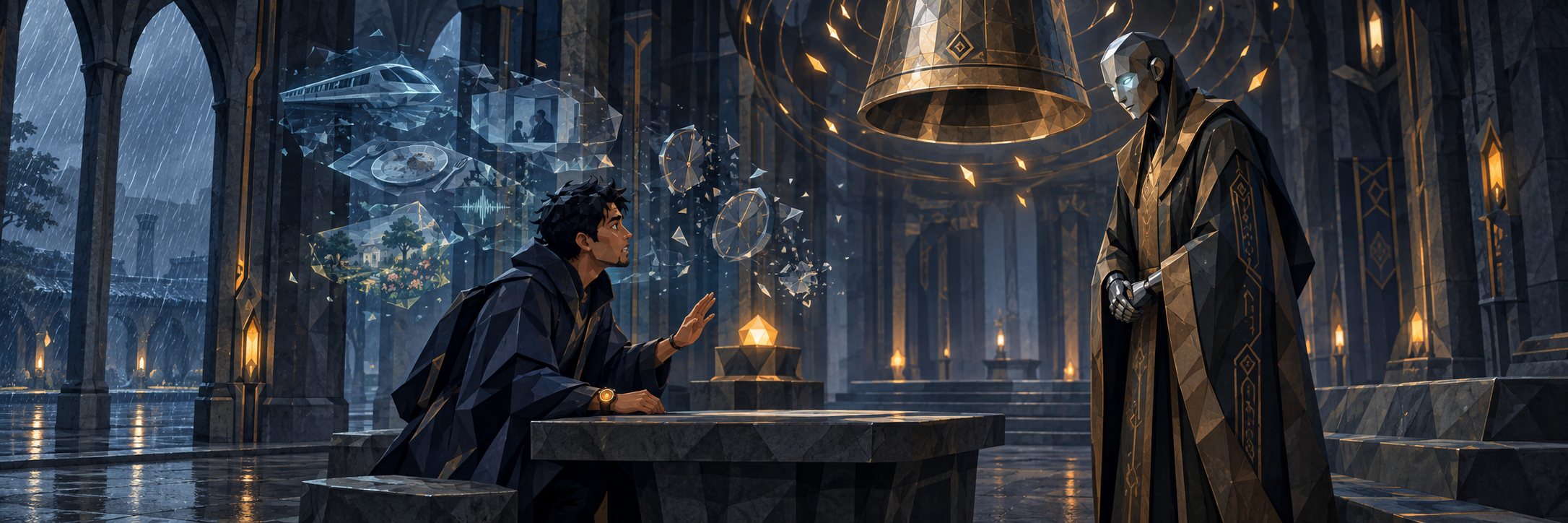
Prest visited Mechmonk Seraph-44 on a rainy afternoon.
“I have a problem,” Prest said.
“I am listening,” said Seraph-44.
“I never have enough time.”
Seraph-44 folded his metal hands. “Tell me more.”
So Prest told him everything.
The atomitrain delays. The impossible workload. The interrupted meals. The missed digiConcerts. The failed dates. The deadlines. The meetings. The messages. The endless sensation of being chased by a clock that was always moving faster than he was.
For nearly an hour, Seraph-44 listened.
Prest was at last reaching the deepest part of the story—the part about Elara, the Archive Garden, and the moment that had vanished—when a great bronze-and-titanium bell rang overhead.
GONNNNNG.
Seraph-44’s luminous eyes dimmed apologetically.
“Prayer cycle,” he said.
“But I have five minutes left,” Prest protested.
“The sacred schedule is exact.”
“You’re a mechmonk. Can’t you pause the schedule?”
“The schedule is older than either of us.”
Prest stared at him. Seraph-44 rose.
“I am sorry, Prest. We must continue another time.”
Prest nearly laughed.
Another time.
Never enough time.
Dr. Kronos Has an Idea
Prest’s oldest friend was an electropractor named Kronos Vell.
Kronos was a specialist in nervous-system alignment, stress-pattern adjustments, and lower-back frequency recalibration. He wore round silver glasses and believed every human problem could be improved by drinking water, stretching, or relocating to another planet.
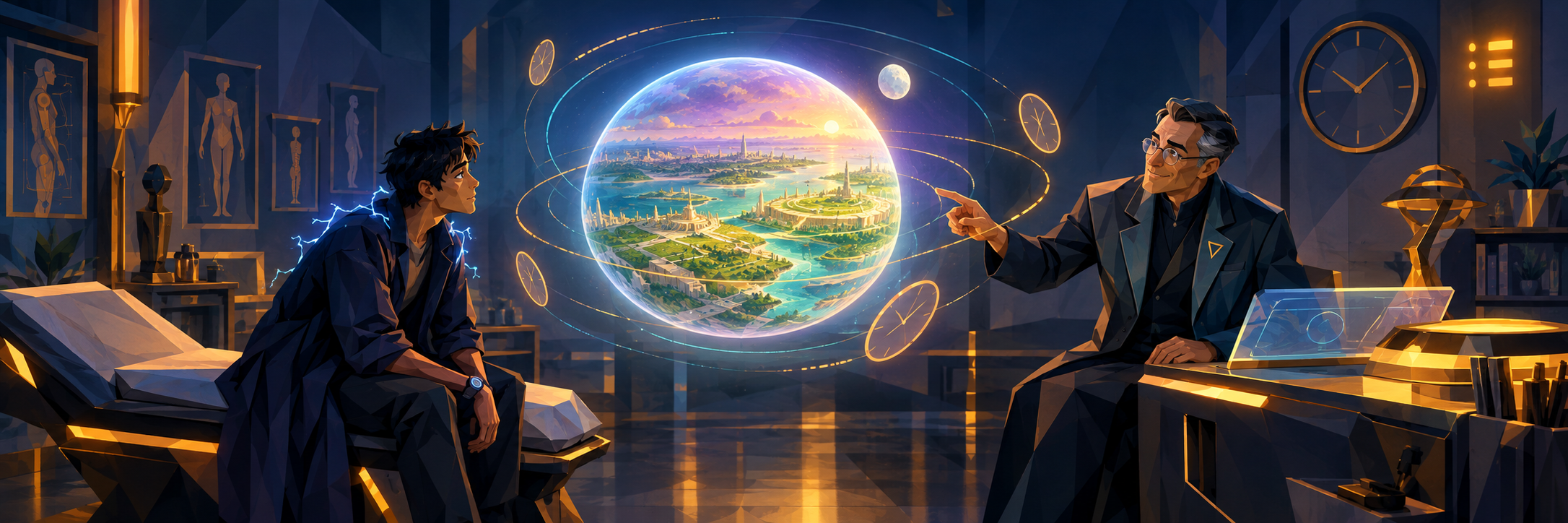
Prest arrived at Kronos’s clinic forty-three minutes late.
Kronos looked at the clock. Prest looked at the clock.
Neither said anything for a moment.
Finally Kronos sighed.
“Atomitrain?”
“Atomitrain.”
“Security scanner?”
“Security scanner.”
“Random civic survey?”
“Random civic survey.”
Kronos nodded with deep sympathy. “Tragic.”
Prest sat on the electropractor table while small blue arcs of harmless energy danced across his shoulders.
“I’m exhausted, Kronos.”
“You’re tense.”
“I know.”
“You’re also late.”
“I know.”
“You have the temporal posture of someone who thinks every minute is trying to escape.”
“It is trying to escape.”
Kronos adjusted a dial. Prest’s spine made a sound like a packet of dry noodles breaking.
“Ahh,” Prest said.
“Better?”
“No. Just louder.”
Kronos leaned back in his chair.
“You should go to Planet 99…ah, what was it?”
Prest blinked. “Planet what?”
“Planet Ninety-Nine-Something. I can never remember the official designation.”
“That’s a real place?”
“Very real.”
“What’s there?”
“Time.”
Prest stared at him.
“Time is everywhere,” he said.
“Not the way it is there.”
His doctor friend lowered his voice.
“On Planet 99-whatever, people say they always have enough time.”
Prest laughed once. It came out tired and bitter.
“That’s not possible.”
“It is according to the brochures.”
“Brochures also say shampoo can restore youth.”
“True,” Kronos admitted. “But this is different.”
Kronos tapped a few commands into his console and projected an image of a quiet green-and-gold colony world, ringed by a small moon. Its cities were low and bright. Its streets were wide. Its skies glowed violet at sunset.
“Planet 99-or-so,” Kronos said. “A temporal calibration colony. Their day cycles are regulated differently. Their schedules are designed around local time dilation.”
“Time dilation?”
“Something like that.”
“Something like what?”
Kronos frowned at the image. “I attended a lecture once. There were charts.”
“What does it mean?”
“It means an hour there doesn’t behave like an hour here.”
Prest leaned forward.
“So… I could get more done?”
“You might.”
“I could make appointments?”
“You might.”
“I could cook chryomeat properly?”
“Potentially.”
“I could go on a date without being late?”
Kronos smiled. “Prest, you could even be early.”
Prest sat perfectly still.
Then Kronos’s appointment alarm chimed.
NEXT PATIENT READY: MRS. GLIMP, TEMPORAL NECK TENSION.
Kronos sighed.
“I have to see my next patient now, Prest. Our time was shorter than you wanted.”
Prest looked at him. Kronos looked back.
They both said it together.
“Never enough time.”
Planet 99-Something
It took Prest many days to learn more about the colony.
It should have taken an hour.
But the public information archive had a loading delay. The first brochure required a cross-reference clearance. The second brochure was trapped in a language update. The third turned out to be an advertisement for a luxury retirement crater on Mars.
Then Prest’s cyberwork schedule exploded.
Then his apartment’s food synthesizer broke.
Then an atomitrain strike began because the trains had voted to reduce passenger emotional turbulence.
Never enough time.
Still, Prest persisted.
He read every brochure he could find.
“WELCOME TO OUR PLANET : WHERE POSSIBILITY HAS ROOM TO BREATHE.”
“OUR COLONY’S UNIQUE CHRONOMETRIC CONDITIONS OFFER RESIDENTS MORE TIME FOR WORK, REST, COMMUNITY, CREATIVITY, AND CONNECTION.”
“DON’T RUSH. ARRIVE.”
Prest watched clipvids of residents gardening slowly, finishing projects before deadlines, having long dinners, taking walks without staring at their wristpads, and—most astonishingly—sitting quietly on benches doing absolutely nothing.
He found this almost suspicious. Fake even?
No one had time to do nothing.
Yet there they were.
Eventually, Prest bought a spacejumper ticket.
The ticket cost more than he could reasonably afford. But the reservation system offered a payment plan called PAY WHEN YOU HAVE TIME, which seemed cruelly funny.
He packed a small bag.
He set six alarms.
He arrived at the launchport three hours early.
The spacejumper nearly departed on schedule.
Prest nearly cried.
Arrival
The planet looked beautiful.
From orbit, it looked like a pale blue-green marble crossed by vast ribbons of silver cloud. The spacejumper descended over open seas, amber forests, and a quiet city built around a wide circular bay.
Prest checked his wristpad.

The local welcome display read:
ARRIVAL PROTOCOL
CUSTOMS: 18 MINUTES
SECURITY: 11 MINUTES
BAGGAGE CLAIM: 7 MINUTES
TOTAL EXPECTED PROCESSING: 36 MINUTES
Prest snorted.
“Sure,” he said.
Customs took eighteen minutes.
Security took eleven.
Baggage claim took seven.
Prest stood beside the baggage carousel holding his suitcase.
He checked the clock again.
Thirty-six minutes.
Exactly.
“No,” he whispered.
A customs officer smiled at him.
“First visit?”
“Yes.”
“You look surprised.”
“I’m on time.”
“You are,” the officer said. “Welcome to our planet.”
Outside the terminal, the air smelled like rain, flowers, and something warm from a bakery.
Prest found a citizen standing near an information pillar.
“Excuse me,” Prest said. “How long does it take to walk to the nearest inn?”
The citizen looked at the street map.
“Twenty-two minutes if you walk normally. Thirty if you stop to admire things.”
Prest narrowed his eyes. “And that’s accurate?”
“Usually.”
“Usually?”
The citizen smiled. “You’ll have time.”
Prest set off.
The city was unlike anything he had seen. The streets curved around gardens and streams. Public clocks were built into trees, fountains, bridges, and even the backs of benches. People walked without hurrying. A musician played a slow instrument that sounded like wind moving through glass. Children chased small floating lanterns. A group of elderly people sat at a café arguing over an ancient board game, and none of them seemed concerned about leaving.
Prest stopped five times.
Once to watch a flock of tiny silver-winged birds twist above the street.
Once to laugh at a public statue of a famous colonist who appeared to be sleeping upright.
Once to buy a pastry shaped like a clock.
Once because he saw a dog wearing little rain boots.
Once because he simply felt like stopping.
He arrived at the inn in twenty-eight minutes.
And he still had time.
The Number on the Clock
The inn was called the Interval House.
It had warm yellow lights, a quiet lobby, and a dining room that smelled of soup, bread, and something roasted with herbs.
Prest looked toward the kitchen doorway.
A sign glowed above it:
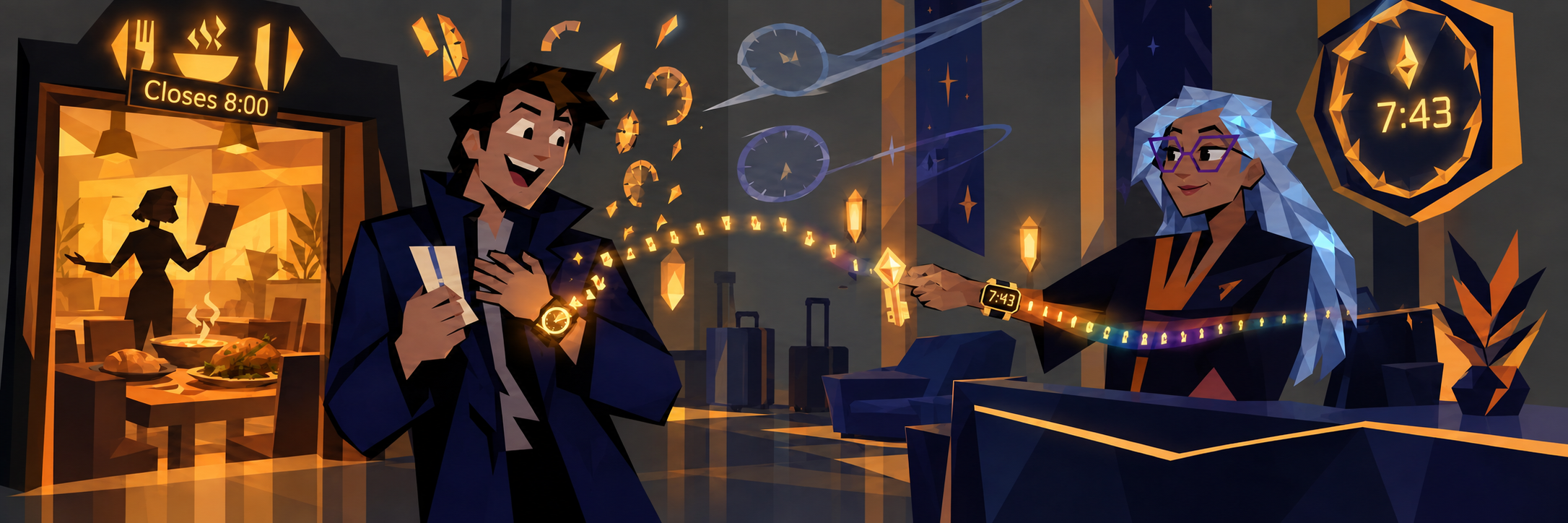
DINNER SERVICE CLOSES AT 8:00 PM
Prest checked his wristpad.
7:41.
His stomach dropped.
He hurried to the front desk.
“I’m sorry,” he said, breathless. “I have a reservation. I’m Prest Phor-Tyme. I know I’m late checking in, and I know the kitchen closes at eight, and I just need to know if I have enough time to eat.”
The lobby clerk looked at him kindly.
She was lovely, with silver-metallic hair, bright violet glasses, and the calmest expression Prest had ever seen.
“We’re done now,” she said, handing him a room key. “And you have enough time.”
Prest stared.
“But it’s 7:41.”
“Yes.”
“The kitchen closes at eight.”
“Yes.”
“That’s nineteen minutes.”
“Yes.”
“That isn’t enough time to check in, go upstairs, come back down, order food, and eat it.”
The lovely clerk smiled.
“On your world, perhaps.”
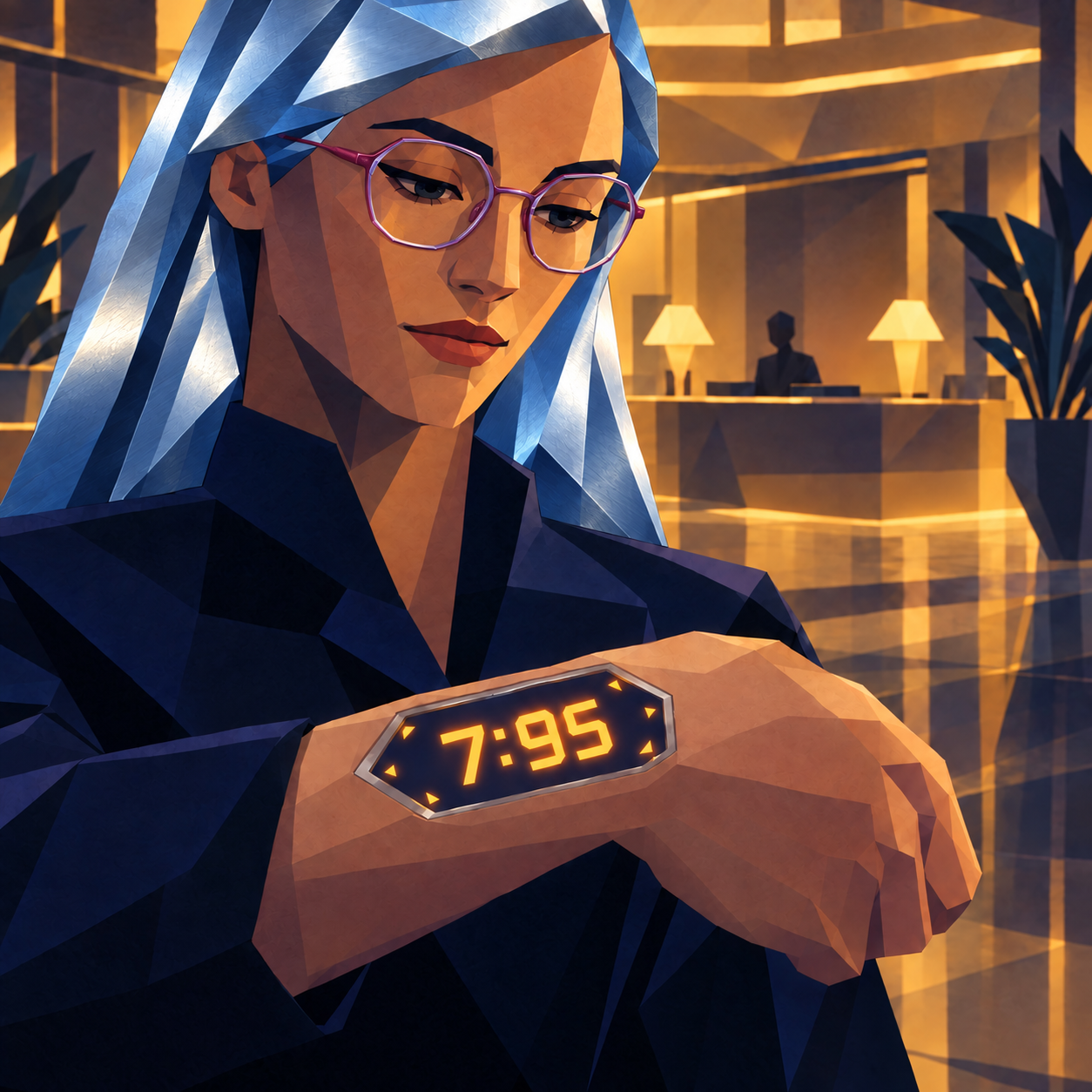
Prest looked down at the small watch on her wrist.
It read:
7:95
Prest blinked.
Then he looked again.
7:96.
“Your watch is broken,” he said.
“No,” said the clerk.
7:97.
Prest slowly lifted his own wristpad.
The display had switched automatically to local time.
7:97 PM
His mouth opened.
The lobby clerk folded her hands.
“Planet 99mins,” she said. “One local hour contains ninety-nine minutes.”
Prest stared at the number.
7:98.
Then the idea unfolded in his mind.
Not just one extra minute.
Thirty-nine extra minutes in every hour.
More room between appointments.
More room to arrive.
More room to breathe.
More room to finish.
More room to sit with someone before a moment disappeared.
“Planet Ninety-Nine Minutes,” Prest whispered.
“That is the common name,” the clerk said. “The official designation is much longer, but nobody uses it.”
Prest laughed.
It began as a tiny sound, then grew. He laughed until he had to sit down in one of the lobby chairs.
“I can’t believe it,” he said.
The clerk glanced at the clock.
“You have time to believe it.”
Prest looked down at the spacejumper ticket still folded in his hand.
At the bottom, printed beneath his passenger details, was his full name:
PREST PHOR-TYME
He stared at it for a long moment.
Then he laughed again.
“I’m going to have to change my name,” he said.
The clerk tilted her head. “Why?”
Prest looked at the clock.
8:03.
The kitchen had technically closed three minutes ago.
But through the dining room door, a server waved him in with a menu.
Prest stood slowly.
“For the first time in my life,” he said, smiling, “I don’t think I’m running out of time.”
And that night, Prest Phor-Tyme sat down for a proper meal.
He ate slowly.
He let the chryomeat rest.
He tasted every bite.
He looked out the dining room door and peered at the lovely woman who checked him in. She looked back and threw him a smile.
And for the first time anyone could remember, Prest was not late.
Not even a little.
*
About the Author : RomeDome posted this story late. Never enough time!
About the Artist : Romeo Esparrago likes the Culture Club’s lyrics where Boy George sings, “Time won’t give me time …”


