
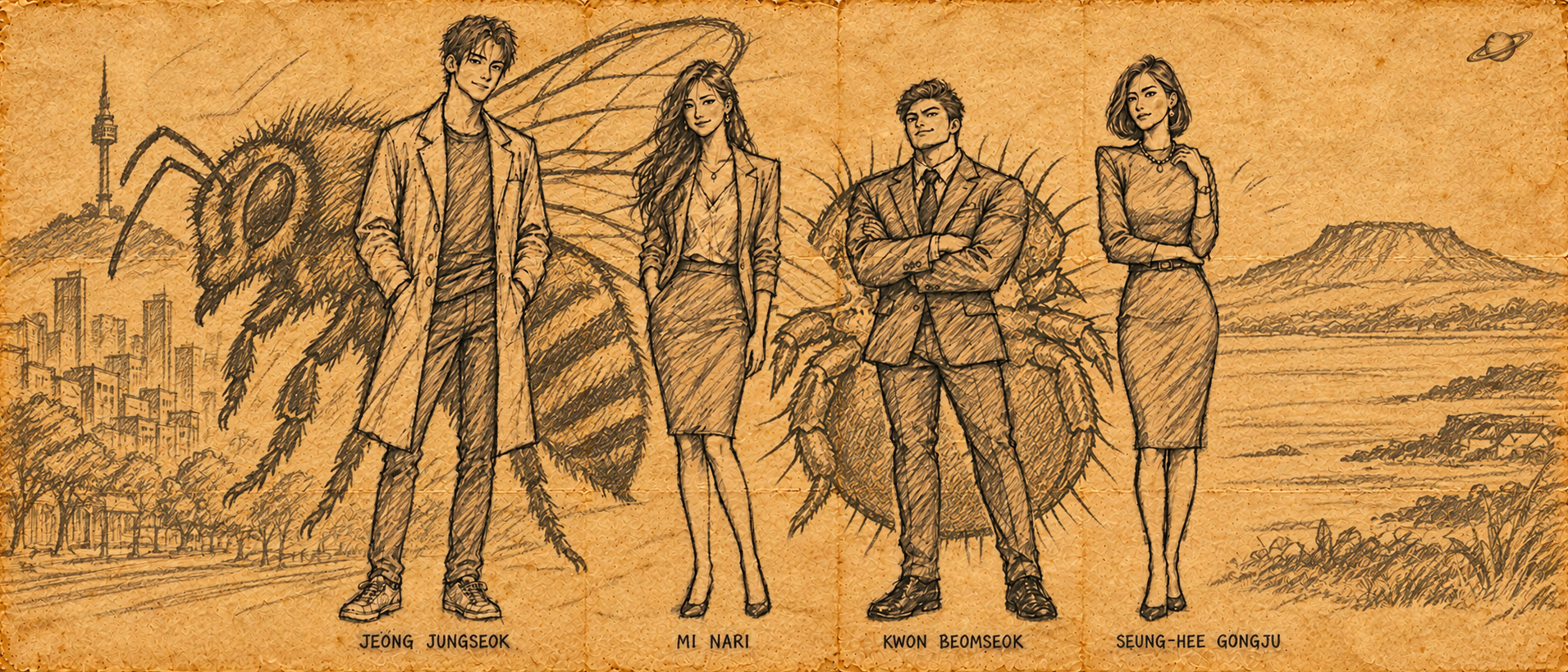
A science-grounded supernatural Korean-Drama romantic comedy from Romeo Esparrago.
An Uncontrolled Encounter.
Chapter One | Seoul, South Korea, March 2028.
The morning’s meeting started with a peculiar, polished hostility in a room in which everyone was waiting for Mi Nari to approve something they knew she should not approve. Maybe because Mi Nari had not had breakfast yet and she was not happy with the word ERADICATE she was looking at on the screen.
“Reduce,” she said. She tapped the screen with the end of her pen. “You can say ‘reduce.’ You may even have ‘substantially reduce’ when Dr. Han gives you evidence. You may not have ‘eradicate.’”
The communications director looked toward Kwon Beomseok. Nari watched him do it and decided that, after breakfast, she would become angry about that too.
Her fiancé stood by the window in a dark suit fitted closely across his shoulders. His tie clip was straight; his hair had apparently signed an agreement never to move without authorization. He wore the expression with which he could soothe a board, charm a journalist, or persuade her that one more postponed experiment was an act of scientific integrity.
“Nari is right,” he said. “Our ambition must not outrun our discipline.”
He said her name gently. It settled the room while making her correction sound like something he had generously permitted.
On the table, her phone lit up. Her mother wanted to know whether October remained possible.
October was possible as a month. Nari was less certain about it as a wedding.
She turned the phone over and asked for the beekeeper’s video.
Ko Haejin appeared on the screen wearing a faded hat and holding a hive frame. There was no dramatic music, only wind against the microphone and an impatient man somewhere off camera asking where she had put a lid.
“The colony looked busy,” Haejin said. “That’s what I want you to understand. You stand outside and see bees going in and out, and you think there are plenty. Then you open it.”
She angled the frame toward the camera. Nari leaned forward.
Haejin did not tell them that the island would starve. She told them what she had paid for replacement stock, what she had promised a grower, and how often she now visited the Apis mellifera colonies that had once demanded less of her time.
“Don’t send me another promise,” she said. “Send something I can test.”
The clip ended on a close view of her glove, enormous against the bees.
For a moment nobody suggested a different adjective.
Nari was thirty-three and had inherited enough authority to be blamed for using it, but not enough to use it without explanation. Daeji Group owned businesses that sold seeds, equipment, crop advice, laboratory services, and several kinds of assurance. The anti-Varroa program was the first substantial undertaking for which she had insisted that assurance was not a deliverable.
It had also become very expensive.
The first apiary she had visited on Daeji business had belonged to a supplier who assumed she wanted photographs. He had wiped the dust from a hive lid and asked where she would like to stand. When she asked instead to see his invoices, his wife brought a box from the kitchen and stayed beside her while she read.
Nari remembered the wife more clearly than the bees. The woman had corrected three entries in her husband’s account without embarrassing him, then explained which replacement expenses they could postpone and which would arrive whether there was money or not.
On the drive back, Nari had tried to fit their lives into the risk categories in Daeji’s report. The categories had room for interrupted supply, lower yields, and reduced margins. They had no space for the way the woman had rested a hand on the box before allowing a stranger to open it.
Nari had funded the preliminary research the following week. She still disliked people calling it her passion, as though a practical problem became less practical when she cared about the people who had it.
“Tell me we are still on schedule,” she said to Beomseok after the others left.
He came around the table and took her pen from her hand. “The revised schedule.”
“That sentence has its own revised schedule.”
He smiled. Up close, his face had the rugged symmetry that made photographers behave as though they had discovered it personally. “We are testing a delivery system, not making a soft drink. You chose a difficult problem.”
“I chose it before I became engaged to the person who keeps telling me that.”
He touched the inside of her wrist. It was a small gesture, familiar enough to lower her guard before she had decided whether it should.
“Come to dinner tonight,” he said. “At my place. No graphs.”
She pictured his rooms at SIGNIEL, the wine already breathing, the meal arriving at precisely the moment a conversation might become uncomfortable. He remembered what she liked. He remembered everything.
“I have the financing committee.”
“Afterward, then. Your mother called.”
Nari withdrew her hand to collect her tablet. “Of course she did.”
By eleven she had escaped the building on the pretext of inspecting an office renovation. Her driver waited where she had asked him to wait, giving her the five minutes of walking she had negotiated as though it were a foreign concession.
The café was crowded. She left carrying coffee in one hand and her tablet in the other, thinking about an image of a beekeeper’s glove.
At the door, she and a server carrying a tray both stepped aside in the same direction.
“Jeogiyo,” she said.
“Excuse me,” he answered, stopping so she could pass. She gave him a quick, grateful bow of her head.

The man outside was looking backward when he collided with her.
Coffee struck his sleeve. A thick book hit the pavement with the sound of an object whose owner could not easily afford another. Nari’s tablet survived because she had spent years catching things before other people noticed they had fallen.
“I’m sorry.” He was already crouching. “That was entirely my fault. There was a delivery man scooter.”
There was, in fact, a delivery scooter. Its helmeted rider called an apology without slowing.
Nari crouched to retrieve a loose sheet from the book. She saw a photograph of a bee and a reddish oval on its body, then reached for the same corner of paper as the stranger.
Their fingers touched.
He recoiled so violently that his shoulder struck the café door.
Nari looked at him. He looked at his hand, then at hers, with an expression too startled to be ordinary embarrassment.
“I apologize,” she said. “I generally require a meeting before electrocuting anyone.”
He laughed once, unwillingly. “Static.”
“You hit a glass door.”
“A substantial charge.”
He was tall, perhaps a head taller than she was in her low heels. Looking up, she saw his black hair falling across his forehead and a face whose attractiveness seemed to have been assembled without the severity of Beomseok’s. His jacket was clean and carefully repaired at one cuff. Under it he wore a black shirt and a thin silver chain.
He pushed his hair back. It fell forward again, and Nari found herself waiting for him to look up as she examined the loose, soft strands. She looked down first, annoyed to have made a decision about it.
The book had opened around a forest of penciled slips.
“Varroa?” she asked.
His expression changed. “Among other things.”
“A student?”
“Formerly.”
That answer usually ended a conversation. He said it as though it ought to be sufficient, then began arranging the damp papers in order.
Nari glanced at the title. “You carry this around for pleasure?”
“I was going to return it. The owner has become unreasonable about the meaning of ‘borrow.’”
“How unreasonable?”
“He says four years.”
She should have left. She was beginning to enjoy not leaving.
Her engagement ring had turned inward while she gathered the papers. She straightened it with her thumb, suddenly conscious of doing so. An attractive stranger was not an event. She encountered attractive people at dinners where even the mineral water had been chosen to impress her. Yet she was standing on a pavement considering another question because she wanted to hear what this particular man would do with it.
He glanced at her hand. She could not tell whether he had noticed the ring or was simply making sure she did not electrocute him again.
Her tablet woke against her arm. The rejected presentation appeared on its screen, bright enough for him to see the photograph and the heading beneath it.
He stopped collecting papers. “That graph is misleading.”
“It is also not intended for public viewing.”
“Then I’m relieved you didn’t pay for publicity.”
She turned the tablet toward herself. “What is misleading?”
He looked at her again, more carefully this time. “Are you asking because you want to know, or because I have made a professional error?”
“Both possibilities remain open.”
He pointed without touching the screen. “You have a colony claim underneath an adult-mortality assay. You may have reasons for showing them together, but the slide isn’t telling anyone what those reasons are.”
Nari studied him thoughtfully. “You don’t know what the treatment does.”
“No. That’s why I can’t tell you it works.”
She had spent the morning with people who knew considerably less and had said considerably more.
“Suppose its intended effect is on reproduction,” she said.
“Then I would want to know why you’re asking it to kill adults before lunch.”
He did not offer a solution. He asked about the comparison groups, the timing of observations, whether the formulation had reached the intended organism, and whether a result had been measured or merely inferred. When she could not answer a question, he did not fill the silence with his own certainty.
At last he glanced at his ruined sleeve.
“This is normally the part where the person whose coffee I spilled asks me to pay for it.”
“I spilled it on you.”
“An unusually equitable accident.”
She gave him her name. This time his surprise was entirely recognizable.
“Jeong Jungseok,” he said, standing straighter. “And I may have made several professional errors.”
“How old are you?”
“Twenty-eight.”
“And the former student part?”
His humor receded but did not become defensive. He had studied entomology and zoological biology, he said. A family injury had changed what his money was for. Then debt had changed what his time was for.
“I can give you the university record,” he added. “It ends before the degree.”
Nari considered the coffee stain, the repaired cuff, and the refusal to invent a credential.
Her scientific-office coordinator had resigned six weeks earlier after accepting a position with fewer emergencies. The remaining assistants were drowning in meetings whose technical content they could not evaluate.
“I have a vacancy,” she said. “Executive assistant, with research coordination. Paid probation. References checked.”
He looked at the building behind her, then back at her face. “Because I criticized your slide?”
“Because you stopped when you reached what you didn’t know.”
“I should warn you that I reach it frequently.”
“Then we will have something in common.”
She offered her business card. He accepted it carefully without touching her fingers, which annoyed her more than it should have.
“Can you manage a calendar?” she asked.
He looked down at the card and then up at her. The shy smile arrived slowly, as though he had decided to risk it.
“If it has a control group.”
The Assistant Variable
Chapter Two | March–April
Jungseok’s references arrived before his replacement jacket did.
The university confirmed his attendance and withdrawal. A former lecturer described him as brilliant, distractible, and chronically incapable of allowing an imprecise statement to pass unharmed. His last employer said he was reliable but had once reorganized the supply cupboard so comprehensively that nobody could find the biscuits.
“There was a map,” Jungseok said when Nari asked.
“The employer mentioned the map.”
“Was the map criticized?”
“The map required a legend.”
He accepted this as a reasonable concern and began work on Monday.
“Annyeonghaseyo,” he said, greeting her with a neat bow from the waist.
“Hello,” Nari replied, returning a smaller bow. “No maps this week.”
He looked as though she had removed one of the principal attractions of employment.
Nari gave him a desk outside her office, a list of permissions he did not have, and a literature folder large enough to make him happy. By Wednesday he had stopped calling every person who appeared older than him “Director,” and by Friday he had learned that Nari’s request for “a short answer” meant an answer shorter than the question.
His first scientific meeting did not go well.
Dr. Han Sora listened to his proposed summary of a delivery problem, then turned his own diagram around and placed her finger on an arrow.
“You’ve shown the material arriving here.”
“That’s the intended route,” he said.
“You’ve drawn an intention as an observation.”
He looked at the arrow for several seconds. “Yes. I have.”
Nari, who had expected a defense, watched him cross it out.
Sora was in her forties, wore her hair tied back with whatever elastic she could find, and distrusted presentations whose colors had been chosen before their measurements. Her laboratory had worked on the formulation before Beomseok arrived. She had also learned, under successive reorganizations, that scientific objections were more likely to survive when they came with a proposed schedule and a budget.
“Give me the revised version tomorrow,” she told him. “Separate what we know from what we want.”
He did. Nari found a copy on her desk with the uncertain arrow replaced by a question mark too large to overlook.
Beomseok called the revision promising.
He also began sending Jungseok recording files after six in the evening.
“Technical familiarity is useful,” he explained when Nari questioned the assignment. “Transcribing the meetings will help him understand the program’s history.”
It was a reasonable explanation. Almost everything Beomseok said was reasonable by itself.
Jungseok transcribed the meetings, then built a decision log linking each decision to its date, author, supporting experiment, and next scheduled observation. By the second week he could tell Nari exactly which deadline had been moved, who had approved the move, and how often the word “temporary” had appeared in its justification.
He did not call it an investigation. He called it the calendar.
“Why does Tuesday say ‘Meeting to Decide Whether to Schedule the Meeting’?” she asked.
“Because we have not yet decided whether to schedule the meeting.”
“And Wednesday?”
“That is the meeting.”
“Cancel Tuesday.”
“Without a meeting?”
She laughed in front of the open office door. Three people looked up, and Jungseok became absorbed in a calendar that no longer required his attention.
The name of the project bothered her less once he began calling everything by its actual name. Someone in branding had proposed Project Nari years before her appointment, and the name had persisted because nobody wanted to be the person who changed it.
“It sounds as though I’m being tested,” she told him.
“Would you prefer DAE-V1?”
“It sounds less personal.”
“It has not disappointed anyone personally yet.”
The jokes were inconvenient because they made her wait for the next one.
By the following week she knew the sound of his knock. This was information she had acquired without authorizing its collection. When someone else knocked in the same rhythm, she looked up too quickly and had to disguise her disappointment as interest in a ventilation invoice.
On Thursday she found herself checking her reflection in the dark strip beside her monitor before calling him in. She removed one earring, put it back, and became angry with both earrings.
“You asked for the afternoon schedule?” he said from the doorway.
“I have a gap at four.”
He checked his tablet. “Yes.”
“We could go over the digest.”
“We went over it at eleven.”
“There may be questions.”
“There were. You answered mine. It was an unsettling reversal.”
She almost laughed, then saw that he was waiting to learn whether she actually needed him. His time was not a private room she could book because she liked being in it.
“Leave the gap,” she said. “You have enough to do.”
“Shall I label it?”
“Certainly not. Someone will send an agenda.”
He smiled. At four she did her own reading, conscious of the empty chair opposite her and of how little credit she deserved for leaving it empty.
There were other inconveniences. He noticed when she stopped listening, and did not pretend a longer explanation would help. He moved difficult reading to the morning because she understood it faster then. Once, after she said she had already eaten, he silently turned over the untouched sandwich packet she had used to support her phone.
“That’s evidence tampering,” she told him.
“You could destroy it by eating.”
On a Friday she asked whether he could attend a weekend preparation session. She had asked it while reading something else, assuming the answer belonged to the same category as every other scheduling adjustment.
“Not Sunday,” he said. “I take my father to an appointment.”
She looked up. “Could someone else take him?”
“Not this one.”
For a moment she felt the impatience she ordinarily felt when a useful resource was unavailable. Then she saw him waiting, neither apologetic nor challenging, and became embarrassed by the word resource.
“Saturday, then,” she said. “Within your hours. Send me what you can finish.”
He nodded and returned to his desk. He did not thank her for allowing him a life, and by Monday she had become grateful that he had not.
He knew she disliked sweet coffee because he had seen her leave it unfinished, not because somebody had supplied a preference sheet. When she found that sheet in his induction materials, he had written beside “PREFERRED REFRESHMENTS”: Ask.
His own coffee contained enough sugar to make her question his judgment in other fields. She watched him empty a third packet into it.
“Is the coffee necessary?”
“For color.”
He drank it without looking ashamed. Nari returned to the preference sheet, then put it away. Consideration was, after all, part of an assistant’s job.
In early April the office prepared a short research presentation for visitors from the agricultural subsidiaries. A designer filled the wall screen with the underside of a female mite, enlarged until its reddish body and tucked limbs resembled an armored piece of machinery.
Beomseok stopped in the doorway.
“Not that image,” he said.
The designer reached for the controls. “Too unpleasant?”
“Unhelpful. Show the bee.”
Nari looked from him to the screen. “We are working on the mite.”
“We are protecting the bee. There is a difference in how one presents the mission.”
It was a valid point. She let the designer change the image.
Later, during a preparation visit to Sora’s laboratory, Beomseok asked a technician to move a labeled reference treatment out of his way rather than lift the sealed container himself. He was immaculate in a lab coat. Nari, whose own cuff had brushed against a marker board, assumed he was being careful.
Jungseok stood beside her without speaking. When she glanced at him, he was studying the space the container had occupied.
The subsidiary visitors arrived in rain.
Nari had been at a financing lunch and came back to find Beomseok waiting outside with a large black umbrella. He met her at the car, fitted his hand lightly around her wrist, and guided her to the dry side of the pavement.
“There,” he said. “You would have stepped in that.”
A shallow puddle reflected the entrance lights. Beyond it, the communications team was photographing the visitors.
Beomseok angled the umbrella above her auburn hair. The cameras clicked, and Nari smiled because failing to smile would create an entirely different photograph.
“You see?” he murmured. “Sometimes I am useful without a graph.”
She smiled properly then. He looked pleased in a way she wanted to trust. In a way she already liked.
Inside, she discovered Jungseok had not come in with the group.
He arrived several minutes later with rain darkening one shoulder. He carried a compact umbrella with a bent rib and a plastic bag containing a dry box of documents.
“What happened to the one from reception?” she asked.
“It developed a more urgent appointment.”
Through the glass she saw a courier crossing the forecourt under the reception umbrella. His delivery bag, previously open to the weather, was now covered.
“You could have taken another,” she said.
“I had this one.”
“It’s broken.”
He examined the rib as though she had made a surprising diagnosis. “Only in one direction.”
That afternoon, Beomseok greeted the eldest visiting director with a formal bow before taking his place beside the screen. He spoke about discipline and long-term testing. Jungseok stood at the back, damp at the shoulder, moving slides when asked.
Nari watched both men and disliked the comparison her mind had begun making without her permission.
It left out too much. It left out the night before her first board presentation as acting CEO, when Beomseok had found her in a service corridor with her speech in one hand and a glass of water she could not make herself drink in the other. She had been sick, then furious that she had been sick, then certain that everyone would know.
He had not told her she was magnificent. He had sat on the floor in his expensive suit and asked for the first sentence.
She had said it. He had asked for the next. By the third page she was correcting his deliberately foolish questions, and by the end she could drink the water. Later, when a director praised her composure, Beomseok had said nothing about the corridor. Not even to her mother.
There had been no photograph of that either.
She watched him now answering a visitor with one hand resting on the back of her chair. He had known her before she could do this without rehearsing. Jungseok knew a woman who already possessed the voice with which she corrected rooms.
Nari placed her hand briefly over Beomseok’s. He turned, surprised into a smile that made her glad she had done it. She kept her eyes away from the damp shoulder at the back of the room.
After the visitors left, she stayed to approve the summary. Beomseok leaned over the shared screen and removed an item from the next month’s schedule.
“The later sampling?” she asked.
“Deferred until we resolve the carrier issue.”
“Sora requested it.”
“And she will have it when the exposure data justify it. Otherwise we spend money interpreting noise.”
He changed the label to PENDING TECHNICAL REVIEW.
Jungseok, who was recording the decision at the end of the table, looked up. “Should I retain the original date in the log?”
Beomseok’s smile was almost immediate. “Of course. We have nothing to conceal.”
Nari approved the summary. That night, back at her leased floor in Grand Walkerhill, she opened the calendar and found the old date still there, neatly crossed through instead of erased.
For reasons she could not yet identify, the thin line across it troubled her more than an empty space would have.
Terms and Conditions
Chapter Three | April
The first time Beomseok had asked Nari to pretend to love him, he had brought a contract.
He was newly arrived from Hwangto Holdings, celebrated for his training and his decision to join a rival. She was newly installed as acting CEO and enduring speculation about whether the appointment would last longer than her next relationship.
A photograph of them leaving a reception had given the speculation a useful direction.
“Three months,” he had said, setting the document between them. “Public appearances we would both attend anyway. No interviews about the relationship. Either party can end the arrangement.”
She had been tired enough to find the proposal sensible.
“You’ve made dating sound like an equipment lease.”
“The equipment lease has a more punitive cancellation clause.”
He had made her laugh, which should not have counted as due diligence but had.
During their third arranged dinner, he told her he remembered meeting her as a child.
“The agricultural foundation picnic,” he said. “You refused to let a boy put a beetle in a bottle.”
Nari had stared. She remembered the bottle, a red tablecloth, and her father becoming impatient because they were late for a photograph.
“You were there?”
“You told him it needed air.”
She had told the story in an interview years later, but that fact had not occurred to her then. Instead she had felt the extraordinary relief of being remembered before she became something people wanted.
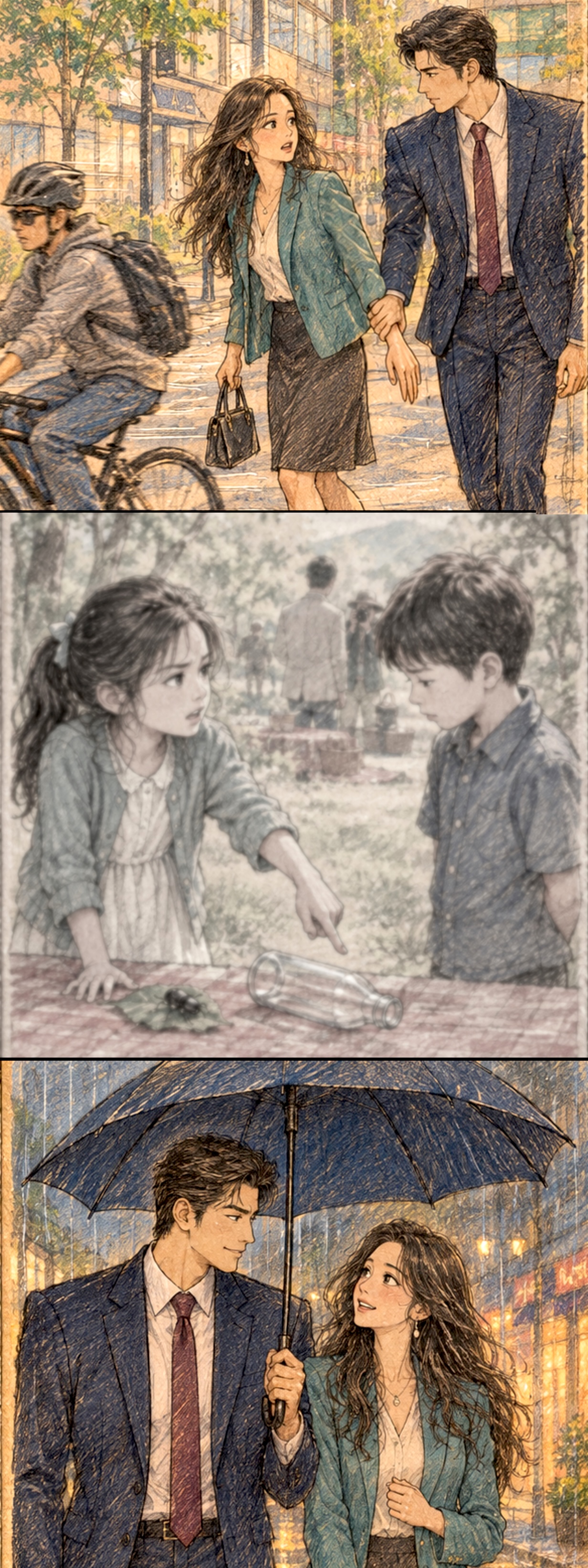
After that, the contract had become a private joke. He caught her wrist once to stop her walking into a cyclist’s path, and she thought of the child with the beetle. He appeared with an umbrella when she had forgotten one, and she thought the world might occasionally be arranging itself in her favor.
When he proposed, there had been no photographers.
That had mattered most.
Now the contract lay in a drawer beneath seating plans and a ring-sizing receipt. Nari found it while looking for a document her mother wanted, and read the cancellation clause twice.
Her phone rang.
“Yeoboseyo,” Nari said, answering.
“Hello,” Beomseok replied. He paused, and she could imagine him hearing the papers move under her hand.
“You’re working,” Beomseok said.
“You are calling during working hours.”
“It’s nine forty.”
She glanced at the hotel window. The river beyond it was a darkness interrupted by moving points of light.
“Then I have made excellent use of the evening.”
“October,” he said gently. “We could keep it small.”
Small, in their families, meant a room containing fewer people than a shareholder meeting.
“After the trial plan is settled.”
“You said after the review.”
“There was another review.”
He was quiet for a moment. She expected irritation and felt guilty before he gave her anything to feel guilty about.
“I can wait,” he said. “I only need to know that you are waiting for the work to end, not for a reason to leave.”
Nari looked down at the contract.
“I’m tired,” she said, and heard how inadequate it was.
The following afternoon, Seung-hee Gongju found her beside the coffee at an agricultural suppliers’ reception. Nari greeted her with a brief bow. Gongju returned a measured inclination of her head, then looked past her at the urn.
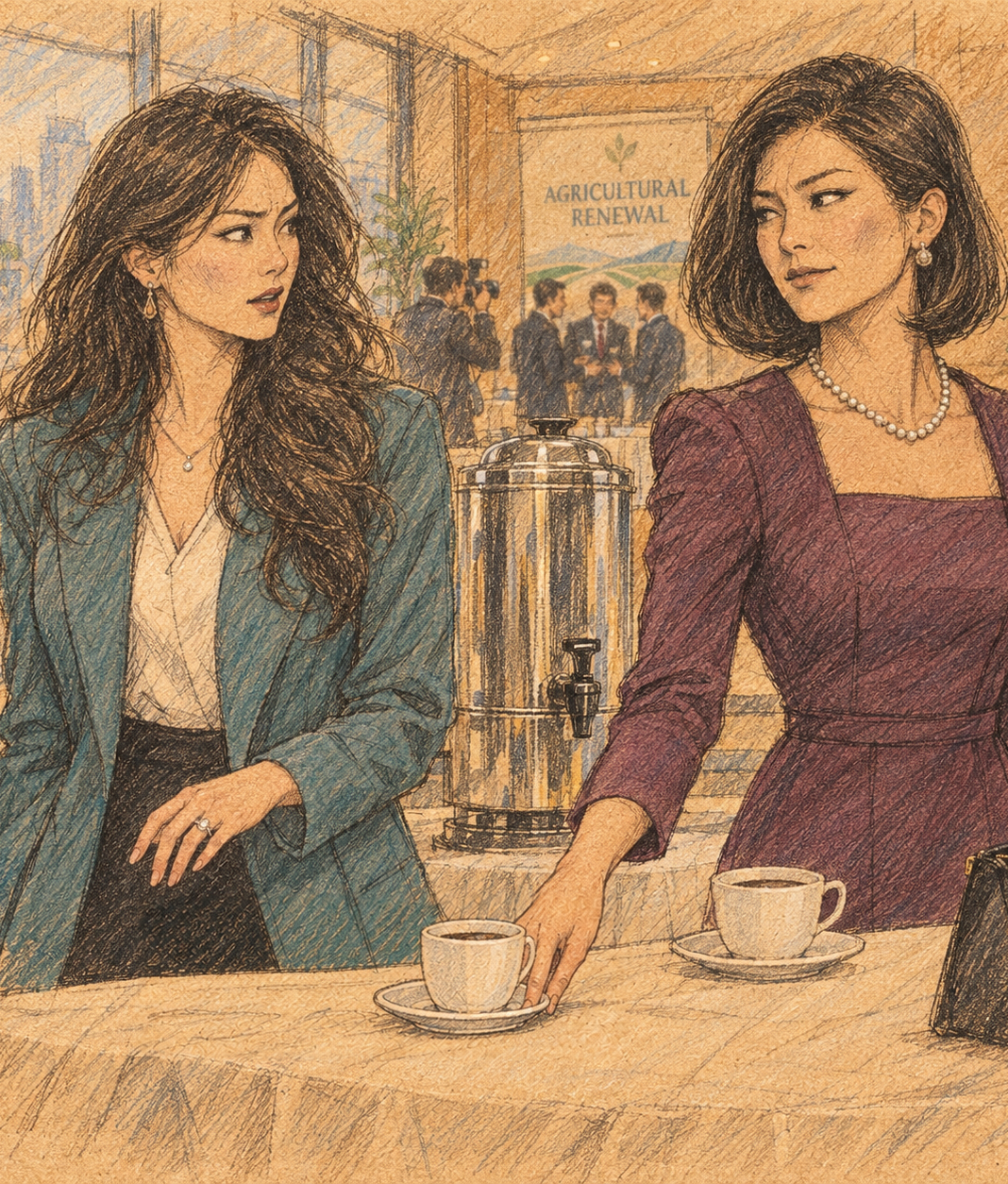
“You have been standing there for four minutes,” Gongju said. “Either choose a cup or buy the supplier. People are becoming anxious.”
Nari took the nearest cup. “Do you time all your competitors?”
“Only the ones standing between me and coffee.”
At thirty-nine, Gongju had six years on Nari and wore the difference as though it made her more qualified. Her black bob curved inward without a strand escaping. She removed a pearl bracelet before reaching across the urn, slipped it into her bag, and filled two cups herself. Nari had expected her to summon someone.
A director passing behind them congratulated Gongju on Hwangto’s improved research margins. Gongju thanked him. Only after he had gone did she put the second cup down.
“He means the bee program,” she said. “Closing it was the most efficient experiment we ever performed. One signature, immediate improvement in the figures.”
“Beomseok said the results didn’t justify continuing.”
“Beomseok explained it very well.”
The pause afterward was small. Nari noticed it because she had been listening for congratulations on having acquired Hwangto’s best scientist, and had received none.
“You think I should stop too?”
“I think you should know what it would take to make you stop. Preferably before your name is on every presentation.” Gongju glanced at Nari’s ring. “And before the project manager becomes family.”
Nari set down her cup too sharply. Gongju caught its sliding saucer with two fingers.
“I can separate the two.”
“Good. Keep doing it. People will give him credit for your sensible decisions and you responsibility for his expensive ones. You needn’t assist them.”
For a moment they stood beside the urn without looking at each other. Across the room a photographer arranged three men in front of a banner about agricultural renewal.
“Was that advice?” Nari asked.
“An observation. Advice would imply I wanted you to succeed.”
Gongju retrieved her bracelet and went to speak to a financing director Nari had hoped to reach first. Nari could not decide whether she had been warned, insulted, or briefly recognized. By the time she decided to follow, Gongju had the director laughing.
Two nights after the call, she was still at headquarters when Jungseok appeared with a stack of meeting records and a convenience-store bag.
“You said you wanted the source for the change in the pilot sequence.”
“I did. Why do you have eggs?”
“Because the records are not nutritious.”
He had found three references to a comparative delivery study in meetings from the previous year. All described it as the necessary next step. None pointed to a completed report.
“It might have been cancelled for a good reason,” he said.
“You’ve written ‘good reason not yet located.’”
“I was trying to be optimistic.”
She moved to the small kitchenette outside the executive offices, where appliances existed mainly to reassure visitors that the company considered eating normal. Jungseok took two bowls from a cupboard.
“Are you inviting yourself to eat ramyeon with me?” she asked.
He looked at her, then at the bag, then at the empty corridor.
“I had framed it as emergency support.”
“Very formal.”
“It seemed safer.”
She took the packet from him. “The instructions say four minutes.”
“Three and a half.”
“Then why do they print four?”
“To accommodate people who enjoy being disappointed.”
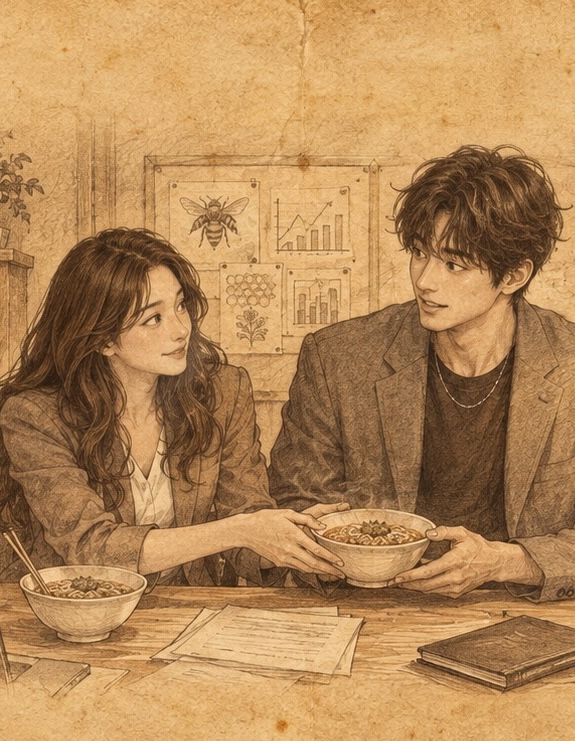
She made hers for four. He said nothing when she tasted his and exchanged the bowls.
“You were waiting for that,” she said.
“I was hoping you’d only take a mouthful.”
She stopped with her chopsticks halfway to her mouth. Then she pushed his bowl back, laughing, and he nudged it toward her again.
“Too late. You’ve established possession.”
“I could make you another.”
“It would arrive in four minutes. We’d be back where we started.”
For ten minutes they were not talking about mites.
He told her about the foster father who had taken him in, a repairman who could mend a radio but could not be persuaded to label the jars in which he kept screws. After an injury, the man had needed more care than either of them could afford. Jungseok left university, worked, returned briefly, and left again.
“Is he better?”
“He can shout at me without getting tired.”
“That sounds promising.”
“He says a degree would help. Apparently I was supposed to complete one while he was shouting.”
The affection in his voice made Nari look down at her bowl.
“You should finish,” she said.
“I know.”
She nearly offered to arrange it. He met her eyes before she spoke, as though recognizing the impulse, and she let it pass.
A drop of broth had landed on his wrist. He wiped it away with the corner of a napkin, still talking about his father’s jars, and Nari lost the next sentence. She wanted to move the hair away from his eyes. The wish came with the imagined resistance of a soft strand against her fingers.
She set down her chopsticks.
“Too much chili?” he asked.
“No.”
Her phone lit up beside the bowl. Beomseok had sent a photograph of the little restaurant where they used to eat after late reviews. Still here, he had written. Whenever you have an evening.
She had an evening. She was spending it exchanging noodles with another man and privately touching his hair.
“I should finish those records,” she said.
Jungseok glanced at the lit screen, then back at his bowl. “Tomorrow would be all right. They aren’t going anywhere. I’ve seen their history.”
She smiled, grateful that he had left her somewhere ordinary to stand. She did not turn the phone facedown. After a moment she answered Beomseok: I remember. Let’s find an evening.
Then she stayed to finish her food. She could neither blame Jungseok for making the room pleasant nor pretend she had not wanted to remain in it.
A moth struck the glass beside the kitchenette light. It tried again, frantic and softly audible.
Jungseok stood, found a paper cup, and waited until it settled.
“That will take all night,” Nari said.
“Then it will be well rested.”
He caught it without crushing it and took it toward a window that opened. A gust folded his sleeve back from his wrist.
“My grandmother used to say a dokkaebi could borrow anything except the consequences,” Nari said. “Usually when I borrowed her scarf.”
He paused with the cup against the window frame.
“A useful rule,” he said. “Especially for a face.”
“What?”
“In a story. Borrow a creature’s true face and you borrow what can undo it.”
She leaned against the counter. “Even if you’re stronger?”
“Strength is what makes the story interesting. It doesn’t change the price.”
He opened the cup. The moth hesitated, then vanished into the dark.
“That’s a severe view of borrowing,” Nari said.
“I’ve been warned about a book.”
Later, when he had gone, she found the missing study listed in a procurement record. Its status was not cancelled but transferred, and the transfer carried a time stamp from a night when the project team had been told the system was unavailable.
It might mean nothing. She no longer liked how many things might mean nothing in precisely the same direction.
She sent a request to Chae Minji in quality assurance asking for a limited independent review of the study’s history and reporting chain. Then she read the message twice to make sure she had not suggested a desired answer.
Beomseok called while she was gathering her coat.
“I saw the review notice,” he said. “You could have asked me.”
“It includes decisions from before you took over.”
“That isn’t what I meant.”
Rain pressed a shifting pattern against the window. Downstairs, a staff shuttle pulled away.
“I know,” she said.
His voice softened. “Let me collect you. We’ll talk over dinner.”
She looked at the kitchenette, where he would never have left two bowls drying beside an egg carton.
“Not tonight,” she said. “I want to walk a little.”
“In this weather?”
“Just to the café. My driver can meet me there.”
He waited for her to change her mind. When she did not, he told her to be careful.
She remembered, much later, how kind he had sounded.
A Very Photogenic Emergency
Chapter Four | Late April
Nari bought a coffee she did not want because the café was warm and nobody inside expected her to decide anything more consequential than its size.
She stood near the window while her driver confirmed that he was coming around the block. Outside, the rain made the road look deeper than it was. She sent him a message saying she would meet him on the opposite side.

The pedestrian signal changed. Nari put the phone in her pocket and stepped from the curb with three other people.
She remembered the heel of the woman in front of her. It was pale yellow, and a thought went through her mind that the woman would regret choosing those shoes.
Then there was an engine too loud for the speed of the traffic.
The lights came from the wrong place.
She did not remember flying. She remembered the coffee disappearing from her hand and the astonishing hardness of something that should have been air.
When sound returned, it came without order. Someone was shouting a number. Someone else kept telling her not to move. She could not understand why moving had become a question when she could not even locate her left arm.
Rain struck her cheek. She tried to say that her driver was waiting, because this seemed the one thing she knew that might be useful.
Later she would remember that effort, and the humiliation of not being able to make anyone understand an appointment.
The next room had no rain.
She surfaced in it repeatedly, each time believing she had already asked where she was. There was a woman in blue, a light over her head, and a terrible dryness in her mouth.
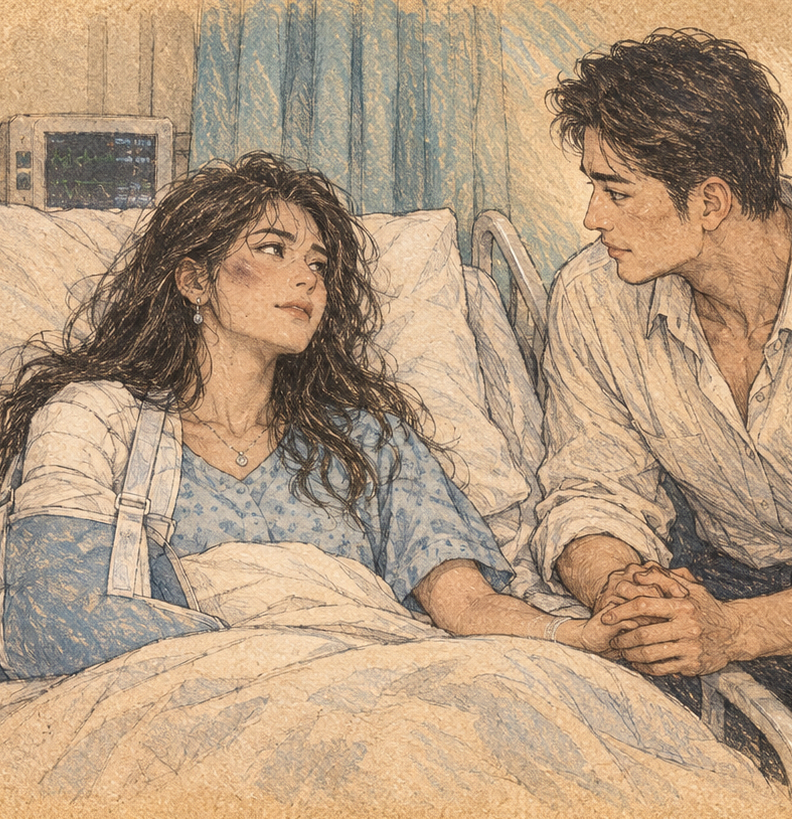
Beomseok sat beside the bed.
He wore yesterday’s shirt. His hair was no longer perfect. When he saw her eyes open, his expression changed so nakedly that she began to cry before understanding what had happened.
“You’re here,” he said. He took her left hand. “You’re here. That’s what matters.”
She tried to look at her right shoulder. A shape of dressings and support prevented the ordinary line of her body from making sense.
“The surgery went well,” he said. “Don’t try to do anything.”
The woman in blue came back. She asked Nari questions and waited for the answers instead of letting Beomseok give them.
The date was wrong. Not because Nari had forgotten it, but because the night had ended without her.
She had a displaced fracture near her right shoulder, bruising in places she could not yet see, and a head injury the doctors were monitoring. The surgeon returned when she was more awake and explained the repair using an image Nari understood only after asking him to show it again.
“How long?” she asked.
He did not give her the reassuring answer she wanted. Bone healing and regaining comfortable use were not the same milestone, he said; her rehabilitation would be guided by the injury and could continue for months.
“I have meetings.”
“Most of them will survive.”
Beomseok smiled at the doctor as though they were allies in a long campaign against her unreasonable habits.
For the first two days she was grateful for him without qualification. He found the right person when her pain worsened. He remembered which sounds kept her awake. He spoke to her mother, who arrived white-faced and left furious with a driver nobody had yet found.
At night he sat beside Nari with his phone facedown and read aloud from things she would ordinarily have read herself. He avoided the reports that might upset her.
“Nothing you need to deal with,” he said when she asked about the review.
She believed him because she could not keep her eyes open long enough to argue.
On the third morning a photograph appeared online. It showed Beomseok entering the hospital with a coat over one arm and an expression of restrained distress.
There were no photographs of her, which she appreciated. There were comments about how fortunate she was.
She looked at him asleep in the chair, one broad hand hanging toward the floor, and thought perhaps the comments were right.
When he woke, he found her watching.
“What?” he asked.
“Nothing.”
“You can tell me.”
She wanted to say that she had been comparing him unfairly with a man who had made a calendar and cooked noodles. She wanted to apologize for the ways in which boredom and exhaustion had disguised themselves as doubts about love.
Her water cup had a bendable straw. Beomseok had found one after watching her spill the first cup, then bent it to the angle she could manage. His thumbnail was split. She did not know how he had done it, and that tiny imperfection made his vigil harder to dismiss than anything the newspapers said.
She had wanted someone who would notice her without a presentation. Here he was, noticing the angle of a straw. Was she really so restless that kindness became invisible as soon as it came from the man she had promised to marry?
She moved her good hand toward his. He took it before she reached him, and the familiarity of that almost made her say yes to October.
Instead she asked whether Jungseok had come by.
Beomseok adjusted the blanket near her feet.
“He has work to do,” he said. “Everyone sends their best.”
The answer was reasonable. It did not answer her question.
That afternoon a police investigator spoke to her. The car had not stopped. Witnesses disagreed about its color; rain and reflected lights had distorted what people saw.
“Did you notice the driver?”
Nari closed her eyes. She remembered the shoes and the lights. She remembered something black turning away, but could not tell whether it was a vehicle or the world itself.
“No,” she said.
The investigator did not ask her to try harder. Nari loved her briefly for that.
Afterward, Beomseok held her left hand until the shaking stopped.

“The world is careless,” he said. “Let me take care of this part.”
She remembered him saying almost the same thing when she had dropped a glass on the evening of his proposal. He had knelt to collect the pieces while she stood barefoot, then placed a Band-Aid over her cut toe. When she looked down at him, their eyes had met and held for ten seconds before they both began to laugh.
She had thought then that a person could be recognized by what he did with another person’s mistakes.
Now she wondered how she had ever doubted Beomseok.
That night the corridor outside the VIP rooms grew quiet.

A woman in a dark dress came out of the elevator carrying no flowers. Her bobbed hair curved neatly below her jaw; diamonds and pearls caught the muted light at her throat. Beomseok rose from the chair outside Nari’s door.
Seung-hee Gongju stopped close enough that they did not need to raise their voices.
“Gamsahamnida,” she whispered.
He inclined his head. He did not reply with a “you’re welcome”. She looked once at the closed door and then walked back to the elevator.
Inside the room, Nari slept.
By morning, the chair beside her bed was occupied again. Beomseok had arranged fresh flowers where she could see them without turning her head, and there was warm water waiting when she woke.
Her mother said he had not left.
Nari looked at the flowers. They were exactly the kind she liked, in exactly the color she would have chosen.
She wondered, briefly and unkindly, whether Jungseok would have known.
The Patient Has Questions
Chapter Five | May–June
Recovery began with things Nari had never considered accomplishments.
She learned to open a toothpaste cap with one hand. She learned which shirts could be put on without a sequence of negotiations with pain. She learned that sleeping, when she most needed it, could become a task performed in fragments between visits, medication, and the effort of finding a position that did not punish her.
Her body had become a poorly coordinated organization. Every department objected to the timetable.
In the hospital, visitors came carrying concern shaped like expensive objects. Fruit stood in arrangements too ambitious to eat. Flowers arrived in vases her staff would have to return. Her mother brought pajamas and then, when Nari finally snapped, brought plain socks and stayed without talking.
Beomseok brought order.
He placed messages in categories. He told people when to call and when not to call. He answered questions in a voice low enough to seem considerate even when she had not finished forming her own reply.
At first she let him. Dependence was exhausting partly because it required so many decisions about what one needed.
Then a nurse brought a notebook.
“This was left for you,” she said. “The sender said there was no need to answer.”
It had a plain blue cover and an elastic loop already beginning to fray. On the first page was a drawing of an office chair with a crown on it.
“Your replacement has arrived,” Jungseok had written. “It has approved a cushion for itself. I thought you should know.”
Nari laughed and immediately regretted the movement.
The nurse waited until she had stopped. “Should I take that away?”
“No. It may be the first useful thing anyone has sent.”
The next pages contained small office reports. A meeting had ended early because nobody could locate the presentation. Sora had declared this the most efficient technical review of the week. The printer had resumed making a noise Jungseok described as “a senior executive discovering transparency.”
Between the jokes were questions.
Did Nari want the project summaries, or would she rather not receive work? Was it all right if he returned the library book late because her coffee had improved the binding? Should somebody water the small plant on her office shelf, or had its death been an intended personnel action?
At the bottom of the page he had written, “You can say no to any of these. Even the plant.”
Nari read that line twice.
There was no declaration of love. He had not used her unconsciousness as permission to tell her anything. He had left room for her to be irritated, uninterested, or asleep.
She asked the nurse whether he had visited.
“Several times. I believe he was told you weren’t receiving colleagues.”
“By whom?”
The nurse hesitated, not because the answer was secret but because she could hear the shape of the problem.
Nari looked toward the flowers.
Beomseok returned shortly before lunch. She waited until the nurse had finished checking her before asking.
“Did Jungseok come here?”
He put a bag on the chair. “I told you everyone sent their best.”
“That isn’t what I asked.”
“You needed rest.”
“I asked whether he came.”
He sighed, gently enough to make her feel childish for requiring precision.
“Yes. I told him it wasn’t a good time.”
“Every time?”
“Nari, you were recovering from surgery.”
She opened the notebook on the blanket. “Did you tell him I had asked not to see him?”
For a fraction of a second he looked at the notebook instead of her.
“You said you didn’t want work brought into the room.”
“I said I didn’t want the financing committee calling while I was sick.”
“I was protecting you.”
She was tired enough that tears arrived before the anger could organize itself. This infuriated her more.
“Then ask me what I need protecting from.”
He came toward the bed. She lifted her right hand, and he stopped.
That afternoon she gave the staff her own visitor instructions. She also asked for her phone, its charger, and the names of the people currently receiving her business messages.
It took less than an hour to recover authority over the room. Recovering confidence in her judgment took longer.
Jungseok arrived the next day carrying a paper bag and looking as though someone had instructed him to be cheerful without explaining how.
He stopped at the door. “Is this a good time?”
“Come in before somebody makes a policy.”
He smiled, then saw her left arm and lost the smile.
She had prepared to be amused by him. The unguarded grief in his face made that impossible.
“Gwaenchanha,” she said, giving him a small, reassuring dip of her head from the pillow.
“It’s okay,” he echoed softly, as though he needed to hear himself say it.
“I’m still here,” she said.
“Yes.”
He set the bag on the table. Inside were plain hair clips, a phone stand that could be adjusted one-handed, and the most ordinary pair of socks she had seen since the accident.
“My mother had the same idea.”
“About the phone stand?”
“The socks.”
“I will try not to compete.”
He sat far enough away that she could invite him closer or leave him there. From that distance he seemed to be waiting for his number to be called.
“The chair has wheels,” she said.
He looked down, then moved it closer. One wheel squeaked at every turn.
“Very discreet,” she said.
“I can go back.”
“We would have to listen to it again.”
He stayed. She looked at the ordinary socks and found she could finally bear to be seen in the ones she was wearing.
For several minutes they talked about nothing important. He had returned the book. The owner had accepted a replacement only after extracting a promise that Jungseok would not improve it with coffee. The office plant had been alive beneath the dead leaves, which he presented as an accusation.
When the conversation ran out, he did not reach for his phone. He sat with her. Nari watched his hands resting loosely between his knees and wanted, with an intensity that embarrassed her, to softly lay her own hand there.
Beomseok’s coat still hung behind the door. She folded her right hand over the blanket instead.
“You don’t have to keep entertaining me,” she said.
“That’s a relief. The socks were my strongest material.”
“I noticed.”
His smile melted her thoughts. She could have asked him to leave, and he would have. Instead she looked at the window and allowed the silence to last. For the first time all morning she was not waiting for a visitor to finish being concerned. She was wishing visiting hours were longer.
At last she asked about the project.
Before he answered, her mother arrived carrying a bag of shirts that fastened at the front. Jungseok stood, introduced himself, and bowed respectfully to her, his gaze lowered. She acknowledged him with a smaller bow.
“Annyeonghi gaseyo,” her mother said when he stepped toward the door.
“Goodbye,” he replied. He left them alone without presenting his departure as a sacrifice.
Her mother watched the door close.
“That is the assistant.”
“He has a name.”
“I heard him give it.”
Nari looked down at the paper bag. She prepared herself for a comment about a younger man, a subordinate, or a life temporarily distorted by injury.
Instead her mother took out a pale blue shirt and held it against Nari’s good shoulder.
“Beomseok says you are difficult to protect.”
Nari closed her eyes. “Does he?”
“He seems to think I will find that surprising.”
The laugh escaped before Nari could stop it. Her mother folded the shirt and put it within reach.
“You don’t have to decide everything now,” she said.
“People keep telling me that.”
“Then let me say something else. You don’t have to let them decide while you wait.”
Nari looked at her. Her mother was studying the shirts as though the advice had concerned buttons.
“You like him,” Nari said.
“Which one?”
“Beomseok.”
Her mother stopped folding.
“I like believing that someone notices when you are tired. If I have been wrong about how he does that, I would rather be embarrassed than have you marry him to save me the trouble.”
It was not the conversation Nari had expected, and she did not know how to thank her for it. She reached for the blue shirt instead, and her mother helped without making a lesson of being asked.
Jungseok checked the visiting hours before returning. When he arrived, Nari asked her question again.
“Sora and Minji should tell you,” he said.
“That sounds serious.”
“It sounds like I’m not the person who can authorize conclusions.”
He had brought a list of questions, not the answers. Nari recognized her own instruction reflected back at her and felt, for the first time in days, useful rather than merely attended.
The joint call took place after she left the hospital, during one of the short working periods her clinicians allowed her to build around recovery.
Her hotel sitting room had acquired a second life as a rehabilitation station. The view beyond the windows was unchanged; the woman before them could no longer assume she would be able to brush her own hair by the time an unexpected visitor arrived.
Minji appeared on the screen from a room with no decorative objects. She had brought Sora and a report that did not contain a conclusion on its first page.
“We preserved the source records before comparing them,” Minji said. “The review is logged. Nobody has altered the originals.”
Nari adjusted the phone stand with her right hand. “Tell me what you found.”
They had found a study that failed because the delivery system had not remained intact. They had found another that failed because too little active material reached the mites. They had found work that was genuinely inconclusive.
“Those failures stay failures,” Sora said.
Then she showed a later series of observations that had not appeared in the executive summaries.
Nari leaned toward the screen.
“Why not?”
“The record says the observations were considered unsuitable for decision-making.”
“Were they?”
“They were not enough to support a decision on their own,” Sora said. “But they justified repeating the work. That’s different from unsuitable.”
The repetition had been deferred, moved, resubmitted, and eventually removed from the budget.
Jungseok sat off to one side of the call, visible only when he leaned forward to identify a meeting date. He did not look triumphant.
Nari asked how many such cases there were. Minji gave her a number and then explained why two of them probably had innocent explanations.
By the end of the call, Nari had authorized a broader independent audit and placed its reporting line outside Beomseok’s control. She had also used up the concentration she had for the day.
He arrived that evening with dinner.
“You should have told me,” he said after they had eaten.
“About the audit?”
“About deciding I could no longer be trusted.”
She put down her fork. “That is not what an audit decides before it begins.”
“Your assistant seems to have decided.”
“He brought questions. Sora and Minji brought records.”
Beomseok sat very still. The room was quiet enough that she could hear the ventilation switch to a lower setting.
“Do you trust a secretary more than the man who stayed beside your bed?”
The question frightened her, not because he had raised his voice, but because he had made staying sound like something she now owed him for.
She looked at the phone stand, the closed notebook, and the dinner he had chosen without asking.
“I don’t want either of you exempt from the truth,” she said.
What the Graph Omitted
Chapter Six | June
By June, Nari could raise her left hand farther than she could in May, and could admit more uncertainty without feeling that it diminished her.
Neither improvement was consistent.
Some mornings she could dress almost normally. On others, a careless movement undid an hour’s patience. She began to understand why her physiotherapist refused to describe progress as a straight line, and why the instruction to stop before sharp pain was not a challenge to demonstrate character.
She was less successful at applying the same wisdom to Beomseok.
He agreed to the audit with exquisite courtesy. He supplied explanations, additional documents, and a statement expressing concern that junior staff might feel blamed for technical judgments they did not fully understand.
Nari read the statement three times. It was protective in exactly the way his decisions at the hospital had been protective.
At the independent review meeting, Sora put two diagrams on the screen.
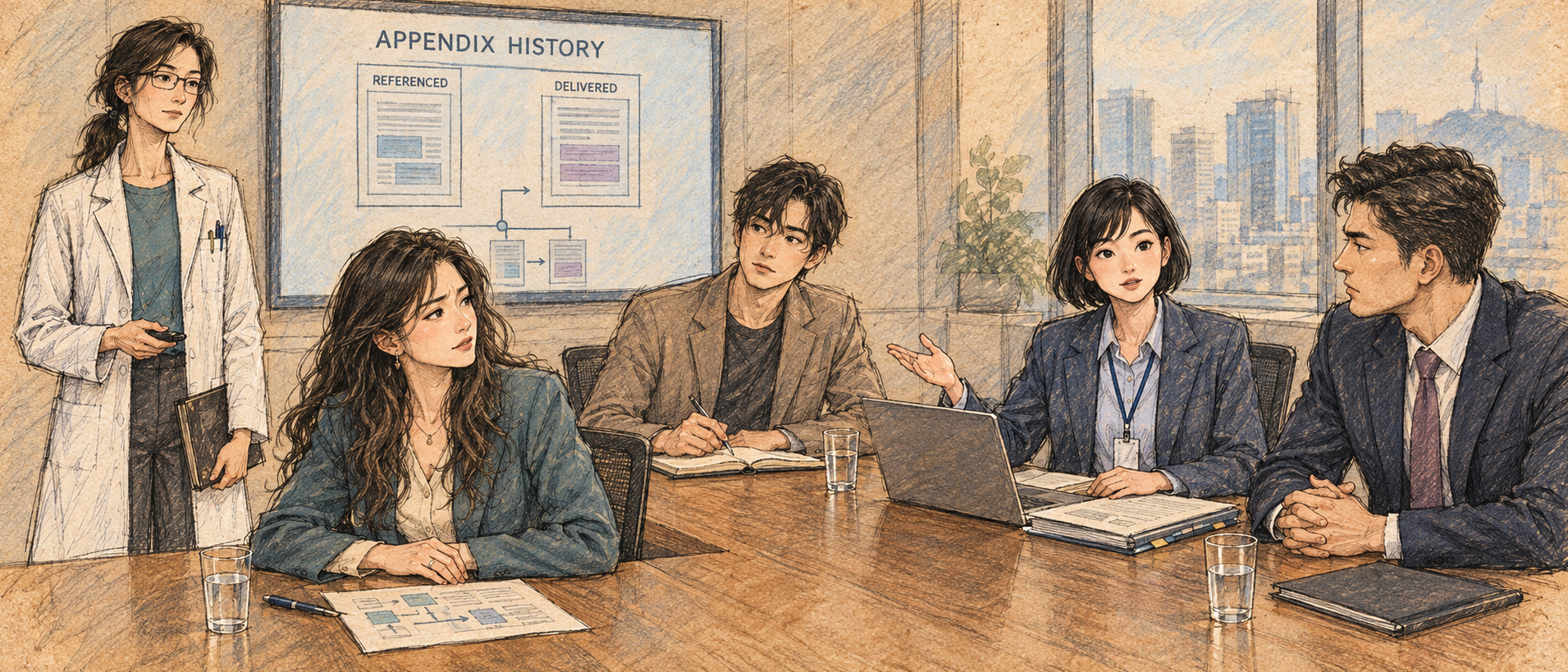
The first showed the intended chain of evidence. Material had to remain intact, reach the relevant biological system, produce the intended response, and eventually make a useful difference in the colony. Each step was a question, not an entitlement.
The second diagram showed what the executive summaries had actually measured.
“Adult deaths at the early observation,” Sora said. “Again and again.”
“An established measure,” Beomseok replied.
“Of a different promise.”
He folded his hands. “A product whose effect cannot be demonstrated promptly is difficult to deploy.”
“Then we discuss deployment,” Sora said. “We don’t silently replace the mechanism.”
Nari looked down at the slide she had shown a stranger outside a café. For the first time she understood why it had made him stop.
“Explain the mechanism to the room,” she said.
Sora did not oversimplify it into a magic word. The project used double-stranded RNA intended to interfere with expression of a mite gene important to reproduction; RNA interference was not Daeji’s invention, and the existing vadescana work already gave them reason not to equate a lack of rapid adult deaths with a lack of biological effect.
“Our claim would have to be about this formulation and this delivery route,” she continued. “Evidence for another product doesn’t establish that ours works. We knew that when we designed the study.”
Jungseok had stopped taking notes. He was watching Nari, perhaps to see whether she would accept the extra time implicit in every sentence.
She turned to Beomseok.
“Why did the early mortality graph become the summary of the whole program?”
“Because the later measurements were too variable to support a claim.”
“Then why not report the variability?”
“I did. In the technical appendices.”
Minji placed a version history on the screen.
Nobody spoke for a moment.
“The appendix referenced here,” she said, “is not the appendix included in the package that reached the executive office.”
Beomseok leaned forward. “That could be an assembly error.”
“It could,” Minji said. “We checked that possibility.”
She did not accuse him. She showed the substitution, the access history, and the explanatory note that had been copied into a later meeting summary. The same note had followed the study through three deferrals.
Nari felt the particular cold of discovering that a thing she had approved had not been the thing she thought she was approving.
The review did not finish with a dramatic denunciation. It finished with preserved records, disputed explanations, further questions, and decisions about who could authorize the next work.
That was worse, in some ways. Beomseok could still stand beside her afterward and say there had been a misunderstanding.
Nari refused to discuss it in the corridor.
She asked Sora to design a repeat that would separate delivery failure from failure of the biological hypothesis. She asked Minji to manage coded samples and independent reporting. She asked the board’s audit representative to oversee the work so that neither her engagement nor the staff’s fear of it could decide what happened.
Jungseok met her afterward with a folder.
“You look disappointed,” she said.
“I thought the evidence would be clearer.”
“It’s clear enough that we have to look.”
“That’s not the same thing.”
“No,” she said. “It isn’t.”
The first repeat failed.
Not entirely, which would have been easier to explain. The active formulation behaved inconsistently across preparations. One result seemed promising; the next made it impossible to tell whether the result belonged to the intended mechanism or to the condition of the material.
Jungseok brought Sora an explanation. Sora showed him a measurement that did not fit it.
He spent the afternoon with the original records and came back to Nari looking tired.
“I was wrong about the carrier,” he said.
She waited.
“I thought a result from the earlier storage test would carry over to the current preparation. It doesn’t.”
“What now?”
“We find out why. We keep the failure in the report.”
She had expected honesty to feel clean. Instead it felt expensive and uncertain and, in some obscure way, less lonely.
That night she tried to make a list of reasons to stay with Beomseok. The corridor before her presentation. The restaurant. The glass on the night he proposed. His hand finding hers in the dark hospital room. She stopped before writing the last one, because she could still feel herself almost agreeing to a wedding to make her gratitude visible.
She had not imagined those moments. Even if she no longer understood him, she had been comforted. She had laughed. She had loved the man she believed was there.
On another sheet she wrote Jungseok’s name, then crossed it out. Not because her feelings were innocent. They were becoming impossible to call innocent. But if he resigned tomorrow, if he turned out to love somebody else, she would still have to answer the question Beomseok kept asking.
She put the two sheets in different drawers. By morning she had stopped trying to make the first one long enough.
She ended the engagement on a Thursday.
Beomseok came to Grand Walkerhill expecting dinner. Nari had placed water on the table and kept the ring on her hand until he sat down, because she did not want him to imagine that a display would explain what she meant.
“I’m not marrying you,” she said.
He looked at her for a long time.
“Because of an inconclusive audit?”
“No.”
“Because of him?”
“No.”
She took off the ring. Her fingers had become less swollen since the hospital, and it slipped free more easily than she expected.
“Because I asked you whether someone visited me and you told me what I needed instead. Because you used staying beside my bed as an answer to a question about records. Because I keep postponing a wedding and you keep asking what problem needs fixing before I can give you the right answer.”
His face changed. Not dramatically, but enough that she saw how much effort its usual expression required.
“You’re recovering from trauma.”
“I am. That does not make this decision yours.”
He stood and walked to the window. She could see him reflected in the glass, broad-shouldered and immaculate, the city behind him.
“I have given you years.”
“I know.”
“That’s all you have to say?”
She wanted to apologize for the pain she was causing. She wanted him to be a man whose pain she could trust.
“I remember the night before my first presentation,” she said. “I remember you sitting on the floor with me. I haven’t decided that didn’t matter.”
He turned from the window. For a moment she saw the man who had waited while she found her first sentence, and her hand moved toward the ring.
“Then give us time,” he said. “Stop seeing him. Let me show you.”
She left the ring where it was.
“If Jungseok left tomorrow, I still wouldn’t marry you.” Saying it hurt. She had hoped clarity would make it hurt less. “I can be grateful for what you did and still mean that.”
“I’m not asking you to agree,” she said.
He took the ring when he left. The next morning it came back in its box, without a note.
Beneath the box was a folded copy of the old public-courtship contract.
Nari read the final clause again. Either party could end the arrangement.
She took a pen and underlined “either.”
Then she put the paper away, called her mother herself, and let the day become difficult without changing her answer.
For several days afterward she still reached for her phone when something happened that Beomseok would once have understood. A bad joke at a meeting. The sight of the restaurant name on a receipt. She missed having someone to whom the first half of a sentence did not need explaining.
She did not give Jungseok those unfinished sentences. He noticed her quietness and left work on her desk without manufacturing a reason to stay. Once she nearly called him back merely because the space after Beomseok was frightening. She went to her rehabilitation appointment instead, came home exhausted, and cried while trying to fasten a button.
The next morning she fastened it on the second attempt. She was pleased, and then wanted to tell somebody, and then was sad again. None of those things required her to take the ring back.
A Result Worth Repeating
Chapter Seven | July–August
The work improved when it became less impressive to describe.
There was no morning on which Jungseok ran into Nari’s office carrying the answer. There were mornings on which Sora asked for another comparison, afternoons on which Minji refused a shipment because its records did not agree, and a particularly long Wednesday when everyone discovered that the explanation they had preferred was the explanation the measurements would not support.
Nari began attending shorter meetings. Some of them ended without a decision.
She also began eating lunch before the afternoon.
Jungseok did not congratulate her on either improvement, which helped.
In July he came to her office with an annotated drawing of an adult bee and a developing pupa.
“Sora says I should make you look at this before you approve the simplified explanation.”
“That sounds threatening.”
“She has learned how we work.”
The explanation concerned where the mite fed and why a convenient delivery assumption might be wrong. Research had shown that mites on adult bees primarily fed on fat body, while those in the reproductive phase feeding on pupae primarily consumed hemolymph.
Nari studied the two figures.
“So if someone says ‘the mite drinks bee blood’?”
“You ask which stage they’re discussing.”
“And if someone says it only eats fat?”
“The same answer.”
She looked up. “You’ve chosen an excellent career for annoying people.”
“I keep being told I haven’t chosen one.”
The delivery system they were developing had to survive more than a clever explanation. Sora’s team traced exposure, measured response, and checked whether the reproductive outcome followed. A material that behaved well in a small vessel could lose usefulness once real handling, storage, and colony conditions entered the argument.
The team did not bypass that difficulty. It spent the summer on it.
At one review, Sora laid out the coded results without telling Nari which preparation had produced which.
“This one changes the reproductive result,” Nari said, touching a column.
“What else changes it?”
The question stopped her. A carrier that stressed the organism could alter the result without establishing the intended sequence-specific action. So could a handling difference. Sora made her compare the active material with the carrier alone and with material that did not carry the intended targeting message.
“And these?” Nari asked.
“The response measurements. If the story we’re telling about the mechanism is true, we want these observations to make sense alongside the reproductive result. Not instead of it.”
The cleanest comparison was less spectacular than the first graph Nari had liked. It was also harder to explain away.
“Can we keep the spectacular one in a drawer?” she asked.
“We keep all of them in the record. Drawers are how we got into trouble.”
Later they looked at colony-health measurements that did not improve merely because the mite result did. Varroa could transmit deformed wing virus; attacking the parasite was not a demonstration that an already infected colony had been cured.
Nari stared at the separate columns for a long time. She had wanted the work to come together into a single answer that could be carried back to the people waiting for it.
Sora leaned across the table.
“We can make something useful without making it complete.”
“That sounds like something people say when they need more money.”
“It is. Sometimes they also need the time.”
Nari approved the next phase without asking Sora to make the explanation shorter for the board.
The sample board filled with dates. Nari’s rehabilitation exercises changed. The bowls in the executive kitchenette migrated into a cupboard where they belonged.
One morning she brought Jungseok a coffee with three sugars. He looked at the cup, then at her.
“I’m not endorsing it,” she said.
“Of course.”
“I was buying one anyway.”
“Of course.”
He was smiling into the lid. She took her own coffee into her office before he could say it a third time.
One evening she found Jungseok repairing the loose handle on a cabinet with a screwdriver borrowed from facilities.
The week before, she had told him he could leave her title out when they were alone and not discussing work. He had asked whether she was sure. She had said yes a little too quickly.
“Annyeong,” she said from the kitchenette doorway, with a small, almost shy bow of her head.
“Hi,” he replied, returning the little nod. He smiled before looking back at the screw.
She held the door steady with her right hand while he tightened the screws. He had rolled up his sleeves, and a little crease appeared beside his mouth when he concentrated. Nari had meant to watch what he was doing. She was no longer watching that. The softness of his lips, the texture of his skin, the gentle curve of his neck.
“Would you mind looking somewhere else?” he asked.
She went still. “Am I distracting you?”
“I’ve tightened the same screw three times.”
He did not look up. The tips of his ears had gone pink.
Nari turned toward the kitchenette window, grinning at their faint reflections. It was unwise to be this pleased over a cupboard, and she made no attempt to stop.
In the glass, she saw him look up at last. His gaze stayed on her reflection until she turned back. Neither of them made the sensible adjustment of looking at the cabinet.
“I could hold a different door,” she offered.
“I don’t think it’s the door.”
He said it quietly, without the smile she could have used to turn it back into a joke. Heat moved up her neck. She was absurdly glad he was not entirely composed either.
The screwdriver slipped from his fingers and struck the shelf.
“That was the door,” he said.
“Ya!” Nari said, looking from him to the entirely motionless door.
“Hey,” he said. “I’m not ruling anything out.”
She laughed, and he did too, bending to retrieve it. When he straightened, they were closer than she had expected. She could see the small uneven edge of his lower lip. She thought about kissing it with a clarity that left no room for pretending she admired his practical skills.
He did not lean toward her. His attention moved to her mouth and back, and the restraint was more unsettling than a touch would have been.
For weeks she had been discovering things she wanted to tell him and saving them until he came by. Now she understood that she wanted the unscheduled part too: to hear what had happened on his bus, to be the person he looked for after something funny, to have the chance to bore him without a folder between them.
Someone rolled a cart past the open doorway. They both turned, although neither had done anything that needed concealing. Jungseok looked down at the cabinet, and Nari, unable to think of a graceful bridge back to ordinary conversation, took the one his repairs offered.
“Your father’s influence?”
“He says if I learned anything, it was accidental.”
“Does he know you work here?”
“He knows I work somewhere with very expensive loose handles.”
“Handle,” she said. “You’ve repaired this one.”
He tested it twice, as though he had not been there when it happened. She let go of the door.
“Gomawo,” she said.
“Thank you to you for holding it still,” he replied, adding a quick bow just solemn enough to make her answer it. They straightened smiling at each other.
He had shown her a photograph once: an older man seated by a window, holding a radio as though it had disappointed him personally. There was no resemblance between them, but she had begun to recognize the same disapproving lift of the chin.
“Bring him to lunch sometime.”
Jungseok’s smile faded.
“You don’t have to,” she added.
“I’d like that,” he said, but did not suggest a date.
She was learning to notice the difference between privacy and an answer that closed a door.
The following evening she almost called him about an appendix she already understood. Instead she sent a message asking whether he was free for a personal call. He called back while she was still deciding where to put her phone.
They said hello. For a moment she listened to the quiet at his end and felt foolish for having asked for it.
“Bogoshipo,” she said, before she could disguise it as a question.
“I miss you too,” he replied.
She looked toward the darkened river. They had been apart for three hours. She knew exactly how ridiculous that was and did not feel inclined to improve it.
“What were you doing?” she asked.
“Trying to figure whether I had a reason to call you.”
Nari put the appendix aside. Neither of them mentioned it again.
The independent repeat arrived in August.
Nari received it while her physiotherapist was asking her to perform a movement she had already failed twice. The notification lit the screen. She stared at it until the therapist took the phone and placed it facedown.
“Eotteoke?” Nari asked, not sure what to do, looking at her uncooperative arm.
“How?” the therapist repeated. “Without looking at your phone would be a start.”
“Five more,” the therapist said.
“It might be important.”
“So might your shoulder.”
When she finally opened the message, it contained no exclamation marks.
The outside laboratory had reproduced the narrow effect under the specified conditions. Not every measurement agreed perfectly. There were qualifications, an awkward difference between preparations, and a request for additional information.
Nari read it once, then again.
She called Sora.
“Can we say it works?”
“We can say what worked.”
Nari closed her eyes and laughed.
“Dahaengida,” she said.
“I’m relieved too,” Sora answered. “Relieved isn’t the same as finished.”
“I know. I’m allowing myself a minute.”
“One minute,” Sora said. “Then open the attachment.”
At the next meeting, Sora allowed herself a smile. The formulation had produced a repeatable reduction in mite reproductive success in their limited tests. At the exposures tested, the selected bee-health observations had not shown the harm signal that would have stopped the program.
“Selected observations,” she repeated as the communications director began writing. “At the exposures tested.”
“Harmless to everything else,” the director said, testing the phrase.
“No,” Nari and Sora said together.
The director crossed it out.
“We have not tested everything else,” Nari added. “We have barely met everything else.”
That line appeared on a sticky note in the laboratory the next morning.
On the way to the boardroom, Sora gave Nari a quick, encouraging nod and a raised fist.
“Hwaiting.”
“Good luck to you too,” Nari said. “You’re the one with the appendices.”
The board meeting was more difficult.
Hwangto had offered competing terms to a financing partner just before Daeji expected to settle its arrangement. The timing had been so exact that nobody in the room was pretending it was a coincidence.
Gongju had also made a public observation about companies that mistook an heir’s personal mission for an agricultural strategy.
She had not named Nari. She had not needed to.
One of the directors asked whether Daeji was merely following a treatment approach other people had already brought forward.
“RNA interference is not our discovery,” Nari said. “The U.S. registration decision for vadescana was in 2025. We are not asking you to fund the first idea anyone has ever had about using it against Varroa.”
“Then what are we funding?”
“A delivery formulation that still has to prove it can be useful outside these tests. A way to handle it that beekeepers may be able to afford. The chance to discover, before selling it, where it fails.”
“That’s an unusual investment pitch.”
“It’s the one I should have been making all along.”
She showed the independent repeat and the failures beside it. She showed the phased budget. When asked what would make her stop, she answered without consulting Beomseok, who was not in the room.
The board authorized a conditional pilot.
It also accepted the audit committee’s recommendation that Beomseok be suspended from scientific duties while the reporting and disclosure questions were investigated. His access was revoked. Counsel took over the formal exchange.
Nari did not watch him leave.
That evening Minji brought her an access report. Main systems, laboratory rooms, and shared project permissions had been checked. Older supplier and delegated logistics records were being reconciled separately.
“Why separately?”
“Because companies love buying systems more than they love making them agree.”
Nari authorized additional help. It felt like a small, unromantic use of authority, and therefore exactly the kind she had neglected.
The financing-calendar leak became clearer two days later.
An intermediary had forwarded a document bearing a Daeji version identifier. The dates matched the calendar used to negotiate the spring financing window. Its recipient chain included Hwangto.
When Nari called Gongju, she expected a denial.
Instead Gongju asked whether Daeji’s lawyers had drafted the question.
“No,” Nari said. “I’m asking it.”
“Then have them draft the next one.”
The answer did not clear Gongju. It also did not tell Nari whether Beomseok’s visits to the older woman’s penthouse had concerned business, romance, or an arrangement she had been too distracted to see.
Nari nearly ended the call. Then she remembered Gongju beside the coffee urn, setting down the second cup after being congratulated.
“When you closed your program, did you ask to see the unfinished work?”
Gongju said nothing for so long that Nari checked whether the call had ended.
“I read his recommendation.”
“That isn’t what I asked.”
“I know perfectly well what you asked.” Something clicked at Gongju’s end, a pen or a latch. “I had a payroll to meet and a board asking which expensive uncertainty I intended to end. He gave me one with a confident explanation. I accepted it.”
“And now?”
“Now my former laboratory manager keeps asking for an independent review of the remaining sample archive. It costs money to store a question I have already announced is answered.”
Nari sat down. “Have you authorized one?”
“No.”
For the first time Nari heard the uncertainty under Gongju’s contempt. If Daeji failed, Gongju would have been prudent. If it succeeded, the closure she had been praised for might require a less flattering explanation. That did not make competing with Daeji a crime. Receiving its private calendar was a different matter.
“You could have asked for a comparison of the programs,” Nari said. “Through the companies. Properly.”
“And let you explain persistence to me at thirty-three?”
“Apparently that would have been unbearable.”
“You do enjoy explaining things.”
Nari almost smiled. “You enjoy being right more than you enjoy checking.”
“So did you.”
That silenced her. Through the glass wall she could see Sora pointing out a problem on a report Jungseok was holding. He listened, crossed something out, and handed it back.
“Keep the archive,” Nari said at last. “Have someone independent look at it. What happened to your program matters even if ours fails.”
“I haven’t asked you to rescue my judgment.”
“Then consider it an observation.”
The call ended without a promise.
She added the document to the audit material and refused the pleasure of deciding more than she knew.
At the manufacturing site, six stainless-steel canisters waited in a clean row.
They were smaller than the publicity department would have preferred. Five held the field lot. The sixth, a compact commissioning unit, contained only a partial fill for approved checks and handling.
“Six tanks,” Jungseok said. “We should have hired a more dramatic tank.”
Nari watched Minji verify their identifiers.
“They took months.”
“That is very dramatic. It just photographs poorly.”
Sora discussed the retained samples and the off-site records. Minji explained how the shipment would travel and who could receive it. Nobody pretended that losing these containers would erase the invention; losing them would erase time, money, and a field window that could not be ordered back.
“Assa,” Sora said when Minji finished the last check, so quietly Nari almost missed it.
“Yay,” Minji answered, permitting herself a smile. “The paperwork agrees with reality.”
Nari laid her right hand on the edge of the table.
“We can carry it from here,” she said. “We don’t need a savior.”
Jungseok did not answer.
She looked at him and found an expression she had never seen on him before. It was not unhappiness exactly. It was the face of someone hearing the right answer to a question he had begun to wish he had not asked.
“What?”
He smiled, but it came late.
“Temporary appointments,” he said. “Sometimes you finish what you were hired to do.”
“Yours isn’t finished.”
He looked at the six canisters. “No,” he said. “Not quite.”
Six Tanks to Jeju
Chapter Eight | Early September
Nari arrived on Jeju with a small suitcase, a shoulder that disliked overhead compartments, and three separate people reminding her that she was not authorized to open a trial container because she was curious.
“I own the company,” she told Minji.
“That’s why I sent the reminder three times.”
The experimental material had traveled through the documented shipment route, not as an ambitious addition to their luggage. Its arrival at the field annex preceded the team’s check-in at Parnas Hotel Jeju by forty minutes.
Nari found this reassuring in a way she would once have considered beneath her attention.
From her room she could see water moving in colors that refused to remain the same long enough to be named. She stood at the window and tried, unsuccessfully, to remember the last time she had gone somewhere without a deadline attached.
Her phone rang before she could decide whether that counted as sadness.
Ko Haejin was waiting downstairs.
The beekeeper from the video was smaller than Nari expected and considerably less interested in the hotel.
“You brought field shoes?” she asked.
Nari looked down at her own practical shoes.
Haejin considered them. “You brought shoes for a meeting about fields.”
Jungseok turned away too late to hide his smile.
“I heard that,” Nari told him.
“He didn’t say anything,” Haejin observed.
“He did it silently.”
They drove to the first apiary in a vehicle whose rear compartment contained more useful objects than Nari’s entire office.
The colonies were local, already part of the participating beekeepers’ work. Nobody had flown infested bees to the island to make the trial convenient. Haejin pointed out the access road, the storage shed, and the place where a delivery van invariably tried to turn despite being told it could not.
Then she handed Nari protective equipment and watched her put it on.
Jungseok checked the fastening Nari could not comfortably reach, then stepped back. His own veil was caught crookedly at one side.
She pointed. He adjusted the wrong side, watching her instead of what he was doing.
“Other side,” she said.
“I knew that.”
“Did you?”
Haejin nodded toward the hives. “The bees are over here.”
At the hives, Haejin lifted a frame with an economy that made the act look easy. Nari heard the colony before she understood what she was looking at: a continuous living sound, larger than any individual insect.
“We’re not testing how grateful I am,” Haejin said. “I want that clear.”
“It is.”
“My time costs money even when your product fails. If a colony needs rescue treatment, we give it. We don’t wait because the graph will be prettier.”
Nari glanced at Sora, who nodded.
“Put those costs in the agreement,” Nari said. “If they aren’t already there, they should be.”
Haejin looked at her with more attention.
“And no photograph of me smiling over a treated hive before we know anything.”
“Agreed.”
The communications director, joining by phone, made a small sound that could have been the loss of a planned campaign.
They discussed eligibility. Varroa was not the only mite problem they had to consider; Tropilaelaps had also been documented on Jeju, and the team could not treat the names as interchangeable.
“Identify what we have,” Haejin said. “Then decide whether the colony belongs in your comparison. Don’t find out afterward and call it interesting.”
Sora smiled. “You’ll enjoy working with Minji.”
“I have no intention of enjoying it.”
She sounded, Nari thought, exactly like someone who might.
At the next stop, a grower met them beside a shed stacked with empty crates. He spoke first to Haejin, not to the visitors, asking whether she could still supply the colonies he had discussed with her.
“I’ll tell you when I know,” she said.
He nodded with the resignation of a man who had hoped that knowing would happen sooner. Then he offered everyone water.
Nari took a bottle and listened while they discussed dates, access, and what would happen if the weather changed the work. Nothing in the conversation resembled the smooth arrows in the corporate presentation. One uncertainty leaned against another, and all of it had to be managed by people who still needed to make a living on Tuesday.
On the walk back to the vehicle, she asked Haejin whether the study would interfere with commitments like that one.
“It could,” Haejin said. “That’s why I was difficult in your meeting.”
“You weren’t difficult.”
Haejin gave her a look.
“All right,” Nari said. “You were useful.”
The beekeeper smiled for the first time that afternoon. Nari was relieved that nobody had a camera pointed at her.
Before they got into the vehicle, Nari turned back and bowed deeply from the waist, her gaze lowered. This was not the small inclination she used to end a meeting.
“Gamsahamnida,” she said. “For giving us a chance to do this properly.”
“Thank you for listening,” Haejin said. “Keep doing that.”
At the annex, the canisters stood behind a locked storage barrier. The building was a rented agricultural facility with a preparation room, a loading entrance, and a small office in which the air conditioner made a noise like distant disagreement.
It was not scenic. This pleased Minji.
She walked them through the receipt record and storage checks. Nari learned where to stand without blocking an exit, which door opened toward the service yard, and which emergency information had been posted beside the office phone.
“You’re making us all do this?” Jungseok asked.
“Especially the people who think they won’t need it.”
The first canister’s identifier matched the record. So did the second. Nari watched all six.
Number 06 stood on a lower trolley beside a sealed pouch containing its short hose and hand sprayer. A technician explained that the compact unit would be used for the approved commissioning check before field application began.
“Not tonight,” Minji said.
“Not tonight,” everyone agreed.
By the time they returned to the hotel, the weather had deteriorated and so had the team’s room arrangements.
The conference room they had reserved was unavailable after a building-services problem. Hotel staff offered a smaller workroom and apologized with an intensity that made Nari want to apologize back. The staff member bowed deeply from the waist as she apologized, her head lowered, then straightened to explain the alternative. Nari returned a brief bow and accepted the workroom.
Sora took a call with the external laboratory. Minji left to resolve a discrepancy in the shipment paperwork. Nari and Jungseok inherited the workroom, one unreliable printer, and enough documents to qualify as forced cohabitation in a particularly dull television drama.
In the lobby on the way there, a young man was arguing softly with a woman beneath a single enormous umbrella.
“If you had let me explain,” he said, “you would know why I said we were engaged.”
“I know why,” she replied. “I’m asking why you told the people delivering the towels.”
Jungseok slowed. Nari caught his sleeve.
“We have our own work.”
“I’m trying to learn from established practice.”
Behind them the woman said, “And buy another umbrella. You can afford two.”
Nari laughed all the way into the workroom.
The printer accepted a command, thought about it, and produced a blank page.
“How much confidence do you have in this machine?” she asked.
Jungseok held his thumb and forefinger together with the smallest space between them.
Nari looked at the little heart the gesture accidentally made. He saw her looking and immediately widened the gap.
“That much?”
“The confidence is shrinking.”
“You’ve made it larger.”
“The error bars are substantial.”
Nari made a smaller heart with her own fingers. “Revised estimate.”
He looked at her hand, and the ready answer failed him. She lowered it slowly, allowing herself to enjoy that.
The printer produced another blank page.
“It’s taking notes,” she said.
“Jebal,” Jungseok said to her. “Don’t make me phone technical support.”
“Please,” Nari answered. “Anything but another meeting.”
Jungseok pulled the plug.
Outside, rain streamed down the glass. Inside, they sorted the enrollment records into the order Haejin would actually use, rather than the order that made the headquarters binder look authoritative. Eventually Jungseok plugged the printer back in. Nari said nothing, which cost her an effort.
Nari’s shoulder began to ache.
“We should stop,” Jungseok said.
“We’re nearly finished.”
“That sentence has a history of dishonesty in this organization.”
She put down the paper.
“Mianhae,” she said. “I said we would stop an hour ago.”
“I’m sorry too,” he answered. “I said I could fix the printer.”
She smiled and stopped reaching for another page.
He moved a chair closer to the end of the table, where she could rest her arm without leaning. He did not touch her. The care was precise enough to feel intimate and ordinary enough that she could pretend it was not.
“Your contract ends after this phase,” she said.
He kept sorting.
“I know.”
“Sora wants you to stay in research coordination. Under her supervision, not outside my office.”
“She told me.”
“I didn’t ask her to.”
He looked up. “I know that too.”
Nari watched rain gather on the window frame.
“It would be better,” she said.
He was quiet for long enough that she thought he would make a joke.
“For the work?”
She turned toward him.
“Not only the work.”
The printer suddenly delivered every page they had asked for, in reverse order, and then announced that it was out of paper.
“Daebak,” Jungseok said faintly.
“It is awesome,” Nari replied. “It waited until we weren’t looking.”
Jungseok shut his eyes. Nari laughed until she had to hold her shoulder.
When she could speak, she said, “Not only the work.”
“I heard you.”
This time he looked at her. His hand rested on the scattered pages, and for several seconds he did not pick any of them up.
When they left, he held the door while she passed. She was already in the corridor when she realized she had forgotten her phone. He had forgotten the documents.
They went back together and retrieved the evidence of their competence. At the elevators he held out her phone. She held out his folder. They exchanged them, and then, because neither had stepped away, stood looking at each other as though another exchange might be required.
“I could lend you something else to forget,” she said.
He glanced down at the folder. “I think I can manage with what I have.”
An elevator opened. Neither moved. A woman inside looked at them, pressed a button, and allowed the doors to close with the tact of someone who had no wish to become involved.
Nari laughed first. Jungseok covered his eyes with the folder.
“We’re making a poor case for the research,” he said.
“The research has other people.”
When he lowered the folder, his smile had changed. It was still for her, but something had troubled it. She wondered whether he had heard a dismissal where she had meant permission to be two tired people outside a workroom.
She wanted to ask him for a walk, despite the rain, despite the ache in her shoulder. Not for an answer about the project. For the pleasure of having him beside her while nothing needed solving. The size of that wish frightened her more than the wish to kiss him had.
“Tomorrow,” she said, “let’s find ten minutes that don’t belong to the schedule.”
He looked at her as though ten minutes were an extravagant offer. “I’d like that.”
This time they took the elevator. Alone in her room afterward, Nari discovered she was smiling at a blank phone screen. She let herself finish before putting it down.
The Last Unanswered Question
Chapter Nine | The following day
At breakfast Jungseok put two eggs, toast, and a small bowl of fruit in front of Nari, then immediately looked uncertain about having done it.
“I asked the staff which station would let me make a complete mess without attracting attention,” he said. “This was the answer.”
The eggs were uneven. One piece of toast was darker than the other.
“You have produced a breakfast with personality.”
“Sora said that too. She meant it less kindly.”
Across the table, Sora was reading the day’s schedule while eating an entirely competent breakfast of gimbap, gyeran jjim, and juk that someone else had prepared. Haejin, who had joined them before the field visit, examined Jungseok’s plate and silently passed him a condiment.
Nari tasted the eggs.
“They’re good.”
“You don’t have to say that because I work for you.”
“Would it help if I criticized the toast?”
“Immensely.”
“You appear to have toasted it twice.”
“Only once. I was there for all of it.”
Haejin slid the butter closer without comment. Nari took the darker piece, broke off a corner, and ate it while Jungseok watched. She could have had anything on the buffet.
The morning was devoted to checks that made little sense as publicity. The enrolled colonies had to remain eligible. The assignment records had to agree. The laboratories receiving coded samples had to be ready to receive exactly what the forms said they would receive.
The plan covered four participating apiaries and forty-eight colonies, with the comparisons allocated within each site. Sora explained the limits of what that scale could establish before anyone called it definitive.
Nari had asked for a study designed around a question, not around the amount of money left after the hotel rooms. The statistician had responded by asking for pilot data, tolerable uncertainty, and less confidence in round numbers.
There would be active formulation, carrier-only and non-targeting-RNA comparisons, and a reference-management arm. Colony-level follow-up, rather than the number of individual bees counted, would determine the independent units in the analysis.
“You can count ten thousand bees,” Sora told a visiting coordinator, “and still not have ten thousand independent colonies.”
Haejin listened with her arms folded. She approved the rescue criteria after changing a contact number and asking who would answer it on a Sunday.
“Me,” Sora said.
“And if you don’t?”
Minji provided the next name, then the next. Haejin finally unfolded her arms.
At the annex, an authorized technician completed the commissioning check on Number 06 while Minji watched and recorded the result. Nari was invited to observe, not to help.
The short hose and hand sprayer remained attached to the compact unit for the approved next use. The technician demonstrated the handling on a separate water-only unit, then secured the working canister on its low trolley. Minji photographed the final arrangement and the new seal on the storage entrance.
“Today’s reference image,” she said. “Not yesterday’s. Every authorized opening has to leave a record.”
Nari checked that the time stamp appeared on the receipt. She had become fond of information that did not require anyone to remember being honest.
At midday, Nari walked along the edge of the site with Jungseok. The ground rose unevenly where the path met a low wall, and her foot caught.
He put out his hand without taking hold of her.
“May I?”
She nodded. He steadied her by the right forearm and released her as soon as she had her balance.
His hand was warm through her sleeve. After he let go, she remained aware of the place where his thumb had rested. She stepped around the next uneven stone without needing help, which was sensible and vaguely disappointing.
“You don’t have to ask every time I trip.”
“I hope you don’t plan to make it frequent.”
She smiled, then looked toward the hives.
“Were you always like this?”
“Poor at breakfast?”
“Careful.”
He considered the question. She had come to like the pause before his serious answers, the refusal to spend a clever sentence in place of a true one.
“No,” he said. “I learned.”
“From your father?”
“Among other people.”
She wanted to ask who else. She was also aware that wanting to know everything about a person was not the same as being entitled to it.
Instead she told him something she had never told Beomseok.
“I hated the picnic.”
“Which picnic?”
“The one in the story. The beetle in the bottle.”
He waited.
“Everyone tells it as though I was a kind little girl. I was mostly angry. My father had promised we could leave after the photograph, then there was another photograph. I wanted the beetle out because I wanted to go home.”
Jungseok smiled, not unkindly.
“The beetle probably didn’t require a pure motive.”
She looked at him and felt something loosen that she had not known she was holding.
“You’re very inconvenient,” she said.
“I have references.”
That evening the team ate early. Minji returned to the annex with two technicians for the last inventory reconciliation, while Sora joined a call with the pilot oversight group.
Nari and Jungseok were left at a small table near the window.
He asked for the sauce on the side because he had noticed, over the summer, that she liked to taste food before someone improved it. It was a preference she had never thought worth recording.
When the server left, Nari put her hands flat on the table.
“I need to say something.”
Jungseok’s expression became very still.
“You don’t have to say it back,” she continued. “And it must not affect the work. Your next position is Sora’s decision, and if you don’t want it, that is also not a message I’m entitled to interpret.”
“Nari.”
It was the first time he had said her name that evening without a title or a joke around it.
“Joh-ahae,” she said tenderly. “Not because you helped the project. Not because you brought me a notebook. I like it when you disagree with me about a noodle packet. I like the part of the day when you come into a room and I don’t know what you’ll say.”
“I like you too. I take the long way back from the laboratory,” he said.
She waited.
“It goes past your office.”
“That’s the long way?”
“Very long. Sora asked if I was injured.”
Nari laughed, and for a moment he looked as pleased as she felt. Then he looked down at her hands, and his smile faded.
She had planned to stop there. She had been sensible for months, or had at least spent months trying to distinguish sensible from frightened.
“I could fall in love with you,” she said. Her voice was quieter now. “I think I’ve already started.”
He looked up so quickly that she knew he had heard every word. She wanted him to reach across the table. For once she did not invent a safer thing to want.
His hand moved, then stopped beside his glass.
“You don’t know everything.”
She felt the warmth leave the moment.
“Nobody does.”
“About me.”
A server passed with a tray. Beyond the glass, a light moved along the darkening edge of the grounds.
“Are you married?” Nari asked.
He looked up, startled. “No.”
“In another country? To a remarkably patient person?”
Despite himself, he almost smiled. “No.”
“Then don’t make me guess.”
He rubbed his thumb against the edge of his glass.
“After the preparations,” he said. “There’s something I need to explain properly. Somewhere we have time.”
She sat back.
“No.”
He stopped moving.
“You can need privacy,” she said. “You can need time to find words. But you cannot ask me to begin something while promising to tell me later what it is I’m beginning.”
He looked as though she had struck a bruise.
“You’re right.”
She hated how relieved she felt to hear it. She also hated that relief did not answer the question.
“I have spent too long being told the difficult part will make sense afterward.”
“I know.”
“Then tell me now.”
He drew a breath. For the first time since the café, she saw him look at her hand as though touching it could be dangerous.
“The face is real,” he said. “The name is mine. They do not belong to the same story.”
She waited for a familiar explanation to follow: adoption, estrangement, a family name changed to escape debt. His expression offered none.
“I’m not the person you would find if you followed this face back,” he said.
“But the university?”
“I went there.”
“Your father?”
“He raised me. That part is mine.”
She felt anger rising through confusion.
“Then what isn’t?”
Her phone rang before he could answer.
Minji’s name appeared on the screen. Nari almost declined, then saw the second incoming call from the annex office and picked up.
“Don’t come alone,” Minji said.
Nari sat forward.
The storage seal did not match the one photographed after that day’s authorized checks, and there was no recorded reason for replacing it. A delegated logistics authorization, created months before the suspension, had appeared in the evening access list under a supplier liaison role. The supplier said it had sent nobody.
“Whose authorization?”
Minji paused. “It originated from Beomseok’s office.”
Nari looked at Jungseok.
He had gone pale.
“Stop all handling,” she told Minji. “Call site security and the police. Nobody touches the containers.”
“Already done. I need you available to authorize the supplier disclosure.”
Nari stood. Jungseok stood with her.
“This conversation is not over,” she said.
“I know.”
She wanted him to give her the reassuring smile he could usually find. He did not.
Outside, the rain had stopped. The absence of its sound made the evening seem less safe.
The Wrong Man in the Annex
Chapter Ten | That night
Nari used the drive to make three calls.
The first authorized the supplier to release its access records directly to Minji and the investigators. The second told Sora to stay with the oversight group and keep the field teams away from the annex. The third was to Minji herself.
“We’re coming to the office,” Nari said. “Not the storage room. Tell security.”
“You don’t need to be here.”
“The receipt authorization is under my office. I can resolve it faster beside the records.”
She heard how close that came to an excuse. Nevertheless, she wanted to be where her decisions were being used.
Jungseok sat beside her. He had stopped trying to explain himself, and she did not know whether to be grateful or angry.
“Did you know he would come?” she asked.
“No.”
“Did you suspect something?”
He looked toward the window. “I suspected him before I could prove anything.”
“That is not an answer I enjoy hearing twice tonight.”
“I know.”
She would remember that too: the absence of a defense when one might have been easier to bear than the truth.
At the site gate, a security guard checked their names. Minji was in the office with the receipt photographs open on a screen. One technician stood by the corridor leading to storage; another was speaking to the supplier on a phone.
Nothing looked like a crisis.
Nari had begun to distrust that fact about crises.
The suspect authorization belonged to a delegated receiving role. It had been created before Beomseok’s suspension and had remained in a supplier’s separate system after his ordinary Daeji credentials were revoked.
“Not a current employee account,” Minji said. “That’s why the first access report didn’t catch it.”
“Who used it?”
“The supplier says nobody authorized by them. We’re preserving the discrepancy.”
An alarm began in the other wing.
The technician nearest the corridor looked up. The sound was sharp and repetitive, coming from the small preparation area beyond the service yard.
Minji spoke into her radio. Security had a smoke indication in the outbuilding.
“Everyone out of that wing,” she said. “No one opens storage.”
The technicians moved toward the yard exit under the guard’s direction. Minji went to the office doorway to make sure nobody was still in the preparation area.
Nari stayed beside the desk.
Jungseok had turned toward the storage corridor.
“There’s someone inside,” he said.
Through the internal window, Nari could see a light where the main storage lights had been off. A man stood beyond the barrier with his back to them.
His shoulders were unmistakable.
Nari picked up her phone and called the emergency number shown on the wall card. When the dispatcher answered, she gave the address first.
Then Beomseok turned.
He was not wearing a tie. The absence of it made him look less like her former fiancé and more like a man who had come to do something inconvenient.
One of the technicians called from outside. Minji’s radio answered in a burst of static.
Beomseok raised his hand, not in greeting but as though asking Nari to wait.
She saw the objects near the storage rack.
She did not know how they worked. She knew enough about their placement, and the care with which he had set them beside the containers, to stop thinking of them as tools.
“Possible explosive devices,” she said into the phone. Her voice sounded almost bored. “A man inside. He is not authorized.”
The dispatcher told her to move away.
Nari took a step toward the yard door.
Beomseok came through the storage doorway before she reached it.
Jungseok moved between them.
It happened without the grace Nari would later be tempted to give it. A chair scraped. Her hip struck the corner of the desk. The phone slipped, and she caught it against her coat with her right hand.
“Let her out,” Jungseok said.
Beomseok looked past him.
“You shouldn’t have come, Nari.”
She kept the call connected and pushed the phone into her coat pocket with the microphone upward.
“Neither should you.”
“I came to stop you making a mistake.”
“By putting those beside the tanks?”
He glanced back. “The tanks can be replaced.”
“Then leave them.”
The dispatcher’s voice sounded faintly from the pocket. Beomseok heard it and his expression hardened.
“You’re frightened,” he said. “You haven’t understood what you’re seeing.”
Nari thought of the hospital flowers.
“I understand you’re blocking the door.”
“Step aside,” he told Jungseok.
Jungseok did not.
For a moment the two men stood close enough that the difference in height should have mattered. Jungseok was taller. Beomseok looked up at him with something almost like pity.
“You should have stayed in the office,” he said.
He struck Jungseok hard enough to drive him into the partition beside the window.
Nari shouted. Somewhere outside, Minji answered.
Jungseok caught the edge of the desk before falling. Beomseok moved toward Nari, and she backed into the opening between the office and the storage passage because the yard door was behind him.
“Don’t come closer.”
“Nari.”
He said it exactly as he had said it in the boardroom, gently, as though the sound of her name could restore the person she had been when she still listened.
She reached behind her for the passage door.
Jungseok seized Beomseok’s arm.
The lights did not go out. The world did not announce that it had changed. Beomseok’s face simply ceased, for a terrible instant, to agree with the shape beneath it.
The line of his jaw widened.
His eyes disappeared into a surface that was not skin.
Nari pressed her back against the door.
Where his face had been was the underside of a mite, broad and flattened, reddish-brown plates surrounded by jointed limbs that folded and unfolded where no limbs belonged. Fine bristles caught the light. The mouthparts moved at the upper edge of the shape, close to the place where she remembered his forehead. She couldn’t scream.
Her mind supplied the old laboratory photograph, unwanted and exact.
She had seen that image enlarged on a screen. She had watched him order it removed.
Now it turned toward her.
His body remained recognizable inside the dark shirt. That was worse than a complete transformation would have been. She knew the shoulders. She knew the hand that had closed around her wrist.
Jungseok dragged him back.
For an instant Jungseok’s own face flickered, and Nari thought the change might be in her injured mind rather than in the room. Then the familiar features fell away.
Dark compound eyes occupied either side of a honeybee’s face. Fine hairs shone gold around a shape she had admired at small scale and could not bear at this one. The movements of its mouth were nothing like a man’s.
Nari was frightened of him too.
That was the truth her body knew before her heart could make exceptions.
The room smelled of damp concrete and hot plastic from somewhere beyond the yard. A phone was speaking from her pocket. The man who had made her breakfast was looking at her through eyes in which she could not find the place to meet his gaze.
“Go,” he said.
His voice was still his.
She tried the passage door. It opened into storage, away from the exit. Beomseok drove Jungseok sideways, cutting off the path back.
Nari stumbled into the room containing the canisters.
The small commissioning trolley stood where she had seen it that afternoon. Beyond it, five cylinders waited in their protected rack.
Beomseok followed slowly.
“A bee’s petitioner,” he said to Jungseok. “Did they send an assistant because they couldn’t afford a scientist?”
Jungseok moved between him and Nari again.
She could not make her hands stop shaking.
“What are you?” she asked.
Beomseok turned the impossible face toward her.
“You have a word,” he said. “You were happy enough to joke about it.”
She thought of a moth, a paper cup, and a childhood warning about borrowed things.
“Dokkaebi,” she whispered.
Jungseok said, “Yes.”
He did not make it easier by pretending the answer meant less than it did.
No Such Thing as Harmless
Chapter Eleven | Continuous
Nari could hear Minji outside, calling her name.
She shouted that there were devices in storage, that people needed to stay back. Her voice broke on the second sentence, and she had to force the words through again.
Beomseok moved toward the sound.
Jungseok caught him at the doorway.
The impact shook dust from the frame. They were too close for Nari to follow every movement. She saw a hand, a shoulder, the bee face turned against the wall. Something in the partition cracked.
Beomseok laughed.
It was not the laugh she knew. It had the same rhythm without any of the effort to be pleasing.
“Look what you’ve done,” he said to her.
Nari pressed herself beside the trolley, trying to keep the storage rack between her and the objects on the floor.
“You brought them.”
“You could have stopped.”
“The project?”
“The questions.”
Jungseok drove him away from the doorway, but Beomseok turned with the movement and hit him in the side. Jungseok folded and recovered badly.
Nari had never watched someone she cared about lose a fight. In films there was time to understand the reversal, time for a face to arrange itself into determination.
Here he was simply slower after the blow.
“You had years to leave,” Beomseok told him.
“So did you.”
“I had work.”
He glanced toward the canisters.
Nari understood then that he had never considered himself idle. The postponed assays, the careful summaries, the months in which everyone had worked hard and arrived nowhere: those had been his achievements.
“You were doing this at Hwangto,” she said.
“Gongju was easier.”
“She trusted you.”
“She preferred a result that let her stop paying.”
The accusation had enough truth in it to hurt even though Gongju was not in the room.
“And I preferred one that let me keep paying?”
“You preferred hope.”
Jungseok struck him. Beomseok’s head jerked sideways, the folded limbs around the face spreading for a moment before settling.
Nari saw a human cheek try to form beneath the plates and fail.
The disguise required something he was no longer willing to spend.
“The graph,” she said.
“A graph is an excellent servant.”
He caught Jungseok’s wrist and forced him backward.
“A changed heading. A deferred comparison. A woman who wants the next report to be better than the last. I hardly needed to lie.”
Nari remembered the line struck through the calendar.
She also remembered her own signature on the approval.
The memory did not absolve him. It did not absolve her either.
“You did lie,” she said.
“About what?”
She stared at the thing that had worn the face she had agreed to marry.
“The picnic.”
He became still for a fraction of a second. Then the laugh returned.
“You told the story in a magazine, Nari.”
It was so small an answer for something that had mattered so much.
She could see the printed interview now: the family photograph, the harmless childhood anecdote, the caption describing her sense of duty. He had not remembered her. He had researched her.
“The umbrella?”
“There was a photographer.”
“The cyclist?”
“There was always going to be a cyclist.”
Jungseok tried to break his hold. Beomseok slammed him into the side of the preparation bench.
Nari flinched and felt the familiar, deep protest of her left shoulder. Her body remembered a harder impact.
She looked at Beomseok.
“The car.”
He turned toward her, and this time he did not bother to shape the answer kindly.
“You would not get into mine.”
For a moment she could hear nothing except the rain that had fallen months ago.
The yellow shoe. The engine coming from the wrong place. Her own voice trying to tell someone that a driver was waiting.
“You hit me.”
“You were about to destroy work you didn’t understand.”
“You stayed in the hospital.”
“Of course I stayed.”
He sounded genuinely irritated that she did not see the connection.
Nari remembered his hand hanging from the chair, the face she had watched while he slept, the shame she had felt about doubting him.
She had almost given him October because he had bent a straw for her. He had watched her try to thank him for surviving what he had done.
She made a small sound that she would not later be able to describe.
Jungseok looked at her.
That was the opening Beomseok used.
He struck him again, hard enough that Jungseok fell against the trolley and drove it a few centimeters toward Nari. The small canister rocked. Its hose slid from the edge and struck the floor.
Nari caught the trolley with her right hand.
Jungseok tried to stand.
“Don’t,” she said, not knowing whether she meant do not stand or do not leave me here.
He pushed himself upright anyway.
“She isn’t your work,” he told Beomseok.
“And what is she to you?”
Jungseok did not answer.
Beomseok’s face moved in a way that suggested amusement without resembling it.
“Did you tell her what happens when they can do it without you?”
Nari looked at Jungseok.
He kept his attention on Beomseok, but she saw his shoulders change. A small surrender, not to the fight.
“No,” she said. “He didn’t.”
The hurt had to wait. There was nowhere safe to put it.
Beomseok stepped forward and drove Jungseok down onto one knee.
Nari looked around the room.
Five canisters stood behind the rack barrier. The sixth was on the trolley beside her, partially filled, with its short hose already attached from the completed commissioning check. Its label faced her. She knew the batch, the permitted use, the limits of what it had proved.
Nothing in those limits included saving a man in the next five seconds.
Then she remembered Jungseok by the kitchenette window.
Borrow a creature’s true face and you borrow what can undo it.
She looked at Beomseok’s exposed form. He had avoided the reference treatment. He had ordered the photograph taken away.
Not because an ordinary man feared a sealed laboratory container.
Because this was not an ordinary man.
He had spent months making sure nobody could establish what the new formulation actually did. Now the independent repeat existed. The biological effect was no longer a claim he could edit out.
She did not know whether the old warning would hold. She knew that waiting would give her an answer she could not live with.
Jungseok fell.
Beomseok bent over him and closed one hand around his throat.
Nari took the compact canister by its handle.
The retaining strap caught for a moment. She released its buckle with her right hand, then closed that hand around the handle again.
It was heavier than she expected. Her first pull merely tipped it against the trolley rail. She dragged it clear, bracing with her good arm, and felt pain flare through her other shoulder when her body twisted to compensate.
Beomseok looked up.
She swung.
The metal struck the side of his head with a flat, ugly sound. The canister dented against one of the hard plates and rebounded, nearly wrenching the handle from her hand.
It did not knock him unconscious.
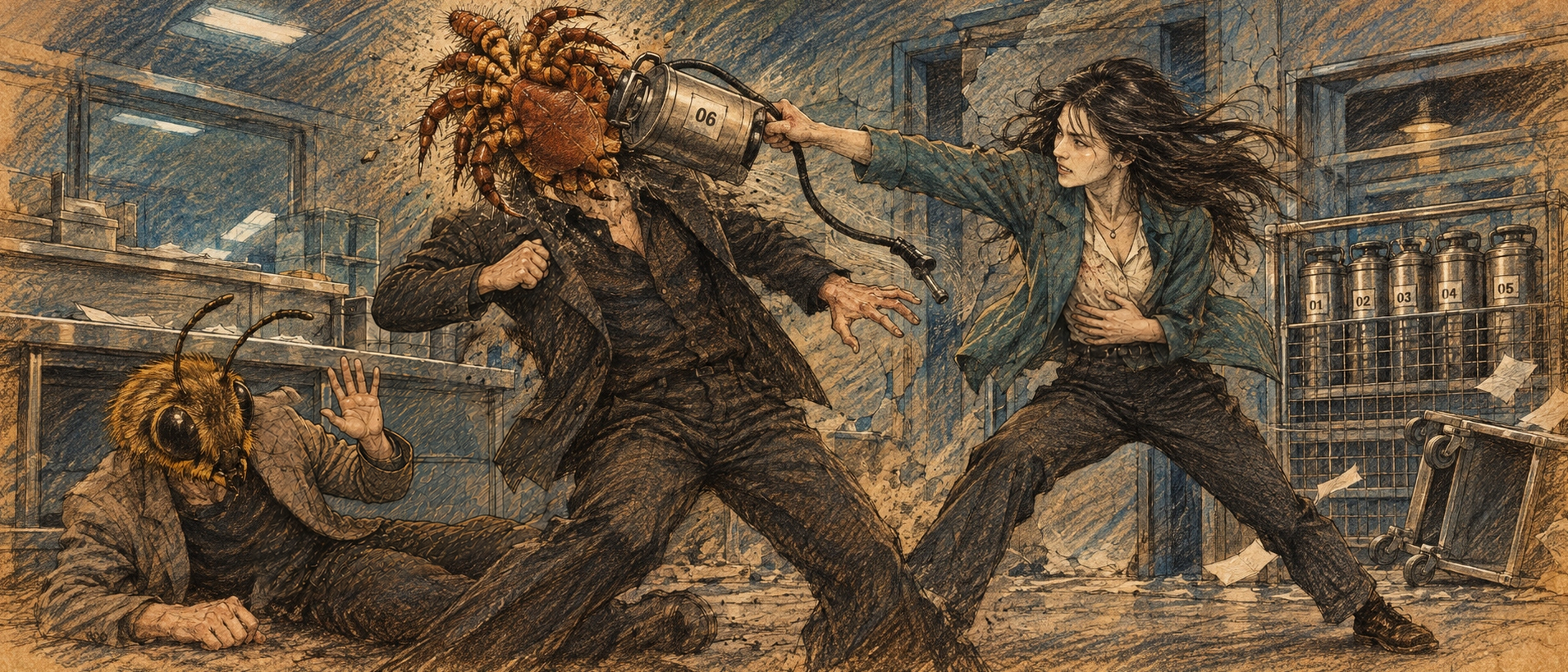
It made him let go.
Nari dropped the canister onto the floor. The attached hose pulled taut, and she caught the hand sprayer as it skidded against her shoe.
Beomseok turned fully toward her.
For one instant the human face tried to return. She saw a familiar eye inside the wrong arrangement of plates.
He said her name.
She pressed the trigger.
The coarse spray struck his exposed face and dark shirt.
He screamed.
The sound had no place in the room. It was too thin and too deep together, like something vast being forced through a crack.
Nari kept spraying.
Where the liquid touched, the creature’s form lost its edges. Not skin burning, not an animal dying from a chemical assault: the shape itself failed, becoming strips of darkness that could no longer agree on where a body ended.
An ordinary mite would not have vanished. The treatment’s measured effects belonged to days and biological processes, not this instant. Whatever law had made Beomseok possible was the thing breaking now.
He reached for her.
Nari stepped back, struck the trolley, and almost fell. She held the trigger even as the spray weakened.
The hand reaching toward her came apart before it arrived.
His last sound ended without an echo. The space in front of her was empty.
The canister tipped against her foot.
For a moment she could not understand why the room had remained. The rack, the labels, the fluorescent light, the little office clock visible through the doorway: all of them persisted with an indecency she could hardly bear.
Jungseok moved.
She dropped the sprayer and went to him.
“Can you stand?”
The bee face turned toward her. She could no longer tell whether the eyes were looking at her or at everything.
“With you,” he said.
She put his arm over her right shoulder. He tried to keep his weight off her, which was both impossible and so entirely like him that she began crying.
The dispatcher was still speaking from her pocket.
Nari told her they were coming out. She said the devices were still there, that nobody should enter.
Outside, Minji shouted again.
Nari and Jungseok moved through the passage and into the service yard. The air smelled of wet earth instead of hot plastic, and beyond the buildings she could hear a siren coming closer.
She did not look back to see whether Beomseok had returned.
For once, she allowed something to be over without checking it again.
What Remains in the Morning
Chapter Twelve | Night into the following days
They reached the far side of the yard, beyond the low wall Minji had identified as the gathering point.
Minji was at the gate directing the arriving responders. She saw Nari and began toward her, but Nari held up her right hand and pointed back at the building.
“Storage,” she called. “Tell them storage.”
Minji looked at the man leaning against the wall, then at the annex, and made the decision Nari needed her to make.
Jungseok’s face was changing.
The compound eyes diminished without becoming smaller. For an instant Nari saw both arrangements at once, one lying over the other like an image not quite aligned with its reflection.
Then it was his face again.
The fall of black hair. The small crease beside his mouth. The expression she had watched over an unreasonable bowl of noodles.
She put a hand against his cheek before she could decide whether she was allowed to be relieved.
“You’re still you,” she said.
He closed his eyes.
“I should have told you.”
She drew her hand back.
“Yes.”
He opened his eyes again. There was no defense in them.
“Not after the trial,” she said. “Not after I said something you wanted to hear.”
“I know.”
“I’m angry with you.”
He nodded. “You should be.”
She hated the fairness of his answer. She wanted enough time to be angry properly, to ask every question, to decide which injuries could be forgiven and which required changes neither of them yet knew how to make.
He was watching his own hand.
Nari looked down.
The light from the yard lamp seemed to pass through the edge of his fingers.
“No,” she said.
He looked at her.
“Tell me what that means.”
He took a breath that did not quite move his chest.
“I was allowed to stay until the work could go on without me.”
“It can’t.”
“It can.”
“There are devices beside the tanks.”
“The records are elsewhere. The samples too. Sora knows what to do. Minji knows who must decide whether anything here can be used.”
“Then you should be here to help them.”
His face changed with an effort she could see.
“That’s what I wanted.”
She looked at the light through his hand again.
“When?”
“When the independent result came back. When you built a way to carry the work without needing to trust one person.”
The canisters. His silence beside them. The temporary appointment.
She had thought he was asking whether she would give him a job.
“You knew.”
“I had a little time. I used it.”
“You could have told me that too.”
“Yes.”
She turned her face away because he was becoming harder to see, and she could not bear to discover that some of it was only tears.
“Don’t tell me this is for my own good.”
“It isn’t,” he said. “If I could stay, I would.”
She faced him again.
He was trying to look at her as though looking were something he could complete.
“What you said at dinner,” he began.
“I meant it.”
“I know.”
“I still mean it. That doesn’t mean I’m not angry.”
Something like his old smile moved across his face.
“You can do two things.”
She laughed once, brokenly.
“More than two. It’s on my references.”
The smile held for a moment.
She asked about his father.
The question hurt him more visibly than the others.
“The care is arranged,” he said. “He knows I can’t always stay. He’s known longer than you.”
“He knows what you are?”
“He taught me how to mend a radio anyway.”
Nari covered her mouth with her hand.
After a moment she asked the question waiting behind all the others.
“Whose face is this?”
Jungseok looked toward the dark beyond the wall.
“A living man’s. Someone I saw, years ago. A countenance I could carry without taking him.”
“You didn’t replace him?”
“No.”
“His memories?”
“His own. His life too.”
She looked at him, searching for the point at which the man she knew ended and an imitation began.
He seemed to understand.
“The university was mine,” he said. “The work. My father. The terrible breakfast.”
“It wasn’t terrible.”
“The toast.”
She tried to smile and could not.
“And Beomseok?”
“Another borrowed face. It belongs to someone who didn’t do this.”
That mattered. She made herself understand it even now.
Beyond the gate, doors slammed. Minji spoke to someone in a uniform. The world continued to require precise information.
Nari looked back at Jungseok.
“What do I call this?” she asked. “Afterward?”
He considered the question with the same care he had given her outside the café.
“You don’t have to call it anything yet.”
She reached for his hand.
“Saranghae,” he said.
“I love you too.” She said it plainly, without making him guess which part of the sentence she could bear. There should have been an ordinary room in which to say it, and time afterward to be embarrassed by how happy it made them.
She stopped just short of touching him. “But don’t make it sound like another apology.”
He shook his head. “It isn’t.”
She closed the last space between their hands.
This time he did not pull away.
His fingers closed around hers, warm enough that she could have believed the light was wrong. She held them carefully, not because gentleness could keep him, but because this was the last thing she could give him without asking for something in return.
They did not kiss.
“I wanted an ordinary day,” she said. “With you. One that didn’t have to mean anything.”
“We had some.”
She thought of a bowl exchanged without permission, a coffee with three sugars, the two of them returning to a workroom because neither had remembered what they were carrying. She had not known to keep those days separate from the rest.
“Not enough.”
“No,” he said. “Not enough.”
His fingers became lighter in hers.
She held on without tightening her grip.
“Goodbye, Jungseok.”
“Annyeonghi gyeseyo, Nari.”
There was no burst of light. No voice from the dark promised that love could overturn the condition he had finally told her.
The warmth diminished. The space occupied by his hand became the space her hand was holding.
Then there was only the night.
Minji found her sitting against the wall.
She asked where Jungseok had gone, and Nari could not answer in a sentence that belonged to the world Minji knew. She said his name once.
Minji knelt beside her and did not ask again until the paramedic arrived.
Morning came with consequences.
The annex remained closed. The devices were dealt with by people whose work Nari watched from outside the perimeter. Nobody asked her to touch a switch, identify a component, or prove that courage had made her qualified for anything else.
The canisters were quarantined.
All six.
Number 06 lay in an evidence container, dented, its hose curled beside it. Nari stared at the label longer than she intended.
The other five had not obviously been damaged. That was not the same as knowing they were fit to use.
Sora said so before Nari could ask.
“I know,” Nari answered.
“The trial will move.”
“I know.”
“We may miss the planned window.”
Nari looked toward the closed building.
“Then we miss it.”
The answer cost money immediately. It would cost more later.
It was still the answer.
Investigators took statements separately. Nari described the threat, the assault, the devices, and Beomseok’s words about the collision. The audio recovered from her phone was incomplete but contained enough to give them questions more concrete than a vanished face.
When she described the transformation, the investigator did not tell her she was wrong. She asked exactly what Nari had seen, what she had heard, and what she could distinguish from inference.
Nari answered as carefully as she could.
There was no body. There was damaged equipment, an unauthorized access trail, and a man whose movements could still be investigated even if his disappearance could not yet be explained.
Gongju’s lawyers sent a statement about the financing calendar. It did not clear Hwangto of wrongdoing. It established, among other things, that a message acknowledging receipt had been sent from the hospital on the night of her visit.
“Thank you,” the message said.
The gratitude had concerned stolen commercial information, not an injured woman in the next room. Nari found that distinction necessary and not remotely comforting.
She gave the material to the investigators and let it remain their work.
At the hotel, Jungseok’s things occupied almost no space.
A spare shirt. A charger. A borrowed screwdriver labeled with the name of the facilities department. His own small notebook, different from the blue one he had given her.
Nari did not open it.
She arranged for his belongings to reach the man who had raised him, with a request that he call whenever he wished. She did not send flowers.
Before leaving Jeju she went back to Haejin’s apiary.
The hives did not look saved. Bees entered and left. Some colonies needed care the new formulation had not yet earned the right to replace.
Haejin stood beside her without offering an interpretation.
After a while Nari asked what work still needed paying for.
Haejin told her.
It was a long answer, and Nari listened to all of it.
A Different Name
Epilogue | September 2029
The first time Nari laughed without feeling afterward that she had betrayed him, she did not notice until several hours later.
It happened in a meeting. Minji said the phrase “single source of truth” and then placed three incompatible shipment records on the table.
Nari laughed, and the meeting continued.
That evening, at Grand Walkerhill, she remembered the sound of it. She sat by the window for a while and let it be something that had happened rather than a test she had passed.
One year later had brought progress of the ordinary kind.
The pilot had proceeded after replacement material, revised timing, and the necessary reviews. Some outcomes encouraged them. Others required changes to the formulation’s handling or reminded them how much a colony’s starting condition mattered.
They had not saved every bee.
They had not abolished mites.
They had established enough to justify broader evaluation without erasing the failures, and Nari had made herself learn to find that sentence satisfying.
Haejin still corrected the company’s publicity drafts. Sora’s group was testing a second manufacturing lot. Minji had finally made the delegated logistics records answer to the same review as everything else, and considered this a greater achievement than the early press coverage.
Nari had visited Jungseok’s father in the winter.
He lived in a modest apartment with a worktable under the best light and more radios than seemed necessary for any one set of ears. At the doorway, Nari greeted him with a deep, respectful bow from the waist, lowering her gaze. He returned the greeting with a nod from his chair; she did not make him stand. He asked whether she preferred tea, accepted her answer, and then discovered that he had run out of it.
“He used to check,” the old man said.
They drank warm water.
Nari had imagined that he might explain the part of Jungseok’s life she had never known. He told her instead about a young man who had once put the wrong screws in a radio case and denied it until the evidence fell onto the floor.
“He argued very politely,” he said. “That doesn’t improve an argument.”
She laughed. The old man smiled, and then neither of them spoke for a while.
Before she left, he gave her the little notebook she had returned with Jungseok’s things.
“There are no secrets in it,” he said. “Mostly expenses. A few things he wanted to remember.”
At the door, she bowed to him again, holding the notebook carefully.
“Annyeonghi gyeseyo,” she said.
“Goodbye,” he answered. “Next time I’ll have tea.”
She did not open it until she got home.
Between a grocery list and a calculation about bus fares, Jungseok had written that she liked the quieter side of a café but always accepted the table nearest the door because people needed to find her.
Below it was one unfinished line: Ask where she would sit if nobody was coming.
Nari kept the notebook beside the blue one. She did not read either every night.
Beomseok remained missing in the official account. The investigation into the collision had found corroborating vehicle and movement records, but there were questions a prosecution could not settle without a defendant.
Gongju cooperated where her lawyers advised cooperation. She and Nari did not become friends.
They met again in May at another industry reception, where the coffee was no better and Gongju was not wearing the pearl bracelet. Nari noticed its absence, then reminded herself that jewelry was not evidence.
“Our review is finished,” Gongju said, before either of them could pretend to be pleased by the encounter. “The archive was incomplete. Enough survived to show we stopped before we understood what we were stopping. Not enough to say we had a product.”
“Did you tell your board both parts?”
“Several times. They preferred the one that made the shortest minute.”
Gongju’s expression invited a laugh. Nari did not give her one yet.
“And the calendar?”
Gongju looked past her toward the room. “I let myself be told it was an informal preview. I knew it wasn’t meant for us. I used it anyway. That is in my statement now.”
Nari waited. She had learned to leave room after an admission instead of supplying the charitable explanation herself.
“The board put those negotiations under independent oversight,” Gongju continued. “I have to ask permission for decisions I used to announce. I’m finding it unpleasant.”
“I imagine you’re making that clear.”
“Very. I don’t want the adjustment mistaken for a change in personality.”
This time Nari smiled despite herself.
Gongju turned her empty cup between her hands. “I told the laboratory manager she should have argued harder. Then I read the closure minutes. She had. I had called it an inability to accept a commercial decision.”
“What did you do?”
“Corrected the record. Asked her to review our next proposals independently, on her terms.”
“Did she?”
“She sent a fee proposal. Apparently clarity has become expensive.”
A waiter approached with fresh cups. Gongju stepped aside to let him reach Nari first. It was a very small courtesy, and Nari accepted it as a courtesy rather than a settlement.
“I still intend to beat you,” Gongju said.
“Publish something worth worrying about.”
Gongju’s smile was sharp enough to be familiar. They took their coffee in different directions. Nothing had been forgiven by accident.
On a bright September morning, Nari sat on a panel interviewing candidates for a university-led research collaboration. Daeji was one of several participating institutions, and the program had finally grown beyond the project that had once seemed to depend on her refusing to stop.
The next candidate’s name was Lee Yunho.
She looked down at his application while the door opened.
“Good morning,” he said, “Annyeong haseyo.”
Nari’s hand stopped on the page.
He stood beside the empty chair wearing a dark jacket that did not fit him quite the way she remembered. His hair fell across his forehead. The tilt of his head, waiting for permission to sit, hurt her with a precision no photograph had managed.
Jungseok’s face looked at her without recognition.
The panel chair introduced everyone. Lee Yunho bowed, thanked them, and sat.
Nari could hear the first question. She could not retain the answer.
Then he began describing a problem in field-study design, and the words reached her because they were not Jungseok’s. He spoke more quickly, with less patience for a digression. He disliked one of the methods Jungseok had defended, and explained why without looking to her for approval.
She asked one question.
“What would make you abandon the explanation you prefer?”
He thought before answering.
Not the same pause. A different man thinking behind a familiar face.
“A good reason,” he said. “But I’d want to know it was good before pretending I was noble about changing my mind.”
The panel laughed.
Nari felt tears gathering and looked down at the application until she could trust her voice.
“I need to recuse myself from this assessment,” she said to the chair. “There is a personal association that could affect my judgment. It concerns a resemblance, not the candidate’s conduct or qualifications.”
Yunho looked alarmed.
She turned to him.
“You’ve done nothing wrong. I’m sorry for the interruption.”
She left the room before she could do anything less fair.
In the corridor she put her hand against the wall and waited.
Nothing disappeared.
The interview continued behind the door.
Two weeks later, she learned through the ordinary program announcement that Yunho had accepted an independently funded university appointment. The selection had been made without her participation; his supervision and evaluation would not belong to Daeji.
She read the announcement once. Then she put it aside and went to lunch.
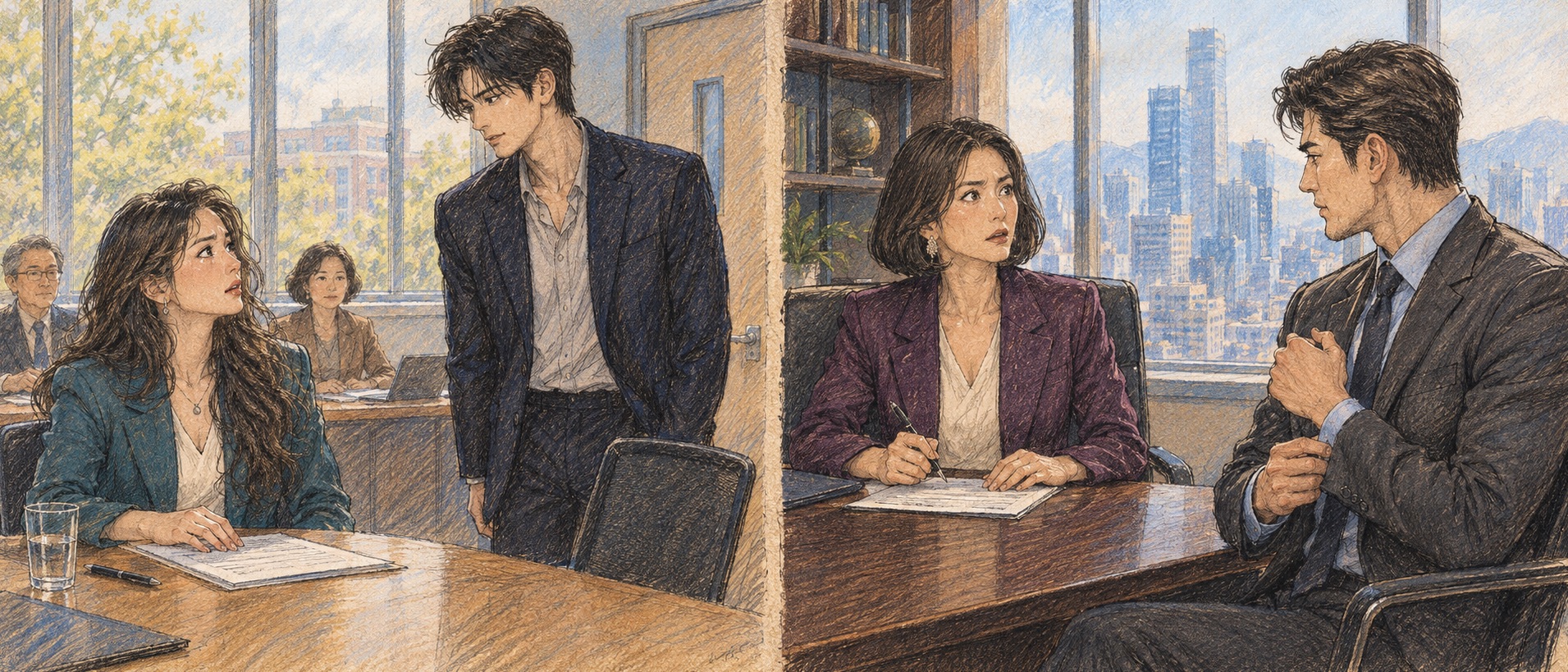
At Hwangto Holdings, Seung-hee Gongju looked up from an application and went completely still.
The man across the desk waited.
“Your name,” she said.
“Park Taegon.”
“And you have a brother?”
He blinked. “A sister.”
“A twin?”
“My sister?”
Gongju looked down at the application, then back at the face that had once assured her a bee project would never justify its expense.
Taegon adjusted his cuffs, a small nervous movement.
“Have we met?” he asked.
Gongju’s hand tightened around her pen.
“No,” she said after a moment. “I don’t believe we have.”
She turned to the qualifications listed on the page.
“Tell me about the experiment that failed.”
Back at Daeji, Nari drafted a message to Yunho three times before sending it through the program coordinator with permission for him not to respond.
She explained that he resembled someone important to her who was gone. She said she understood that resemblance did not make him that person, and that she would not ask him to behave as though it did.
Then she asked whether, outside the collaboration and without any professional expectation attached, he might like to have coffee.
His reply arrived the next afternoon.
“Coffee, yes,” he wrote. “But I’m terrible at being anyone but myself.”
She laughed. Then she cried a little, and neither response cancelled the other.
They met at a café she had not been to before.
He arrived carrying a book about coastal birds.
It was such a small thing to be grateful for: a different book.
Nari ordered her coffee without checking whether he would remember what she liked. He ordered tea, then changed his mind and asked the server a question Jungseok would not have asked.
She let him.
Outside, people moved past the window with the ordinary urgency of lives that did not know they were passing an important moment. No rain began. No childhood connection emerged. Nobody collided with anybody.
“Are you always this careful?” Yunho asked.
Nari looked at the space between their cups.
She thought of a hand she had held until it was no longer there, and of the difference between leaving a place empty and refusing ever to sit somewhere new.
“I’m learning to be,” she said.
He smiled, not quite as she expected.
She found that she wanted to know why.
🪐
Author’s Note: Established science: Varroa destructor is a parasitic mite, and Apis mellifera is the western honeybee. The 2026 Korean surveillance paper identifies Varroa as an important vector of deformed wing virus. The October 2026 National Geographic article describes observations of both Varroa destructor and Tropilaelaps mites in honeybee colonies on Jeju Island. The EPA released a final registration decision for vadescana products for Varroa control on September 25, 2025.
About Romeo Esparrago: Born in 1964, the same year Muhammad Ali said he would “Float like a butterfly, sting like a bee” against Sonny Liston. He did not mention mighty mites. Romeo & his wife started watching Kdramas during Covid.


