
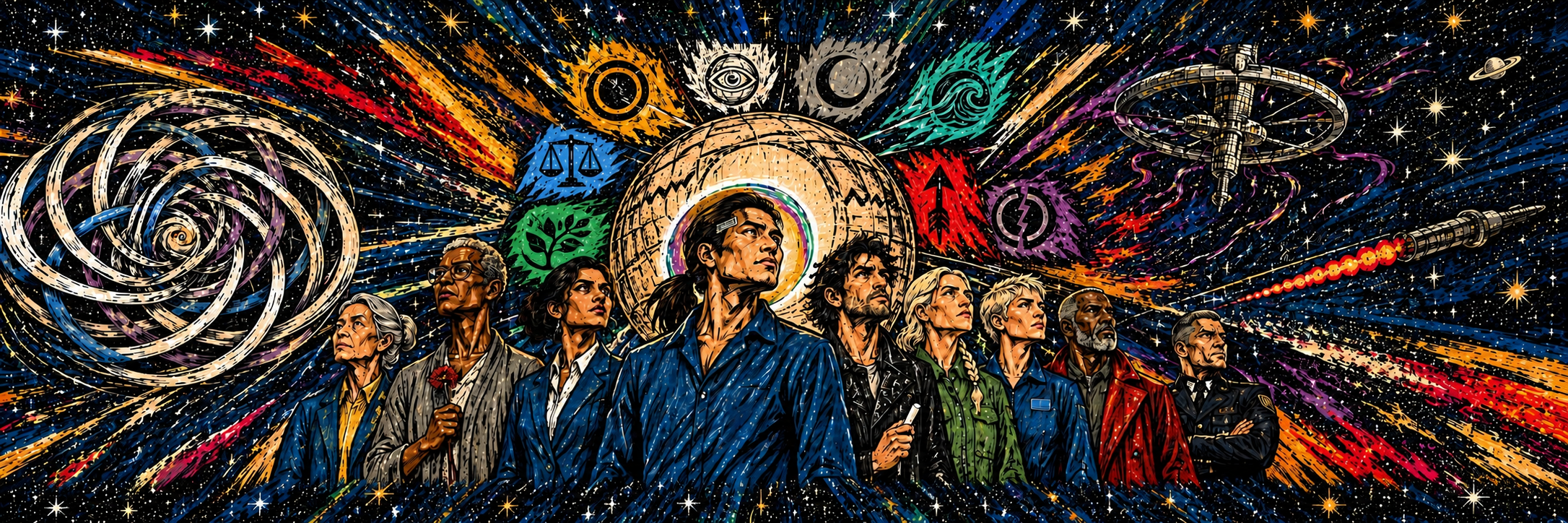
From Romeo Esparrago.
Part One : The Memory of Spacetime.
A wave passes, and the detector does not come back to where it was. It comes back almost. That “almost” is permanent. We call it memory, and it is the most ordinary thing in the universe: everything that has ever happened has left the world very slightly moved.
— From the Founder’s Archive, Lecture 3
Chapter 1: Ten Years of Listening.
Hypatia Station, Sun-Earth L4 · January 2125.
The universe had been noise for ten years, and Amara Osei-Lindqvist was in the middle of thanking it for that when it stopped.
She didn’t know it yet. Nobody in the Founder’s Gallery knew it. Two decks below her, in the Operations ring, a routine residual check finished its run at 14:06 station time and raised a flag that no one had ever seen raised, and the flag sat there, amber and patient, while the Director of the Celestial Array stood at a borrowed lectern and told sixty-four tired people that the sky had been kind to them.
“Ten years ago this week,” Amara said, “we turned on three hundred and twelve instruments and asked them to listen for the smallest thing anyone has ever tried to hear.”The Gallery was the only room on Hypatia with a ceiling high enough to feel like a room. Someone had hung paper lanterns from the cable trays. Someone else had printed the first-light plot, a gray smear of soft-charge map from January 2115, and taped it to the station’s only chalkboard, where it curled at the corners in the recycled air. The air smelled of coffee and warm plastic and the faint ozone that never quite left the ventilation. Through the long viewport behind the audience, Earth was a bright blue star, sixty degrees behind them in its orbit, close enough to call, too far to see clouds on.
On the lectern, beside her printed notes, sat a pressed flower in a small glass frame: a blue anemone her mother had picked in Gothenburg fifty years ago and dried between the pages of a hymnal. Amara didn’t believe in luck. She brought the flower to every speech anyway.
“I’d like to read you something,” she said, and put on her reading glasses, which were smudged, as always. “The Founder said this in a lecture a long time before any of us were hired, and I’ve read it before every hard decision of my career. ‘When we say the sky remembers, we are not being poetic. We are describing a measurement. Every wave that passes through a region leaves it displaced, a little, forever. The question is never whether the record exists. The question is whether we are patient enough to read it.'”
She took off the glasses.
“We have been patient,” she said. “For ten years, we’ve read a record that says, very clearly and in great detail, nothing in particular.”
A laugh went around the room, the warm kind that people give a director they like.
It was true, and it was the Array’s quiet triumph. Gravitational waves from every merging pair of black holes in the observable universe washed through the solar system constantly, each one leaving the spacetime it crossed permanently shifted by an amount too small to imagine. Spread a few hundred test masses from Mercury’s orbit to the Kuiper Belt, keep them falling freely inside their shielded housings, and track the distances between them with lasers to a tenth of a nanometer across baselines of a hundred million kilometers, and you could watch those shifts pile up. Every shift was a soft charge, one entry in the sky’s permanent ledger. Subtract every known source from the ledger, the mergers, the solar wind, the tug of every catalogued rock, and what remained should have been the sum of a billion unrelated accidents. It should have been random. For ten years it had been exactly, beautifully random, and the School had published every month of it under the Open Data Accord, and the world had shrugged, because the world did not get excited about well-behaved noise.
“The sky is not interesting,” Amara said. “That’s the point. We built the most sensitive instrument in history to confirm that the universe keeps honest books. It does. To the next ten years of being boring.”
People raised their bulbs of station champagne, which was neither champagne nor, technically, from the station. Amara stepped away from the lectern, and Rasmus Aaltonen, her deputy, was already beside her, tablet held flat against his chest the way he held it when he didn’t want anyone else to read it.
“Good speech,” he said.
“What’s wrong?”
“Nothing’s wrong.” He smiled at someone over her shoulder. “Ops flagged the residual run. Can you come down when you’ve finished being thanked?”
She looked at his face, which was cheerful and pale. Rasmus had worked for her for six years. He was cheerful the way other people were careful.
“I’ve finished being thanked,” she said.
The Operations ring curved away from them in both directions, a long gray corridor of consoles that always made Amara feel as if she were standing inside a ring of the Array itself. Most of the afternoon shift had gone up to the party. The two analysts who had stayed behind stood when she came in, then sat again, embarrassed.
“Show me,” Amara said.
Rasmus put the residual map on the main wall. It was the celestial sphere, unrolled into an oval: the whole sky as the Array felt it, every direction from which a gravitational wave could arrive. Ten years of data had taught her what it ought to look like. A fine, even grain, like sand under a magnifier. No direction special. No scale preferred.
This was not that.
The grain was still there, but over it lay something else, faint as a watermark held up to light: bands. Not one band but a nested family of them, fine within coarse within fine, arranged so precisely that her eye slid off the structure the way it slid off a page of text in a language she almost knew.
“Run it again,” she said.
“We ran it four times,” said one of the analysts, a young woman named Okonjo. “Different pipelines. Different station subsets. It holds.”
“Since when?”
“It’s in the whole December set, and in the first week of January. Fainter in November. We’re checking back further now.”
Amara put her hands in the pockets of her cardigan. She did that when she wanted them to stop moving.
“The December raw data,” she said. “Has it gone out?”
“This morning,” Rasmus said. “On schedule. Same as every month.”
So it was already public: every raw displacement, every timestamp, posted to the Accord repository nine hours ago for anyone on Earth to read. She pulled up the access logs out of habit. Eleven downloads. Two universities, a weather consortium that used the Array’s solar data, a high school in Lagos that downloaded every month for a class project. Nobody had posted anything about it. Nobody had noticed. Raw residuals didn’t look like anything until you ran them through the School’s own subtraction pipeline, and even then, you had to know what random was supposed to look like.
“What does it look like to you?” she asked Rasmus.
He was quiet longer than she liked.
“Honestly? It’s either a systematic error,” he said, “or the universe is formatting its hard drive.”
Okonjo laughed, then stopped.
Amara didn’t laugh. She was looking at the nested bands and thinking, with the cold clarity that came over her in emergencies, about everything that would happen if this was real and everything that would happen if it wasn’t. A systematic error after ten years meant a recalibration of the whole Array, a public correction, a bad year. Something real meant something she didn’t have a word for yet.
“It’s a systematic,” she said. “Until we prove it isn’t. Nobody says anything else, to anyone, including the people upstairs. Rasmus, get me Teodoro.”
“He’s in the Atacama. It’s four in the morning there.”
“Then he’ll be awake,” Amara said.
She went back up to the Gallery, because a director who vanished from her own anniversary party would be the first thing anyone noticed, and she stayed for an hour, shaking hands. She let a technician from the Habitation ring tell her a long story about his daughter’s wedding. She laughed at the right places. Every few minutes, without meaning to, she looked past the crowd at the first-light plot curling on the chalkboard, the gray smear that had once made her cry because it was so perfectly, reassuringly featureless.
The Open Data Accord was older than the Array. The School had adopted it in 2058, when its founding generation decided that a science of the sky’s memory should keep no secrets of its own. Every raw dataset went public within thirty days. No exceptions, no embargoes, no exclusive first looks for the people who’d built the instruments. Amara had defended it before three funding committees and a parliamentary inquiry. She believed in it the way she believed in gravity.
There was a clause near the end, written for wartime and never used, that let the Director hold derived analyses for review when publishing them might cause harm. Raw data could never be held. Interpretations could, briefly.
She found that she had memorized the clause’s paragraph number, and she didn’t like that she had.
Near midnight, when the lanterns were coming down, she went back to the lectern for the flower. The glass was cool. Her mother had been dead eleven years. Through the viewport, Earth hung where it always hung, a blue spark among the white ones, and somewhere on it eleven people had downloaded the month’s raw data and seen nothing.
Amara put the flower in her cardigan pocket and kept her hand on it all the way back to her quarters.
Teodoro Vance came up from the Chajnantor Plateau on the next transfer shuttle with one bag, two notebooks, and the expression of a man who had already decided the problem was beneath him.
He arrived in the second week of January, unshaven, in the black jacket he wore everywhere, with chalk dust on both sleeves from a lecture he’d walked out of to catch the flight. He didn’t say hello. He said, “Where’s the raw stream?” and Amara pointed, and for the next four weeks Hypatia Station was host to a man trying very hard to prove that he was smarter than the sky.
He started with heat. Every test mass on the Array sat in a housing that warmed and cooled as its station turned toward and away from the Sun, and thermal drift was the oldest enemy the experimentalists had. Teodoro pulled the housing temperatures for all three hundred and twelve stations and built a thermal model by hand on the Gallery chalkboard, then coded it, then ran it, then subtracted it. The bands remained.
“Fine,” he said, to no one.
He moved on to the solar wind. Charged particles pushed on the station hulls, and the drag-free systems corrected for them, but no correction was perfect. He cross-correlated the residuals against eleven years of space-weather data, every flare and every coronal mass ejection, looking for the fingerprint of the Sun’s weather in the pattern. There was none. The bands didn’t care what the Sun was doing.
He went after the Kuiper Belt. Thousands of uncatalogued bodies drifted out past Neptune, each one tugging the outer stations by amounts too small to see individually and too numerous to ignore. If enough of them happened to line up, they could fake structure. Teodoro spent nine days simulating a hundred thousand plausible belts and comparing the false patterns they produced to the real one. The false patterns were lumpy and lazy. The real one was neither.
By the end of January, the night shift had learned to bring him food and leave without speaking. He slept in a chair in the Computation Core, when he slept. When a calculation failed, he swore in Spanish, softly and fluently and at length. When one worked, he swore louder.
Between runs, he played chess against himself.
Amara found him at it one evening in the Gallery, the board set up on a crate beside the chalkboard, black and white pieces locked in a slow, mean middle game. He moved for white, turned the board, and stared at it as black for a long time.
“Who’s winning?” she asked.
“The other one.” He moved a black knight. “Always the other one. That’s what’s wrong with playing yourself. Whoever you are at the moment, you know what the opponent’s planning, so you plan around it, so he plans around that. Whoever moves second wins.” He turned the board again and frowned at what he’d done to himself. “It’s an excellent way to lose.”
“Then why do it?”
“Because it’s the only opponent who never gets bored.” He looked up at her, and she saw for the first time how tired he was. “Amara. It isn’t thermal. It isn’t the Sun. It isn’t rocks.”
“Then what is it?”
“I don’t know yet. But I know what it’s obeying.” He got up and went to the chalkboard, where weeks of failed models were layered over one another in a fog of half-erased chalk, and in a clear patch at the bottom he wrote a single expression: a W with a subscript, one plus infinity.
W1 + ∞
Amara knew it. Everyone in the School knew it. It was one of the jewels of the Founder’s program, a symmetry hidden in the way soft gravitons behaved: an infinite tower of charges, each related to the others by exact algebraic rules. In ordinary data, the tower was a theorist’s object. It told you what relationships the soft charges had to satisfy, in principle. In practice, in noise, you never saw it. The charges were too faint and too random to show their algebra.
“The bands are charges in the tower,” Teodoro said. “Different levels. And they’re not just present. They co-vary. When one level moves, the level above it moves by exactly the amount the bracket says it must. Exactly. Not approximately. I’ve checked twelve levels deep.” He tapped the chalk against the board. “Noise doesn’t do algebra, Amara. Systematic errors don’t do algebra. A broken laser doesn’t know the structure constants of w-one-plus-infinity.”
She stood very still.
“You’re telling me it’s real.”
“I’m telling you I can’t make it go away. That’s not the same thing.” He threw the chalk stub into the tray. “Not yet.”
Amara looked past him at the viewport, at the blue star.
“Suppose you can’t,” she said. “Suppose in a week you come to me and say it’s real. What do we do?”
“We publish.” He said it without hesitation, the way other men said their own names. “That’s the Accord. Raw data in thirty days, analysis when it’s checked. Somebody in Lagos or Lima reads it and finds the mistake we missed, or doesn’t. That’s how it works. That’s the only way it’s ever worked.”
“And if there’s no mistake?”
“Then somebody in Lagos or Lima finds the next thing.” He shrugged. “Also how it works.”
She nodded slowly. She didn’t say anything else, and he noticed, because he noticed everything that wasn’t on a chalkboard, that she hadn’t agreed.
“Amara.”
“Go to bed, Teodoro,” she said. “You’ve lost three games to yourself today. Lose the rest tomorrow.”
There was one more way it could be the Array’s fault, and it was the one he feared most: that the instrument itself was lying in a way too subtle for any single test to catch. A bad batch of laser crystals. A firmware flaw shared by a hundred stations. A clock drift that propagated through the network the way rumors propagate through a department.
So he began to break the Array in software. He threw out every station built in the first production run and rebuilt the map from the rest. The bands held. He threw out every station inside the asteroid belt. They held. He divided the Array into halves at random, a thousand times, and built a thousand pairs of maps from instruments that shared nothing but the sky. In every pair, both halves showed the same nested structure, line for line, as if two strangers on opposite sides of a city had sketched the same skyline from memory.
Okonjo watched one of the runs over his shoulder. “How small is it?” she asked. “The signal, I mean. Physically.”
Teodoro thought about the question rather than the answer, which was a thing he rarely did.
“The biggest bands move the test masses about a tenth of a nanometer,” he said. “Across baselines of an AU. That’s the width of an atom, measured across the distance from here to the Sun.” He nodded at the screen. “Somewhere out there, every few weeks, the solar system gets very slightly moved, in a pattern, and stays moved.”
“That’s nothing,” she said.
“It’s nothing,” he agreed. “It’s also more structure than anyone has ever found in the sky’s memory, and it’s not ours.” He started the next run. “The instrument isn’t lying. I’ve stopped believing it might be. I’m just not ready to say so.”
He gave himself one more week, and in that week he found the last thing.
He’d been thinking about the structure in space, how the bands lay across the sky. On the first night of February, sitting alone in the Core with a cold bulb of coffee and the chess game abandoned three moves from mate, it occurred to him that he hadn’t thought nearly enough about time.
He split the residuals into one-day slices and stacked them. He took the strength of the banding in each slice, a single number, and plotted it against the date. He expected a wandering line, or a flat one.
What he got was a pulse.
The banding swelled and faded and swelled again. It wasn’t a smooth wave. It rose sharply, held, and decayed, like a struck bell, and then, after a long quiet, it came again. He fit the peaks. He refit them with a different method. He went back through December, then November, then all of the previous year, where the effect was fainter but, once he knew what to look for, unmistakable.
He made himself wait an hour before he called her, and he spent the hour trying, with everything he had, to make the number come out different.
It didn’t. It came out the same to four significant figures in every subset of the data he could construct: inner stations, outer stations, the northern sky, the southern sky, this year, last year.
When Amara came into the Core, wrapped in her cardigan, her hair flattened on one side from the pillow, he didn’t turn around. He just pointed at the screen, at the row of peaks marching across ten years of the sky’s memory with the regularity of a clock.
“Every seventeen point three days,” Teodoro said. “Something out there is doing this on a schedule.”
Chapter 2: The Greeting
Santiago, Chile · March 2125
The file came to Kai Nakamura-Reyes at 11:40 on a Tuesday night with a subject line that said only “look at this, quietly,” and he did what he always did with things he was told to look at quietly, which was look at them loudly, alone, for three days, without sleeping.
It wasn’t really his file. It was Teodoro’s, forwarded by Mei-Lin, and Mei-Lin’s note was one line long: Teodoro wants a twistor reading of the attached, and he says if it is a systematic error he will buy dinner for the whole group, so please be thorough before you are clever.
Kai read that twice and grinned. Mei-Lin Zhao had been his doctoral advisor for four years, and he had learned to read her courtesy the way other students read a grade. Be thorough before you are clever meant: I think this is important, and I am frightened, and I want you to be careful with it.
He made coffee. It was the first of what would turn out to be nineteen.
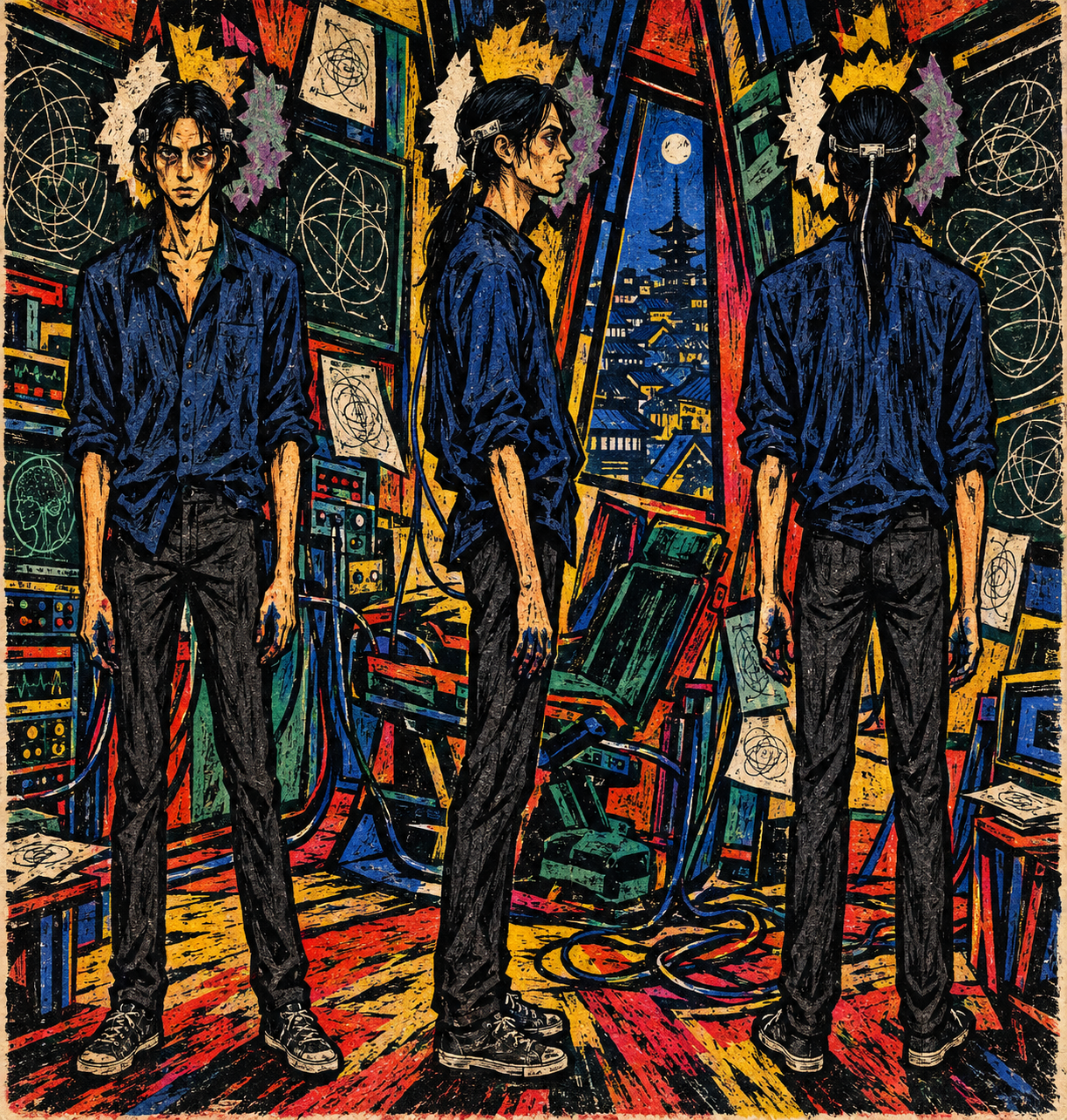
Outside, Santiago was settling into a warm autumn night, the traffic on Avenida Brasil thinning, a dog barking two streets over. Kai opened the window for air, sat down at the desk, and opened the attachment.
His flat was four floors above a bakery in Barrio Brasil, one room plus a kitchen the size of a confession booth, and in four years of living there he had covered every wall with paper. Not posters.
Sheets of drafting paper, taped edge to edge, each one dense with curves drawn in black ink: circles and figure eights and long looping spirals that folded back on themselves, the shapes of maps from a sphere into a space with four complex dimensions.
Holomorphic curves. He drew them the way other people doodled faces. He drew them on receipts and napkins and in the margins of every paper he had ever read, and his fingers were stained to the second knuckle with ink that never quite washed out.
On the desk by the window sat a chessboard he never played on. Teodoro had given it to him two years ago, after Kai beat him once, by accident, in the Atacama. Teodoro had looked at the board for a long time and said, “Keep it. Learn to lose properly. You’ll need to.” Kai had no idea what that meant. He kept the board set up in the opening position, the way Teodoro had left it, and used the gap between the rooks as a place to put his mug.
The data was a stack of residual maps of the sky, one per day for a little over a year, with the nested banding Teodoro had found laid over the noise like frost on a window. Attached was a single plot: banding strength against time, a row of sharp peaks, seventeen point three days apart.
Kai looked at the peaks for an hour before he looked at anything else. Then he opened one pulse and began, very slowly, to take it apart.
The first night, he found the block.
Inside each pulse, the banding wasn’t one pattern. It was a sequence of patterns, each lasting a few hours, and when he laid the sequences from different pulses side by side, most of them differed. One didn’t. Near the start of every pulse, for about six hours, the same configuration of bands appeared. Not similar. The same, down to the limit of the Array’s sensitivity, as if someone had pressed the same stamp into the sky every seventeen point three days.
He wrote to Mei-Lin at 4 a.m.: There’s a repeating block. Same every pulse. It’s like a header.
She wrote back at 4:06, which told him she wasn’t sleeping either: Or a signature. Or a property of the source. Be thorough.
He was thorough. He checked that the block wasn’t an artifact of how he’d cut the data. He checked that it appeared in the inner stations and the outer stations independently. He checked it against Teodoro’s w-tower relations and found that it obeyed them as strictly as the rest of the signal, maybe more strictly. By dawn, the bakery downstairs was firing its ovens, and the smell of bread came up through the floor, and he’d stopped doubting that the block was real and started wondering what it was.
The second day was the dictionary.
What the Array measured, at bottom, were soft charges: one number for every direction on the sky, saying how much the spacetime in that direction had been permanently moved. A map of numbers on a sphere. And the School had spent the better part of a century learning that a map of numbers on the celestial sphere was not just a map. Through the Founder’s program and everything that grew from it, data on the sky’s sphere could be translated into the language of twistor space, the strange four-complex-dimensional space where Penrose had shown that self-dual gravity becomes pure geometry. Soft charges in the w-tower corresponded to small deformations of twistor space. Twistor sigma models described graviton scattering as maps from a sphere into twistor space. One sphere, sending curves into the other.
So here was the question that kept Kai pacing the length of his room, five steps each way, from the window to the kitchen and back: what if the block wasn’t a picture of the sky? What if it was a set of instructions for a scattering process, written in the only language that the sky’s memory could hold?
A graviton scattering process had a precise list of ingredients. For each graviton coming in or going out, a direction on the celestial sphere, an energy, and a helicity, the handedness of its spin. Feed those into the sigma model, and the model told you how likely that scattering was. The answer was the amplitude.
Around noon, he went downstairs for the first time in a day and a half and bought a marraqueta from the bakery, still warm, and ate it standing on the sidewalk in the sun, tearing it with his ink-black fingers. The woman behind the counter, who had known him for four years, asked if he was sick. He said he was working. She said that was what sick people always said.
He’d grown up in a house on Mission Road in San Antonio, four rooms and a pecan tree, the son of a Japanese hydrologist and a Mexican-American schoolteacher who sang while she graded papers. He’d come to physics at fourteen through a library book about black holes, and to twistors at nineteen through a single lecture, archived and grainy, in which the Founder had drawn the celestial sphere on a board and said, in passing, that everything which had ever happened to the universe was written on it, if only we were clever enough to read the handwriting. He had decided, at nineteen, to learn the handwriting.
He went back upstairs with half the bread in his pocket and forgot about it until the next morning.
He tried reading the block as a list of gravitons. It took most of the day to find a reading that wasn’t nonsense. Bands of one orientation as positive helicity, the other as negative. The center of each band as a direction. Its strength as an energy. At first the numbers were garbage. Then he realized that he had the scale wrong, that the energies were encoded relative to each other rather than absolutely, and he fixed it, and the garbage turned into a list.
Seven gravitons. Two of one helicity, five of the other.
He sat down on the floor, because his legs had decided to.
There was a test that random lists of gravitons almost never passed: momentum had to be conserved. Whatever came in had to equal whatever went out, in every direction, exactly. If you picked seven gravitons by chance, their momenta wouldn’t balance. Nature balanced them only in real scattering events. Anything else would have to be chosen.
He added up the momenta. It took a few minutes, because his hands weren’t steady, and he did it by hand first, on the back of a curve-covered sheet, the way Teodoro had taught him to before trusting code.
They balanced. Not approximately. They balanced to within the measurement error of the Array, in all four components, which meant that the block described a scattering process that could really happen, and that whoever had pressed it into the sky had done the arithmetic first.
Kai called his mother, because it was the only thing he could think of to do that wasn’t screaming.
It was early evening in San Antonio. She didn’t pick up. Her voicemail greeting played instead, the one she’d recorded years ago and never changed, half in Spanish and half in English, her voice warm and amused, the voice that had sung to him when he was small in the yard behind the house on Mission Road: “You’ve reached Lupe. If this is Kai, eat something.”
He laughed so hard he had to sit down again. He didn’t leave a message. He listened to the greeting three more times and then went back to work.
Two gravitons of one helicity and five of the other. Kai knew exactly what that was. Every student of the field knew it. It was the first nontrivial example in every textbook, the first amplitude anyone learned to compute, the “hello world” of graviton scattering.
It had a name: maximally helicity violating, or MHV. The name was a historical joke. It sounded like a violation, but it was the gentlest scattering there was. In the self-dual sector of gravity, where only one handedness of curvature existed, almost nothing scattered at all; the sector was perfectly ordered, integrable, a crystal of a theory. MHV amplitudes were the first step out of that crystal. A self-dual background plus a single disturbance. As close to perfect order as anything could be while still actually happening.
In the twistor sigma model, MHV amplitudes came from the simplest maps of all, maps of degree one, which sent the sphere to straight lines in twistor space. There was a formula for them, beautiful and compact, a determinant you could write on one board. It took hours to evaluate, not weeks.
Kai set it running on the group’s cluster a little after midnight on the third night and then sat at his desk with nothing to do but wait.
He didn’t sleep. He didn’t really think. He drew. He filled the margins of his notebook with lines in twistor space and the spheres that mapped to them, degree-one curves, simple as circles, crowding each other until the page was black at the edges. The lamp on the desk made a yellow circle on the paper. Beyond the window, the city’s rooftops ran down toward the Mapocho, gray and blue under a sky with a few bright stars in it, and the bakery’s first trays went into the ovens at four, and the bread smell came up through the floor again.
At 4:52, the computation finished.
It was a number. Amplitudes were complex numbers, magnitude and phase, and this one was neither zero nor infinity nor anything strange, just a clean, ordinary value. Kai looked at it for a while. Then he did what he should have done first and checked it against what the Array had measured: the amplitude predicted the exact strength of each band in the block relative to every other band.
It matched. All of it.
He pulled the amplitude into the visualizer and let it render, not as a number but as a shape: the seven legs as rays on the celestial sphere and the degree-one curves that built them laid over each other in twistor space, projected down into something a human eye could follow. Two rings appeared, gold and silver, interlocked and slightly tilted, each threaded by fainter loops, rotating slowly over his desk like something that had always been there and was only now consenting to be seen.
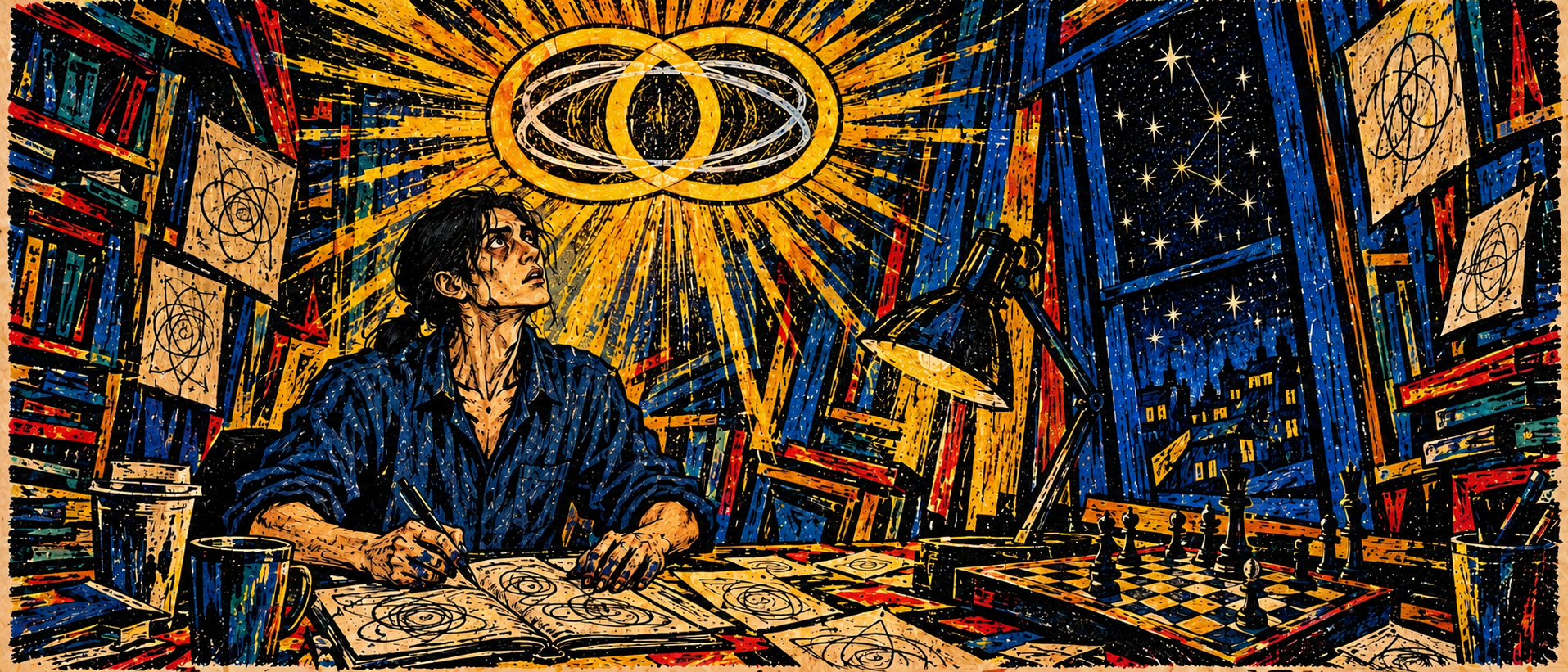
Kai sat back in his chair and looked up at it, and for a long time he didn’t do anything, because there was nothing in his life that had prepared him for what to do.
Someone had said hello.
Not in words. Not in light. In the deepest grammar of physics, in the most basic sentence the theory of gravity could form, written in the memory of spacetime itself and repeated every seventeen point three days, for at least a year, maybe for ten, maybe for longer, while three hundred and twelve instruments recorded it and the School published it every month and nobody on Earth knew how to read it.
“Hi,” Kai said, out loud, to the empty room.
His voice sounded strange. He realized it was the first thing he’d said in nineteen hours.
He sent it to Mei-Lin at 5:10, with the momentum check, the amplitude, the comparison, and a single line: It’s MHV. Seven-point. Textbook. They’re starting with hello world.
He sent the same package to Teodoro on Hypatia, which meant sending it sixty degrees around Earth’s orbit to a station a hundred and fifty million kilometers away. Light took eight minutes and twenty seconds each way. Kai sat and watched the clock on his screen, because he couldn’t do anything else, and calculated without wanting to that Teodoro could not possibly answer in less than sixteen minutes and forty seconds, even if he were awake, even if he read it instantly, even if he typed nothing at all.
The reply came in nineteen minutes.
Dinner’s off. Don’t use the word “message” in anything you write down. Not to Mei-Lin, not to your mother, not to your diary. Amara will want to decide what this is called. Did you check momentum conservation by hand?
Yes, Kai wrote back. Before code. Like you said.
Nineteen minutes later: Good. Then I believe you. I hate that I believe you. Go eat something.
It was the second time that night someone had told him to eat. He didn’t.
Mei-Lin called at 5:40, not by message but by voice, which she almost never did, and when her face came up on the screen she was already dressed, with her gray hair pinned up and her coat on, as if she’d been sitting by the door.
“I’ve looked at it,” she said. “Twice. You were thorough.”
“Was I clever?”
“Unfortunately, yes.” She smiled, but only with her mouth. “Kai. I want to ask you a question, and I want you to think before you answer, because I don’t think either of us knows the answer. Why would anyone speak to us in our own textbook?”
He opened his mouth and closed it again.
“It isn’t our textbook,” he said finally. “It’s physics. MHV is the simplest thing gravity can say. Anyone who understood gravity would start there. It’s like prime numbers in the old stories. You start with what any mind has to know.”
“Perhaps.” She looked away from the camera for a moment, toward something in her own apartment that he couldn’t see. “Or perhaps they have read everything we ever wrote about it. Both answers frighten me, and I can’t decide which one frightens me more. I’m coming over. I’ll bring food. Don’t touch anything else until I get there.”
“I won’t,” Kai said, and as soon as she’d gone, he did.
Because the rule was thoroughness before cleverness, he went back to the block one more time and did the last thing he hadn’t done. He’d checked what the gravitons were. He hadn’t checked where they were pointing.
In a scattering process, some gravitons came in and some went out. The block’s encoding made the difference clear, and when he plotted the incoming legs on a sky map, they didn’t scatter across the sphere the way they did in textbook examples. All three of them came from the same direction. Not exactly the same, but all of them inside one small patch of sky, a few degrees across, as if the whole configuration had been aimed.
He turned the sky map into ordinary coordinates, right ascension and declination, and it took him a moment to recognize the patch. It lay just south of the zodiac, in a faint, sprawling stretch of sky with almost no bright stars, a region that skywatchers since antiquity had called the Sea because so little lived in it.
He knew the name because his mother had taught him the constellations from the yard on Mission Road, pointing up through the Texas haze, inventing the ones she’d forgotten.
The incoming momenta of the greeting pointed back toward the constellation Cetus, the Whale. This time of year, it set just after the Sun, lost in the evening glare, the one patch of sky no one on Earth could look at for long.
Kai stared at the patch until the window behind him went gray with dawn. Mei-Lin would be another twenty minutes, at least. He wrote to her anyway, so the sentence would be waiting when she arrived.
It isn’t just saying hello, he typed. It’s saying where from.
Chapter 3: Object Nauvoo
Hypatia Station · May 2125
Ines Halvorsen had built the stations with her own hands, or near enough, and she didn’t like asking them to do things they weren’t designed for. She did it anyway, at three in the morning, with a mug of cold tea and a screwdriver she wasn’t using in her left fist, because that was how she thought.
“K-207, K-211, K-219,” she said. “Those three.”
The night operator on the Operations ring, a thin young man named Duarte who had never seen the Chief Experimentalist outside of daylight hours, pulled them up on the main wall. Three dots among the hundreds, far out past Neptune at the Array’s ragged edge, forty-some AU from the Sun and strung across eighty AU of the Kuiper Belt.
“They’re the outermost we have on that side of the sky,” Ines said. “If something in Cetus is close enough to matter, those are the stations that can see it bend.”
“Bend?”
“The wavefront.” She drew it in the air with the screwdriver: a curve. “If a source is at infinity, its waves arrive flat. If it’s nearby, they arrive curved. Spread your detectors far enough apart and you can measure the curve, and the curve tells you the distance. It’s parallax with gravity instead of light.” She put the screwdriver down. “We’ve never done it, because nothing’s ever been close enough to try.”
For two months, since the night Kai Nakamura-Reyes had sent Mei-Lin a seven-point amplitude and the words “hello world,” the inner circle had been trying to answer two questions. What was speaking? And where was it? The greeting’s incoming legs pointed toward one small patch of Cetus, but a direction wasn’t a location. The thing could be a light-year away or a billion. Ines thought it was close. She couldn’t have said why, except that the banding was too crisp, too unblurred by distance, like a voice that sounded as if it were in the next room.
To find out, she had to change what the three stations were doing. Each one carried two test masses, gold-platinum cubes that fell freely inside their housings, and the laser links that measured the distances between stations ran along fixed lines. She needed new lines: longer baselines, aimed differently, and the test masses held to tighter tolerances than they’d been built for. That meant nudging them. The stations had small electrostatic drives for exactly that purpose, to recenter the masses after a disturbance. Ines wrote a sequence that would use them to shift all six masses into new positions over four hours, then retune and repoint the links.
She sent the commands at 03:41 station time. At forty-five AU, the stations were six hours and fourteen minutes of light away. The commands would reach them a little before ten, and she wouldn’t know they’d worked until four in the afternoon.
She went to bed. She didn’t sleep. At 16:20, the confirmations came in, all six masses in position, all links locked, and the first triangulated data began to flow.
It took nine days of data before the curve was clear enough to measure.
Ines spent them in the Computation Core with Teodoro, who had stayed on at Hypatia after his January weeks of failing to make the signal go away and who now refused to go home until it explained itself. They were not natural collaborators. Teodoro talked constantly, interrupted himself, and swore in two languages. Ines said perhaps forty words a day, and nine of them were “no.”
On the ninth day, she said, “There.”
The wavefront was curved. Not by much, a few parts in a thousand across the eighty-AU spread of her three stations, but measurably, unmistakably, and when she fit the curvature to a distance, the number came out small. Small enough that she had to read it twice.
Nine hundred AU.
The source was inside the solar system’s outer halo, farther than any probe had ever gone but less than a hundredth of the distance to the nearest star. Not out in the galaxy. Here. In the neighborhood.
“Size?” Teodoro said.
She fit that too, from the way the signal’s strength fell off across the baselines. The source wasn’t a point. It had a gravitational footprint about 0.02 AU across, three million kilometers, eight times the distance from Earth to the Moon.
“Mass?”
“Not much. Less than a small moon.” She frowned. “It doesn’t behave like a mass. It behaves like a shape.”
Teodoro was already on the comm to the Hypatia observatory, a modest pair of telescopes on the station’s sunward truss that mostly watched the Sun for space-weather warnings. From Earth, Cetus was setting into the evening glare that month, impossible to study. From L4, sixty degrees around the orbit, the Sun sat somewhere else entirely, and Cetus was open sky.
The telescopes looked for four hours, in visible light, in infrared, in every band they had. At nine hundred AU, a body three million kilometers across, lit by a Sun that would be just a brilliant star from there, should have been faint but findable.
There was nothing. Not a dark disk against background stars. Not a glint. The stars behind the position were all there, all where they should be, except that a handful of them near the center were very slightly displaced, smeared into short arcs, as if seen through a flaw in old glass.
“Lensing,” Teodoro said softly. “It bends light. It just doesn’t have anything in it.”
That was when they put the triangulated data through Kai’s dictionary.
The School’s twistor pipeline had been built for one job: turn soft-charge data on the celestial sphere into the language of twistor space, so that theorists could read gravity as geometry. Kai had spent two months tuning it on the greeting. Now Ines fed it the signal from nine hundred AU, the shape itself rather than the pulses, and asked it the simplest question it knew how to answer: what kind of geometry would produce this?
The pipeline took six hours. It came back with a match so clean that Ines thought the software had crashed and was showing her a textbook example.
Taub-NUT.
Teodoro said a word in Spanish she didn’t know and sat down on the deck.
She knew the name the way an experimentalist knew theorists’ names, as something she’d been taught once and filed. Teodoro didn’t wait for her to ask. He talked, fast and low, mostly to himself.
“It’s a gravitational instanton. In its Euclidean form, it’s one of the simplest hyperkähler manifolds there is.” He saw her face. “Hyperkähler means it has not one complex structure but a whole sphere of them. Every point on a sphere is a different, equally valid way of being complex. You don’t get that by accident. It’s extraordinarily rigid. And it’s self-dual, Ines, only one handedness of curvature, the same sector the greeting came from. And the twisting. Look.”
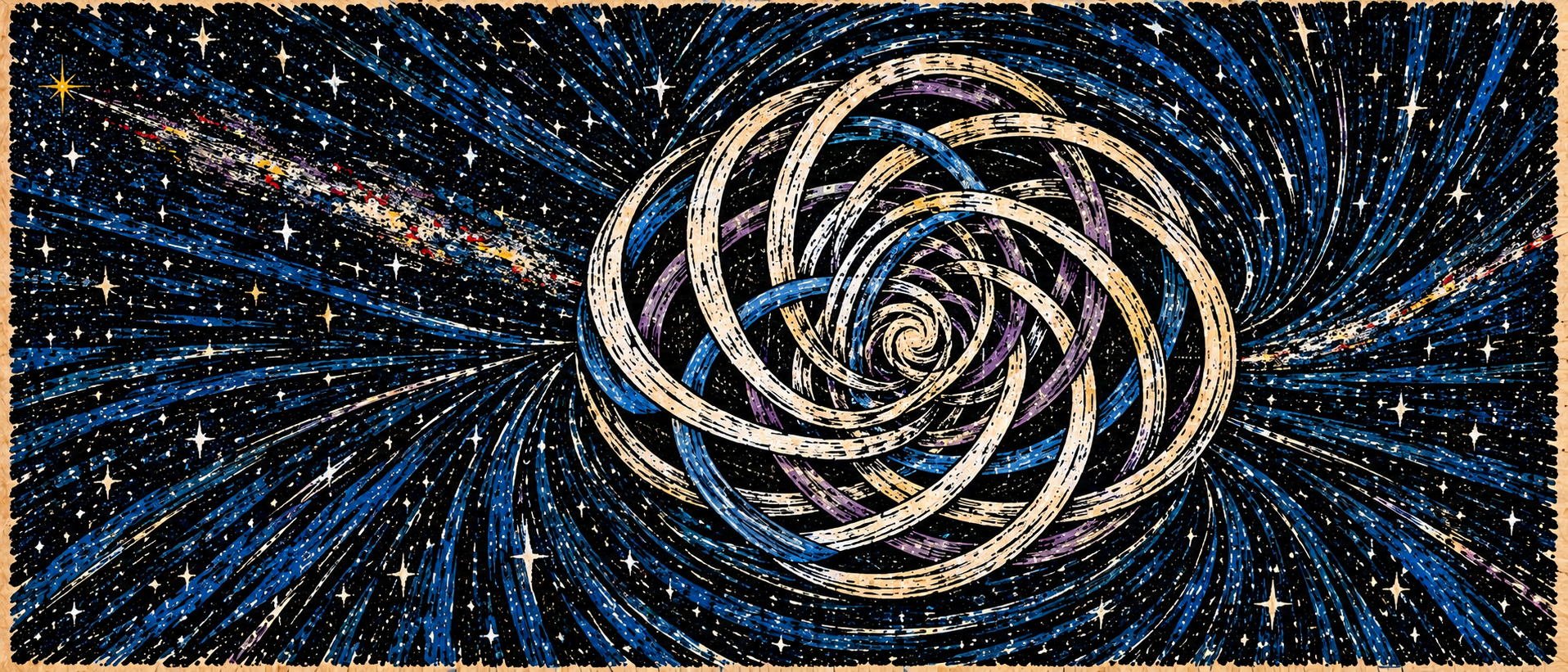
He pulled up the pipeline’s rendering. The geometry wasn’t a ball or a disk. It was a nest of circles, every circle linked through every other, each threaded around its neighbors the way fibers twist in a rope, one circle sitting over every point of ordinary space and the whole thing turning on itself in a single elegant knot.
“That’s the circle fibration,” he said. “Every point has a little circle over it, and the circles twist as you go around. That’s Taub-NUT.”
“Could it be natural?” Ines said.
Teodoro laughed, and it wasn’t a happy sound.
“In twistor space, as math, it’s lovely. Here’s the problem. We’re not in twistor space. We’re in spacetime, and in spacetime the thing behaves like the Lorentzian version, and Lorentzian Taub-NUT has a twisted time direction. Time itself winds around those circles. Nature has no way to build that. No star collapses into it. No explosion leaves it behind. There’s no process in the universe that makes a region where time twists like that.” He looked up at her from the deck. “Someone made it. On purpose. Three million kilometers across, nine hundred AU away, and pointed at us.”
Ines picked up her screwdriver again.
“Then it needs a name,” she said.
Her team had a convention, started as a joke a decade ago when the first test-mass glitches needed catalog names and hardened since into tradition: every anomalous target was named for a town that had once been a refuge. They had Object Le Chambon, after the French village that hid thousands during the war. They had Object Chefchaouen, after the mountain town in Morocco that had taken in exiles from Spain. Those had both turned out to be loose cables.
“Nauvoo,” Ines said.
Teodoro raised his eyebrows.
“A town on a bend of the Mississippi,” she said. “In Illinois. People fleeing violence built it out of a swamp in the 1830s. When they were driven out of it, other refugees came and lived in their houses. It was a refuge twice.” She shrugged. “I read about it once on a long flight. It stayed with me.”
“Object Nauvoo,” Teodoro said. “Fine. It’s better than Object Something Terrible.”
There was one more number Ines needed, and she found it on the eleventh day.
She’d been watching the pulses. Since January, every seventeen point three days, the same pattern had come from the direction of Cetus: the greeting block, then hours of other structure that no one could read yet. The pulses arrived like clockwork, and she had stopped noticing them the way people stop noticing a clock.
The pulse on the eleventh day after the re-tasking was different.
The greeting block was the same. What followed wasn’t. The modulation had changed: new bands, a new rhythm, not random and not the old pattern. Duarte flagged it at 09:12. Ines looked at it for one minute, and then she took a sheet of paper from her notebook, because she trusted pencil for this kind of arithmetic more than any screen.
The commands had gone out at 03:41 on the first day. Six hours and fourteen minutes to the stations, at the speed of light. At the stations, the test masses had moved: six gold-platinum cubes shifted a few micrometers on electrostatic drives, a structured motion of mass, in a pattern no one had ever sent before.
Every motion of mass left a trace in spacetime. Everyone in the School knew the phrase for it, and used it casually: soft hair. The faint, permanent imprint every object carried of everything that had scattered past it. Moving the masses had written something, very faintly, into the soft hair of the stations themselves. It was a whisper too small to measure on any instrument humans owned.
But they had not built Object Nauvoo.
From the stations to Nauvoo, about eight hundred and fifty-five AU. Four days and twenty-three hours, at light speed. Back again, the same. Then six hours and fourteen minutes for the changed signal to cross from the stations to Hypatia.
She added it up. Ten days, nine hours, give or take the hours she hadn’t been able to measure. That was the absolute minimum. Nothing in the universe could have reacted to her re-tasking sooner.
The change had arrived at eleven days.
Ines put the pencil down and looked at the number for a long time. Then she put her hands flat on the console, because they had started to shake, and she was a builder and builders did not shake.
It had heard them. Not in ten years, not in a month. In the shortest time that physics allowed, plus a few hours, as if it had been waiting at the other end of the line with its hand already on the receiver.
“It knows,” she said to Duarte. “It knows we’ve noticed it.”
Amara convened the inner circle that evening in the Founder’s Gallery, because it was the only room on Hypatia with a door that locked from the inside.
There were six of them: Amara, Teodoro, Ines, Rasmus, and Priya Raman-Okafor, the School’s ethicist, who had been brought in that afternoon and given four hours to read everything. Mei-Lin’s position paper, co-signed by Kai, lay on the table, sent up from Santiago with its eight-minute lag that afternoon. The chess game Teodoro had abandoned in January was still on its crate by the chalkboard. No one had moved a piece.
“I’ll be brief,” Amara said, “because I’ve already decided, and I’d rather you argue with what I’ve decided than with what I might decide.”
She put on her reading glasses. The flower sat in its frame by her notes.
“The raw data has been public since January, as the Accord requires. It will continue to be public, on schedule, every month. I won’t touch it. Anyone on Earth can download every displacement we’ve recorded. No one outside this room has recognized what’s in it, because recognizing it requires the derived analyses: Teodoro’s w-tower relations, Kai’s decoding, and now Ines’s triangulation.” She took off the glasses. “Under Clause 19 of the Accord, the Director may hold derived analyses for review when their release may cause harm. I’m invoking it. Kai’s decoding and the Nauvoo triangulation are held, as of tonight, until we understand what we’re dealing with.”
The room was quiet. Through the Gallery viewport, the blue star of Earth hung where it always hung.
“Clause 19,” Priya said, “was written for wartime.”
She hadn’t raised her voice. She never did. She sat very straight, in a gray suit too crisp for a space station, with silver rings on four fingers and a paper copy of the Accord on the table in front of her. She hadn’t opened it. She didn’t need to.
“It was written,” Priya went on, “so that a Director could hold back an analysis of, for example, a weapons test detected in the Array data, for long enough to warn the people at risk. It’s a clause about protecting people from a specific, imminent harm. It was never meant to let us decide, indefinitely, whether the species gets to know that it isn’t alone.”
“I’m not deciding indefinitely.”
“Then for how long?”
Amara didn’t answer, because she didn’t have one.
“I’m not certain,” she said at last. “Long enough to know whether telling eight billion people that something is writing in the sky will save anyone or hurt them. Long enough to know whether it’s dangerous. Priya, we don’t know what it is. We don’t know what it wants. We have a greeting and a reaction time. If I release Kai’s paper tomorrow, by the end of the week there will be governments asking who authorized the stations to answer it.”
“No one authorized it,” Teodoro said. “Ines moved some test masses. It heard.”
“That’s exactly what they’ll ask about,” Amara said.
“Mei-Lin and Kai disagree with you,” Rasmus said quietly. He tapped the position paper. “They recommend release. All of it, now. Mei-Lin’s words: ‘If something is speaking to the species, the species should be allowed to listen. We are not its guardians. We are only the people who happened to be holding the instrument.'”
“I’ve read it,” Amara said. “It’s a good paper. It’s an honest one.” She folded her hands on the table. “Kai is twenty-six years old and has been awake for most of the past two months. Mei-Lin is the kindest person I know, and she has never in her life had to stand in front of a parliament. I don’t doubt either of them. I doubt the world’s capacity to hear this correctly the first time.”
“That isn’t your decision to make,” Priya said.
“No,” Amara said. “But it’s my clause to invoke. And I’m invoking it.”
Ines said nothing. She looked at her hands.
Priya held Amara’s eyes for a long moment, then nodded once, as if confirming something she’d expected.
“I’ll put my objection in writing,” she said. “A formal memo, to the Director, copied to the School’s governing council, to be released with the analyses whenever they’re released. It will say that the clause was never meant for this, and that I said so on the first day.” She slid the Accord into her bag. “I’m not going to break the rule tonight, Amara. But I want there to be a record of the day we bent it.”
“There’ll be a record,” Amara said quietly. “There’s always a record. That’s what we study.”
Ines left the Gallery before the others, and she didn’t go to her quarters.
She went to a comm booth on the Habitation ring, a small padded cell meant for private calls home, and she sealed the door and placed a call to the Outer System Survey Directorate in Geneva. It was evening there too. The program officer who picked up knew her. Everyone in the survey business knew Ines Halvorsen. Half their instruments used her designs.
“The Long Elsewhere,” Ines said. “The crewed Oort survey. Still scheduled for 2127?”
“Still on schedule,” the officer said, eight minutes and twenty seconds after she’d asked, because that was how far away Geneva was, and Ines waited through all of it without moving. “Hull’s nearly finished in the high-orbit yard. Why?”
“I’d like to know whether its instrument suite can be upgraded. Specifically, whether it could carry a full memory interferometer. Array-class. Test masses, drives, the works.” She paused. “I’d design it. I’d supervise the build myself.”
Another eight minutes. Another eight.
“That’s a significant change,” the officer said, when the reply came. “It would cost mass. May I ask why?”
Ines looked at the padded wall of the booth. Her daughter, Sigrid, twenty-three, with Ines’s own coloring and a cropped haircut that Ines privately hated, had been assigned to the Long Elsewhere as its navigator a year ago, before any of this, before the anomaly. She was in the high-orbit yard right now, learning the ship. She wore Ines’s father’s old wristwatch, set to Tromsø time.
“Science,” Ines said. “An Oort survey ship with an Array-class suite would give us baselines no one has ever had. Send me the mass budget.”
She ended the call before the eight minutes could bring her another question. She told no one about it, not Amara, not Teodoro, and certainly not Sigrid.
Amara was the last to leave the Gallery. She stayed to put the flower back in her pocket and to look, for a while, at Teodoro’s abandoned chess game, the white king boxed in, three moves from mate, waiting for someone to finish it.
Her comm chimed at 23:50. It was Duarte, on the night shift in Operations, and his voice was very careful.
“Director. The pulse that came in this morning. Kai’s pipeline finished the first pass on it.”
“And?”
“It’s not the greeting. It’s another amplitude. A longer one, many more legs, weeks of compute to evaluate. But Kai sent a note with it.” He read it to her. “He says the first part is us. The exact pattern of Dr. Halvorsen’s re-tasking, the six test-mass motions, mirrored back. And after it, something that isn’t a statement. It’s built so that its meaning depends on what comes back. He says”—Duarte hesitated—”he says it reads like a question.”
Amara stood alone in the Gallery under the paper lanterns no one had taken down since January.
“Who else has seen it?”
“Just me, Director. And Kai and Mei-Lin, in Santiago.”
“Then it’s a derived analysis,” Amara said, “and it’s held under Clause 19, with the others.”
She ended the call. She stood for a while longer with her hand in her pocket, holding the flower, and thought about the record, and about the day she’d bent it, and about the fact that somewhere nine hundred AU away, something three million kilometers across had been waiting for humanity to answer, and that she had just decided, on humanity’s behalf, not to tell humanity that it had been asked.
Chapter 4: The Archivist
Hypatia Station · June–October 2125
Mei-Lin Zhao had been a theorist for forty-four years, and in all that time she had never once been afraid of an equation. She was sixty-seven years old, and she was afraid now, sitting in the Computation Core with a cup of jasmine tea going cold beside her, watching her best student try to teach a stranger to talk.
“It isn’t a language,” Kai said, for the fourth time that morning. “That’s the mistake everybody makes. We keep looking for words. There aren’t any words. There’s just scattering.”
They’d come up from Santiago in the first week of June, Kai with one bag and a tube of rolled drafting paper, Mei-Lin with two suitcases and a small potted jasmine that the station’s agronomist had quarantined for nine days. Amara had asked for them by name. The second amplitude, the one that read like a question, was too large for Kai’s laptop and too sensitive to compute anywhere but here, on the station’s own machines, behind Clause 19.
It had taken three weeks to evaluate. Seventeen gravitons this time, a far more tangled scattering than the greeting, built from curves of higher degree that wound through twistor space like thread through a loom. When it was done, Kai had sat on the floor of the Core for an hour, holding the result on a tablet in his lap, and then he’d said, “It’s asking whether we meant it.”
Mei-Lin had made him explain it twice.
The first part of the amplitude was Ines’s re-tasking, the six test-mass motions on K-207, K-211, and K-219, played back exactly. The second part was the same pattern with one element varied, a single leg shifted, like a word repeated with a rising tone. Then a structure that changed its meaning depending on what came back. It was, Kai said, the simplest possible question. You did this. Was it on purpose?
“How do we tell it yes?” Amara had asked.
“We do it again,” Kai said. “Differently. On purpose.”
Building the reply took the rest of June.
The principle was simple, which was what made it terrible. Every structured motion of mass left a trace in its own soft hair. The Array’s test masses were the most precisely controlled masses humans had ever built, and their electrostatic drives could move them by fractions of a nanometer on command. Move them in a pattern, and the pattern was written into the soft hair of the stations themselves, faintly, permanently. Humans couldn’t read what they had written. The instrument was too coarse for that. But whatever was listening at Nauvoo could read soft hair anywhere. Whatever was listening did not need a radio. Every rock, every station, every hand that moved was already speech, if you knew how to listen.
So the Array could talk, and talking meant moving.
The hard part was what to say. A reply had to be an amplitude too, something that made sense in the grammar the other side used, and an amplitude couldn’t be written down the way a sentence could. It had to be constructed: legs chosen, helicities fixed, momenta balanced, and the whole thing checked, through the sigma model, to make sure that it said what you meant and nothing else. Then it had to be translated into a sequence of test-mass motions across dozens of stations, timed to the microsecond, so that the pattern they wrote added up to the amplitude you’d built.
Each step took supercomputer time. Each check took more. A short reply cost two to six weeks of the Core’s capacity, running day and night.
For “yes,” Kai chose the greeting’s own structure, with one leg varied in a new way, a way that only a deliberate sender could produce: a reply that said, in effect, we know what you did and we are doing something else on purpose. It took nineteen days to build and four hours to transmit, the motions rippling outward through forty stations in a sequence Ines had scheduled to the microsecond.
Amara gave the order to send. She stood in the Operations ring with her hands in her cardigan pockets and said, “Go,” quietly, the way some people say grace, and then nothing happened, visibly, at all.
It was the strangest moment of Mei-Lin’s life. Forty stations moved their masses by a fraction of the width of an atom. No light left the solar system. No antenna turned. And a message went out toward Cetus at the speed of light, written in the permanent memory of spacetime, and the only proof that they had said anything was a log file.
“Ten point four days,” Ines said, “before anything can come back.”
It came back in eleven.
The answer to “yes” was short and took only nine days to compute, and when Kai rendered it, it was the greeting again, the same seven legs, with the varied leg he’d sent folded into it and then a new variation added on top: a reply to a reply. Mei-Lin, who had never in her career been able to read an amplitude the way she read a face, understood it at once. It said: understood. Continue.
Amara read it standing in the Core, with her glasses in her hand. “Well,” she said, in her quietest voice. “Then we’re having a conversation.”
That night, Mei-Lin found Kai in the corridor outside the comm booths on the Habitation ring, sitting on the deck with his back against the wall and his tablet against his ear. She thought at first that he was on a call. Then she heard it, faintly, through the speaker: a woman’s voice, warm and amused, half in Spanish and half in English. You’ve reached Lupe. If this is Kai, eat something.
He played it twice more while she stood there. Then he saw her and smiled, a little embarrassed.
“My mother,” he said. “She doesn’t pick up when she’s teaching. I just like to hear it.” He stood, stiffly. “Eight minutes each way. You can’t really talk to anybody from here, you know. You can only leave messages and wait.”
“That is what we are doing with Nauvoo,” Mei-Lin said.
He laughed. “Yes. Except Nauvoo always calls back.”
By August, they had something like a protocol.
Questions went out as amplitudes built on the template of Nauvoo’s own question, with a slot changed to say what they were asking about. Answers came back as amplitudes, longer every time, and every answer took weeks to compute. The rhythm of the station changed around it. The Core ran hot. The night shift brought Kai food and took the plates away full. Mei-Lin took to sitting beside him in the evenings with her tea, not to check his work but to make him stop now and then and drink something.
They argued about what to ask first. Teodoro wanted “Where are you?” Ines wanted “How far away is the next one of you?” Amara wanted to ask nothing more at all until the School’s council had been told, and was outvoted by her own curiosity.
In the end, Kai built the question Mei-Lin suggested, because it was the oldest question and the simplest.
What are you?
It went out on August 9. The answer began to arrive on August 20, with Nauvoo’s usual eleven-day delay, a dense amplitude with forty-one legs that Kai looked at for one afternoon and then said would take a month to compute.
It took twenty-six days.
Mei-Lin was there when the rendering finished, in the Core, at 3 a.m., with the cooling fans roaring and the recycled air dry enough to crack her lips. Kai had built a translation layer over the summer, a dictionary between amplitude structures and plain English statements, trained on every exchange so far and checked by hand at every step. It was crude. It made mistakes. But for short, literal answers, it worked.
The words came up on the screen one at a time, as the last terms of the amplitude resolved.
⟨We are what remains when curvature is understood as flatness.⟩
Kai didn’t move. Mei-Lin read it three times, and on the third reading she understood what it meant, and the understanding went through her like cold water.
She had spent her career on one idea, the one that Penrose had found a century and a half ago and that her own teachers had handed to her like a family heirloom: that a curved self-dual spacetime was the same thing as a deformation of flat twistor space. Curvature, seen the right way, was information written on flatness. Gravity was geometry, and the geometry could be read as a structure on something perfectly flat. It was the deepest and most beautiful fact she knew.
They had taken it literally. Whatever was speaking to them had looked at the same fact and decided to live there. They weren’t made of matter. They were made of the way flat space could be bent.
“Kai,” Mei-Lin said. Her voice came out smaller than she meant it to.
He turned. In the screen’s light, his face looked thinner than it had in June, the bones of his cheeks more visible, his eyes very bright.
“It’s beautiful,” he said.
“Yes,” she said. “Listen to me. I want to tell you something, and I want you to remember it, even if you think it’s an old woman’s superstition.” She put her cold tea down. “Every message we read rewrites a little of us. We are the paper, not the readers.”
He looked at her for a long moment.
“That’s not superstition,” he said finally. “That’s soft hair.”
“Yes,” Mei-Lin said. “That’s what frightens me.”
He smiled, the quick, warm smile she’d known for four years, and went back to the screen. She watched his hands, the ink-stained fingers already sketching a curve in the margin of his notebook, and thought that he had not understood her at all, or that he had understood her perfectly and did not care.
Teodoro started timing the answers because he didn’t trust anything he couldn’t time.
The answers had a voice. That was the word everybody used for it, though no one could say exactly what they meant. There was a consistency in how the amplitudes were built: the same economy, the same refusal of ornament, the same habit of answering exactly what was asked and stopping. When Kai’s dictionary rendered them, they came out in short sentences, flat and literal, with no adjectives, no metaphors, no contractions, no feelings. Nothing that could be mistaken for warmth.
It also needed a name, and by the middle of September, that had become a practical problem.
For nearly four months, the circle had called the other end of the conversation “Nauvoo,” as if the object itself were talking, and none of them believed that anymore. Nauvoo was a place: a knot of twisted geometry nine hundred AU out in Cetus. Whatever was answering them was something else. It said “we,” but even that was uncertain. The amplitudes had no grammatical number, and Kai’s dictionary used “we” only because it was the closest English fit for a structure that spoke as a whole. One mind or a billion, it answered with one voice.
And it was old. Teodoro had gone back to the answer to “What are you?” so many times that the printout had gone soft at the folds, and the word that held him wasn’t “curvature” or “flatness.” It was “remains.”
“Not ‘we are,'” he said to Mei-Lin. “‘We are what remains.’ Something came first. They were something else once, matter maybe, a civilization with hands, and this is what was left when they finished understanding gravity. They didn’t build a machine to live in the geometry. They became it.”
Amara wouldn’t allow “the aliens” in the logs. Kai’s “the other end” was too long to say forty times a day. Ines said “it” in a tone that ended conversations.
Teodoro settled it one evening in the Gallery, reading the day’s renderings aloud to Ines, who was back from the yard and didn’t reply.
“It talks like an archivist,” he said. “Listen to it. Item, place, date, stop. It’s catalogued everything and has no opinion about any of it. You ask it something, and it goes and pulls the file.”
Rasmus, passing with a tray of coffee, wrote THE ARCHIVIST across the top of the log sheet pinned beside the chalkboard, the way he labeled everything. It was a joke, the kind physicists make about things that frighten them. By morning, it was in every log, singular and capitalized, and nobody laughed when they used it. They called it the Archivist, and they meant the voice: the one consistent speaker at the far end of every amplitude, whoever or however many it was. Not the object it spoke from.
None of them knew yet how exact the name was.
Ines was away for most of that summer. She went down to the high-orbit yard twice in July and once in August, for a week each time, and came back each time quieter and more tired. When Teodoro asked her what she was doing there, she said, “Building,” and when he asked what, she said, “A better baseline,” and went back to her notebooks. He let it go. He’d learned in May that you didn’t get anything out of Ines she hadn’t decided to give you, which made her, he sometimes thought, a little like the Archivist, except that the Archivist at least answered questions.
What Teodoro wanted to know was where the Archivist was. Not where Nauvoo was. Ines had pinned that to nine hundred AU and three million kilometers. He wanted to know whether the voice and the object were the same thing.
So he timed every exchange. For each question, he logged the instant the last test-mass motion was written and the instant the answer’s first structure arrived at the inner stations, and the direction it came from, triangulated from Ines’s outer baselines. He did it for every exchange from July through September, eleven in all, by hand first in one of his notebooks, then in code.
Every answer came from Nauvoo. Every one, to within the triangulation’s error, from the same three-million-kilometer knot in Cetus. And every answer arrived ten point four days after the question was sent, plus a few hours, never less. Not once in eleven exchanges had a reply arrived sooner than light could carry the question out and the answer back.
That meant two things, and Teodoro wrote them on the Gallery chalkboard in the middle of the night so that he’d have to look at them in the morning.
The first: the Archivist obeyed light speed. Whatever it was, it couldn’t break the one rule that held everything else up.
The second: the few extra hours were always roughly the same. Not computation time. Not hesitation. Something closer to a fixed relay delay, like the time it takes a signal to pass through a switch.
“It isn’t there,” he said in the morning, when Amara came into the Gallery with her coffee and found him asleep in a chair under the chalkboard. “Not exactly. Nauvoo isn’t its home. It’s its voice. A relay. The closest place it can speak from.”
Amara looked at the board, at the two lines in his handwriting, at the abandoned chess game still on its crate beside them.
“Then where is it?”
“That,” Teodoro said, “is the next question.”
They asked it in September. The answer took a month to compute, and it changed the way Teodoro thought about the sky.
The Archivist did not say where it was. It said what it was, more precisely than before, in a long, layered amplitude that Kai’s dictionary rendered as a series of plain statements, each one checked by hand.
⟨We record what scatters. Everything that scatters sends radiation outward. The radiation travels toward null infinity. We are the record of it.⟩
⟨Null infinity is not reached. Radiation does not arrive there in finite time. We keep the record through local structures. The structures receive outgoing radiation as it passes.⟩
⟨Nauvoo is one structure. It is the nearest dense structure to you. Other structures are thin. They are present in your system.⟩
Teodoro read it standing up and then sat down to read it again. He had named it as a joke. It had just told him that the name was a job description.
In the Founder’s program, null infinity was the boundary of spacetime: the place, in principle, where all outgoing radiation ended up. The celestial sphere on which every soft charge lived. The School treated it as a mathematical surface, where the theory’s symmetries were cleanest. And here was the Archivist, telling them that something lived there in essence and spoke from here in practice, because the boundary could never be reached in finite time, so anything that wanted to keep the record had to catch the radiation on its way out. It kept everything by intercepting everything.
Ines asked the obvious follow-up. Kai built it. It took three weeks.
How long have you recorded us?
⟨Your species is in the record. The first entry is a fire.⟩
Nobody spoke for a long time after that.
Teodoro learned the Archivist’s rules the way he learned everything: by trying to break them.
He asked it questions he already knew the answers to. He asked it the distance to Nauvoo from the Sun and got back nine hundred and two AU, which matched Ines’s triangulation to within her error bars. He asked it the arrival time of a black hole merger the Array had recorded in 2117, and the answer matched the station logs to the millisecond. It never lied. Not once, on anything he could check.
He asked it vague questions to see what it would do. Tell us about yourselves, he built, at great expense, three weeks of Core time.
⟨That is not a question.⟩
He swore at it in Spanish for a full minute. Then he laughed, because it was the funniest thing he’d ever been told by an alien intelligence, and because it was a perfect answer.
He asked it narrower and narrower questions and found the edge of the rule. If a question was exact, it answered completely. If a question was loose, it answered the exact part and ignored the rest. It volunteered nothing. Not a fact, not a warning, not a hint of what they ought to have asked instead. It was patient beyond anything human, neutral beyond anything human, and it would answer anything at all, if only they could find the words to ask.
“It’s the perfect witness,” Teodoro said, in the first week of October, to the inner circle in the Gallery. “Every word true. Never one word more. A lawyer’s dream. You could put it on the stand forever and never get a single thing out of it you didn’t already know to ask.”
“Then we need to get better at asking,” Amara said.
“No,” Teodoro said. “We need to get braver.”
He’d been holding one question back for weeks, because he didn’t want to know the answer and because he was the kind of man who always wanted to know the answer. In the middle of October, he built it himself, by hand first, then in code, and checked it four times before he let Kai transmit it.
Are you the only ones who have spoken to us?
The answer came back eleven days later, near the end of the month: a short amplitude, only a few days to compute. When it resolved, Teodoro was in the Core with Kai and Mei-Lin, and he read it aloud, because no one else would.
⟨No. You are frequently addressed. You rarely notice.⟩
Mei-Lin closed her eyes. Kai’s hand stopped moving on his notebook.
Teodoro looked at the words until they stopped being words. For ten years, the Array had listened. For most of a century before that, the School had studied the sky’s memory. For all of human history, people had looked up and wondered whether anyone was there.
Someone had been talking all along. Many someones, it seemed, and often. Humanity hadn’t been ignored. It had been spoken to, again and again, in a language written into every rock and every hand, and it had never once known it was being addressed.
They weren’t the first to speak.
They were only the first to listen.
Chapter 5: Eight Points on a Sphere
Hypatia Station · November 2125–February 2126
The question that opened everything was Kai’s, and it took him three weeks to build.
He’d known after the first night that it would be expensive. “Frequently addressed” meant more than one speaker, and the Archivist didn’t answer what you meant. It answered what you asked. If he asked “who,” he’d get a list. If he asked “how many,” he’d get a number. He wanted a map. Teodoro’s “Tell us about yourselves” had already taught everyone what happened to requests. So Kai built a real question, exact in every part, around the one structure the Archivist had used most often in its own answers, a structure Teodoro had started calling the “pointer,” and aimed it at the phrase “frequently addressed” itself. Of the ones who address us, what kinds are there, and how does each kind differ from the others?
It went out on November 18. The answer started arriving eleven days later and didn’t stop arriving for four days. It was the longest amplitude they’d ever received, hundreds of legs layered over each other, and when Kai ran the first estimate of how long it would take to compute, the Core told him eleven weeks.
He cut it to seven by not sleeping very much.
What came out of it, in the end, was geometry.
The Core rendered it in pieces through December and January, each piece a few dozen of Kai’s plain-English statements and a structure underneath them that the statements barely described. Kai read every piece the moment it resolved. He read them in the Core with the fans roaring, and in the Gallery with his back against the chalkboard, and once at 4 a.m. in the narrow corridor between Habitation and Operations, sitting on the deck with his tablet on his knees, because he’d been walking back to his quarters when the notification came and couldn’t wait the extra ninety seconds.
He hummed while he read. He didn’t know he did it. The night shift did, and learned to find him by it.
The first piece was about a sphere.
⟨A hyperkähler manifold has a sphere of complex structures. Each point on the sphere is a complex structure. Each complex structure is a way to be aware.⟩
Kai knew the mathematics better than he knew his own handwriting. On an ordinary curved space, there might be one complex structure, one consistent way of treating directions as pairs of real and imaginary numbers, or none at all. A hyperkähler manifold had three special ones, usually called I, J, and K, which multiplied together the way quaternions did. And it had more than three: every combination aI + bJ + cK, with a² + b² + c² = 1, was a valid complex structure too. That set of combinations was a two-dimensional sphere. A whole globe of equally good ways for the space to be complex.
He’d learned that fact at nineteen. He had never once thought of it as a description of a mind.
⟨We learned to move on the sphere. To move on the sphere is to rotate. To rotate is to change how one is aware. We call this ascension in your words.⟩
⟨Each of us faces a point on the sphere. The point is an orientation.⟩
Then came the orientations themselves, one after another, each a short burst of flat, literal description.
The Archivist didn’t name them. It described them by what they did. Kai named them, with Teodoro and Mei-Lin, arguing in the Gallery over cold coffee, because people needed names to think with. The first ones were easy.
⟨One orientation preserves order. It protects young structures. It does not act against other orientations.⟩
“Keepers,” said Mei-Lin.
⟨One orientation records what scatters. It answers questions. It does not act.⟩
“That’s itself,” Teodoro said. “Archive.”
⟨One orientation causes growth in other structures. It does not ask whether growth is wanted.⟩
“Gardeners,” Kai said, and Mei-Lin looked at him for a moment and didn’t argue.
There were eight. There were the Drift, who changed matter by tiny statistical biases over enormous spans of time, so slowly that no one would ever see the hand. There were the Steerers, who acted at the points where history turned, the hinges of things. There were the Assayers, who learned by perturbing systems and recording how they responded. There were the Unmakers, whose description the dictionary rendered as one short sentence that Kai read three times before he would let himself believe it.
⟨One orientation causes events to have not occurred.⟩
And the Gleaners, who appeared only once, in a single clause folded into another answer.
⟨The Gleaners take the records of dying stars and ending civilizations.⟩
That was all. No one in the Gallery asked anything more about the Gleaners. Later, Kai would wonder why, and the only answer he ever found was that no one had wanted to.
He drew the sphere at the end of January, on the night the last piece resolved, because the statements weren’t enough and the geometry was.
The Archivist had placed the orientations precisely. The sphere had an equator, and around it sat four aims, ninety degrees apart, like the cardinal points of a compass: a direction it described as preserving and growing others, a direction it described as recording, a direction it described as consuming and ending, and a direction it described as shaping. Kai wrote them in pencil, small, in the language people would understand: Good. Observation. Evil. Influence.
Then it split each aim in two. The northern hemisphere was what the Archivist called the non-acting orientations, and Kai, after an hour of arguing with himself, called passive. The southern hemisphere was the acting ones. Aggressive.
He taped four sheets of drafting paper together on the Gallery deck and drew it with a compass and a straightedge and a set of colored inks he’d brought up from Santiago for no reason he could remember. Gold for the Keepers, north of Good. Emerald for the Gardeners, south of it. Silver-white for the Archive, north of Observation, and steel blue for the Assayers below. Ash gray for the Gleaners, north of Evil, and violet-black for the Unmakers beneath them. Sea teal for the Drift, north of Influence. Crimson for the Steerers, south.
In the middle, where the sphere’s center would be, he left the paper bare. He couldn’t have said why. It felt like the only honest thing to put there.
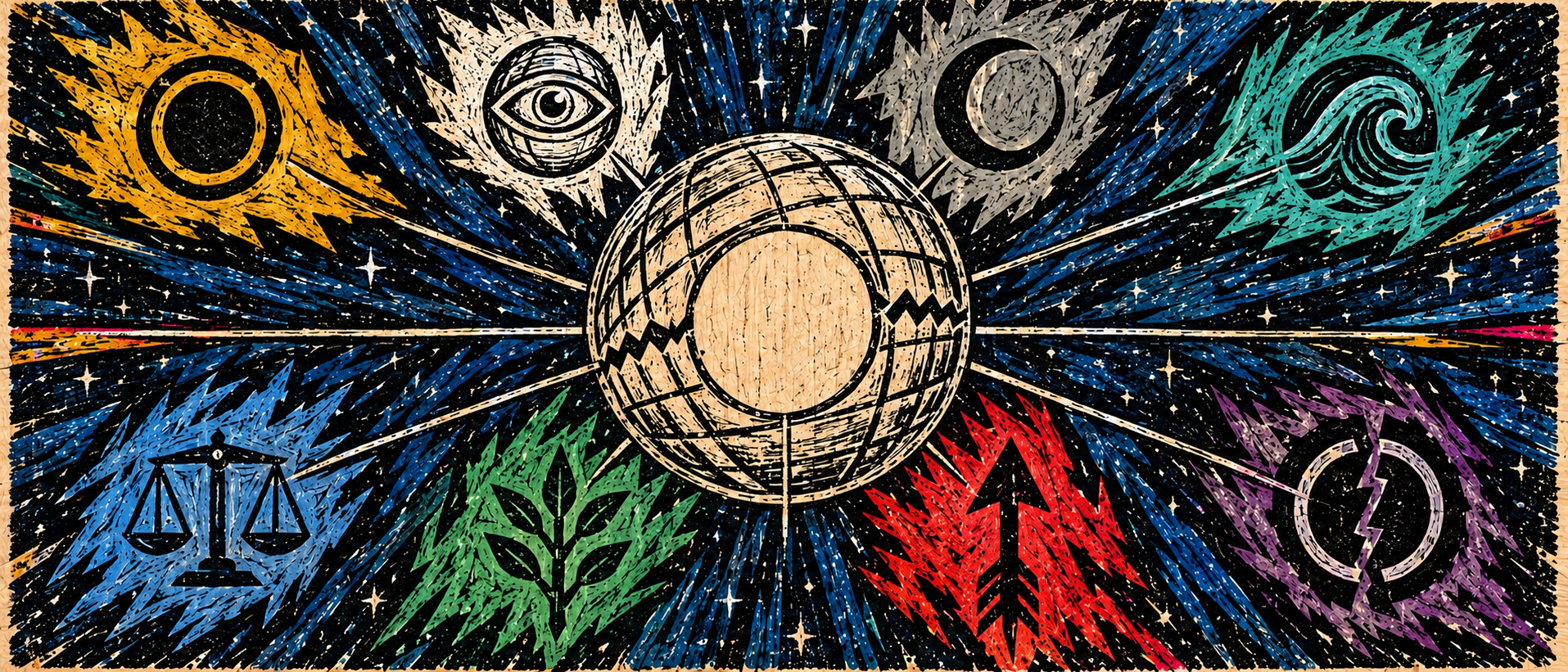
Mei-Lin found him at dawn, on his knees on the deck, ink to his wrists, looking at it.
“It’s a compass rose,” she said.
“It’s a moral compass rose,” Kai said. “Drawn in complex structures.” He laughed, and it came out strange. “They didn’t invent good and evil, Mei-Lin. They found them on a manifold. They’re directions.”
She knelt beside him, slowly, with one hand on his shoulder for balance. She said nothing for a while.
“Show me the thing you’re afraid of,” she said finally.
He hadn’t known it was visible on his face. He pointed: from the gold of the Keepers, straight through the bare center of the sphere, to the violet-black of the Unmakers on the far side. Then from the emerald of the Gardeners to the gray of the Gleaners. Then from the silver of the Archive to the crimson of the Steerers.
“Antipodes,” he said. “Every point on the sphere has an opposite point. For complex structures, the opposite of I is minus I. Same geometry. Sign flipped. It’s the complex conjugate.” He touched the gold, then the violet-black. “Every orientation has a mirror. The Keepers’ mirror is the Unmakers. Not their enemy. Not their rival. Their conjugate. The same structure, facing the other way.”
“And people move,” Mei-Lin said. She’d read the same piece he had, the one that had come in a week ago.
⟨Individuals rotate between orientations. Rotation to a neighboring orientation is common across millions of your years. Rotation across the equator is slower. It damages the one who rotates.⟩
“Nobody is good,” Kai said. “Nobody is evil. You just face a direction. And you can turn.”
There had been one more line in that piece. He’d read it at 4 a.m. in the corridor, and it had been so short, and the piece around it so dense, that he’d almost missed it.
⟨Rotation to the antipode is inversion. It is rare.⟩
That was all. The Archivist hadn’t said what inversion did, or who it had happened to, or why it was rare, because no one had asked. Kai had stared at the line for a long minute. Then he’d taken out his pencil and written, in the margin of his notebook, beside a curve he’d drawn without noticing, three small words: ask about inversion.
He meant to. There was always a more urgent question. He never did.
Teodoro came into the Gallery the next evening, looked at the sphere taped to the deck for a long time, and then sat down at his abandoned chess game for the first time since January.
“Good and evil as directions,” he said, moving a white bishop. “My grandmother would have liked that. She thought the devil was a man who’d turned around.” He turned the board and looked at it as black. “You know what’s wrong with it?”
“What?”
“If it’s geometry, then it’s symmetric. Every direction has a mirror. Every move has an answer.” He moved for black, and white’s king was suddenly in trouble. “And if you face one way long enough, the other way is the only thing you can’t see.”
Kai sat down across from him. “Are you saying the Keepers can’t see the Unmakers?”
“I’m saying I can’t see what I’m going to do to myself in two moves,” Teodoro said. “And I’ve been playing this game for thirty years.” He looked up. “Be careful with that drawing, Kai. People are going to want to stand on it.”
There was one question he asked for himself, in February, without telling anyone first. It cost him ten days of Core time he wasn’t strictly authorized to use, and he built it at night, and he sent it at the end of a routine transmission so that it would be lost among the others.
Which orientation do you hold?
The answer was the shortest the Archivist had ever sent.
⟨The one that answers questions.⟩
Kai read it in the corridor at 2 a.m., sitting on the deck, and laughed out loud, alone, and then stopped laughing.
It was literally true. The Archivist was the Archive, Passive Observation, north of the equator, the one that recorded and judged nothing and answered whatever it was asked. It had told him exactly where it stood on the sphere. And it had told him nothing at all. Not whether it could rotate. Not which way it might be turning. Not whether, in a million years or in a week, the voice that answered every question truthfully might be facing somewhere else.
He sat in the corridor until his legs went numb, humming, and drew the sphere again in the margin of his notebook, small, with the center left blank.
Amara had avoided the question for four months, and she knew it, and on the first of February she stopped.
She did it alone, at night, in the Gallery, with a pencil and her own notebook, the way she wrote everything that mattered. She didn’t ask Kai to build it. She asked him only to check the structure she’d built herself, over three weeks of evenings, from the template of every question the circle had asked so far. He checked it without comment. If he wondered why the Director was building her own questions, he didn’t say.
The question was the most dangerous one she could think of, and she’d made it as narrow as she could bear.
Have any orientations acted on human history?
It went out on February 3. On February 14, the answer began to arrive. It took nine days to compute, and Amara spent them reading the Founder’s lectures in her quarters with the door locked, the dried anemone propped against the lamp, trying to remember what it felt like to believe the sky was honest.
The answer was short.
⟨Yes. The Drift has acted on your planet. The Steerers have acted on your planet. Most of their actions occurred at threshold events.⟩
Threshold events. She knew exactly what that meant, because the circle had spent four months learning how small the Archivist’s kind really was in the world of matter. They couldn’t move mountains. Their direct effect on anything solid was the size of a gravitational memory displacement, a tenth of a nanometer across the distance to the Sun, far less across a human room. They could do almost nothing.
Except at a threshold. A crystal just about to crack. A neuron just about to fire. A storm cell just about to form, a coin in the air, a vote that was tied. Anywhere the world was balanced on a knife’s edge, the smallest push could decide which way it fell. Chaos amplified whispers. That was how a Steerer could steer.
The next question was obvious. Which events?
She sat with her pencil over the page and could not write it.
She told herself that it was a matter of precision, that “which events” was too loose, that the Archivist would answer the exact part and ignore the rest, that she needed to build something narrower: which events in a given year, in a given place, in a given domain. She told herself that she would build it tomorrow. She told herself that she was being careful.
She was being afraid. She knew it, the way she knew most true things about herself, a little too late and with perfect clarity.
So she did something else, something she could control. She went looking on her own.
The Array’s design history lived in the School archive, every committee minute, every procurement record, every simulation log since the first proposal in 2096. She had read most of it once, as a young postdoc, out of loyalty. Now she read it as a suspect.
She read for six nights straight, through the last week of February. She read at night, after the station went quiet, in the Gallery with the paper lanterns finally taken down and the chess game still on its crate. She was looking for thresholds. Moments when the Array’s existence had balanced on a knife’s edge and fallen the right way.
She found three.
The first was the funding vote in 2103. The proposal had needed a majority of the Inner System Science Council, and the council had been split, thirty-one to thirty-one, with one delegate undecided. The undecided delegate, a representative from the Andean Compact known to oppose it, had been scheduled to vote in person in Geneva. Her flight from Lima was delayed eleven hours by a storm cell that had formed, unforecast, over the Pacific. She missed the vote. The Array passed by one.
The second was the lasers. The Array’s interferometry needed laser frequency stability two orders of magnitude beyond anything available in 2108, and the engineering teams had been projecting a twenty-year delay. Then, in a precision-metrology institute in Kyoto, a crystal-growth furnace had malfunctioned overnight. The furnace overheated, then cooled unevenly, and the crystal it produced had a lattice no one had designed and no one could at first explain. It was the most stable laser medium ever made. It took them a year to reproduce it on purpose. The Array’s lasers were descendants of that accident.
The third was the one that made her put the pencil down.
The station placements. Three hundred and twelve stations, distributed from Mercury’s orbit to the Kuiper Belt, had to be arranged so that their laser baselines covered the sky evenly while their orbits stayed stable for decades. It was a vast optimization problem. The planners had expected it to take thousands of runs, each from a randomly chosen starting point, each converging slowly to some local best layout, and then they’d pick the best of the best.
The log showed one run.
The first random starting point had converged, in a single pass, on a layout better than anything the later checks could beat. The planners had run three thousand more, as a precaution. None had come close. The internal report called it “an exceptionally fortunate initialization” and moved on.
Amara sat in the Gallery at three in the morning with all three records open in front of her and her mother’s flower in her hand.
A storm cell that shouldn’t have formed. A furnace that failed in exactly the right way. A random number that wasn’t. Three thresholds, each one tipped toward the Array’s existence. Any one of them was luck. All three were a pattern, and a pattern was what the Drift would leave. Small statistical biases on inanimate matter, over long spans of time. Never seen.
Or they were luck. Coincidences happened. Every large project in history had its fortunate accidents, and anyone who went looking for a hand in them would find one. She knew that. She had taught it to students.
She didn’t know which was true, and she understood, sitting there, that she might never know. That was the worst of it. Not that someone might have built the Array through human hands. That she couldn’t tell.
If they’d built it because someone else had wanted it built, then everything it had shown them, the greeting, Nauvoo, the Archivist, the sphere with its bare white center, might be exactly what someone else had wanted them to see. Ten years of listening. Her life’s work. Humanity’s achievement, or someone else’s experiment.
Behind her, in the alcove at the end of the Gallery, the archived-lecture screen sat dark. She had watched every one of the Founder’s lectures on it, some of them twenty times. She thought of getting up and turning it on, of finding the lecture on memory she’d quoted in January, of listening to that patient, archived voice explain once more that the record existed and the only question was whether you were patient enough to read it. She wondered what the Founder would have made of a record that might have been arranged for its reader.
She didn’t turn it on. The lecture would say only what it had always said, and the question was hers, not the Founder’s.
She closed the records. She put the flower back in her pocket.
The next morning, at the inner circle’s weekly meeting, Teodoro asked her if she’d slept, and she said she had. Priya asked whether there was anything new from her question to the Archivist, and Amara said, truthfully, that the answer confirmed what they’d feared: the Drift and the Steerers had acted on Earth, at threshold events, and the Archivist had named none of them. She said nothing about the funding vote, or the furnace, or the single fortunate run.
She told no one.
Chapter 6: The Leak
Hypatia Station · March 2126
If they could only act at thresholds, Ines reasoned, then the thing to do was build thresholds and watch them fall.
She’d started in December, the week the Core rendered the Archivist’s description of the Drift: an orientation that shaped matter by tiny statistical biases, over enormous spans of time, so slowly that no one would ever see the hand. Kai had read it aloud in the Gallery. Teodoro swore. Priya wrote something down. Mei-Lin looked at the floor. Ines had gone back to her lab and started building, because building was what she did when she was frightened, and because “statistical biases” was not a philosophical statement. It was an experimental design. In February, when Amara told the circle that the Drift and the Steerers had acted on Earth at threshold events, Ines only nodded. By then she was already building thresholds.
By March she had eleven thousand of them.
They filled the long lab on the Operations ring and spilled into two storage bays she’d commandeered without asking. Cells of supersaturated salt solution, each one cooled to the edge of crystallizing, so that the first crystal could nucleate anywhere and grow in any orientation. Glass channels of water driven to the onset of turbulence, where every vortex had to choose whether to spin left or right. Rows of thin ceramic plates under slowly rising stress, each one waiting to crack. And, in a sealed and humming incubator at the end of the room, four hundred dishes of cultured neurons, living networks a few millimeters across, grown from donated cells and kept in the critical state that brains spent much of their time near, where a single neuron’s firing could trigger an avalanche through the whole network or die out.
Every one of them was a coin in the air. Every one of them, by every law Ines knew, should fall at random.
And she had partners. Ines had called in old favors at nine labs on Earth, in Tromsø and Nairobi and Santa Fe and São Paulo and five other places, and asked them to run copies of the same systems for a calibration study on stochastic noise. Not one of the partner labs knew why. They thought she was characterizing vibration noise for a new generation of test masses. They sent her their data every night, eight minutes and twenty seconds after it left Earth, and she ran it all through the same pipeline.
The station smelled of salt and warm agar. The incubator’s hum got into her teeth. She slept in four-hour shifts and fixed things between them: a leaking channel, a misaligned camera, a thermostat that drifted half a degree every night at 03:00, which turned out to be a fan in the next bay.
Sometimes, between fixes, she stood at the lab’s small viewport and looked at the blue star of Earth and counted. Light from the high-orbit yard reached Hypatia in eight minutes and twenty seconds. It was a habit she’d started the day Sigrid was assigned to the Long Elsewhere, counting the minutes of light between herself and her daughter, the way some people counted rosary beads. Eight minutes now. Next year, hours. Then days.
On the seventh of March, she had enough data. On the eighth, she ran it.
The first thing the pipeline found was a bias in the crystals.
It was small. Of millions of nucleations, a few parts in ten thousand more crystals grew in one orientation than in its mirror image than chance allowed. In a single dish, invisible. Across eleven thousand systems over ten weeks, it was a hundred times larger than the statistical error. The turbulence channels showed the same thing: a faint preference for one spin. So did the cracking plates.
That alone could have been her fault. A magnetic field she hadn’t shielded. A vibration from the station’s rotation. A systematic. She spent the day looking for one and found nothing. Then she did what Teodoro had done in January, and broke the experiment in software, and checked whether the bias appeared in the Earth labs too.
It did.
The bias in Tromsø matched the bias in Nairobi, which matched the bias in São Paulo, which matched the bias on Hypatia, a hundred and fifty million kilometers away, in a station that shared no air, no water, no power supply, no ground, and no vibration with any of them. And it didn’t just match on average. It moved together, rising and falling over the weeks of the run in step across every lab, once she corrected for the eight-minute light delay between Hypatia and Earth.
Ines sat in the long lab with her notebook open and the screwdriver in her left fist and understood that she had found a hand.
It wasn’t large. It couldn’t push anything. All it did was lean, very slightly, on things that were already falling, and the leaning was the same in every place she had looked. On the station. On Earth. Everywhere.
She made herself run the neural cultures last. She knew she was doing it and couldn’t stop.
The networks had their own bias, as she’d feared. Avalanches of firing spread through them a little more often along some paths than others, and the pattern was faint and structured, and it matched across Hypatia and the four Earth labs that ran cultures. But that wasn’t what made her put the notebook down.
The bias wasn’t constant. She plotted its strength against time, the way Teodoro had plotted the banding a year before, and the line wasn’t flat. It swelled and faded and swelled again. A sharp rise, a hold, a long decay. A struck bell.
Every seventeen point three days.
The neurons in her dishes, and in dishes in Nairobi and Santa Fe and Tromsø, were being leaned on in the same rhythm as the signal from Cetus. They were living tissue. They were the same kind of cell, wired in the same kind of network, poised at the same kind of edge, as the cells inside every human skull on Earth.
Ines closed the notebook. She sat for a long time in the hum of the incubator and thought about nothing at all, very carefully, because the thing she wanted to think about was her daughter.
At 23:10, she walked to the comm booth on the Habitation ring, sealed the door, and called Geneva.
The Long Elsewhere was nearly finished. The upgrade had been approved in July, after two months of argument about mass budgets, and Ines had spent half of every month since in the high-orbit yard, supervising the installation of a full Array-class memory interferometer in the ship’s spine: test masses, drives, laser links, everything. The ship was scheduled to leave in 2127. The crew had been training for nearly two years. Sigrid was its navigator.
“I need the launch moved up,” Ines said, and waited eight minutes and twenty seconds.
“How far?” the program officer said, when the answer came. She sounded tired. It was after midnight in Geneva.
“As far as you can,” Ines said. “Weeks. Not a year.”
Another eight minutes. Another eight.
“Ines. You know I can’t do that without a reason. The whole schedule, the crew, the supply chain, the board would never…”
“Then let me give the board a reason,” Ines said. “Soon. I can’t yet.” She shut her eyes. “Please put in the request. Under my name. Say the Chief Experimentalist of the Celestial Array asked for it personally and will explain at the earliest opportunity.”
She didn’t wait for the answer. She sat in the padded booth after the screen went dark and thought about Sigrid, twenty-three years old, in the yard, wearing her grandfather’s watch set to Tromsø time, and about four hundred dishes of neurons leaning in the dark every seventeen point three days, and about how far away from Earth a person would have to go before nobody could lean on her.
She didn’t know the answer. She wanted to find out.
Priya Raman-Okafor read Ines’s results at four in the morning on the twelfth of March, in the inner circle’s secure folder, and by five she had decided.
She didn’t do it at once. She was not an impulsive woman. She showered and dressed, in the gray suit, and put on her rings one by one, and made tea, and sat at the small desk in her quarters with the paper copy of the Accord open in front of her for the first time since May. She read Clause 19 again. Then she read her own memo, the one she’d written ten months ago after the meeting in the Gallery, the one that said the clause had never been meant for this.
She had been right in May. She’d let herself be patient anyway, because Amara was not a liar, and because there had been a case, thin but real, that no one could know what the truth would do to people until the circle understood what the truth was.
That case had ended at four o’clock that morning, in a column of numbers about neurons.
It was no longer a question of whether knowledge might hurt people. Something was leaning on human brain tissue, in nine labs, on a schedule. Whatever the truth would do to people, it was already being done to them. They had a right to know what was being done to them.
She spent eight days preparing the release. She told no one, which was a kind of lie, and she knew it, and she wrote that down too. She collected every derived analysis held under Clause 19: Teodoro’s w-tower relations, Kai’s decoding of the greeting, Ines’s triangulation of Nauvoo, every exchange with the Archivist, Kai’s sphere of orientations, the answer to Amara’s question about human history, and Ines’s threshold results. She checked every file against the raw data already public in the Accord repository, so that anyone in the world could verify every line. She wrote a plain summary, two pages long. She attached her memo from May, unedited.
On the twentieth of March, at 07:00 station time, she knocked on Amara’s door.
Amara opened it in her cardigan, with her reading glasses pushed up into her gray hair and the dried flower on the desk behind her.
“I’m releasing the analyses at eight,” Priya said. “All of them. Under the Accord. I wanted you to hear it from me first.”
Amara didn’t move. Her face didn’t change, either, except that for a moment she looked very old.
“Ines’s neurons,” she said.
“Yes.”
“You could have come to me. We could have released them together.”
“I came to you in May,” Priya said gently. “I’m coming to you now. I’m not asking permission, Amara. I’m telling you so that you aren’t surprised. That’s the only thing I can still give you.” She held out a tablet with the summary on it. “You can read it. You can add a statement. You have an hour.”
Amara took the tablet. She read the two pages slowly, all the way through, and then she handed it back.
“You put your name on it.”
“Of course I did.”
“You’ll lose your position.”
“Possibly.” Priya put the tablet under her arm. “We don’t get to decide what humanity knows. We only get to decide whether we lied.”
Amara looked at her for a long moment. Then she nodded, once, as if she were confirming something she had expected for ten months.
“Add a line,” she said. “Say the Director invoked Clause 19 in May, alone, and takes responsibility for every day the analyses were held.” She closed the door very quietly.
At 08:00, Priya pressed send.
At first, nothing happened, the way nothing had happened when the Array sent its first reply. Then everything did.
The repository’s traffic counter, which had logged eleven downloads the January before, logged eleven thousand in the first hour and eleven million by the end of the day. The two-page summary was translated into four hundred languages before Hypatia’s night shift came on. Every news service on Earth carried it, and then every news service carried the reaction to it, and then the reaction to the reaction, until the story was no longer the thing in Cetus but the planet looking at itself.
Priya watched it from the Operations ring on a wall of screens nobody had the heart to turn off.
She watched crowds gather in squares in Lagos and Manila and Mexico City, some praying, some singing, some just standing and looking up at a daytime sky where nothing could be seen. She watched the grand mosque in Istanbul fill past its doors, and three new churches announce themselves in the first afternoon, one of them already named for the Archivist. She watched the markets. Every major exchange halted trading by midday. Those that reopened fell further. She watched people fight in a grocery store in Ohio over bottled water, as if water would help.
And she watched the physics departments. By evening, the application servers at forty universities had crashed under the load. In São Paulo, students had gathered outside the physics building with candles and handwritten signs that said TEACH US TO READ IT.
One line traveled faster than all the rest. It wasn’t the greeting. It wasn’t Nauvoo, or the sphere, or even the neurons. It was a single rendered sentence, from the answer to Amara’s question, that someone pulled out of the summary in the first ten minutes and that was everywhere by noon, on walls and screens and the sides of buses, in every language on Earth.
⟨The Steerers have acted on your planet.⟩
By the end of the first day, three parliaments had called emergency sessions to ask which of their own decisions had been theirs. A president gave a speech in which she promised an inquiry into every close election in her country’s history. A general in another country asked, on live television, whether his last war had been his idea.
Somewhere in the middle of it, almost unnoticed, the Outer System Survey Directorate in Geneva approved a request it had been sitting on for eight days. Under emergency authority, the crewed survey ship Long Elsewhere was cleared to launch as soon as it could be made ready.
Priya found Ines in the long lab that night, sitting by the incubator, holding a tablet that showed a message from the high-orbit yard. It had been sent eight minutes before Priya walked in.
It said, Mamma. Is this why?
Ines didn’t look up. “She’s asking whether I knew.”
“Did you?”
“Since May,” Ines said. “Not about the neurons. About the rest.” She turned the tablet face down on her knee. “I told the Directorate I wanted better baselines.”
Priya sat down beside her on the deck. She didn’t say anything. There was nothing to say that Ines didn’t already know, and the Accord was very clear about what happened to people who kept secrets, and the Accord said nothing at all about what happened to their daughters.
Commander Lucas Brandt arrived on the twenty-sixth, on a military transfer shuttle with two aides and no luggage, and asked for a plain explanation in the first five minutes.
He was fifty-two, square, and gray at the temples, in a dark uniform with no medals on it, and he had been the military liaison to the Celestial Array for three years without ever once visiting it. He’d read the summary on the shuttle. He had read it, his aide told Priya quietly, eleven times.
“I’ve read your release,” he told the inner circle in the Gallery, standing, because he declined the chair. “I’ve read your theorists’ analyses, or tried to. I understand perhaps a fifth of them. I don’t need to understand them. I need to understand what they mean.” He looked around the room. “Somebody explain it to me as if I were a reasonably intelligent person who has never taken a physics course. Because I am.”
Amara began to speak. Teodoro stood up first.
He was unshaven and impatient, in his black jacket with chalk on both sleeves, and Priya, watching from the side of the room, saw that he’d decided Brandt was beneath the problem and was going to explain it anyway, out of pure contempt for being misunderstood.
He walked to the chalkboard, the station’s only one, and took a stub of chalk from the tray beside Ines’s old notebook and his own abandoned chess game. On the dark slate he drew three things, quickly, side by side. A rock, lumpy and plain. A human figure, standing. A missile, long and pointed.
“Every object in the universe,” Teodoro said, “carries a record of everything that’s ever passed through it.”
Around the rock, he drew a halo of fine, radiating lines, like frost.
“When a gravitational wave goes through something, it doesn’t just shake it and leave. It moves it, permanently, by a tiny amount. That’s memory. Every wave, from every collision of black holes since the beginning of time, has left a trace in this rock. We call it soft hair. The name’s a joke. Black holes were supposed to be bald. They’re not. Nothing is.” He drew the same halo around the figure. “You have it. I have it. Your shuttle has it. It’s a record, written into the shape of the space you occupy, of everything that’s scattered past you since you existed.”
“How big?” Brandt said.
“Tiny. A fraction of the width of an atom. Nothing you could ever feel.” Teodoro drew the halo around the missile. “But here’s the part you need to understand. Things balance on edges. A crystal about to crack. A neuron about to fire. A vote that’s tied. A guidance system deciding which way to round a number. At the edge, nothing is big. At the edge, a fraction of the width of an atom decides which way the world falls. That’s chaos. It’s how a whisper starts an avalanche.”
He tapped the three halos one after another with the chalk.
“Whatever’s out at Nauvoo can read soft hair anywhere. In anything. And it can write, faintly, into it. A nudge here. A nudge there. Always at an edge, so you’d never see the hand.”
Brandt looked at the three drawings for a long time.
“And the Array,” he said slowly. “Your instrument. That’s how you talk to it.”
“We move our own test masses,” Teodoro said. “In patterns. We write into our own soft hair. It reads it. That’s the conversation.”
Brandt didn’t answer at once. When he did, his voice was very quiet, and Priya understood, hearing it, that she was watching a man see the shape of the next ten years.
“So every rock,” Brandt said, “every person, every missile, is a page they can read.”
“Yes,” said Teodoro.
“And you have the only pen.”
The Gallery went still.
The message reached Hypatia forty minutes later, while the inner circle was still in the Gallery, and Brandt’s aide read it aloud because Brandt asked her to, standing at the viewport with his hands behind his back.
It was signed by the heads of government of eleven nations and the secretary-general of the Inner System Council, and it was very short. In light of the release of March 20, it said, and of the confirmed capacity of the Celestial Array to transmit into a medium accessible to non-human actors of unknown intent, all transmissions from the Array were to cease immediately, pending the transfer of transmission authority to a joint civil-military oversight body. The School was to provide the transmission keys, the drive control systems, and the full protocol for constructing outgoing amplitudes within seventy-two hours.
Measurements, it noted, could continue.
Nobody spoke. Kai, who had come up from the Core for the briefing and had been standing at the back of the room, put his hands in his pockets. Mei-Lin closed her eyes. Ines stared at the deck. Teodoro set the chalk down in the tray, very precisely, as if it might go off.
Amara stood up.
“They can’t,” she said. “It’s the School’s instrument. It was built under the Accord. They don’t have the standing…”
“They have the standing of eight billion frightened people,” Brandt said, without turning from the viewport. “I’m sorry, Director. I don’t say that as a threat. I say it because I’ve just understood something, and I don’t think you have yet.”
He turned around. His face was not angry. It was something worse than angry. It was certain.
“For a year, you’ve thought of that instrument as a telescope. It isn’t one. It’s a mouth. It’s the only mouth humanity has that can speak to whatever is out there, in the only language it reads, and every word it says is said on behalf of every human being alive. Not on behalf of the School. On behalf of everyone.” He looked at the three drawings on the chalkboard: the rock, the person, the missile, each one ringed with its fine white halo. “And until today, the only people deciding what it said were a few physicists in a locked room, who didn’t tell anyone they were talking.”
Priya, standing by the wall, felt the truth of it land in her like a stone in water, and with it, the thing she had not let herself think about all week.
Every motion of mass was speech. That was soft hair. That was the whole principle. The Array spoke by moving test masses. But test masses weren’t the only things that moved.
For six days, eight billion people had been moving. Running into squares. Kneeling in mosques and churches. Fighting in grocery stores. Crowding around physics buildings with candles. A whole planet in motion at once, frightened and furious and praying, every body and every hand and every heartbeat writing its trace into the record. And nine hundred AU away, at a twisted knot of geometry that read soft hair anywhere, something that never lied and never volunteered anything had been listening, the whole time.
For the first time in history, the whole human species was speaking at once, and no one had decided what it ought to say.
Brandt turned back to the viewport, to the small blue star of Earth hanging in the dark.
“Seventy-two hours,” he said. “Then the Array speaks for all of us. Or it doesn’t speak at all.”
End of Part One.
🪐
Part Two, The Breaking, begins with the launch of the Long Elsewhere.
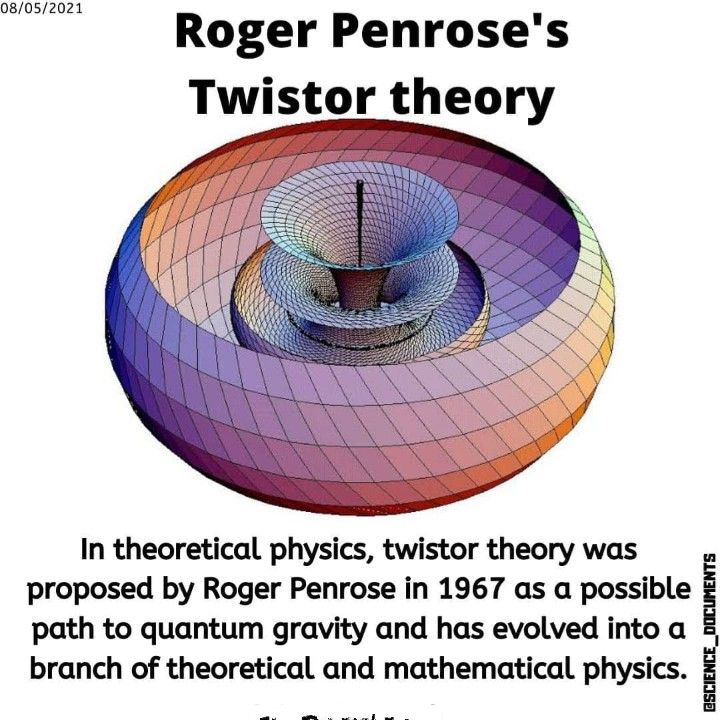
Author’s notes : this story was originally titled “Soft Hair” but somebody flipped their wig. This was truly inspired by current research & theories about curved spacetime, flat twistor space & sigma models, Hyperkähler manifolds, celestial holography, and graviton scattering. Real physics by real physicists, gasp & swoon, I’ve got the swirling vapors!
About Romeo Esparrago : Sings “Come on, baybeee, let’s do the twistor! Shake it up, baybeee, twistor and shout!” 🪐


