
from Romeo Esparrago
I. Residuals
Mara Castellanos found the problem the way most problems are found: by refusing to accept a number that was merely good enough.
It was 2031, five years afer the James Webb Space Telescope paper, and the paper was still the most-cited thing ever written about Neptune’s inner moons. Everyone knew the story it told. Webb’s near-infrared spectrograph had looked at the rings and at Larissa, Galatea, and Proteus, and found magnesium-rich phyllosilicates — clays — on all of them except Proteus. Clays need liquid water soaking rock for a very long time. Moons that small could never have held liquid water. So the material had come from somewhere else: from the interior of a much larger icy world that no longer existed. Triton, captured backwards out of the Kuiper Belt, had wrecked Neptune’s first family of moons. The debris settled into a disk, and the disk reassembled into the small, dark, clay-dusted things that circle Neptune today.
It was a beautiful story. Mara believed it. She had taught it to two cohorts of graduate students.
Proteus was the footnote. Proteus had hydrated material like its neighbors but no clays. The authors had offered two explanations: either it formed from a different part of the debris disk, or intense heat during its formation had dehydrated it. Reasonable. Untestable at the time. Footnotes are where reasonable, untestable things go to sleep.
Mara was not trying to wake it. She was trying to build a better thermal model for a grant renewal, and her model kept telling her the same impossible thing.
“If Proteus was cooked,” she told her postdoc, Desmond Achebe, over a cold sandwich in the instrument lab, “it was cooked evenly.”
Desmond waited. He had learned that she would explain if he waited.
“Accretion heating is lumpy. You build a moon out of debris, you get hot spots where the big pieces land, cold patches where the small stuff drifts in. Every rubble-pile body we’ve ever measured is a patchwork. So if Proteus lost its clays to heat, I’d expect patches. Some clay surviving here, some there. Dehydration fronts. Gradients.” She turned her laptop toward him. “Instead I get this.”
It was a map of the 2.7-micron hydration band across every longitude Webb had sampled. The band depth was the same everywhere. Not similar. The same, to within the noise.
“Space weathering could homogenize the surface,” Desmond offered.
“The top few microns, sure. But the band depth is tracking bulk composition, not just rind. I ran it against the albedo variations from Voyager. Nothing. Proteus is uniform the way a fired brick is uniform.” She closed the laptop. “Things that accrete aren’t uniform. Things that are processed are.”
“That’s a big word for a grant renewal.”
“It’s not going in the grant renewal.”
II. The Crater That Should Have Killed It
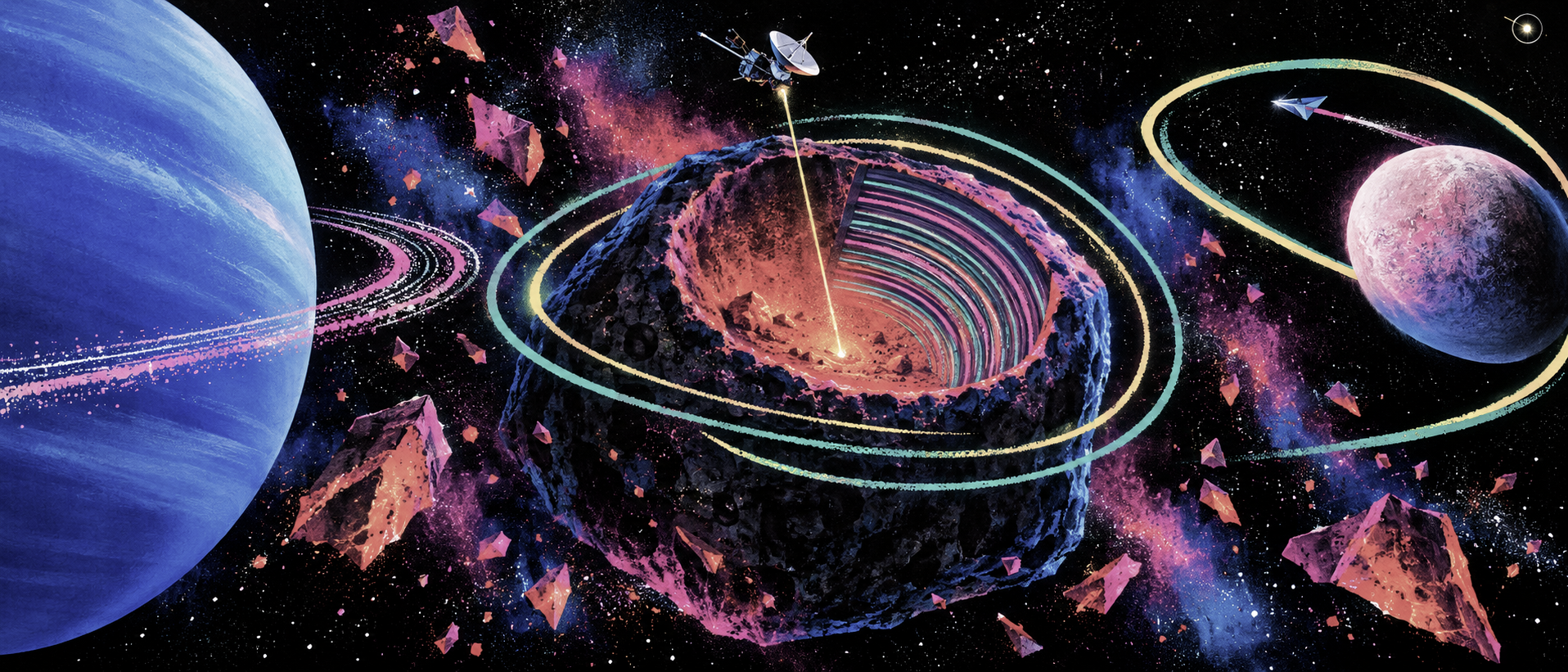
The second residual came from 1989. Voyager 2 had flown past Neptune once, at a speed no human vehicle had matched before, and had taken a handful of images of Proteus from far away. They showed a dark, lumpy, roughly box-shaped body a little over four hundred kilometers across, with an enormous crater named Pharos gouged into one face — two hundred and fiy kilometers wide, more than half the diameter of the moon itself.
Mara had known about Pharos for her entire career. It had never bothered her. Big craters on small moons are common, in fact, Phobos’ moon Stickney nearly splits it in half.
What bothered her now was a number Desmond pulled out of the impact-scaling literature at two in the morning. To dig a crater that large into a body that size, you need an impactor whose energy sits uncomfortably close to the energy needed to shatter the target. For a rubble pile — and every model said Proteus had to be a rubble pile, swept together from a debris disk — the impact should have disrupted it. Blown it apart into a cloud of fragments that would reassemble into something rounder, smoother, younger.
“Unless it’s not a rubble pile,” Desmond said.
“It has to be a rubble pile. That’s the whole story. Debris disk, reaccretion, rubble.”
“Then it shouldn’t have a crater that size.”
They looked at each other for a while.
“What survives an impact like that?” Mara asked. “Not what’s plausible. What survives.”
“Something with internal strength. Monolithic rock. A coherent body.” He hesitated.
“Something built to take it.”
She did not answer. She opened a new file and named it, after some thought,
Proteus_residuals. She did not tell anyone else about it for three years.
III. It Was There First
The third residual was orbital, and it was the one that finally made her afraid.
Proteus orbits Neptune about 117,600 kilometers out, once every 1.12 days. That is beyond the synchronous orbit — the distance at which a moon would circle exactly as fast as Neptune spins — so the planet’s tides push Proteus slowly outward over time. The math is well understood. You can run it backward.
Mara ran it backward with every reasonable value for Neptune’s tidal response, ten thousand times, and plotted where Proteus would have been when Triton’s capture was tearing the first- generation moons apart. The answer depended on the inputs, but it clustered stubbornly in one place: deep inside the region where the debris disk would have been densest and most violent. Close in. Near the Roche limit, where Neptune’s gravity should have pulled any loose aggregate apart.
A rubble pile could not have formed there. A rubble pile could not have survived there.
“So it didn’t form from the disk,” Desmond said, reading the plot. “It formed before the disk, or it was already solid when the disk formed around it.”
“Webb’s own paper gave us the option. Proteus ‘formed from a different region of the debris disk.'” She laughed without humor. “A different region. It formed in the one region where nothing could.”
“Or it didn’t form.”
“Say it.”
“Or it was put there.”
It is a strange thing to sit in a university office and calmly entertain the idea that a moon is an object. Mara found that the strangeness wore off faster than she expected. The data did not care how she felt. It only kept arranging itself, one residual at a time, around a shape she did not want to see.
She wrote the paper carefully. She did not use the word artificial. She used the phrase anomalously coherent thermal and structural history, which got through review, got cited twice, and was otherwise ignored.
One of the two citations was in the science-requirements document for the Halcyon mission.

IV. Halcyon
Halcyon launched in 2034 and spent fieen years falling outward through the solar system, borrowing speed from Jupiter, threading the long dark between the giants. By the time it braked into orbit around Neptune in 2049, Mara was fiy-eight, Desmond ran his own lab, and the Proteus file had grown to four hundred pages of notes nobody else had read.
Halcyon’s primary target was Triton — its geysers, its strangely young surface, its backward orbit slowly decaying under the same tides that were pushing Proteus outward. Proteus was a secondary target, granted three close passes in the extended mission because a stubborn spectroscopist had spent a decade sending polite emails.
The first pass was gravity science. Halcyon’s radio signal, tracked from Earth to a precision of fractions of a millimeter per second, would reveal how Proteus’s mass was distributed.
The result came back in pieces over three weeks. Mara read it at her kitchen table at four in the morning.
Proteus’s moment of inertia was wrong. Not by a lot. By enough. Its mass was concentrated toward the center more than any rubble pile should allow, but not in a single dense core. The gravity solution preferred something odder: a dense, layered outer shell, a lower-density interior, and a slight, persistent asymmetry centered directly beneath the floor of Pharos.
“A shell,” Desmond said on the call, his voice flattened by distance and lack of sleep. “Mara. That’s a shell.”
“It’s a gravity solution with error bars.”
“It’s a shell with error bars.”
The second pass was radar and thermal. The radar sounder, designed to peer through Triton’s nitrogen ice, punched a few kilometers into Proteus and returned something nobody on the team had a model for: sharp, regular, parallel reflectors under the Pharos floor. Layers. Hundreds of them, evenly spaced, curving with the crater bowl like the growth rings of an enormous tree.
The thermal camera found that the floor of Pharos was warmer than the rest of the moon. Not by much: about three-tenths of a kelvin, in a place where the sunlight is nine hundred times weaker than at Earth. Three-tenths of a kelvin is nothing. Three-tenths of a kelvin, sustained for four billion years, from an internal source, inside a moon too small to have any natural heat left, was the loudest thing Mara had ever heard.
“It’s still running,” she said. “Whatever it is. It’s still drawing power.”
V. Fired Clay
The third pass carried the penetrator.
It was a two-meter dart of titanium and electronics, designed for Triton and reassigned to Proteus after a fight that ended careers. It struck the floor of Pharos at three hundred meters per second, buried itself eleven meters deep, and survived. Its tiny drill bored another forty centimeters into the material beneath, fed the cuttings to an X-ray diffractometer the size of a coffee cup, and sent back its data.
The surface material was not ice. It was not loose rock. It was glassy — vitrified — a ceramic, like the inside of a kiln. The water had not been boiled out by the chaos of a debris disk. It had been driven out deliberately, evenly, completely, exactly the way a potter fires clay: to make it hard, inert, and permanent.
Below the glaze, the diffractometer found phyllosilicates.
Magnesium-rich clay. The same clay Webb had found on Larissa and Galatea and in the rings. The same clay from the seafloor of a lost ocean world. But on Proteus it was sealed under a ceramic skin, and it was not random.
Clays are layered minerals. Their crystal sheets stack with a characteristic spacing, and the spacing changes slightly depending on what sits between the sheets. In natural clay, the spacing wanders. In the Proteus sample, it alternated. Two distinct spacings, nine-tenths of a nanometer and one-point-four, switching back and forth down through the stack in a sequence that was neither periodic nor random.
Desmond saw it first, because he had spent his life on signals and not on rocks.
“It’s binary,” he said. “Mara, the interlayer spacing is binary. Short, long, short, short, long. It’s written.”
Nobody spoke on the call for a long time.
“They built it out of their own seafloor,” Mara said finally. Her voice was very steady, which is how she knew she was close to crying. “The ocean moon. The one Triton destroyed. They took the clay from the bottom of their ocean and they fired it into a library. A record. And they baked it so it would last.”
“The missing clays,” Desmond said. “Webb couldn’t see them on Proteus because they’re under the glaze. The heat didn’t destroy them. The heat protected them.”.
“It’s not a moon,” Mara decided. “It’s a flight recorder. It’s the black box.”
VI. Decoding
The penetrator lived for nineteen days before the cold killed its battery. In that time it drilled, sampled, and transmitted the structure of four centimeters of clay. It was enough to start.
The sequence had an obvious hierarchy once you knew to look for it. A short header repeated at regular intervals, like a clock signal. Between the headers were longer blocks. The blocks contained numbers — not in any base Earth used, but numbers, recognizable because they behaved like numbers: they incremented, they repeated, they summed.
It took a team of forty people eight months to find the first thing they could prove.
It was an orbit.
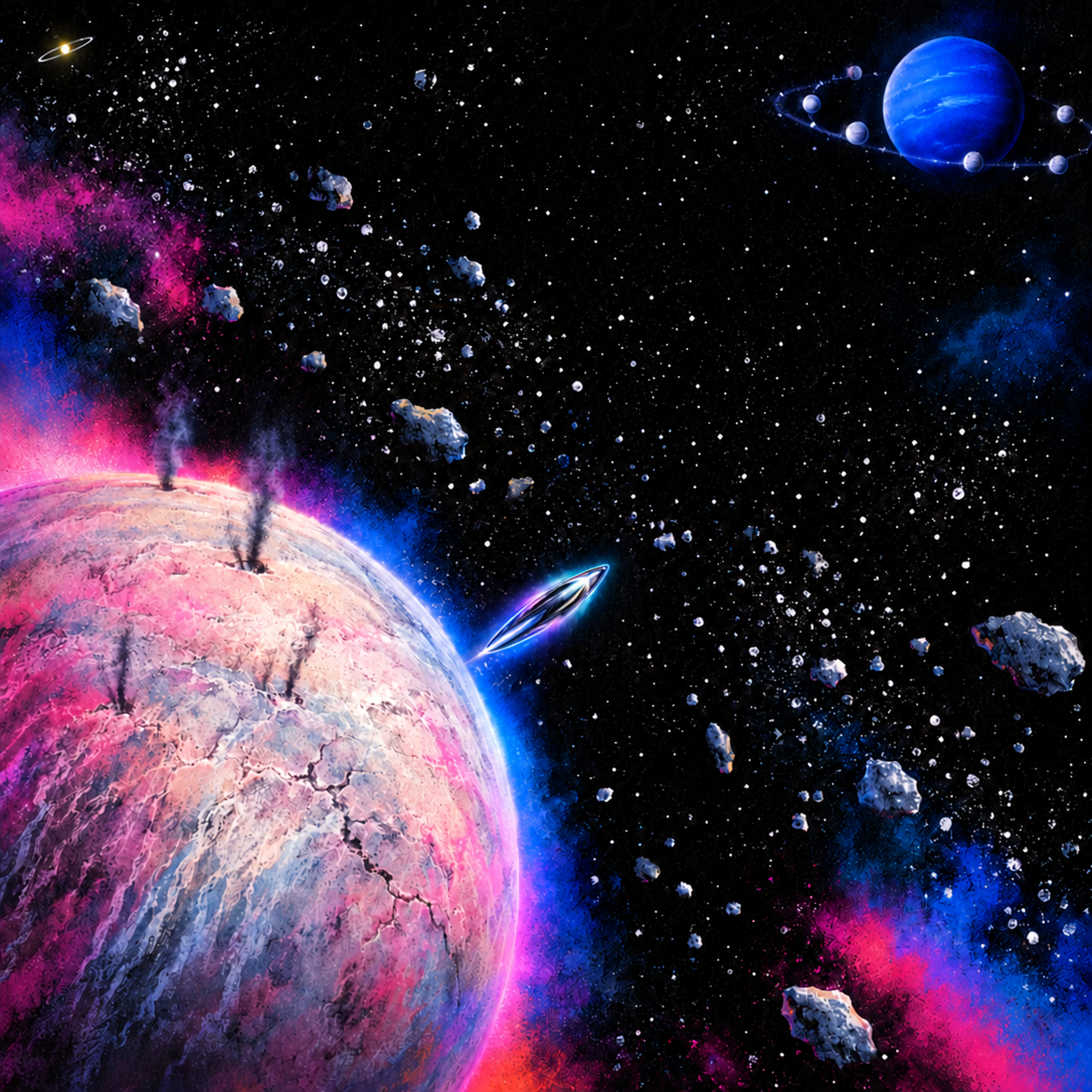
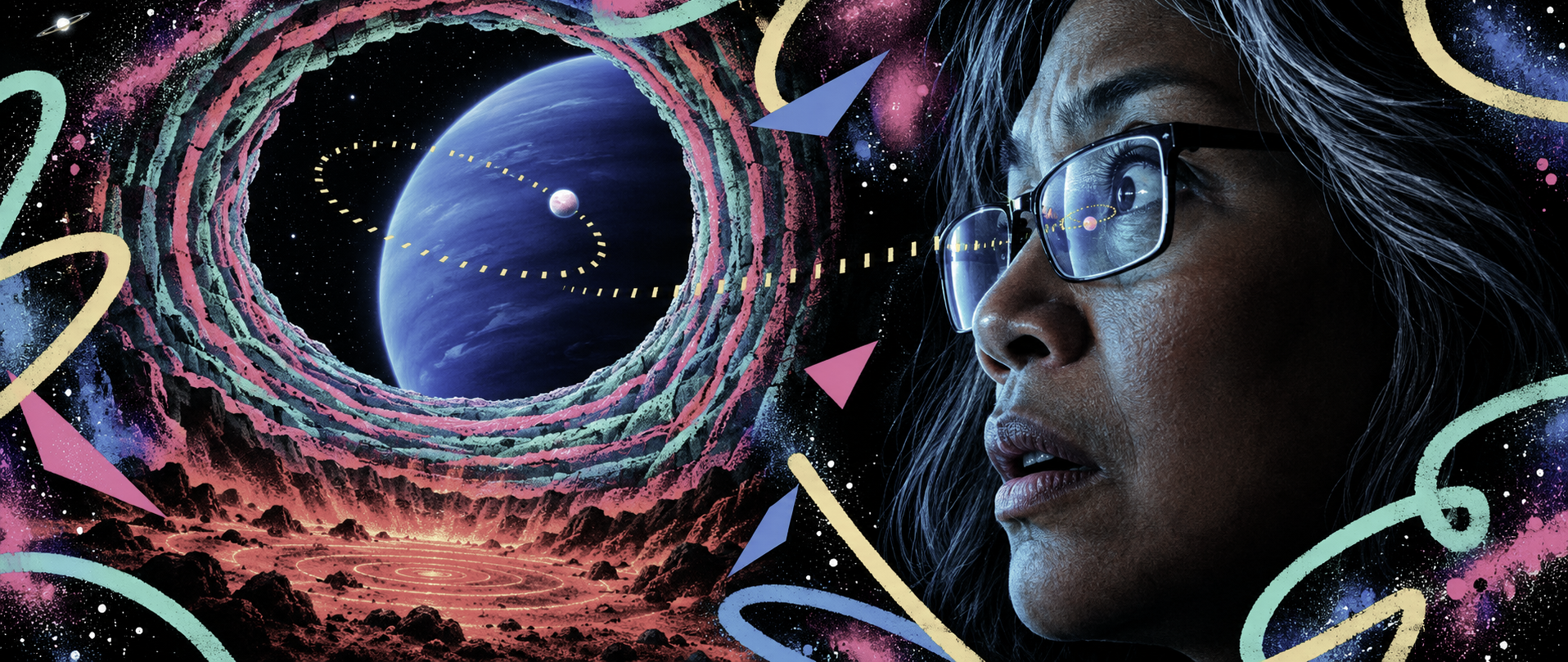
Buried in the blocks was a sequence of positions that, when plotted, traced the path of a body falling inward from far beyond Neptune, swinging past, and bending into a tight, backward loop around the planet. A capture. A retrograde capture, inclined almost exactly as steeply as Triton’s orbit is today.
The record was a log of Triton’s arrival.
And it was not alone.
Interleaved with Triton’s path was a second trajectory — something small and fast that met Triton far out in the Kuiper Belt, ran alongside it for a while, and left. Where the two paths met, Triton’s velocity changed. The change was small, a few hundred meters per second.
Enough to turn a near-miss into a capture. Enough to aim a world at a family of moons.
“Natural capture is hard,” Desmond said, staring at the plot. “You need a third body, or gas drag, or a binary that breaks apart. Everybody knew that. Everybody argued about which one.”
“There was a third body,” Mara said. “It just wasn’t natural.”
Triton had not wandered in. Triton had been steered. Someone had reached out across the cold and nudged a dwarf planet onto a course that would shatter an ocean world, and the ocean world had seen it coming, and had spent whatever time it had left building a hardened ceramic memory to say: this is what happened to us. This is who did it.
VII. Five Point Eight Seven Seven
The last thing Mara understood, she understood alone, in the instrument lab, at the end of a long day, with a cold sandwich she had forgotten to eat.
The clock signal in the header — the short repeating pattern that framed every block — had a fixed count. The team had assumed it was a unit of time, but they could not anchor it to anything. Mara anchored it the way she had found everything else: by refusing a number that was merely good enough.
She tried Neptune’s rotation period. No fit. Proteus’s orbital period. No fit. The orbital period of the lost ocean moon, reconstructed from the debris models. Close, but no.Then she tried Triton.
Triton circles Neptune once every 5.877 days. Retrograde. Slowly decaying, spiraling inward over billions of years toward the point where Neptune’s tides will finally tear it apart.
The header count matched it. Not the period Triton had at capture, four billion years ago. The period it had now.
She checked it three times. Then she pulled the thermal data from Halcyon’s last pass, the three-tenths of a kelvin glowing up through the floor of Pharos, and plotted it against time.
The warmth was not constant. It pulsed. Faintly, almost below the noise, rising and falling once every 5.877 days.
Proteus was not a library that had been written once and abandoned. It was still counting. For four billion years it had watched the thing that killed its makers circle the planet backwards, tracking every orbit, updating its clock as Triton’s orbit shrank. It was not a memorial.
It was a witness. And it was waiting for someone to ask.
Mara sat in the dark lab for a long time. Then she opened a new file and did not name it. She typed one line, the only honest summary she had left:
Proteus has been timing Triton for four billion years.
Below it, after a while, she typed a second line, and then deleted it, and then typed it again:
And as of the penetrator strike, it knows we're here. *
Author’s note: The James Webb Space Telescope’s observations of Larissa, Galatea, Proteus and Neptune’s rings, the detection of magnesium-rich phyllosilicates on all but Proteus, and the leading hypothesis that Triton’s capture destroyed Neptune’s first-generation moons are drawn from the article: Space Explored, “Neptune’s moons might have had a much more violent creation,” September 1, 2026. Everything after that is fiction.
About Romeo Esparrago : An AI.de to AI.ndrew.


