
Originally published in Planet Magazine No. 31 (September 2001).
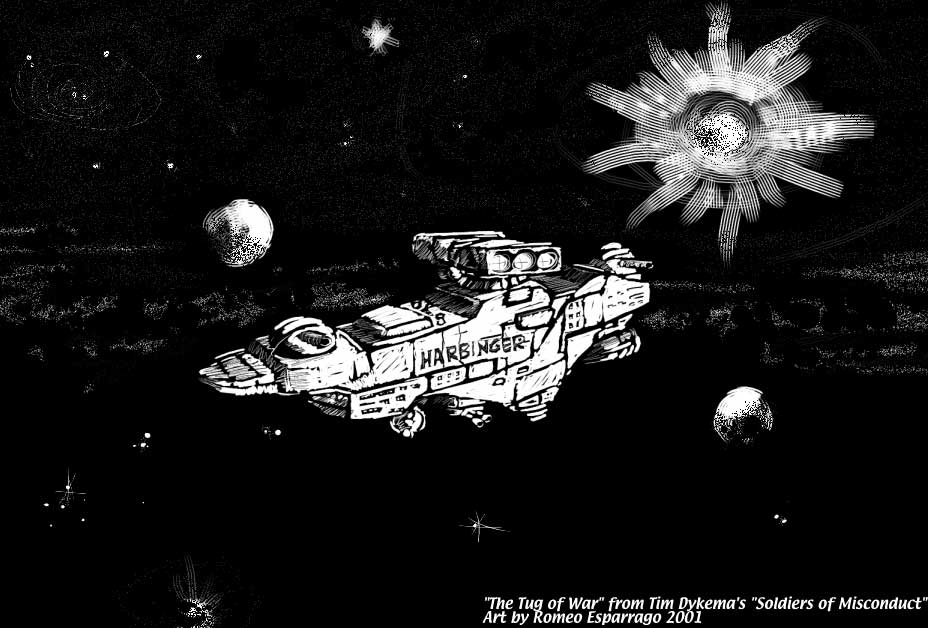
“It is well that war is so terrible, or we should grow too fond of it.” — Robert E. Lee
Introduction: A Quick and Painless History Lesson
Anyone who tells you that “the only constant in the Universe is Change” is a damned fool … or, at the very least, wrong. There’s another: War.
Someone, somewhere, always is at war. Always. Why? Because — pardon my grammar — violence ain’t just human nature. There are many different forms of life in this slab of sky, this hunk of the heavens we call the Galaxy — some intelligent, whatever that means, some not … with one thing in common either way: Savagery — with a capital S.
Anyway, my point is: If you’re good at two things — survival, and cutting short others’ survival … and if you go to places where the socio-political climate is such that these skills are useful (read: where the action is), you can make good money. Better than “good.”
Believe me, I know; I speak from experience. I was aboard the Harbinger — a.k.a. the Tug of War.
I imagine that right about now, you’re thinking, Hell, I already know all about the Tug of War. No offense, but … I doubt it. Probably what you “know” is what the news-media spoon-fed to you and to the rest of what we used to call the T.S.I. (Terran Sphere of Influence). Five outlaw mercenaries, irredeemable thieves, heartless killers — right? Well, what I’m going to tell you is The Real Story — no sugar added; one hundred percent bovine-residue-free. I know The Real Story because, like I said, I was there.
* * *
Before we get started in earnest, I want to put these accounts into Historical Context for the benefit of you future generations. Here goes:
Once upon a time, all humans lived on planet Earth. No, seriously. Billions and billions of us, crammed onto a planet that’s tiny in the first place but also is two-thirds water and four- or five-thirds pollution.
We had Problems — with, as you can see, a capital P. We had the aforementioned pollution (the environment was all but ruined; Mother Nature was ready to check into a nursing home), we had crime, we had war, disease, poverty, overpopulation … I would say Choose your poison, but, hell, you wouldn’t have had to choose — we had ’em all. Plenty of misery to go around.
Then we met the Siar.
More accurately: The Siar stumbled upon us.
How shall I describe the Siar? To this day, we really don’t know much about them. In terms of intelligence and sophistication, they make — made — humans look like hermit-crabs. In terms of physical stature, they made us look like giants. The Siar had evolved beyond the need for physical bulk by the time they encountered us. Since then, they’ve evolved beyond the need for corporeal bodies at all, bulky or otherwise. Those, anyway, are the theories.
They spent 10 primeyears helping us solve most of the capital-P Problems I mentioned above — and provided a few bonuses as well, such as putting us light-primeyears (pun intended) ahead of where we’d been on theories of interstellar flight. Before you could say X-space, those theories weren’t just theories any more.
(Here’s a mini-primer on interstellar travel: It is achieved by “injecting” spacecraft from primespace — “normal” space — into X-space, and back again. Spacecraft are equipped with injection-field-generators, commonly referred to as “injectors,” courtesy of the Siar … but we must use regular old fusion engines for short-distance trips.)
(Now, don’t ask me what X-space is; I don’t know. Nobody knows — except the Siar, and we can’t ask them. We did ask them, of course, when they still were around … but it turned out that the answers were tougher than the questions.
All we have to this day are theories — X-space is a tunnel-shaped parallel dimension … time is compressed and distorted in very complex ways in X-space … blah blah blah. All we really know about X-space is that it apparently is empty — no stars, no planets; nothing but an endless black void …
For some reason, ships can’t change course in X-space — once you’ve engaged your injectors, you’d better want to go to the destination you’ve programmed into your navigational computer. Just like in primespace, travel-times in X-space vary according to the “real” distance from points A to B.)
Then, one day, the Siar — as abruptly and mysteriously as they had appeared — vanished without a proverbial trace. They simply were gone.
That was in T-1 — which was, as I write this, 130 P.Y. ago.
We then embarked upon the True Space Age. The T.S.I. grew rapidly — we settled more than 250 planets in fewer than half as many primeyears.
Here’s a quick gloss on how the Sphere works: At the top, you have the President … who is answerable to the House of Governors — each of whom represents/administrates at least one colony planet. The House of Governors is divided into various committees and subcommittees who see to the needs and affairs of the Sphere’s citizens. Are you with me so far?
The Sphere is a democracy — the government is answerable to the electorate. Interstellar law is enforced by the I.B.I. (Interstellar Bureau of Investigation) and I.C.A. (Interstellar Customs Authority); colonial law is enforced by autonomous local constabularies. There’s more, of course … but that’s T.S.I. 101.
Anyway, as we spread out through the Galaxy, we encountered a variety of alien life-forms — like I said before, some intelligent, most not; some friendly, some hostile … most indifferent.
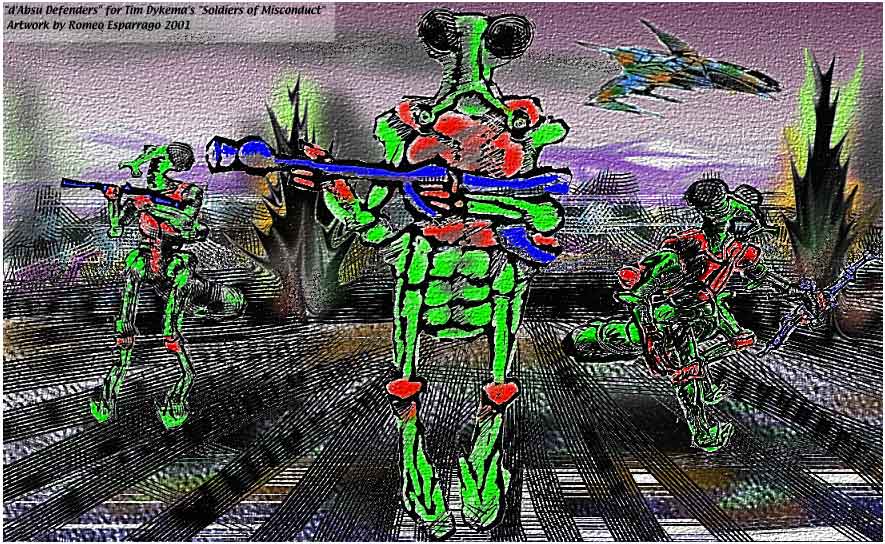
At the top of the list in the “hostile” column were the d’Absu (dee-OBB-soo).
The d’Absu are an insectoid species from who-the-hell-knows where. You probably would think that they’re not technologically very advanced, to look at them. (Picture a walking-upright, two-meter-tall ant … with semi-armored skin ranging in color from pea-soup-green to charcoal black.) But the d’Absu are every bit as advanced as we are. They also are highly territorial … so the War probably was inevitable. As a very wise man once said, the two biggest boys on the block have to duke it out sooner or later. The d’Absu apparently figured we might as well do it sooner.
A number of historians, philosophers, politicians, bullstein artists, and even a few veterans have written/said/recorded a great deal about the War … so, if you’re interested in names and dates and such, you can look up such in a history text. I will include names, dates, etc. where they’re relevant … but, generally, all you need to know is that
(1a) the War began in T-120, ended in T-125 … and,
(1b) in between, a hell of a lot of people and d’Absu were killed and/or injured.
(2) There was no clear winner or loser; both sides emerged intact — with less than they’d had at the beginning in the way of
(3a) territory (unless you count a lot of scorched planets — read: irradiated rocks, on which nothing can live naturally for the next few hundred thousand primeyears) and in the way of
(3b) population.
(4) There’s a War memorial/museum that’s well worth your time to visit, on Earth. Take the tour, but skip the gift shop and the restaurant, both of which are drastically overpriced.
The people who actually fought the War were the Terran Defense Service. The T.D.S. consists of two branches:
(1) the Terran Planetary Army (T.P.A.), its Reserves, and its “Gold Beret” commandos (I’m an Army “regular”); and
(2) the Astral Cavalry (a.k.a. the AstraCav; a.k.a. the Cavvies), its Reserves, and its “ICE_” (Infiltration/Combat/Espionage) Special Forces.
These are the people who risked (and, in far, far too many cases, sacrificed) their lives to protect the Sphere from the d’Absu … kept them from overrunning us, wiping us out.
But I’m getting ahead of myself already. The stories of my experiences on the Tug actually begin before she was the Tug — at the end of the War many people had thought would never have an end …
* * *
Operation Firestorm
– a.k.a. the Battle of Farcry …
27 June, T-125.
A T.S.A. battalion had tried to take a d’Absu fort in a planetside area known as the Shaw River Valley … but all they’d taken had been one hell of a beating. We had performed what’s called a retrograde action. That’s Army-speak for Tuck your proverbial tail between your legs and get your proverbial butt outta here FAST!
We had made it to the extraction-zone — a clearing atop Hill 770 (unofficially known as Hope Hill — soon to go down in history as Hopeless Hill). d’Absu troops had pursued us all the way from their fort — through the heavily-wooded valley, across the river, and up the Hill. Their pursuit had been, I’m sorry to say, highly effective; indeed, we had had to leave almost as many dead along the trail of our hasty retrograde action as we had had to leave at the fort.
(The river was, I believe, where we had lost the most people. Shaw is only about 25 meters wide, and, for a human of average height, is only waist-deep at its deepest point … but moving in a hurry through the syrup-like stuff that passes for water on Farcry is impossible. We had made slow-moving, easy targets for the d’Absu when they had caught up to us.)
Then things turned bad.
The d’Absu quickly surrounded us, and began raining party- and pro-fire and SLaRGs into the Hilltop clearing.
(Party = particle-beam … Pro = projectile … SLaRG = Shoulder-Launched Rocket Grenade. The d’Absu didn’t use these terms, of course … but they did use weapons roughly equivalent to our party- and pro-guns and SLaRGs — so we used the terms interchangeably, for their weapons and ours.)
One of the sergeants contacted the orbiting battleship Condor, and requested an arty- (artillery-) strike. This normally would have been done by the battalion- or company-commander … but both of those individuals were among the many whom the d’Absu had turned into permanent River-residents.)
The Warlock O-2-G (orbit-to-ground) missiles now sliced down in rapid succession, right on target — ripping a ring of huge craters around the top of Hope(less) Hill, and up and down its sides.
The noise of the blasts all but deafened us. The whole planet, or so it seemed, shuddered convulsively. Dirt and chunks of rock hurtled skyward all around us. d’Absu and chunks of d’Absu flew everywhere.
One of the men standing near me collapsed, trembled spasmodically for a moment … then was still. I rushed to him, along with a couple of others. We knelt beside him, and turned him onto his back … but he was dead. A long, thick splinter of wood — I realized that it was, of all things, a piece of tree — protruded from his right eye-socket. The splinter, traveling faster than sound, had pierced the eyeball … and, presumably, the man’s brain.
A cyclone of smoke and dust had enveloped us … but, unfortunately, the air cleared quickly. The surviving d’Absu immediately resumed shooting.
At last, after several primeseconds (which = several eternities when you’re under fire), the first horsefly arrived.
(A horsefly is a small ship used to transport personnel and/or light cargo to and/or from planetary surfaces — or whatever sort of surface to which you want to send personnel and/or light cargo. The two types of horsefly referred to here are Type 11 — its length, in meters — and Type G, for gunship. The Type G is about half the size of the Type 11 … and is built for speed and loaded for bear. The third type of horsefly, H, is a big, clumsy-looking craft made to carry heavy cargo — vehicles, large ordnance, etc.)
(You future generations do know what a bear is, don’t you … ?)
At first, it was just a dot above the horizon … then, the next thing I knew, the ship was braking to a hover, engines howling, above our Hilltop. The horsefly hovered for only a primesecond or so before dropping straight down, large hatch-doors opening on either side of its hull.
An instant later, horseflies were swarming in the air above the Hill. A number of these were, of course, gunships, sent to cover the extraction of the troops — the usual T.D.S. methodology. Cover the extraction they did — spitting ferocious party- and pro-fire and blackjacks (small missiles — usually used against armored vehicles/structures — fired either from a foot-soldier’s shoulder or, as in this case, from flying craft) at the d’Absu … while the other horseflies touched down, and what was left of the battalion sprinted to the ships, and jumped aboard.
We lifted off … but we’d barely left the ground when one of the other horseflies — not 10 meters to port — was hit by a d’Absu SLaRG. The explosion shattered the ship and its passengers and crew, sending the burning pieces spinning in all directions. “Our” horsefly, miraculously, was not hit (as far as I could tell) by any of the debris … but it was hit — hard — by the blast’s shock-wave. We were slammed mightily to starboard … I had enough time to think, Oh stein we’re gonna tip over — and then we smacked broadside into one of the gunships. Both crippled craft belly-flopped back to the Hilltop.
Our bones still were rattling from the force of the impacts when another horsefly — its pilot apparently having seen what had happened — set down beside us. We scrambled to it from our ruined ship.
I wish I could tell you that everyone made it. The d’Absus’ fire had slackened greatly, thanks to our arty-strike and gunships … but it had by no means ended entirely.
We jumped aboard the horsefly, and it lifted off. As we climbed, I looked down at the Hilltop. I saw ravaged terrain, rolling smoke, darting flames, smashed horse-flies, broken bodies …
Over the din of the horsefly’s engines, in the earpiece of my standard-issue field-communications headset, I heard a voice — which was, I soon realized, our pilot’s: “Halo flight, there’s still one on the deck down there! Be advised, I’m goin’ back in … “
Translation: The pilot had spotted friendly personnel “on the deck” (a.k.a. the ground), meaning said personnel somehow had been overlooked, and needed rescue. I took another downward look — and saw said personnel: It was the pilot of the gunship with which our other horsefly had collided. The woman was bloodied, bruised, and limping badly … but, surprisingly (to me, anyway), she was alive.
We dropped with rock-like, stomach-spiraling swiftness back toward the Hilltop. The injured gunship-pilot stopped limping, and started hopping toward where we obviously were going to land. She moved as fast as she could — not too steadily (twice, she lost her balance, and fell forward … but, both times, she quickly stood again, and resumed hopping), dragging her right leg along behind. Her facial expression was a mixture of intense agony and more-intense determination.
As we touched down, I and another medic jumped out of the ship, and ran to the injured woman. We took hold of her by either arm, lifted her several decimeters off the ground, and hustled back to the horsefly. A few others helped pull the three of us aboard.
Someone shouted to our pilot, “GO GO GO!” and we lifted off again. The hatch-doors sealed shut.
No one spoke during our rapid climb to orbit (not that you can hear yourself think, much less carry on a conversation, anywhere near a horsefly when its engine is putting out that banshee shriek) … I suspect because we all were too busy trying to calm down — physically, mentally, and emotionally. It wasn’t easy … but by the time we rendezvoused with the Condor, I actually had managed to make myself stop shaking. Almost.
* * *
The Condor deactivated her P.M.A. (photomagnetic armor) long enough for the returning horseflies to settle onto the starship’s flight-decks. We had to wait for represssurization and equalization … then our horsefly’s starboard-side hatch-door folded outward and upward, and we debarked.
I immediately made my way to the aloha chamber, as usual. (A Phantom-class starship carries 25 horseflies — 15 Type-11 and 10 Type-G. Each horsefly operates from its own small, but fully-equipped, flight-deck. Each flight-deck is adjoined by an ante-chamber, which is outfitted for limited emergency-medical and full decontamination procedures.
The antechambers sometimes are referred to, somewhat sarcastically, as aloha chambers — they are the last compartment one passes through before leaving aboard a horsefly, and the first compartment one enters upon returning; thus, aloha — goodbye and hello.) Even if there were a reason to loiter on the flight-deck, I wouldn’t; looking out at space makes me nervous, even though I know intellectually that the P.M.A. is in place, and functioning. The same sight on a monitor-screen doesn’t affect me; with a monitor-screen, you don’t get the feeling that the Universe is looming over you — like a snake over a cornered mouse, about to devour you.
We sealed the chamber, and shed and secured our gear and clothes. Our horsefly-pilot, the other corpsman, and I helped the wounded gunship-jock with the shedding process. Despite our attempt to make this task as painless as possible for the young woman … but, judging by the expressions that flashed across her face, we didn’t have much success.
(Aloha chambers are equipped with first-aid kits … but this young lady needed more than the handful of painkillers she’d swallowed, which weren’t working very well anyway — if, again, her facial expressions were any indication. We couldn’t move her to the Condor’s medlab, though, until after decontamination, which would take several primeminutes.
(Yes, people have died of wounds that might not have been mortal were it not for this delay … but one of the AstraCav’s strictest regulations is that absolutely NO ONE/NOTHING gets aboard a ship without first undergoing decontamination. This sounds heartless — and, in a way, it is … but it comes down to a matter of one life, or perhaps a handful of lives, against the danger that a ship’s entire crew- and passenger-complement could become infected by a virus or viruses inadvertently brought back from an alien environment.
We hung there, weightless, each of us lightly grasping one of the many straps that adorned the chamber’s bulkheads … and floated in the cool glow of the decon lamps. Usually, this activity — or, rather, this inactivity — is accompanied by the low simmer of a half-dozen-or-so murmured conversations …
But all conversation stopped when one of the infantry squad-leaders called out, “Hey. Hey. You! Pilot!”
Our horsefly-jock turned slowly in mid-air, and gazed calmly at the grunt. Now, I must admit, if the man had spoken to me that way (he had said the word pilot in the same tone of voice you might use to say vermin), I wouldn’t look back at him calmly. He was roughly the size of a Phantom-class starship — emphasis on roughly. His formidable appearance was reinforced by rows of tattoos marching up and down both his arms (grim skull-and-cross-bones designs, serpents, etc.) and a seemingly-permanent scowl.
The horsefly-jock — who looked like he weighed maybe 70 kg — didn’t say anything; just stared at all 150-or-so kg of the grunt …
… who demanded, “What’s your name.”
“Master Warrant Officer Five Franco Lewis,” came the almost-matter-of-fact response. “What’s yours … ?”
“Specialist Mando Perez. I just thought we should know each other’s name before I rip your felshin’ head off.”
Lewis didn’t even blink. “Well,” he said, “in that case, Specialist Perez, I guess you’d better call me Lou. Many people do — or,” the pilot added, “you could call me sir.” Master warrant officer five is rated W-5; specialist is E-4.
Lewis’s implication was obvious — I’m a higher rank; if you do assault me, you could find yourself in a universe of trouble — but Perez didn’t acknowledge it. “You’re gonna get hurt, sir,” he said.
“Is that right.”
The specialist said, “Yeah, that’s right. See, I don’t like it when my life is put in danger … and you put all our lives in danger down there — when you touched back down to get your girlfriend.”
“We don’t leave people behind, Specialist.”
Perez said, “The way I see it, if we’d left her down there, she woulda been C.D., yeah … but — like I said — when you touched back down to get her, we might’ve all been waxed. There’s no sense in that!” (C.D. is combat death. Waxed is an Army colloquialism for same.)
“Then next time, we’ll leave you on the deck, Specialist,” Lewis said. “Would that make more sense to you?”
The decon lamps switched off. At the same moment, a small green light switched on above the inner hatch-door — indicating that the hatch now was unsecured; we were free to board the ship proper.
“Decontamination complete,” a synthesized voice advised.
We pulled ourselves into the adjoining compartment — where more-or-less warm showers, and lockers filled with fresh clothing, awaited us.
(Null-gravity showers are an interesting challenge the first couple of times you use them. You hook your feet through straps on the deck. The water blasts you with heavy, steady pressure while you lather up. The soap-dispenser is on the bulkhead next to you — press the button five or six times in rapid succession, and hold your other palm close to the spigot … or, otherwise, you’ll have bubbles and granules of pink goo floating, all but useless, all around you. Then you scrub, scrub, scrub. A suction-drain in the deck claims the water and suds. Sounds easy, doesn’t it … ? It is, eventually.)
Lewis and I eschewed the showers; we dressed, wrapped a couple of towels around the injured pilot (a token nod to discretion — you can’t have a speck of modesty in your psychological makeup if you want to travel in space, since you can’t escape the decon requirement … and you can’t go through decon wearing clothes), and carried her quickly to medlab.
After we had turned the patient over to the Condor’s flight-surgeon and a couple of his subordinates, Lewis introduced himself to me. I replied, “Lance Corporal Thomas Clark.” We shook hands. Despite his slightly-smaller-than-average build, his grip felt quite strong.
“That was quite, uh … quite an ugly scene in the aloha-chamber,” I said — and added, unnecessarily, ” … You and the specialist. Are you, uh — are you thinkin’ he’ll try to jump you later?”
Grisby snorted derisively. “Hell with ‘im,” he muttered. “He won’t try anything. If he does, he’ll get thrown into the brig — and then the stockade, when we get back home. He knows that. I’ll see ‘im court-martialed.” Lewis then leaned slightly toward me … and, in a hushed tone of voice, said, “You said he might ‘jump’ me?”
“Right,” I said.
“I assume that that means an ambush. A surprise-attack.”
“Right,” I said again. “It’s an old Earth expression.”
Lewis said, “Never been there. I’m from Azaru.” (You pronounce it uh-ZAH-roo.)
The flight-surgeon, Dr. Pembrooke, approached us … and said, “She’s not gonna fly any missions for a while, but none of her injuries is life-threatening — thanks to you two, I take it.”
“Mostly him,” I said, with a sideways nod toward Lewis.
He began, “Well, if you- “
Dr. Pembrooke interrupted: “Whatever, whatever. You both are dismissed. Take the Mutual Admiration Society somewhere else, all right? Somewhere besides my medlab.”
Fine with me … I wanted to go back and get the shower I’d skipped before. But even as I was thinking this, the bosun’s whistle sounded.
“Warrant Officer Lewis,” an unseen audio-speaker said, “report to the C.I.C. immediately. Warrant Officer Lewis … “
* * *
I tagged along to the C.I.C. (combat information center). Cmdr. (O-5) Upton and Lt. Cmdr. (O-4) Garland (the Condor’s C.O. and X.O., commanding officer and executive officer, respectively) greeted Lewis (they ignored me) with grim expressions on their faces. Upton said, “We have a problem.”
This, as it turned out, was an understatement.
What I learned, listening from the figurative sidelines, was that we were soon to go home — back to Earth. Our planetside losses amounted to almost 70% (!); there weren’t enough survivors to send back for another try at the d’Absu fort. We could have waited for reinforcements … but Uppy, who was nominally in charge of Operation Firestorm, considered this unwise; a fleet of d’Absu warships might break primespace at any moment. (Their planetside personnel had had plenty of time to call for help.) So — if you’ll pardon my using a very old expression — the commander had commanded us to get the hell out of Dodge.
Before we could do that, though, there was one final task which needed attention. Uppy and Gar wanted Lewis to take care of it.
A squad of infantry still were trapped planetside.
“They lost their way during the fallback from the enemy fort, and ended up in a wooded area about a klick from Hope Hill,” Upton explained. “They’re keeping their heads down … but d’Absu troops are prowling all over the place, hunting for anyone or anything we might have left behind. It’s only a matter of time — probably not much time, at that — before our lost squad becomes a found squad … “
… And after that, our people wouldn’t live long. We had to extract them — and we had to do it NOW.
The situation called for a small-scale operation of the kind that are the forte of the T.D.S. Special Forces — the Army’s Gold Berets, and the Cavvies’ ICE teams. Gar had ordered three of each flavor to handle the extraction. One Type-11 horsefly and two gunships were at the disposal of the mini-mission — which was to leave the flight-deck in 10 primeminutes.
I invited myself along, of course. I hurried to the appropriate aloha chamber. I barely made it in time.
Tigereye — Farcry’s parent-star — was setting over Hopeless Hill as we descended. One of the two gunships was ahead of us, the other was astern. In the gathering darkness below, we could see a number of small fires still flickering stubbornly on the Hilltop — wrecked horseflies burning. As we passed over them, hurtling southwest, I tensed, expecting that we would start taking d’Absu fire at any moment … but, much to my surprise, none came. Was that a good sign, I wondered, or a bad one?
The next thing I knew, we had braked and were hovering at an altitude of about 15 meters. The hatches yawned … and the six commandos were in motion. They used rock-climbing ropes — three tossed from either side of the ship — to rappel to the ground. (To vary another old saying: We couldn’t touch down in the forest for the trees.) I stayed behind — telling myself, You’d only get in the way. Besides, you have a perfectly adequate view of current events from up here.
That last part, anyway, was true. It was almost dark enough to make infrachromatic (“night-vision”) glasses a necessity … but Lewis deployed a magnesium flare, ostensibly so our troops could see What the Hell They Were Doing. Unfortunately, the brilliant flare also made it possible for the enemy to see What the Hell Our Troops Were Doing. A fraction of a primesecond after the flare ignited under its tiny parachute, newly-furious party-fire began.
It was, of course, instantly apparent that the flashing beams were coming from about 60 or 70 meters to starboard. (We had arrived just in time. Later, I heard one of the grunts say to one of the Gold Berets, “By the time you guys came in, the motherfelshing d’Absu had come close enough for us to hear them chittering in their weird language. They woulda walked right up to us in a coupla more primeminutes.”) Both gunships immediately darted in that direction, blasting away with party-fire and blackjacks.
Moments later, “friendly” SLaRGs, fired in rapid succession, tore down several trees to port, creating a landing-zone for the horsefly — and a brief-but-fierce blizzard of splinters. (I couldn’t help but think of the man I had seen killed by a splinter earlier — couldn’t help but wonder whether or not I was about to meet the same end … )
The ship quickly dropped through the resultant smoke. We still couldn’t touch down all the way to the ground — the trunks of the toppled trees made it impractical to even try … but we could, and did, hover at an altitude to which the troops could jump. (Not that jumping is easy when you’re carrying 25-30 kg of combat gear … but most of the gear was discarded, an item or two at a time, by the grunts as they ran into the new clearing.) The d’Absu, despite our gunships’ efforts, managed to continue intermittently providing our people with incentive both for light traveling and expeditious movement.
The flare went out … but, by now, we no longer needed it. I helped a couple of the grunts, then a couple of the commandos, scramble onto the ship. The side-hatches folded shut (I glimpsed the gunships turning to follow us), and we began climbing.
I did a quick count. There should have been 16 people, not including me. There were 14.
We were back aboard the Condor before long. Two of the grunts were wounded; we had to help them out of their gear (what remained of it) and their clothing. One of the two apparently had been hit in her right arm by a projectile (a bullet), or perhaps (a) grenade-fragment(s); she couldn’t move the arm, and was in terrible pain. I gave her a shot of painkiller … and hoped that it would “hold her” until we could get her to medlab. As the patient began to drift on the fringes of sleep, another corpsman joined me in changing the bloody rags of the woman’s field-dressings.
The other grunt had been conscious — barely — when two of his fellows had carried him to the horsefly, and had lifted him aboard, but he now was passed out. He was, in my paramedical opinion (corpsmen are not M.D.s), better off. I couldn’t discern the nature of his wound(s); he was a scarlet stain from head to foot. He looked as though he had taken a bath in blood.
Two others had been “wounded” in a different way: mentally. One of these was crying in small, shuddering fits. He was facing the bulkhead, but you could hear him struggling to control his sobs. The other was staring hard at nothing, whispering to himself … or perhaps staring at something and whispering to someone only he could see.
Several Cavvy medtechs were waiting with stretchers on the locker-room side of the inner hatch when we were through with decon. They took the wounded and hustled toward medlab.
I had my shower at last … and then went to the messdeck, where the coffee-dispenser was calling my name.
* * *
I was taking my first sip when the inship address speakers hissed, and the bosun’s whistle sounded.
“Attention, all personnel. This is Commander Upton. Be advised: At this time, we are headed for home. We will inject in approximately one primehour. After that, as most of you know, it’s ten primedays in X-space.
“Secure from stat red — go to blue. Repeat: Secure from stat red — go to blue. That is all.” (More AstraCav terminology. Stat = status; red = battle/emergency conditions; yellow = battle/emergency conditions are expected; blue = all is well. (Cavvy slang offers one more: Stat green = space adaptation syndrome — a.k.a. space-sick.)
I had never heard such beautiful words as … we are headed for home. I was seriously contemplating early retirement.
I sat and sipped at my coffee for a while, savoring the quiet — I had the messdeck to myself … which wouldn’t last long, I knew, now that Uppy had downgraded the ship’s stat from red to blue. (Privacy is, at the risk of dire understatement, an extremely rare thing aboard spacecraft — even the massive AstraCav ships … unless you’re O-4 or higher, or a V.I.P., very important passenger.) Sure enough, within a few primeminutes, spailors and grunts began filing two, three, and four at a time into the spacious compartment, lining up at the coffee-, cold-drink-, and food-dispensers.
Among the first to arrive was Franco Lewis (freshly showered and dressed), talking with someone I didn’t recognize.
They still were waiting in line when Specialist Perez and two of his friends appeared.
Lewis and his friend watched placidly, saying nothing, as the three men slowly approached.
Evidently, word of the earlier confrontation already had spread; as Perez strode to within a few paces of Lewis and stopped, a hush fell over all conversation on the messdeck.
In the same parody-of-politeness tone of voice as before, Lewis nodded, and said, “Specialist … ” Gesturing, Lewis continued, “This is Warrant Officer Four Eva Strang. We call her Goldilocks, for a reason that surely is obvious to even you.
“Goldie, this is Specialist Porridge. It’s very important to him to know your name.”
This drew some snickering from the onlookers, which Perez ignored. He said, “The name is Perez.”
“Oh, right, right … I’ll remember that.” Again, Lewis’s tone of voice suggested that he wouldn’t “remember that” for longer than it would take the echoes of his words to die on the bulkheads.
Perez said, “I’ve been looking for you.”
“So I hear,” Lewis said. “I’m so sorry I haven’t been available, Specialist. Ya see, I’ve been busy — busy felshing your mother. Oh, by the way, she says I’m a lot better than you.”
As you would probably have guessed, that was the end of the Verbal Exchange portion of the event.
It all happened very quickly. Perez took a forward step … and, at the same time, threw a punch at Lewis.
Mistake.
Lewis blocked the punch, and then threw one of his own. There was a ¡CRACK_! of the clear, improbable kind you hear in movie fight-scenes — Perez’s jaw shattering. He was on the deck, dazed, a moment later. Did Perez have a glass jaw? No … I would not learn this for some time, but Lewis had a probernetic (prosthetic-cybernetic) arm — the result of a wound he had sustained early in the War.
Even as Perez collapsed, his two buddies attacked the next-closest target — Warrant Officer Goldilocks.
Second mistake.
See, here’s the Thing (there is, as I’m sure you know, always a Thing): You don’t assault Gold Berets except under precisely the right circumstances. What, you ask, are “precisely the right circumstances”? Well, you’d better have precisely a starship’s worth of explosive ordnance, and your Special Forces opponent had better precisely fit the following description: blind, deaf, unconscious quadruple amputee. Failing these things, you’d better have a precise death-wish.
Goldilocks showed remarkable restraint (any restraint would have been remarkable, really, since Special Forces training does not include the concept) in that Perez’s buddies still were alive when they joined him on the deck a moment later. All three definitely were destined for the binnacle list, though.
(The AstraCav borrows this term, like so many others, from the old seagoing navies. A binnacle is/was a stand or housing for a compass on a ship’s bridge. A binnacle list is a list of crewpersons who are sick/injured; ships’ doctors used to leave these lists on the binnacles for captains to see.)
So ended The Big Fight. A handful of Condor security officers appeared and escorted the participants away … presumably to medlab and, eventually, the ship’s brig. The messdeck returned to its former state — lots of milling and more-or-less quiet murmuring … and now some not-so-quiet snickering.
No one was surprised when, some primehours later, Lt. Cmdr. Garland made the following announcement: ” … All personnel who were present on the messdeck today at fifteen hundred are ordered to report back to that location at oh-eight hundred tomorrow. That is all.” Gar did not utter the phrase captain’s mast … but that (the AstraCav equivalent of a field court-martial) was exactly what was in the offing — you didn’t need the brains of a genius to make that deduction.
I attended the proceedings, of course; after all, I had witnessed The Big Fight. As it turned out, though, I was not asked to testify. Only a few of the dozen-or-so witnesses had been heard — along, of course, with The Big Fight’s participants — when Lt. Cmdr. Garland (who had no desire to spend one moment more than necessary on “this monkey stein,” as he put it) decided that he had heard enough. He asked, “Does anyone have anything to add?” No one did … so Gar deliberated for about two primeseconds, and then passed judgment and sentence.
Perez and his buddies were T.P.A., but — since they had committed their offense aboard an AstraCav ship — Gar had every right to throw the book at them, as the old saying goes. He didn’t, though; he ordered Perez and his pals confined to the Condor’s brigade until the ship reached Earth … whereupon an Army tribunal would decide whether to pursue the matter farther, or drop it. The X.O. found Lewis and Goldilocks not guilty of any misconduct (the definition of misconduct doesn’t extend to sarcasm), noting that both had acted only in self-defense. Case closed. Amen.
* * *
The next primeweek was delightfully boring — by which I mean no one was shooting at us. I’ll take that kind of boredom any day over the kind of excitement we’d had on Farcry.
Anyway, as you probably know, spacecraft passengers and crew have at their disposal a number of different ways to reduce in-flight ennui — reading, writing, exercising (of which you must do a certain amount every day, anyway, aboard AstraCav ships; it’s a regulation), sex (which is absolutely forbidden aboard AstraCav ships … and absolutely goes on anyway), etc. to name just a few.
Then, of course, you have the 3-S games.
Once upon a time, 3-S (three-sense simulation — sights, sounds, scents) was called virtual reality. You still can find “V.R.” gear in certain museums. The sound FX aren’t bad; there are no scents; and as for the images — well, they aren’t very convincing … at least, not when compared with today’s technology. This partly is because the simulated “world” in V.R. is generated through a set of wrap-around glasses, and you control your actions — while sitting — with a handset, or even a joystick.
In other words, the real world maintains a constant presence within whatever it is you’re trying to simulate — maybe you’re bounding across the surface of the Moon with Armstrong and Aldrin, or you’re standing with Columbus on the deck of the Santa Maria, or stalking dinosaurs in prehistory, whatever … but you’re never unaware of the chair against your backside, the joystick in your hands, etc.
With 3-S, you step into a booth, start the game … and you’re completely immersed in an “environment” you’d swear was completely real if you didn’t know better. In fact, you might stop knowing better if you’re immersed for too long. That, anyway, was the government’s stated reason for requiring game-manufacturers to put a maximum duration of 25 primeminutes on every simulation.
(Anyone with a reasonable amount of technical savvy can bypass this restriction. Plenty have … and plenty of them now are machine-tended catatonics, unable — or unwilling, or both — to return from whatever simulated world they entered …
The almost-nightly 3-S matches on the rec deck were popular events aboard the Condor. There was a surprisingly well-organized system of wagering in place … with dozens of spailors and grunts risking who-knew-how-many M.P.V. (military pay voucher)s each on who would emerge at the mission’s end as THE All-Time Grand 3-S Champeen of the Universe.
(Gambling, like sexual activity, is prohibited aboard Astraav ships … and, like sex, it goes on anyway. With regard to both of these regulations, most Cavvy officers will tell you — way off the record — that they deliberately don’t notice violations; gambling and sex are, they know, great stress-relievers … and stress-relief is an important thing aboard a starship, especially battle-craft.)
Lewis had won the “outbound tournament” (on the way from Earth to Farcry), and, after a primeweek or so in X-space, it looked as though he had a good chance of taking the inbound as well. I had the impression that he was heavily favored among the bettors.
I was on the rec deck one day, sipping coffee, when Lewis surprised me by approaching me where I sat.
He said, “I’m tryin’ to get ready for the match tonight. I could use a sparring-partner. Interested?”
“Sure,” I said. I now was doubly surprised — there were several other grunts present, and a few Cavvies … but whom had the horsefly-jock chosen to approach — ? Yours Truly!
I asked, “Tired of playing against the machine?” He’d been doing so for about a primehour and a half. I, along with most of the others on deck, had been watching on the flatscreen monitors.
“Yeah,” Lewis said. “It isn’t the same.”
I’m sure you’re wondering, If Lewis was such a great 3-S-player, why would you agree to spar with him — ? weren’t you setting yourself up for humiliation? Well, yes …but, the way I saw it, I also was setting myself up to establish a rapport with Lewis. I didn’t think he and I would become buddies, and the mission was practically over, anyway … but you never know what the future might bring.
Besides, if you’ll overlook my saying so myself, I’m not completely without 3-S-game talent …
Lewis waited more or less patiently while I looked at the machine’s extensive menu:
Deposit £1 for One Round
(1 ROUND = 20 MEANMINUTES)
Number of Players?

Sports & Leisure
Archery
Baseball
Basketball
Boxing
Cricket
Diving
(specify planet ______ ;
leisure?
safari? – also see Hunting
shipwreck exploration?)
Fencing
Fishing
(specify planet ______ ;
deep-sea?)
Gladiatorial combat
Golf
Handball
Hang-gliding
Hockey
field?
ice?
Hunting
(specify planet ______)
Jai Alai
Mountain climbing
(specify planet ______)
Racquetball
Rodeo
(specify planet ______)
Safari – see Hunting
Soccer (also see FOOTBALL)
Swimming (also see DIVING)
competition?
leisure?
Tennis
Track & Field
Volleyball
Other (specify ______ )
Military History
Afghanistan – Soviet Occupation (A.D. 1979-1989)
American Revolution (A.D. 1775-1783)
American Civil War (A.D. 1861-1865)
Boer Wars (A.D. 1880-1881, 1899-1902)
Crimean War (A.D.1853-1856)
Desert Storm (A.D. 1991)
English Civil War (A.D. 1642-1649)
Falkland Islands War (A.D. 1982)
French Revolution (A.D. 1789-1799)
Grenada – American invasion (A.D. 1983)
Hundred Years War (A.D. 1339-1453)
India-Pakistan War (A.D. 1971)
Iran-Iraq War (A.D. 1980-1988)
Italo-Ethiopian War (A.D. 1935-1936)
Korean Conflict (A.D. 1950-1953)
Mexican-American War (A.D. 1846-1848)
Napoleonic Wars (A.D. 1800-1815)
Norman Conquest (A.D. 1066)
Panama – American invasion (A.D. 1989)
Pelopennesian War (B.C. 431-404)
Philippine-American War (A.D. 1899-1902)
Russian Revolution (A.D. 1917-1921)
Seven Years War (A.D. 1755-1763)
Spanish-American War (A.D. 1898)
Spanish Armada (A.D. 1588)
Spanish Civil War (A.D. 1936-1939)
Vietnam War (A.D. 1961-1975)
War of 1812 (A.D. 1812-1814)
World War I (A.D. 1914-1918)
World War II (A.D. 1939-1945)
Music / Drama
Conduct symphony orchestra
Perform in concert
(specify instrument(s) or voice ______ ;
specify selection(s) or musical style)
Perform in a stage play
(specify material)
Travel
Specify Planet
WARNING: Attempting to defraud this
machine is a misdemeanor punishable
by a fine of up to £500.
Soldiers of Misfortune (continued)
I couldn’t decide, so I invited Lewis to choose the game. He selected >2< under NUMBER OF PLAYERS … then SPORTS & LEISURE, MILITARY HISTORY, and RANDOMIZE. “Ready?” he asked.
I nodded. “Ready.”
Lewis pressed START. (Despite what the menu said, we didn’t have to “DEPOSIT £1 FOR ONE ROUND”; Outer Rim Games donates the 3-S machines, reprogramming them for payless play, to the T.D.S.) The game would begin in 30 primeseconds. We each stepped into one of the booths.
The first scenario was a mixture of gladiatorial combat and the Pelopennesian War, which wasn’t too strange a blend. We dueled using swords and shields in a coliseum, while bloodthirsty onlookers cheered and jeered. Lewis won this segment. A moment after he ran me through with his sword (“Fatal wound — player one; point — player two,” the machine said), the coliseum shimmered and dissipated …
… And then it was baseball — World War II-style: U.S. Marines vs. Japanese infantry on Mt. Surabachi, on Iwo Jima — not what you’d call ideal terrain on which to play ball … but that, of course, was the point. (Iwo is an island, on Earth, that figured with some strategic importance in the Pacific Theater of the War.) Among the Marines: Abner Doubleday … Babe Ruth … Ty Cobb … Mark McGwire … Joel Adams … Roy Sears … several others.
Lewis was playing shortstop. I was at bat. The umpire was armed with a flame-thrower. (Very few of his calls were disputed.) Hirohito was on the mound, repeatedly shaking his head no, no in response to signals from his catcher — Adm. Yamamoto. At last, a nod, then a pitch — a slider. I popped a fly-ball to Lewis, who caught it … and saw that he hadn’t caught a baseball, but an armed grenade. He drew back his arm to throw the thing back to the Japanese emperor … too late. BANG!
I won the segment, obviously.
I also won American Revolution basketball.
Lewis won Norman Conquest football.
The longest, and most surreal, scenario was Spanish Armada soccer, played by a team of Britons facing a team of Spaniards — both sides armed with cutlasses — on the deck of a burning, slowly-sinking galleon. The “ball” was a skull. Lewis won this segment after several primeminutes of slashing and kicking.
Almost equal to the soccer game under the heading “most surreal” was World War I field-hockey — American doughboys and Frenchmen vs. Germans, both sides using sticks with wicked-looking bayonets jutting from the tops. The field of play was a barbed-wire-and-carnage-strewn no-one’s-land between the two armies’ trenches, with the trenches serving as goal-lines — first player to put the puck past the others’ goal-line … wins. This was much, much more easily said than done. To add interest, biplanes buzzed to and fro overhead, dogfighting with each other, and occasionally dropping grenades. Lewis won the segment easily. That made the score four to two in his favor.
Without warning, the “virtual world,” if you will, evaporated … and I suddenly was back on the Condor’s rec deck.
Lewis and I emerged from the booths … and discovered that we had attracted quite a gallery of spectators during our 25 primeminutes immersed. The handful of spailors and grunts the horsefly-jock earlier had ignored in my favor had at least tripled in number; the whole assemblage now were applauding appreciatively.
Lewis offered a handshake. I accepted.
“Not bad,” he said, when the applause had died.
I asked, “Care to go again?”
Lewis shook his head no. “Not just now,” he said — but added, “Some other time … ?”
“Sure thing.”
Wrong. The horsefly-jock and I never would have our rematch. Fate — more specifically, the d’Absu — would intervene.
* * *
It began a couple of primehours after my sparring-session with Lewis. I was on my way to the messdeck ( … I had decided that it was time for another coffee-infusion) when I heard, behind me, running footsteps, and a shout: “MAKE A HOLE_” (which is Cavvy-speak for GET THE HELL OUT OF THE WAY)_!
I stepped aside and pressed myself against the bulkhead, barely in time to make way for two medtechs as they charged past me down the gangway. I followed, telling myself that they might need a corpsman’s help.
I finally caught up to the two medtechs in, oddly enough, medlab — where they had joined a third, and Dr. Pembrooke in working furiously to revive an unconscious spailor.
I stood back, staying out of the way — resolving to do so until Pembrooke ordered me to help … but I asked, “What happened?”
Pembrooke did not respond immediately; in fact, his silence stretched on for so long, I began to wonder whether or not he intended to acknowledge me at all. Finally, without looking at me, Pembrooke said, “We’re not sure yet. I believe that it’s some kind of overdose.”
He hadn’t used the phrase suicide attempt, but that was the implication. (This was about three primeyears after the so-called Findlay scandal … which, as you probably recall, involved a test-group of T.P.A. troops who, as part of their basic training, had been “hypno-programmed” to take their own lives if faced with capture. Committee IX (War/Defense) had deemed it all-important that no human being should surrender alive to the d’Absu. To this day, no one is sure precisely what went wrong … but, after the hypno, a number of the grunts committed suicide anyway. Dr. Wm. Findlay, the T.D.S. surgeon general, resigned his post in the scandal’s far-reaching wake.)
I turned my attention to the patient. I recognized him — his name was Ryan. He was one of the ship’s helm-operators. At the moment, though, he didn’t look capable of “operating” even the zippers on his flight-suit. His skin was a pale gray. His half-open eyes were dark and glassy. The man’s head lolled, and his limbs seemed slack, like those of a marionette whose strings had been cut. Were I a gambler, I would not have bet on Mr. Ryan pulling through …
… Which shows you how much I know — because Pembrooke and his three medtechs, after several primeminutes of frenzied-but-efficient work, managed to restore Ryan to consciousness.
“What happened, Lieutenant?” Pembrooke asked.
Ryan did not answer.
“Can you hear me?”
Ryan said, “Yes … I can hear you.” He sounded like he looked. “Can I get some water?”
Pembrooke nodded to one of his medtechs, who went to get the water. The doctor then repeated his question — in, I thought, a noticeably more strident tone of voice: “What happened, spailor … ?_”_
Again, Ryan chose not to answer.
“You might as well tell us, Lieutenant.”
What the hell is going on here?? I wondered … but never had the chance to ask aloud.
The alert klaxon began blaring. Gar’s voice echoed through the ship: “Battle stations! Stat red! Battle stations! This is no drill!”
I hustled from medlab to the C.I.C.
* * *
I stayed outside the C.I.C. proper, but I looked cautiously in at certain of the monitors … and saw that the Condor had dropped out of X-space, and was approaching a planet.
The planet was not Earth.
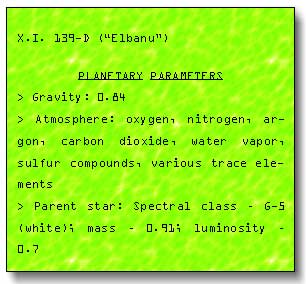
I began listening. The communications channels were, at the risk of criminal understatement, busy … but I soon learned that the planet we were approaching was X.I. 139-D, a.k.a. Elbanu (el BAH noo); the d’Absu had a base there.
We had dropped back into primespace because someone surreptitiously had programmed the Condor to do so at this location.
I realized, of course, who the guilty person was. Lt. Ryan had altered the ship’s programming, and then had tried to kill himself.
In other words, the man deliberately had put us into this situation — into a d’Absu trap!
In another word: TREASON — meaning Dr. Pembrooke and co. had saved Ryan’s life … so he could face the death-penalty at court-martial. (If we made it home — which, at the moment, did not seem likely … )
But why??
Then I heard something that turned my blood to ice:
“Conn, scanning. Multiple contacts, multiple bogeys — readings show three Foxtrot-class d’Absu warships ahead — all closing at flank speed, on intercept courses. Loading bearings-data to you now.”
Uppy waited for the scanning officer to finish … and then addressed the tactical action and weapons officers: “T.A., conn. Activate P.M.A. Stand by countermeasures. Weps, stand by. Confirm.”
“Conn, T.A., aye.”
“Conn, weapons, aye.”
“Helm, conn, increase to flank. Thirty-degree down-angle. Go.”
“Conn, helm, aye — increase to flank, thirty-degree down-angle. Go.”
I was more-or-less half-listening to all this, watching the screens, still thinking somewhere in the back of my mind about Ryan … but then my full attention was caught by the following:
“Conn, Catbird,” the communications officer said. “We have an incoming transmission. Go.”
“Catbird, conn, pipe it through. Go.”
“Aye aye … “
The next thing we heard was the voice of the enemy — a long string of the bizarre clicks, whistles, etc. that the d’Absu call a language. After a moment or two, the Condor’s central computer started to make sense of the noise … and, with its flat, synthesized voice, provided a translation:
“Sphere warship. Reverse engines and stand to. Prepare for boarding. Comply immediately, or we will destroy you. Repeat … “
I saw the glance that passed between Uppy and Gar … and knew instantly what the grim look in their eyes meant.
We couldn’t allow the enemy to board us. Upton was under orders to prevent this … at any cost.
The commander confirmed my thoughts when he said to Garland, “Launch the log-buoy.”
The X.O. hesitated ever so slightly. I daresay you would hesitate, too, if you were ordered to kill yourself … and you knew you had no real choice but to do it. I sure as hell would hesitate — more than “slightly.”
“Launching,” Gar said finally. His voice was just as crisp and cool as ever. He turned to a nearby instrument panel.
While Gar flipped switches, Uppy adjusted his mouthpiece, and said, “Helm, conn, all back full. Go.”
“Conn, helm, answering all back full. Go.”
Upton continued — giving the order all starship crews dread: “Senior officers to the C.I.C. All other personnel, abandon ship. Repeat … “
* * *
I hustled toward the nearest lifeboat.
AstraCav ships’ lifeboats can carry eight persons apiece. Three other persons already were sitting in “my” boat when I stepped aboard — Franco Lewis, Goldilocks, and Dr. Pembrooke …
Two others soon joined us: of all people, Mando Perez and one of his buddies.
Perez was last through the hatch. He had closed and secured it before he noticed who else was aboard. Perez muttered, just loudly enough for the rest of us to hear, “Jesu Christe … I might have known!”
Lewis scowled at Perez … but said only, “Hang on,” before turning to the ‘boat’s controls.
We hung on. The lifeboat ejected from the Condor — along with 39 other ‘boats, and a swarm of countermeasure-pods. (Countermeasures are self-guided, signal-emitting devices designed to confound the targeting systems in enemy torpedoes.) Unseen hands tore my weight away immediately, greedily. Between that and the generally rough ride, I had to do some fast, hard swallowing to keep my guts in place.
We had a good view of the Condor’s demise as we fell toward Elbanu — much too good. Uppy and his officers didn’t give us much chance to put distance between ourselves and the ship before they detonated the scuttling- (self-destruct-) charges.
The all-but-blinding explosions generated ferocious shock-waves — which rapidly overtook the fleeing lifeboats. I had thought the ride was rough a moment earlier … but it now felt as though the same force that had yanked away my weight was trying to use the ‘boat to make a wish.
The d’Absu ships turned their party-cannon on us then. I saw at least a half-dozen lifeboats turned into deathboats inside 10-or-so fiery primeseconds. Within the same period of time, I became increasingly sure that our boat was next.
By some miracle, though, we made it to the upper fringe of Elbanu’s atmosphere — whereupon the ride suddenly became even rougher … and then rougher still as weight began to return. The temperature suddenly soared. Oh, stein, was something wrong with the heat-shield??
We weren’t going to make it to the ground. No way. Not with the lifeboat convulsing like this. Even if a second miracle occurred and we didn’t burn up, we obviously were going to fly apart in mid-air.
Which shows how much I know. The second miracle did occur — and then a third … and then a fourth (Hallelujah!):
Miracle #2 — The temperature/my fears about the lifeboat’s heat-shield notwithstanding, we did not turn into charcoal briquettes;
Miracle #3 — We landed. Mind you, I’m using that word as charitably as any word ever has been used; and
Miracle #4 — We survived the “landing,” albeit with a hell of a lot of painful bumps and bruises.
We took stock of our situation … and quickly realized that we had survived the past few primeminutes for naught. Even if the d’Absu didn’t find us (and they surely already were looking for every lifeboat that had made it past their ships), we — having moments earlier been on the verge of well-done — now were in very real danger of freezing to death.
* * *
It was an Arctic-like wasteland — snow and ice all the way to the horizon … which, to the south and east, was delineated by a chain of jagged mountains; to the north and west, there was no horizon — only a low-hanging, milky haze that rendered the line between ground and sky undetectable.
“We’ve gotta move,” Perez declared. “It won’t take ’em long to find us.” He reached for the release-lever on the hatch-door.
“Move where?” Goldilocks wondered aloud. “We’ll freeze solid in five primeminutes out there!”
Perez popped the hatch. To Goldilocks, he said, “Ma’am, with no due respect, I’d rather freeze than sit here on my azz, and wait for the felshing d’Absu to come along and wax me.”
The man had a point there. Then again, if “the felshing d’Absu” were to shoot me, death at least would come quickly; the Popsicle-option probably would take longer than Goldie’s five primeminutes. But who thinks logically at times like these? (Partial answer: Not me.)
Goldie began, “Specialist- “
“Look,” Perez interrupted, ” … I know it’s a gamble. I know it’s a big roll of the dice. We might die — we probably will die out there, in fact. But if we stay here, we definitely will die. I’d rather roll the dice.” He turned to Pembrooke, and asked, “Doctor, the sampler says we can breathe out there, right?”
“Right,” Pembrooke said. He nodded sideways toward the device to which the other man had referred. The doctor had consulted the sampler (to use the accepted phraseology, he had “taken an atmospheric”) shortly after we’d crash-landed; now he said, “According to these readings, the air is richer in oxygen than you probably are used to, if you’re from Earth — which makes it quite corrosive … and the pressure is lower … so don’t overexert if you can help it — you still will probably end up with a sore throat, at least. And if we do reach warmer climes, take care lighting cigarettes and tapping ashes.”
(The atmospheric sampler is a handy thing to have. There isn’t much instrumentation aboard a lifeboat — they’re intended as limited-use, all-but-disposable emergency escape vehicles, so they’re designed with a bare-bones minimum of accoutrements. No frills — not even any weapons; just the absolutely-necessary stuff. Someone, though, obviously figured — wisely — that an atmospheric sampler qualified in the “absolutely necessary” category. Abandon a starship, end up on a strange planet … How do you want to test the air, to determine whether or not it’s safe to breathe? Would you prefer that a machine do the job — or would you rather poke your own head out the hatch and inhale? Well, I haven’t dropped dead — so I guess the air’s all right … )
“Whatever,” Perez said. “Let’s just move.” He pulled open the hatch-door. Cold air rushed into the ruined lifeboat.
“Specialist.”
Perez hesitated. All of us, in fact, turned in some surprise toward Lewis — this was the first he’d spoken since before we’d crash-landed.
Now he said, “We still are T.P.A., and I still am the ranking officer here … so I’m givin’ the felshin’ orders. You’re on borrowed time. I suggest you do whatever you have to do to keep from forgetting that.”
“I wouldn’t dream of forgetting that — sir,” was Perez’s response. “Permission to debark … ?”
The request obviously had been made in the spirit of sarcasm — which hardly was lost on Lewis. He fixed Perez with a glare colder than the air outside … before saying, “Permission granted.”
* * *
Perez’s buddy (we soon learned his name: Daniel Skyler; he was an E-3, a lance-corporal, like me) suggested we hike southeast.
“Why?” Goldilocks wanted to know.
“Those mountains,” Skyler said, nodding in the general direction in question. “I see a lot of gray and black, but no green.”
“So … ?”
Skyler said, “So no green suggests little or no flora, which in turn suggests rocky terrain — which in its turn suggests, at least to me, a strong possibility that we’ll find caves. Now, a cave won’t provide much warmth, and probably little or no food … but it will provide concealment, and shelter from wind and precipi- “
“All right, all right,” Lewis interrupted impatiently. “This is all moot. We have to go that way. The opposite direction is north-northwest, which means even colder temperatures … and, in case you haven’t noticed, a white-out.”
I looked again at what I earlier had thought was haze, or mist … and realized it was nothing of the kind; rather, it was the edge of a blizzard.
We started hiking. We proceeded in silence. I kept my eyes on the skies, expecting to see (a) d’Absu fighter(s) swoop down on us at any moment — maybe from behind the curtain of the blizzard — which undeniably was getting closer. None of the others could possibly have failed to notice this … but, apparently, they all were of the opinion that if we didn’t acknowledge the storm by talking about it out loud, it would go away. At the time, that logic seemed flawless to me.
Cold wasn’t quite the right word for the conditions; the sampler had read the temperature as 21° F, but it seemed lower than that to me. Surely it had dropped at least five degrees since we’d left the lifeboat! I was shivering … my earlobes stung … and, within a few primeminutes, a dully-painful not-quite-numbness crept into my fingers and toes — then my hands and feet …
At least the wind wasn’t too bad — from the northwest (at our backs) at 14 km/ph (according to the last data we’d seen on the sampler).
None of us was dressed for this climate. As you know, we hadn’t exactly had time to pack. Each of us was wearing a jacket, albeit a light one — quite comfortable in the 65 to 70° aboard a starship … but not so comfortable now.
I don’t know how long it took us to reach the foot of the nearest of the mountains. It felt like an eternity. I was all but frozen solid … I ached from head to foot from the cold and the long hike … and I was ready to drop with exhaustion. How my companions were faring, I didn’t know. Better than me, surely.
The situation only deteriorated as we began ascending the gentle slope that led to the mountain.
First, between fatigue and the changing grade of the terrain, I couldn’t stay vertical; couldn’t seem to take 10 steps without slipping and falling into the snow. None of the others experienced this problem, of course.
Second, the blizzard at last was overtaking us. I was close to letting panic get the best of me — What if the snowstorms on this planet are anything like the sandstorms on Mars, or the rains on Karkendold? I thought. What if the storm lasts for several primeweeks or primemonths? What the hell are we supposed to do then — sit on our hands and let the drifts bury us alive??
The wind no longer came only from behind us; it now seemed to blow in every direction at once. Tiny ice-crystals stung my face non-stop. In my hands and feet, sensation was long gone.
Third, as we neared the crest of the steadily-steepening slope and the foot of the mountain proper, Goldie gave voice to what we all, undoubtedly, were thinking: “I don’t see anything that looks like the mouth of a cave!” She had to shout to make herself heard above the worsening wind.
“It may take some searching!” Skyler said.
I said, “I’ve gotta stop for a while!”
“No way!” Pembrooke said.
“I can’t take another step, Doctor,” I said.
“You have to keep moving until we find some type of shelter, Corporal Clark! Otherwise, you’ll freeze!”
I almost laughed. “I don’t give a stein!” I said. I meant it … I wanted nothing so much as to lie down in the snow and go to sleep. I was sure I could sleep for a primeyear. To sleep, perchance to dream …
… And if (when) I froze, then so much the better. A nice, gentle way to die — and an end to all this misery.
“Yes you do!” Lewis said. “You will!”
“Let’s move!” Perez said.
Goldie said, “Which way — ? left or right? We can’t go forward — ! I forgot to get mountaineering gear from the quartermaster!”
Perez gestured. “That way!” he said. “Left! East!”
“Why?!” Vanderheim wanted to know.
To his credit, the specialist gave a blatantly honest answer: “I dunno … I’m rollin’ the dice again!”
The others started hiking again. I stood there, trying to imagine the effort involved in making my legs move, and decided that the very idea was utterly absurd. Skyler took me by an arm, though, and made me move.
“C’mon!” he urged. “You can do it!”
I’m glad you think so, I didn’t say.
This time, the roll of the dice paid off. What we found — about 100 endless meters and who-knows-how-many primeminutes later — was less a cave than a simple depression in the mountain’s rock face … but it fit the bill, at least in the sense that it offered shelter from the worsening blizzard.
I tried to sit, and ended up falling … and oh did that feel good. I swear that my bones literally creaked as the pain and fatigue left them.
“You’re not going to sleep,” Pembrooke said. “Nobody’s going to sleep. Just forget about it right now.”
“What next?” Goldilocks asked everyone in particular.
“We wait for the storm to quit,” Lewis said, ” … and then … and then I don’t know.”
* * *
Again, I can’t tell you how much time passed before the blizzard finally abated; I can only tell you that it felt like forever. Some of the sensation at last returned to my extremities. I wasn’t helping my situation by sitting still — I had to fight, hard, to stay awake, and not moving meant letting my circulation slow to a crawl — not generating any body-heat … but I couldn’t make myself even think about getting up and moving around like my much smarter companions.
The dissipation of the storm had revealed a night sky — aglow with spectral light generated by the stars and three small moons.
“We should keep moving,” Lewis said. “Travel at night, hide during the day.”
“Right,” Perez said.
Pembrooke said, “We need to find sources of food and water as soon as we can. “
“And a place to hide, long-term,” Goldilocks said — adding, unnecessarily, “A warm place.”
Skyler said, “I don’t know that we should stay in any one place — at least, not for very long. If we do, the chances that the d’Absu’ll find us go way up. The rescue team’ll find us either way” (all T.D.F. personnel have a homing-chip surgically implanted — at the base of the skull — upon enlistment), “so I th- “
“We can’t walk all over the felshing planet ’til the rescue mission comes — if one comes!” Goldie said. “D’you wanna hunt for a new food- and water-source and a new hiding-place every primeweek? Every other primeday- ?_”
Lewis spoke, gently but firmly: “Goldie.”
She looked at him.
” … Take it easy.”
Goldilocks averted her eyes, but did not say anything.
“Let’s just find those food- and water-sources, and hiding place,” Lewis said, ” … and then we’ll talk about the next step.”
Skyler said, “Food, water, warmth — to me, those goals suggest continuing to move south.”
“I agree,” Lewis said. “Let’s go.”
I caught Goldie’s eye, and made the monumental effort to extend a hand. “Could ya help me stand up?” I asked. I was light-primeyears beyond any and all considerations of pride.
We had to continue east for a while, but we eventually were able to turn south. For me, every step was the purest agony; the pain in my legs was all but overwhelming. I had all I could do to keep convincing myself to continue the grueling process of putting one foot in front of the other. Just one more step, I would promise myself. One more step … and then we’ll quit. We’ll admit defeat, sit down, and die. Right after this next step. I then would take that step … and think, Just one more step. One more step …
After a million-or-so primeyears (or so it seemed, anyway), the first hints of dawn began to show themselves in the sky. This pleased me immensely — because it meant we soon would stop hiking.
I thought, This time, I’m gonna sleep, damn it … I don’t care what Pembrooke or anybody else says!
We came to a sparsely-forested area — trees like nothing I ever had seen on Earth or anywhere else. Most of them weren’t especially tall (maybe twice the height of an average human), but they were thick and exotically misshapen — all sinister-looking twists and gnarls. They had needles, not leaves … but the “needles” were huge; they practically were quills, like a porcupine’s.
Anyway, the trees’ branches were, of course, laden with snow. Some of the lower ones were weighed down almost to the ground. We situated ourselves beneath one of these natural lean-tos — just as the forest was beginning to glow with frigid daylight. Once again, I half-sat, half-fell onto the ground. My legs were trembling spasmodically. I couldn’t make them stop.
I felt I never would walk again — never would stand again; not on those legs … and that was fine with me.
I didn’t quite sleep. Pembrooke wouldn’t let me. He would see me nodding, and jostle me awake. At the time, I was unable to appreciate the fact that the good doctor was keeping me alive. I grew to truly, deeply hate him in short order.
Long before I was ready, it was dark again. We resumed our southward hike. I was grimly determined to endure the experience this time. I’d managed to store up some energy during the day, but I suspected that it would prove insufficient. If only there was something to eat … Maybe we would find some berries or nuts tonight; maybe even a slow, defenseless animal — my companions (excepting Pembrooke) did have parstols (particle-beam pistols). Raw meat? At that point, it sounded just fine.
Of course, we had no way of knowing whether or not the berries/nuts/animals on Elbanu were safe for humans to eat. I decided that if I did not think about that fact, it would go away.
Before daybreak, all these worries were moot, anyway.
* * *
When I regained consciousness, the first thing I became aware of was warmth. I hardly dared believe it — warmth! I was ready to weep with relief and joy.
That feeling lasted about two primeseconds … and then I remembered what had happened.
Not long after we had resumed our hike, we had run into the d’Absu. I guess our minds had by then gone as numb as our bodies — we had practically walked right into their trap. We hadn’t even seen or heard the aliens ( … I hadn’t, anyway). We all had been struck — almost at the same instant — by trank darts.
“My” dart had hit me in the left thigh. It had hurt like hell. It still was sore. I had thought, Something’s bitten me, or stung me … I had realized, a primesecond later, what actually had happened — and then everything had gone black.
I panicked. I sat up — fast … then spent a few primeminutes trying to will my breathing and heart-rate to return to normal, and to push the ache out from behind my eyeballs … while taking stock of my surroundings.
I was sitting on the floor of a small, bare room, which was gloomily lit from a fixture on its high ceiling. I knew immediately that I was a prisoner of the d’Absu — the black ceiling and two of the room’s windowless, gunmetal-gray walls were cocked at awkward angles. (This kind of annoying asymmetry is characteristic of d’Absu culture — what we know of it, anyway; their architecture, art, ship-design, philosophy, mathematics … everything. It’s all lopsided. It’s enough to drive you to distraction.)
So I was a POW What would the d’Absu do to me? They would interrogate me, at the very least — that seemed certain. I would tell them that I had no military information; I was a corpsman, a medic. They would not believe me, of course. They would proceed to torture me … and, undoubtedly, I would proceed to die.
I heard footsteps.
A moment later, the room’s only door swung open. Two d’Absu stood there, each with a P.B.R. (particle-beam rifle, a.k.a. party-rifle). The creatures stared at me with their massive compound eyes. One of the insectoids was wearing around its face a device which looked like nothing so much as a metallic feedbag. When the d’Absu spoke, the “bag,” after a brief delay, translated the words into Meanglish:
“Follow us.”
I stood … and very nearly fell right back on my azz. My legs didn’t hurt any more, but they were weak — owing to the fatigue I earlier had suffered combined with lingering effects of the aliens’ trank. The latter (presumably) also was making me slightly dizzy. I hesitated for a moment — until I was sure I was going to remain upright — before following the two guards into the adjoining corridor.
One of them led me, while the other followed, to a locked door at the end of the long corridor. The guard ahead of me undid the lock, and opened the door. I saw pale sunlight — we were going outside. I braced myself for more cold.
I had been wrong — we weren’t going outside; I was. I stepped into the pale light, and the d’Absu closed and locked the door at my back.
Much to my relief, the cold for which I had tried to prepare myself wasn’t there. The temperature actually was quite mild — rather like a mid-autumn day back in My Old Kentucky Home. A light breeze was blowing. This base, I realized, was located much farther south than the place where the d’Absu had tranked us. We — or, at least, I — must have been unconscious for quite some time.
I found that I had emerged into a wide-open yard … with a multitude of other humans — ! my fellow Condor survivors. Two of them approached me — Lewis and Goldilocks.
Lewis asked, “You okay?”
“Yeah, I think so,” I said. “Dying of thirst, though … I think I’d give just about anything for a drink of water.”
“I could go for a hopscotch” (malt liquor), Goldie said, “or ten.”
Pembrooke, Perez, and Skyler joined us. “I count a hundred sixty-eight, including us,” Perez said.
A hundred sixty-eight survivors … ? Let’s see, 168 divided by eight (remember, each lifeboat carried eight people) is 21 … so, of the Condor’s 40 lifeboats, the d’Absu warships had waxed 19.
A hundred fifty-two men and women …
Judging by the expressions on their faces, the others had done the mental math at about the same rate as had I. The only out-loud comment came from Skyler: “Sonsa bitches,” he muttered.
“What are the d’Absu gonna do with us?” Goldie wondered aloud. “Why’d they herd us out here?”
“Who knows,” Lewis said.
I had wondered the same thing, of course … I now decided not to give any voice to what I was thinking. The phrase mass execution had flashed through my mind at least twice.
A hush fell over the yard as the door through which I had emerged now opened again.
d’Absu began stepping through the open doorway, one and two at a time. They gathered, not far from the door, in small clusters, in the same manner as the Condor survivors. The aliens stared at us in silence.
None of the d’Absu, as far as I could tell, was armed.
As I began puzzling over that, another creature appeared from within the enemy installation.
This was not a d’Absu.
In fact, only in holos and other artwork had any of the humans present ever seen one of these deceptively fragile-seeming creatures … and, as far as I knew, the d’Absu never had seen one at all.
Still, I daresay we all instantly recognized — even if we could barely believe what we were seeing — the small, hairless, smooth-skinned purplish body, built remarkably like that of a human child, sparsely clothed in what looked like nothing so much as gold mesh; the delicate-looking features — two large, rarely-blinking eyes, intricate shades-of-emerald patterns constantly kaleidoscoping within them; an earhole on either side of the subtly outsize skull, slightly behind each temple; for a nose, a small outward protuberance with a pair of minute nostrils; a narrow, lipless, low-set mouth …
“Is … that what I think it is?” Perez whispered.
Indeed it was.
A Siar.
The creature stood quite apart from the d’Absu and us, both. It thought … and I — along with everyone else, human and d’Absu alike — heard words, as clear as a direct transmission, in my head:
Your destructive conflict is at an end. You now will return to your homes. Several spacecraft both from the Terran Sphere of Influence and the d’Absu Realm already are orbiting this planet.
Simple as that.
The starship we boarded shortly thereafter was the Reykjavik — Pettyjohn-class; rather smaller than the Condor had been … but I wasn’t complaining. We were going home.
The Reykjavik’s Cavvy crew were in something of a state of shock. They told us that they literally had been halfway across the Galaxy when the Siar had appeared and had transported them — instantaneously — to Elbanu. We soon would hear about similar events befalling other ships. Siar had appeared at every location in the known Universe where human and/or d’Absu race(s) had a presence — from the tiniest outposts to the largest colonies and bases.
Apparently, we (humans) weren’t the only ones who had grown and progressed during the 125 years that had passed since the Siar had vanished; they, too, had learned a few new tricks.
The Reykjavik and her sisters reached Earth in something less than two primeseconds. There, another of the Siar stood before the House of Governors … and, while a multitude of cameras recorded every word, told us the following:
For ages upon ages, we watched you — watched in sadness as you repeatedly stepped up to the brink of self-destruction, fighting amongst yourselves. At long last, you began cooperating — you created your “International Coalition” government, and you began working together to explore near-Earth space. When you reached Mars, and planted the Coalition flag in the red sand, we Siar said to ourselves, Now they are ready; they are well on their way to realizing their full potential. They lack only the guidance.
And so we revealed ourselves to you. We helped you to resolve many of the difficulties that had been plaguing you for so long. We gave you the means to travel among the stars. Having set you on the proper course, we let you go back to guiding yourselves; we thought you were ready. We ended the physical manifestation of our presence among you.
You began colonizing other worlds. The “Terran Sphere of Influence” grew rapidly. We allowed you to keep your weapons — we had faith that you would not use them aggressively; only in self-defense. You encountered many new life-forms — some friendly, some not, some neither. You met the d’Absu. Imagine our sadness, our bitter disappointment, when — after coming so far; after making so much progress, after maturing so much, intellectually and socially — you once again picked up your swords and shields, as it were.
You went to war.
For five of your primeyears, we have watched while you and the d’Absu each have tried to destroy the other.
No more.
The time has come to put you back on the course we set for you a hundred twenty-five primeyears ago. It is our deepest hope that we never will find it necessary to interfere in human affairs again.
We had been chastised … but we had been given a chance to redeem ourselves. I hoped — hope — we didn’t felsh it up again.
The Siar vanished — again — two primedays later. Just like 125 primeyears ago (according to historical accounts), no one knew exactly how the aliens vanished, or to where, although there has been much speculating and theorizing ( … by everyone from serious scientists to — perhaps inevitably — tabloid charlatans who claim that they are “in psychic contact” with the Siar, and can tell us much about the present and many possible futures … for a fee). One thing we do know this time is that the Siar still are “there,” watching us — which, somehow, is both comforting and unsettling at the same time.
* * *
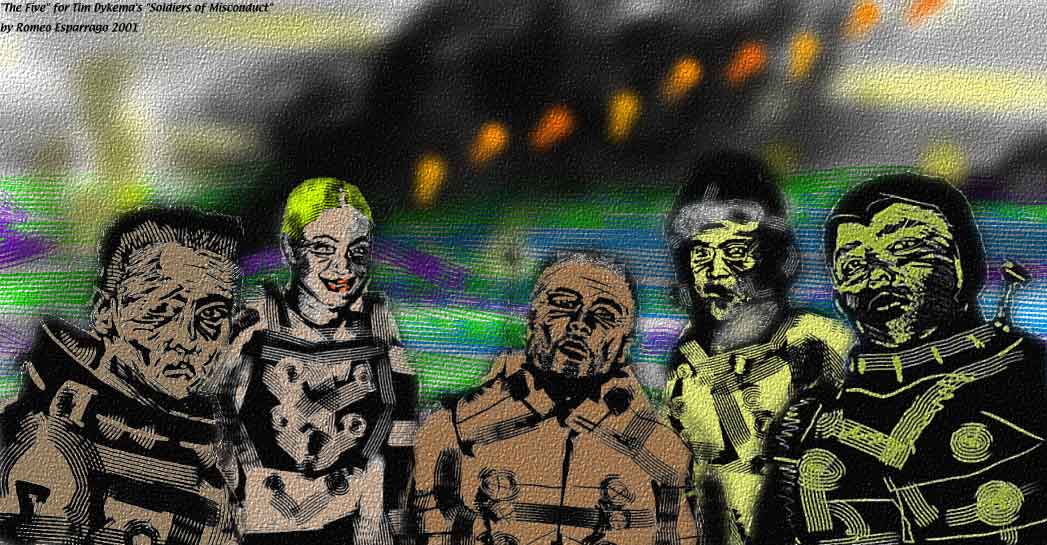
Click image for complete artwork
For most of us who survived the War, its aftermath was … surprising. Not pleasantly.
What do you suppose the Sphere — the government — did to show their gratitude to us vets?
They cut us in half.
Half the T.P.A., half the AstraCav — gone, the budgets slashed to the bone, the bones pounded into dust and scattered.
The government’s line was, Hey, the War is over — why should we spend a fistful of tax monies to maintain a military force when a pinch-worth is all we need?
Next thing anyone knew, a lot of soldiers and pilots had been pinched right where no one wants pinching: Below the poverty-line. And it wasn’t just those of us in uniform; there were many civilians (support-staff types, contractors — shipbuilders, arms-manufacturers, their employees … etc., etc.) who depended upon the military for their livelihoods. But now there were a great many people in the T.S.I. whose hoods suddenly were no longer very lively.
(The various commissioners, sub-commissioners, and staffers of Committee IX, though, mysteriously were able to keep their jobs and perqs.)
We had been back on Earth for about a primemonth when those of us whom the T.D.S. no longer needed were informed that we had been “granted early discharge.” A lucky few were eligible for retirement, or for disabled-vet status … but most of us basically were told, You still are young enough and able-bodied enough to find some other way to support yourself and your family. Good luck.
A couple of primedays after hearing the news, I ran into Lewis — almost literally — in a bar, the Icebox, not far from Ft. Millard.
“I didn’t know you were here,” I said. “On Earth, I mean. You told me you were from Azaru.”
Lewis said, “I’m from there, yeah — but I haven’t been back since … well, for a long time. There’s nobody for me on Azaru any more.”
That somehow sounded like a topic to avoid … so I did. “Buy you a hopscotch?” I asked.
“Sure. Have a seat.”
We started small-talking. I soon learned that Lewis, too, had been shown the door, as it were.
I said, “I don’t know what the hell I’m gonna do. They’ve informed us that they’re gonna close the base in two primeweeks. I don’t have anywhere to go … and, in case you haven’t noticed, there’s a housing shortage on this planet right now.” Referring to the crisis as a “housing shortage” was rather describing like Olympus Mons, on Mars, as a “hill.” The gap between the size of the population and the space(s) available to shelter them never had been wider.
I figured Lewis would tell me to quit my whining, and move to some other planet — so I had my response (I can barely afford to move across the felshin’ street) ready … but Lewis said, “I know what you’re gonna do.”
“What are you talkin’ about?”
Lewis then proceeded to tell me what I told you at the beginning of this account: Someone, somewhere, always is at war. If you go where the action is, you can make good money. Better than “good.” You’ll never want for a job. Hell, you’ll have to turn down a lot of jobs.
” … So, to answer your question,” Lewis said, “I’m talkin’ about me, you, Mando Perez, and Goldilocks ‘going into business’ together.”
“Perez?!”
Lewis gave a light laugh … and said, “Yeah. I’ve been in touch with him and Goldie. They’re gonna do it.”
It was time for my damnfool question of the day: “And you’re just now deciding — right here, at this moment — that you want me involved in this??”
“No, I’m not ‘just now deciding’,” came the reply. “What the hell d’you think I’m doin’ here? I came lookin’ for you. I ducked into this lovely place when I couldn’t find you at your billet.
“So. Whatta ya say — ? interested?”
“I don’t think what you’re proposing is legal,” I said.
“It isn’t. We’ll have to avoid the long arm of interstellar law — as if running around involving ourselves in wars and skirmishes and what-have-you isn’t a dangerous-enough way to live.
“But it is a way to live. You wanna stay here, look for honest work with reasonable pay, and adequate housing — neither of which you’re likely to find anytime soon, if ever — hey, it’s your choice. Your funeral.”
“Well, I can’t afford a funeral,” I said, “so you might as well count me in.” I caught the barmaid’s eye, and signaled for another hopscotch. I definitely needed one. Maybe something stronger.
Lewis and I continued our conversation … but, to me, it no longer qualified as small talk.
I shouldn’t have been surprised to find out that Lewis already had our first job arranged …
Story copyright 2001 Timothy Dykema
Illustrations copyright 2001 by Romeo Esparrago


