
Originally published in Planet Magazine No. 20 (December 1998).
Part One: The Tomb
[Editor: this story follows the continuing adventures of Simon de Montfort, his beautiful niece Lillian, and their obsession in recovering the rare thirasite jewel, the FlameStone, introduced in last issue’s story ” The Green City’s Secrets“.]
The New Assassins
“Is your Order in a direct line-of-descent from the Terran Assassins of ancient Persia?”
Lilly guessed his answer to her question, but sought it as a way to begin the process of cultivating this functionary of the Order. She also knew that such organizations sometimes hold the myths of their origins as tightly as they do their worldly possessions.
Simon, who had been staring out the window of the groundcar, turned to observe the black-suited Assassin in the front seat. (“Black for an assassin — how appropriate,”) he observed, silently.
“Our ultimate origin is not known, for certain, Doctor. We believe that the immigrants from Old Earth who settled Laagulaan must have modeled the Order after some Terran organization. Unfortunately, these secretive men did not record their inspiration, and the oral knowledge faded through the years,” replied the young man who smiled pleasantly at Lilly, ignoring her uncle. The Assassins were not monks, and the guide was clearly smitten by the attractive archaeologist.
“Since your Order is known to eschew drugtaking, such a practice must have been discarded at some point in your Order’s history if it descends from the hashish-users of Earth,” said Lilly.
“Most certainly. I understand, also, that the ancient Assassins originated as an offshoot from the prevailing Islam of the twelfth century. Their activities were basically defensive of their faith. By the time the Laagulaan Order was founded, there was no longer a reason for a religious orientation; however…”
(“This fellow is crammed full of it,”) thought Simon. He turned back to the window. The discussion was becoming tedious. He had researched the Order and was satisfied that it had no organizational connection with the ancient Assassins, who were supposedly eliminated, eons ago, by the Mongols of Genghis Khan’s son, Hulagu. Simon also subscribed — contrary to the prevailing wisdom — to the premise that the Assassins got their name, not from their smoking practices, but from the name of their founder, Hasan Sabah. Simon was somewhat of a heretic, himself, among the Old Boys of the Association of Amateur Archaeologists.
He didn’t care much about the Order’s origins, anyway, although he did suspect an alien influence of some kind. The easy tolerance of this seemingly-human group by many nonhuman races made him wonder if some “others” were behind the humanoid face of the Assassins.
He and Lilly had traveled here for one purpose: to find the unique, tangerine-colored thirasite gem known as the FlameStone. It was a gem from a highly-possessive world whose sun had gone nova, leaving the FlameStone the only piece of thirasite remaining in the Elsewhere.
His quest for this fabulous gem had taken him to several worlds and had involved him and Lilly in memorable adventures which had, so far, produced a chain of failures. Hoping against hope, he expected to find the Stone here — if not held as a organizational treasure, then concealed in the grave of the former Master of Assassins who, he was informed, had purchased it.
He admitted, but only to himself, that he was growing a little tired of pursuing the Stone from collector to collector. Only the competition from other wealthy Old Boys of the Triple-A kept him at it. He knew that he could not endure the indignity of having to congratulate someone else for finding it, now that his obsessive search was becoming known.
Although he admired the Assassins for their organization, and had even purchased their “special” expertise a few times, Simon was just too old and too wise now to be impressed by them.
The headquarters of the Ancient and Honorable Order of Assassins was located in the middle of a vast, grassy plain on the Earthlike planet of Laagulaan. Simon and Lilly had landed their yacht, the Phaselus, at the planet’s only spaceport and had transferred to an Order groundcar for the drive to the Templara. The Assassins did not allow aircars bearing visitors to approach the complex of buildings which was the galactic center of their farflung Order.
For some minutes, Simon had watched the waving grass of the plain rush by. The plain was devoid of development for thousands of square kilometers around the Templara and its spaceport. It was said that the Assassins, like old King Yoy of Alawaan, preferred to see their potential enemies arriving slowly.
One might imagine that they would locate in a castellar redoubt in the mountains, like the Hasanites had done in medieval Persia. But the Laagulaan founders had preferred to build where they could command the skies. The great plain they had chosen was so immense that from nowhere on their world was there a surface line-of-sight, optical or radio, to their sacred Templara.
(“Somehow, all this caution seems inappropriate for an organization which presents itself to the galaxy as a technology-transfer outfit. Of course, corporations with `special’ expertise often have enemies.”)
Simon returned his attention to the conversation.
“When we reach the Visitor Center, you and Mr. de Montfort may tour our Museum and Exposition Hall before the Master receives you.”
“Oh, good. That sounds fascinating — doesn’t it, Simon?” purred Lilly.
“Yes. Fascinating,” replied Simon. (“I wonder if they’ll hand us datapads with order forms before they start us out, so we can purchase some of their gadgets while we’re waiting.”)
“You must view the tabletop model of the Templara. It’s automated to answer many of the questions you may have about our holy place,” chirped the guide.
(“All but one question, I think,”) Simon mused.
Masterful Deal
“The Master of Assassins will see you, now.”
Simon glanced at his niece with only a trace of expression. It was enough. She read: “It’s about time. Much as I enjoy relaxing in Art Deco anterooms…” At the Templara, every building was designed in the Earth-disseminated Art Deco style — even the cathedral-like Temple, itself — where the Order “worshiped” its traditions and accomplishments.
He spoke to his niece, sotto voce. Let me do the talking, Lilly. Dealing with these guys requires real finesse.
“Okay. I’ll just be the dumb assistant,” she replied, with a brief frown of annoyance.
“Now, now, Lilly. I didn’t mean it that way.” After their successes — due in no small measure to her abilities — his niece was quick to resent any implication that they were unequal partners, or that she was undiplomatic. There had been times when her own “diplomacy” had involved real personal sacrifice.
They followed the Secretarius into the spacious office which, despite its size, seemed merely an extension of the anteroom. Simon quickly glanced about him to take in the furnishings and subtle decorations; there were few of either. The room, like the organization it represented, was severely functional. The walls were plaster-white and the carpet light-gray. The leatheroid guest-chairs were black, as was the massive desk they faced.
In fact, the most decorative items in the room were the two silvered torcheres against the far wall which illuminated, between them, the commercial logo of the Order, which was carved into a block of honey maple. The centerpiece of the logo — the traditional assassin’s dagger, inlaid in rare California redwood — was so stylized that it was almost unrecognizable as a weapon. It was a case of tradition mutating for the sake of commerce. The Order’s name was inlaid in dark oak. These exotic woods were yet another concession to the organization’s presumed Terran origins.
Behind the desk and beneath the logo, the man in a black “priest’s” suit — complete with clerical collar — smiled hospitably at the visitors, like a real estate man seeking to close a big sale. He had a pleasant, middle-aged countenance; it was a smooth facial embodiment of the Order of Assassins, one of the galaxy’s most reliable and respected corporations.
Simon’s eye next found the engraved, golden orb resting at the front of the desk. It was just large enough to symbolize the Order to the Master’s visitors, but not large enough to seem ostentatious. It had an equatorial band of finest turquoise and was surmounted, not by a Christian cross, but by the ancient Egyptian symbol which had been adopted by the Order — the ankh.
The juxtaposition of orb and ankh seemed vaguely humorous to Simon, as did the use of a symbol of life by a company of killers. He suppressed a grin as he raised his eyes to the Master, who was wearing another such cross on a golden chain which fell across his vest like that of a monastery abbot or prior.
The Master of master assassins was ogling his niece.
Simon eyed the golden orb on the desk. (“What I wouldn’t give for that; it’s solid, I’ll bet, and engraved with the names of the past Masters. How I’d like to donate it to the Triple-A museum. It appears the Laagulaan founders sculpted their Order from a pastiche of Terran traditions, a mongrel organization, so to speak…. I wonder…”)
His musing was interrupted, as the man behind the desk introduced himself. “I’m Master Semyavanches. Please be seated. How may I help you?” He knew much about these two. Assassin intelligence was very good, especially concerning visitors.
“I’m Simon de Montfort and this is my niece, Dr. Lillian Melba-Affonick. Lilly constitutes the brains of our family archaeological enterprise.” He hoped these words would compensate for his previous gauche remark to his niece about “finesse.”
Lilly gave the man her most gracious smile. “I’m honored to meet the Master of Assassins. I’ve heard so much about your Order.”
The Master demonstrated his skill at dealing with outsiders in a surprising manner…. He scowled.
“None of that is true.”
Simon and Lilly were taken aback.
Then, he beamed and chuckled. With relief, his visitors responded with nervous laughter.
(“My, my: a jesting Assassin… What next?”)
* * *
“Yes, I’ve heard of it. But, I assure you, it’s not in the possession of the Order. We don’t collect gems, except those required by our research laboratories. In fact — and as you must know, Mr. de Montfort — we don’t collect or deal, at all, in precious metals or art objects. We’re a technology-transfer corporation.” He continued to smile, even as his voice took on a slight edge of annoyance.
(“…In addition to being merchants of death,”) opined Lilly. (“And what about that orb? I doubt it’s the only objet d’art here?”)
“What is so special about this gem you seek?” Semyavanches’ question almost negated his previous claim of knowledge about the FlameStone.
“Master Semyavanches — aside from the fact that it’s the only gem of its kind in the known galaxy — it has the admirable property of fluorescing, lambently, when irradiated by ultraviolet, even in sunlight. Its last owner, Sor Vitrux Lamakeele, built a special tubular skylight in his darkened treasure room so that the filtered rays of his world’s sun would set the FlameStone afire at noontime. He and his envious guests would stand around it, marveling at it for just the right amount of time, until the sun moved on and the gem’s stimulated internal fire extinguished.
“Later that night, he would move the Stone, in its special security container, to his banquet roundtable, so his guests could continue to view its flaming beauty while they consumed exquisite desserts under safe, ultraviolet-rich lamps.” Simon seemed enraptured as he related this to the Master of the Black Order, who was not much of an esthete, withal.
After an appropriate silence, Semyavanches responded.
“Hmmmm… Interesting, but…”
Simon quickly followed up on his anecdote. “Now, I have it — on good authority — that the FlameStone was purchased by former Master Cheritoma, personally. I’d like to know how he disposed of the Stone before he died. If he did not, and it’s indeed here on Laagulaan, I’m prepared to make a generous offer for it. And, of course, to prepare a cover story about how I acquired it from an obscure dealer on an obscure world — if you so desire.”
The Master scowled at the prospect of such collecting by one of his predecessors. But he knew that, like the lines of ancient priests and monks, some of the Masters had deviated from the ideals of their Order. This “archaeologist” was probably right about the gem, but Semyavanches sought to put a positive spin on Simon’s knowledge.
“Cheritoma was a wealthy man before he entered our Order, of course. He must have purchased the gem then. Such a purchase by a sitting Master would have been contrary to our Rule.” He contemplated this minor blot on the reputation of his Order. (“Could Cheritoma have concealed it, hereabouts?”) He pictured the former Master sitting in this very office, illuminating his fabulous gem with a UV handlamp. It was a ridiculous picture, but Cheritoma had been somewhat of an eccentric.
Simon was quick to assume a sympathetic attitude. “I understand, Master. I’m sure he brought the Stone with him. Given its unique beauty and absolute rarity, I can see how reluctant he must have been to give it up. Perhaps it’s interred with his remains?” He hoped, desperately, that Semyavanches would show some sympathy for his quest.
“Are you sure he didn’t sell it before he was elevated to office?” asked the Master. “That would have been the customary procedure.” He began keying his deskterminal. He never used voice-access when visitors were present.
Simon responded, carefully. “Gems like the FlameStone have a way of making their locations known to the collecting community. I’m afraid it appears that, since Master Cheritoma couldn’t show it off, he must have decided to take it with him — so to speak.” He paused, while the Master seemingly ignored him to explore the records of Cheritoma’s tenure.
The silence of the room was broken only by the sounds of the data search. After a low-pitched beep, the Master looked up from the viewscreen in his desk. “Nothing here about gemstones. But I do recall we had to dispose of some other personal collectibles after his death — I’m sorry to say.”
“Collected contrary to the Rule?” twitted Simon, with minimal finesse. “How unfortunate. But I do thank you for your honest revelation — my lips are sealed, of course…. However, I’ve known great men to be lain to rest with their most precious baubles clutched in their hands, or even held within a tightly-closed mouth.” He lifted an eyebrow to emphasize his point. “Why, I even recall one grandee who had the mortician replace one of his eyes with a large star sapphire from his collection. You can imagine the stir that caused at his open-casket funeral.”
(“This is finesse?”) questioned Lilly, silently.
Semyavanches pursed his lips and scowled, again. (“Atah! I’m sure my predecessors had to deal tactfully with men like this damned little collector. And so must I.”) Also, he was curious.
“What about the other eye?”
Simon was taken aback, somewhat, by this question. “Uh, it was closed to draw attention to the one with the implanted sapphire — you see?”
“Yes… well… I’m sorry, but even the location of Cheritoma’s remains are in question. We know that he was cremated and his ashes interred somewhere in the old-fashioned dolmen he constructed as a tomb — but exactly where within — that is uncertain. It was the way he wanted it. The Rule allows Masters to dispose of their remains by choice, so long as they keep them on Laagulaan.”
Simon sighed, internally. (“A dolmen? — `old fashioned,’ indeed. So it’s grave robbing, now. A shame to have to resort to that.”) At his age, he was more aware of his own mortality, and increasingly contemplated the method of his corporeal disposal and that of his most treasured valuables.
“Master Semyavanches, let us suppose for a moment that the FlameStone is interred with Master Cheritoma. Would you have any objection to recovering it? — with minimal disturbance to the remains, of course. Given that it may have been possessed against the wisdom of your Order’s Rule…” His voice trailed off, meaningfully.
The Master’s mind raced. Disturbing the tomb of one of his predecessors was a disconcerting prospect. (“But the Order could certainly use an infusion of capital the sale of such a valuable gem would bring, if it were handled discreetly.”)
“How much are you offering for this gem, Mr. de Montfort?”
Simon exulted. (“So much for the great, incorruptible Assassins. That was easy — too easy.”)
“I and my backers are prepared to offer a minimum of one million New Credits. After you’ve researched the item, we’ll be pleased to entertain your counterproposal.” Under his chair, Simon crossed his fingers.
Lilly noticed this familiar gesture. (“After their research, they’ll laugh at a million,”) she thought.
The Master stunned them with the swiftness of his acceptance. He seemed to want to conclude the distasteful business, quickly. “That sounds satisfactory,” he replied. He keyed his deskcomm. “Veterator, will you join us in my office, please.”
Simon slowly relaxed. Semyavanches’ henchman would handle the details. (“And if necessary, Lilly will handle the henchman.”)
It was not that Simon had initially planned to leave Laagulaan with the FlameStone concealed, and then to “discover” it later in some other place. But, if the Master’s trusted subordinate happened to be …reachable… well then, so much the better. Simon was sure that if the fellow became intoxicated with his niece, he might take less than a million NCs to hand it over and keep quiet about their finding it. Seduction was a modus operandi Simon had used, successfully, before.
It was a measure of Simon’s courage that he would even consider swindling the deadly Assassins out of a valuable possession. However, he rationalized that since Cheritoma had violated their tradition of noncollection, the Order didn’t deserve to profit by that Master’s misbehavior. Besides, Simon had sought the Stone for so long that he had come to feel it belonged to him.
Lilly guessed what her uncle was planning, though. (“If he expects me to seduce some Assassin so he can get the Stone for a pittance, he’s mistaken. He may be near to contemplating his Maker, but I have a lot of time left and I don’t want to spend it anticipating the revenge of the Black Order.”)
Unfortunately for Simon’s scheme, his dilettante’s vocabulary of the ancient Latin language did not include the title of Semyavanches’ “henchman.”
New Camster Round
(“So much for that idea.”)
Simon mentally kicked himself, again, for underestimating the Assassins. He ignored Master Semyavanches’ subordinate to stare out the window of the circling flyer at the structure on the grassy swale, below. (“Amazing. It’s a perfect copy of, uh, that passage grave in old Scotland.”)
Veterator Helmesoviu was holding forth to Lilly in a pleasant manner about Cheritoma’s tomb. He was not intoxicated with her, though. The Veterator was so old and wrinkled that Simon had joked to Lilly that he must be one of the fabled founders of the Laagulaan Order.
“That suits me just fine, Uncle,” she had replied. Lilly only called Simon “Uncle” when she was making a strong counter-point, or was seriously annoyed with him.
“But Lilly,” he had replied, puckishly. “Don’t you miss the challenge of using your wiles?”
“`Wiles’? Your choice of term is so delicate, Simon. In a word: no. I don’t care to use my `wiles’ on an Assassin.”
Despite his age, Helmesoviu impressed the archaeologists with his bonhomie and sprightly energy. During the obligatory Templara tour and on their flight to the mountains, he regaled Simon and Lilly with interesting anecdotes about the Order and its history. At times, his delivery approached the irreverent. To Simon, this seemed a bit like touring the Sistine Chapel with a Monsignor guide who refers to the Michelangelo ceiling as “Somewhat gaudy — don’t you think?”.
“Cheritoma was a rather undistinguished Master, actually, and many assume he used his wealth to gain his position,” offered the old man.
Simon gave a silent snort. (“Many such as you, I suspect. If I could proclaim you Master of the Order, you’d probably give me the Stone — gratis.”)
On this point, Simon erred. Helmesoviu did not want, or need to be, Master of Assassins. He was the Chairman of the Advisory Council and, in some ways, was more powerful than the Master. He continued…
“You’ve, no doubt, noticed that the least-big men of history often build the grandest monuments to themselves. This one is less spectacular than some, hereabouts. But Cheritoma did import the rocks from Old Earth, spending much of his wealth in the process — and thus denying it to the Order,” he added.
Lilly stared at the dolmen below and replied, noncommittally, “It’s lovely, in a crude sort of way — as a modern tomb, I mean.” She glanced at Helmesoviu, who was leaning close to her to look out the window. “It seems to be modeled after the Camster Round Grey Cairn in old Scotland.”
“I imagine it is. I’ve never even seen vidimages of the original. Cheritoma was an amateur archaeologist, like yourself, Doctor. I’m not surprised that he preferred to be buried in a neolithic pile like that.”
(“He was a collector, you mean — even against your Rule,”) Lilly thought. She decided to test the Veterator’s attitude toward Simon’s quest.
“Well, let’s hope he took the FlameStone with him into his rocky sepulchre,” she said, brightly.
The old man leaned back into his seat. “Yes. The Order can use the money.”
Cold, Gray Tomb
Simon, Lilly, Helmesoviu, and an Assassin assistant stared at the sight of it…. The assistant was young, handsome, and brawny. Simon wondered if he’d been chosen to attract Lilly. (“What are they planning for us?”)
Before them, a passageway opened beneath the arms of a huge ankh, which had been carved from a monolith. The cross’s vertical member was centered in the entrance, allowing one person to pass around each side. In the loop of the cross above was an inverted, teardrop-shaped hole. It was much smaller than the solid-rock loop in which it was carved. If the sun had been shining then, it would have thrown a narrow shaft of light through the hole and down the passageway.
“It’s beautiful,” said Lilly. “Most unusual,” added Simon, as a thought occurred to him. It was the kind of thought that struggles for release. It was the kind of thought he should have kept to himself. He turned to Helmesoviu with a twisted little smile.
(“Uh, oh. He’s going to cast for a bite,”) thought Lilly. She had seen Simon yield to his puckish urges, before. Since his early schooldays in Upper Alpland, he had been a minor-league iconoclast.
“It’s certainly an imaginative use of the crux ansata, wouldn’t you say, Veterator?”
The old man took the bait. “Crux ansata? I’m afraid I’m unfamiliar with that term,” he admitted.
Simon’s smile broadened. “It’s what the ancient Romans called the Egyptian Cross of Life. The Romans were a practical people, you see. They were more concerned more with empire than about belief. They must have scoffed at the elaborate Egyptian religion because, when they first encountered the ankh, they called it crux ansata — the cross with a handle.”
Veterator Helmesoviu’s face became a mask of self-control, Lilly saw. But he managed to respond with a weak, diplomatic smile at Simon’s lack of respect for the Order’s sacred symbol.
“How interesting. Shall we enter?” He strode ahead under the cross.
Simon winked at Lilly. “Finesse?” she muttered, in reply.
“Of a kind,” he replied.
(“I hope Simon doesn’t carry his “scholarship” too far. Humor doesn’t seem to be a predominant Assassin trait.”) She motioned for Simon to follow their guide. He gave her a little salute and moved forward, smirking.
The collector gave a sigh of discovery as he stepped into the narrow passageway in Cheritoma’s tomb. A striplite at the side was lighted to illuminate those near the door — and Helmesoviu, who was well ahead of them. Between the two, the light had extinguished.
“Fascinating. A delightful fusion of ancient architecture and modern technology,” Simon proclaimed. As they moved ahead, the illumination accompanied them and extinguished behind them. The light was warm and appropriate for the gray-brown, piled-slab stone walls.
The artificial lighting was not entirely necessary, however. Above the heads of the explorers, diffuse outside light from the teardrop hole in the “handle” of the cross feebly competed with the striplite as a source of illumination.
Heavenly Light
A mortarless, large-stone wall formed the straight rear-end of the semicircular chamber which was at the end of the passage. Centered on the wall, but above their heads, was a golden decoration which seemed brightly out-of-place.
“It’s a genuine Zoroastrian sunburst.” Helmesoviu glanced quickly at Simon. “I know the Persian Assassins date from long after the Zoroastrian ascension, but Cheritoma was apparently unable to resist this touch of Persiana.” Simon’s flippant remark about the ankh had put him on the defensive.
“Oh, it seems quite appropriate, Veterator,” replied Simon, in a placative manner. “I like it,” added Lilly.
They looked around the semicircular chamber for a sign of where Cheritoma’s ashes might rest. The flat stones forming most of the chamber wall rose to form a corbeled-arch half-dome. There were no signs of interment — only some opportunistic fungus.
“Could they be behind the sunburst?…” speculated Simon to nobody in particular. “…Cheritoma’s cremains, I mean.”
“It seems likely,” said Helmesoviu.
“I’ll check it with the sonic probe,” said Lilly. She turned to their young Assassin assistant, who retrieved it from the bag of tools he was carrying. He smiled boldly at Lilly as he handed her the probe. (“Now, this is more like it,”) she thought. But she returned his smile in a cautious, demure manner.
After wielding the probe about the sunburst, she shook her head. “Negative. It’s solid for at least a meter.”
“Do the whole wall, Lilly.” Simon’s voice carried a certain impatience. He could be near the end of his quest. No stone must remain unturned.
Lilly swept the wall from top-to-bottom and side-to-side, as high as she could reach.
“Still negative. Of course, the goods could be behind one of the higher stones, beyond my reach.” The Veterator winced, slightly, at her choice of words for the remains of Master Cheritoma.
“But which one?” queried Simon, his disappointment unconcealed. “Which one?”
They all stood back and scanned the wall. Even using a portable spotlight, they could see no significant difference between the individual stones, and no clear indication that any were removable.
“Apparently, he didn’t want his `goods’ to be disturbed,” remarked the Veterator, dryly.
Then, outside the sepulchre of Master Cheritoma — to the good fortune of the party of discoverers — the morning sun emerged from the clouds.
“Oh!” Simon could not contain himself. He and Lilly looked at each other. “Newgrange!” they yelled, in unison.
On the wall a bright, upside-down teardrop splash of sunlight pointed sharply to one of the stones at the bottom.
Part Two: The Treasure
Treasure Denied
“Ancient Earth monuments of this type are sometimes constructed to admit the light of the rising `midsummer’ sun, on June 21 of the Earth calendar. I’ll bet Cheritoma followed that custom,” Simon speculated. “That explains the small hole in the loop of the cross. It’s a pointer.”
“But the summer solstice is weeks away, now,” protested the Veterator.
“True. But perhaps we can estimate where on this wall the sunlight spot would fall at that time. Can you tell me about where on the horizon the sun rises at the solsticial dawn?”
“Why yes, as a matter of fact, I can. I was here when the place was dedicated to the memory of Cheritoma. His will specified that it be done at just that time. I remember seeing the sun rise above a distant tor.”
“Let’s go outside and find that landmark, and return to estimate the line-of-sight it makes to the wall,” said Simon, enthusiastically. “Then, we’ll know which stones to work on.”
The party filed outside, and Helmesoviu pointed out the tor to Simon and Lilly. Then, they all returned to the sepulchre.
“Lilly, you’re the lightest among us. If you sit on our assistant’s shoulders, you should be able to see the tor and estimate its line- of-sight to the wall.”
The assistant suppressed a smile at the prospect.
(“Sometimes I could strangle Simon.”) However, Lilly knew he was right. If she didn’t cooperate, they would have to return to the Templara to obtain more equipment.
“Of course, Uncle,” she said. The young Assassin linked his hands and held them down for her to put her foot into. Then, he hoisted her to his broad shoulders, where she sat uncomfortably and grasped his head tightly to steady herself. She sighted through the teardrop hole in the entranceway ankh.
“Can you see the tor?” asked Simon, impatiently.
She squinted at the distant landscape beyond the hole in the loop of the cross. “Yes, I see it.”
“Try to guess the line-of-sight between there and the wall.”
She looked, back-and-forth, between the hole and the wall until she had made a rough approximation of the probable line of solsticial sunrise illumination. “I’ve got it, I think. It seems to be to the right of and below the sunburst, about halfway to the edge of the wall.”
“That sounds logical,” opined Helmesoviu. “Yes. Let’s start there,” ordered Simon. “You can come down now, Lilly.”
“Thanks so much, Uncle,” she said, as the assistant ducked and returned her to terra firma, his hands lingering at her waist a moment too long. She turned and smiled sweetly at the young man. “Thank you.”
“Now what, Mr. de Montfort?” the old man said to Simon. “Yes, Simon. What now?” added Lilly.
Simon drew himself up to his full meter-and-a-half-plus height. He had been cogitating since the sun had illuminated the wall with its distinctive spot of light.
“Well… when I was studying archaeology, a group of my fellow students and I once speculated about hiding places for cremains. We’d been fascinated by the strenuous efforts of the Egyptian pharaohs to conceal their tombs. One of the boys suggested locating the ashes and valuables in a box behind a long, solid stone. The stone-and-box could be pushed out by a telescoping hydraulic ram in response to a distinctive rap on the face of the stone. A special acoustic sensor would trigger the mechanism, you see?”
“A distinctive rap?” queried Lilly. “How distinctive?”
Simon fondled his beard, as he often did when he was thinking. “A respectful one, I believe. Let’s try something.” He turned to the assistant. “Do you have a wooden mallet in there, son?” By way of reply, the young man fished in his bag, retrieved one, and handed it to Simon.
“Good.” He took a monogrammed handkerchief from his pocket. “Now, Lilly, would you spread this before the most likely stone? Stand aside from it as you do.”
She spread the handkerchief over one of the stones, in somewhat the posture of a bullfighter displaying her cape to a bull.
WHAP!… Simon struck the handkerchief-covered stone a muffled rap with the mallet.
Nothing happened. Everyone looked at Simon. The Veterator was smirking. “Perhaps you weren’t respectful enough, Mr. de Montfort.”
Embarrassed, Simon said, “Try the next one, Lilly.”
WHAP! … Scritch, scritch, scritch…
“My God!” Helmesoviu gasped as, with a rasping sound, the stone began to move out of the wall. “It worked,” shouted Lilly. The young assistant gaped in amazement.
Simon beamed. “All in a day’s effort,” he proclaimed, triumphantly.
Rock dust sprinkled onto the gravel floor of the chamber as the stone was extruded from the wall at chest-height — then fell heavily to the floor — to be replaced at the opening by a stainless-steel strongbox similar to a safe-deposit tray. Then, the mechanism stopped.
“We’ll never get that stone back in, again,” joked Lilly.
Simon flourished the mallet and cried. “The remains of Master Cheritoma!… And, perhaps, the end of my quest…. Will you do the honors, Veterator?”
“Of course.” Hastily recovering his administrative dignity, he moved to the box, inserted his fingers into the recessed handle, and lifted the lid. A mini-striplite in the box turned on, illuminating the interior. Everyone stepped forward and peered into the box.
Cryptic Message
“How grotesque. Is this all he left of himself?” asked Lilly.
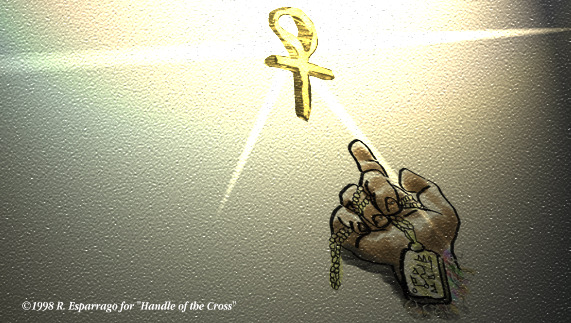
On a red-velvet surface rested a mummified hand, clenched into a fist. It seemed to be concealing something.
“I recognize that ring. It was Cheritoma’s,” said Helmesoviu.
“And in that hand is what we’ve come for, Veterator…. May I?…” Simon reached toward the box as he looked at the elderly Assassin.
“Please do, Mr. de Montfort.” It was clear that he looked upon this particular task with distaste.
As Simon’s hand approached, the one in the box suddenly unclenched and spread its fingers.
“Agggh!” Simon yanked back his hand, reflexively.
“It’s been bionically modified. How clever,” assessed Lilly, professionally. “But what’s that in its palm?”
Resting in the palm of the open hand was a small, embossed-metal coupon similar to a soldier’s “dog tag.”
Simon concealed his intense disappointment by his silence. (“Where the hell is the FlameStone?… Maybe the tag says.”) He reached for it with a hesitant, shaking hand — as if he expected Cheritoma’s bionic remains to suddenly close again, seizing his fingers in a macabre grasp. He snatched the tag from the relic and brought it to his anxious eyes. He read it, then raised his eyes to the zenith.
“Why?!” he screamed. “Why do the possessors of the FlameStone have to be so perverse?!… Yoy, Senefru, Gradalis, Lamakeele!…” He beseeched the arched ceiling of the tomb. “Oh, Lord, why?!
Lilly took the tag from her uncle’s hand and read it aloud.
“`Ask the Overlord,'” she read. She looked at Helmesoviu. “Who is `the Overlord’ he refers to?”
“Yes! Who?!” shouted Simon, accusingly.
The Veterator’s face took on a slight expression of alarm. He controlled himself well, though, in his Assassin-trained way.
“`Overlord’?… I don’t know.” He managed to hold eye contact with Simon.
But both Simon and Lilly knew he was lying.
The Overlord
“I can’t leave here without knowing!” Simon struck his open palm loudly with his fist to emphasize the point. He had become increasingly agitated as they had packed their suitcases to leave the Guesthouse. “I don’t give one damn about the Order’s secrets, but I have to have a lead on the FlameStone.”
“Careful, Simon. You’ll crack the opal in your ring. We’re lucky to be able to leave, at all. I think we’ve stumbled onto a big Assassin secret. I’m not sure what it is, but I have a nagging suspicion.”
“Mind sharing it, Lilly?”
“I’m sure you’ve guessed it, too: the Assassins are controlled by a nonhumanoid alien.”
Simon nodded. “Yes. It has to be that. If this `Overlord’ were human, he’d just be another Assassin bureaucrat. And he wouldn’t be called `Overlord.'”
“There’s nothing in the open literature on the Order that even hints that the Master isn’t the Order’s top dog. There is an Advisory Council of senior Assassins, of course. But — whoever he is — `the Overlord’ must be well behind the scenes,” Lilly contributed.
“Got to be,” Simon sighed and resumed his packing, after checking the opal in his ring for cracks. Then, he stopped and faced Lilly. “You know, of course, they’re listening to our every word. If we’re right about this, we probably won’t be allowed to leave — or our remains will be sent home in a tray like Cheritoma’s.”
Lilly contemplated this in silence, afraid to say more.
Then, the roomcomm chimed, as if on cue.
“Yes?…” Simon called out, weakly, fearing the worst.
From the speaker, the calm voice of Veterator Helmesoviu addressed them. “Before you leave, Mr. de Montfort, I’d like you to see someone.”
“The Overlord,” Lilly whispered.
“Just so,” replied her uncle.
* * *
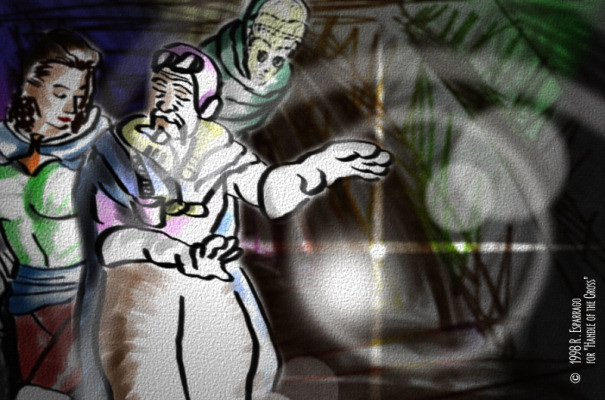
Simon, Lilly, and Helmesoviu exited the liftube on the gallery floor of the Great Hall of the Temple — and stopped in their tracks. Ahead, standing on an ornate, carpeted riserbox and leaning over the railing was a little …being… with his back to them. He was pale and bald, and was dressed in a simple white robe which dropped to the box, concealing his feet.
The scene was sunlit from the large skylight above. The marble walls and floors of the immense space softly rumbled with a continuous reverberation, even after their footfalls had died away. Then, Helmesoviu reentered the liftube and descended, leaving them alone with the alien.
Simon and Lilly stood fast and stared at the little being’s back, uncertain of the protocol the situation required. Seconds passed, heavily.
Then, the alien raised an arm and beckoned them forward. Lilly noticed that he had no fingernails. Slowly, they moved up to the polished mahogany railing, one of them on each side of the figure. They peered over at his face, which was tilted downward to the seats of the empty Great Hall. Without looking at them, he spoke in a little piping voice, in a Universal accent that his guests had never heard before.
“I never tire of this view. You should be here during one of their ceremonies.” He glanced quickly at each visitor.
He had a lined, near-humanoid face with large dark eyes, a minimal nose, and small mouth. He was apparently hairless. He could almost have been mistaken for a dwarf Homo sapiens.
“You’re the Overlord,” asserted Simon, boldly.
“One of them. I sit on the Advisory Council to guide the Assassins.”
“Where are the others, sir?” inquired Lilly, respectfully.
“Oh, they’re harvesting crops and caring for the stock — things like that. The things we did before the Assassins came. There aren’t many of us left, now.”
Simon rested his arms on the railing, relieved to find the alien so accommodating. “Did the Assassins come in peace, Overlord?”
“Call me `Thuse’, Mr. de Montfort. No need to be so formal.” The little alien accompanied this request with a slight smile, which he then aimed at Lilly. “The Assassins didn’t come to Laagulaan, uninvited. We imported them.”
Simon wrinkled his brow. Lilly raised an eyebrow.
“You see, long ago, we decided there was only one way to defend our beautiful world from those who would take it from us. Oh, we have our own special powers, of course. But not sufficient to repel a determined invasion. To guarantee that humanoid imperialists would avoid Laagulaan, we established the Order of Assassins. We made selected humans into ruthless killers, feared throughout the galaxy But we also made their services available for hire to anyone.
“We guessed that nobody would dare to invade the homeworld of the Black Order. Time has proved us correct. We control the Assassins and we live our simple lives. That’s the sum of it. You and your niece are among the few outsiders to know this,” he concluded, ominously.
He watched Simon carefully for his reaction. The archaeologist chose his words carefully.
(“Now’s the time for real finesse, Simon,”) begged Lilly, silently. (“We don’t want a sample of their `special powers.'”)
“We didn’t want to know this,” Simon replied, gravely.
“Well, the Assassins wanted to eliminate the two of you because of what you learned, but I convinced them that, after a confidential explanation, we could trust you to be discrete.”
“Yes, Overlord Thuse. We will be.” Simon’s gratitude was effusive, but genuine. “We’re not concerned with the Order of Assassins. We seek only the FlameStone. In a way, Master Cheritoma sent us to you. So, here we are.”
Thuse reached into a pocket of his robe and extracted something shiny. He handed it to Simon.
“You’re looking for something like this, then?”
Simon gaped at the thing in his hand. It was a model of the fabulous FlameStone, perfectly formed in clear synthetic rutile. Its flat base rested securely on Simon’s open palm. The facets of its old-fashioned dome-cut surface sparkled and flashed colors at the slightest movement in the sunlight. He looked at Thuse for an explanation.
“We found that among Cheritoma’s possessions when he died. He kept it as a memento after he sold the genuine article to get funds for his tomb. By the way, we didn’t know about the tag he placed in the mummified hand. His little jest was not in the best of taste…. Anyway, I’ll give you a copy of his secret sale-record so you can resume your search. And you can keep that flashy bauble. It’ll help people understand what you’re looking for.”
Still staring at the faux FlameStone in his hand, Simon was speechless with relief — and disappointment.
“Thank you, Thuse. We’re very grateful.” supplied Lilly. She smiled sweetly at the little alien.
“You’re welcome, Doctor. You know, I do wish I’d seen the great orange gem — its flaming fluorescence, and all. I never did.”
With that, the little alien turned, stepped down from the riserbox, and walked to the liftube, his robe sweeping the marble floor. He disappeared into it, without looking back.
Onward
“What is about us that inspires people to trust us with their secrets, Lilly?”
“In this case, our certainty they can get us if we blab. Also, I suspect that the Overlords are now an open secret to the powerholders of the outerworlds. It may be a while before they make it into the textbooks, though.”
“Probably. But I ask you: Who else could come to the homeworld of the Black Order, probe a Master’s tomb, discover their darkest secret — yet leave in triumph?” he crowed.
“With a piece of rutile,” she teased.
Simon and Lilly were in their yacht, preparing for departure. It was a traditional time of reflection for them. “I’d like to know something,” she added.
“What?”
“How you knew how to reveal Cheritoma’s remains? I don’t believe that story about you and your pals in Upper Alpland sitting around and dreaming up just the right kind of hiding place.”
“How cynical, Lilly. It happens to be true. One of the boys just up and came out with it. We thought it was a nifty idea.”
“And how strangely applicable to our situation, here,” smirked Lilly.
“Yes, it was. And for a good reason, one I didn’t mention while we were with the Veterator. By the way, I checked my Latin database. Among other things, `Veterator’ means `an old fox’: a fairly good description of Helmesoviu, I think.”
“That suits me. I don’t have to seduce elderly foxes — do I, Uncle?”
“Well, let’s not foreclose any avenue of action, Niece. Our greatest challenge could be just ahead, what with the Stone having been sold to an alien autarch on the mysterious World of Ten Thousand Fires, Ufai t’Nakt Ruvaam… et cetera. Such a long name.”
“Great. That sounds like a lovely place with friendly people, all of whom look like the Devil Incarnate, no doubt.”
“They are a bit… scaly. But there’s a nice air-conditioned trading settlement for repulsive aliens like us. We’ll begin there to see just what the situation is.”
Lilly finished keying their initial course into the autonav. “And end up in a volcano, maybe…. So, what made your old schoolpal’s nifty idea so applicable to Cheritoma’s tomb?” she asked, belatedly.
Simon smiled that twisted smile which meant that he was about to launch a revelatory petard. “The boy’s name was Orvon Cheritoma — Master Cheritoma’s son!… When I found out that the Stone might be in his father’s tomb, here, I couldn’t believe my good fortune. I knew the old Master’s goods had to be hidden as Orvon had conceived it on that schoolday, long ago.”
“Why did it *have* to be that way?”
“Because, Lilly, I would have been most disappointed, otherwise.” Simon beamed, avuncularly.
“God forbid, Uncle.”
“One must try to have a positive attitude, Lilly. Now, let’s get the heck out of here before the Assassins change their minds.”
“A `positive’ attitude, you said?”
“When it’s called for, of course.”
Story copyright © 1998 Frederick Rustam
Artworks “Fingerpointing” & “False Discovery” copyright © 1998 Romeo Esparrago


