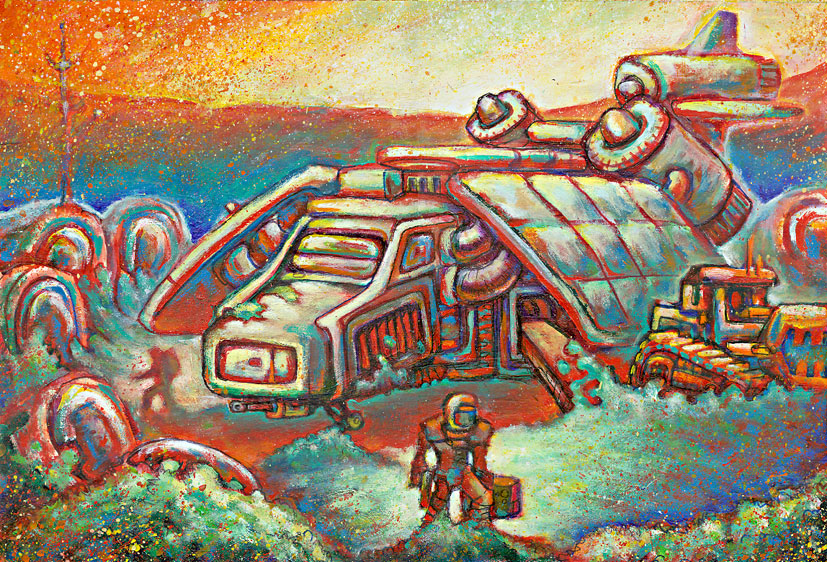
Originally published in Planet Magazine No. 42 (August 2004). Illustration: “Ringside” by Andrew G. McCann A sudden snow squall blinded the downhill skier. In the oblivion of whiteout he impacted the sturdy pine tree head-on at over twenty miles per hour. He was located ninety minutes later by the Aspen Ski Patrol, unconscious and bleeding … Continue reading Ringside Seat, by E.S. Strout
Tag: E.S. Strout
Amanda, by E.S. Strout
Originally published in Planet Magazine No. 41 (March 2004). Illustration by Leo/GaiaGear (This is another of a series of Professor Paula J. Lynch stories. The previous tale in this series, "Field Trip", appeared in issue 37 of Planet Magazine.) AMANDA (Antarctic Muon and Neutrino Detection Array), a hunter of ghostly particles, is ready to go … Continue reading Amanda, by E.S. Strout
Barrier, by E.S. Strout
Originally published in Planet Magazine No. 40 (December 2003). Illustration: “"m1024"” by Alain Valet An intriguing puzzle arises when we consider that the laws of physics treat matter and antimatter almost symmetrically. Why is it that the stars, dust, and everything else we observe are made of matter? If the cosmos began with equal amounts … Continue reading Barrier, by E.S. Strout
Green T, by E.S. Strout
Originally published in Planet Magazine No. 39 (September 2003). Illustration by Romeo Esparrago "The thymus gland's function is to activate the body's T-lymphocytes prior to puberty. These cells effect arousal of the dormant human immune system. They produce a hormonal substance which stimulates our immune response to overwhelm any threatening agency. They may serve additional … Continue reading Green T, by E.S. Strout
Worm Turns, by E.S. Strout
Originally published in Planet Magazine No. 38 (June 2003). Illustration: “Launch Cannon” by ehrad October 19, 2001: Scientists at Lucent Technologies’ Bell Labs have succeeded in fabricating molecular-scale transistors that rival conventional silicon transistors in performance using a class of organic (carbon-based) semiconductor material. In such transistors the length of one molecule defines the channel’s … Continue reading Worm Turns, by E.S. Strout
Field Trip, by E.S. Strout
Originally published in Planet Magazine No. 37 (March 2003). Illustration: “Equation X” by Ehrad BOSON: Any of a class of subatomic particles such as the photon, pion or graviton that have no detectable mass and obey statistical rules permitting any number of identical particles to occupy the same quantum state. - Satyenda Nath Bose God … Continue reading Field Trip, by E.S. Strout
Fade to Black, by E.S. Strout
Originally published in Planet Magazine No. 36 (December 2002). Illustration: “Morning Star” by Ehrad "There is considerable material in the universe that emits very little or no light, according to cutting-edge astrophysicists. This has been discerned through observation of the flow of intergalactic hydrogen streams. These behave as though they are being acted upon by … Continue reading Fade to Black, by E.S. Strout
Buckyball, by E.S. Strout
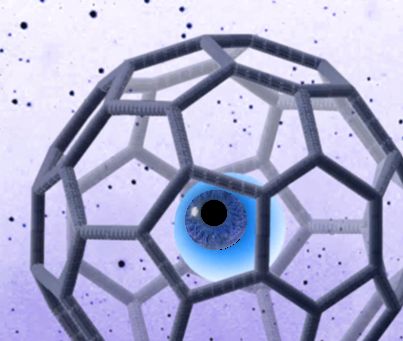
Originally published in Planet Magazine No. 36 (December 2002). Illustration: “BuckEye” by Andy McCann Astropilot Commander Dennis Gorman shook his head to clear the cobwebs from his sensorium. “Terry?” “I’m here, Dennis,” Major Teresa Hernandez replied after a gaping yawn. “What woke us?” Gorman viewed the status readouts of the intergalactic spacecraft JOHN GLENN’s overhead … Continue reading Buckyball, by E.S. Strout
The Net, by E.S. Strout
Originally published in Planet Magazine No. 34 (June 2002). Illustration: “Da-Net” by Rick Hudson 1. "Look at this, Marty." Julie Prentiss gulped black coffee from a Styrofoam cup, made a face, then tapped a fingernail on the real-time CRT image of a Hubble Telescope transmission. "Pretty exciting stuff on The Net from the Astronomy Division … Continue reading The Net, by E.S. Strout
Blue Shift, by E.S. Strout
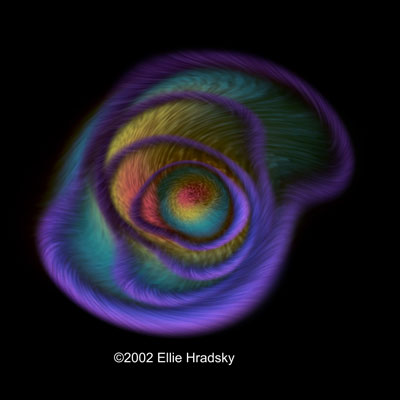
Originally published in Planet Magazine No. 33 (March 2002). Illustration: “Wormhole” by Ellie Hradsky In one scenario, the universe is expanding slowly enough that the gravitational attraction between galaxies causes the expansion to slow down and eventually stop. The galaxies then start to move toward each other and the universe contracts. -- Alexander Friedmann 1. … Continue reading Blue Shift, by E.S. Strout