
[Illustration: New illustration created for the archive.]
Mary knew that the holidays were not a good time to ask her husband for a favor. He already was heading the committee organizing the party the police threw each year for the poor and homeless kids in the city, and he still had his regular job to do. She had to ask, though, or she’d never get to the bottom of the mystery.
“Honey, could you come in here a minute?” she called.
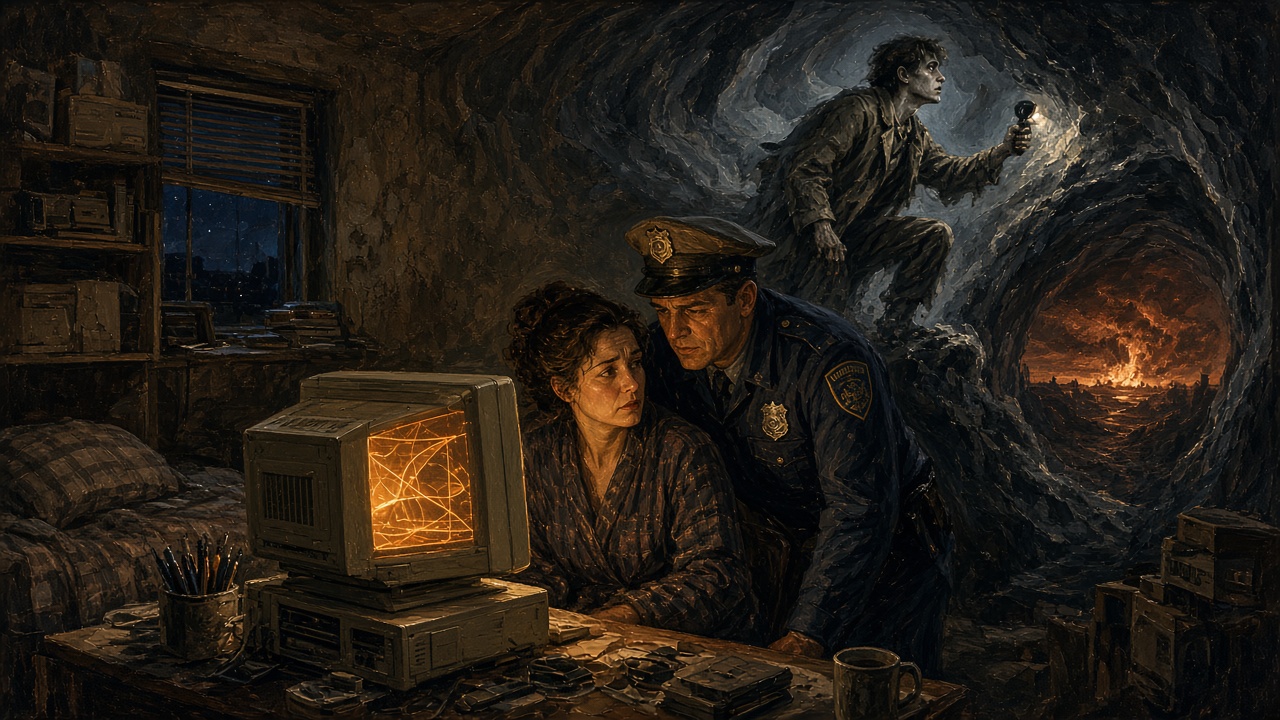
With dinner over, she had a few minutes before she left for her job at the mall. Christmas Eve would be the last night, but the extra money would help. She sat in front of a real dinosaur of a computer in what should have been their one extra bedroom, except that it was crammed with obsolete PC junk. She pointed to the glowing amber letters on the ancient monochrome monitor as Ron walked in.
“Tell me what you think of this.” She pointed as he leaned over her shoulder to read.
August 8, 1984. Chronological dimensional translation to assigned supersymmetric node in Greenbrier Park was successfully completed three days ago. I rented a room on Bayly Street, within walking distance of the University of Virginia campus, from Sarah Danko, a real grandmotherly type. She accepted my reproduction paper money for this era without question as did the clerk at the store where I purchased the relic I am now using for my notes. Finally Dr. Eisner’s class in pre-event technology is proving useful. It’s slow going because I have to physically enter each letter. Certainly the Institute’s restriction preventing the transport of current technology using the Sorg Chronological Field is correct, but maybe a little extreme in not even allowing augmentations. I feel like I’m walking around naked without them.
“That’s great,” he said. “Instead of old computers, you’re starting to write science fiction. Do you need help in moving all of these old machines out of here?”
“I didn’t write it. It was on this old computer from the thrift store. I never thought I’d find one — the first Compaq Deskpro. One thing that’s unusual about it is that it’s all original — no upgrades at all. I’ve never found another old PC without upgrades.”
“Must have belonged to someone who wrote science fiction,” he replied. “Are there other stories on there?” He pulled a wooden stool from under a table and sat.
Mary typed dir/p and hit the Enter key. “That’s the other thing that’s strange.” She put her index finger against the screen. “Project.nb, that’s the only file on it. And notice the date it was saved, March 25, 1987. That matches the last entry in the journal.”
“Journal? Don’t tell me you think it’s real. It’s the start of some sci-fi novel, that’s all.”
Mary shook her head. “Somebody named Glasnof wrote it. I haven’t read all the entries, but it sounds real. If it is, we’re in big trouble.”
“What do you mean?”
“This Glasnof talks about how he wanted to do something different for his research project — study a time far away from the event, not right before or right after like everyone else. That’s what he calls it, an event, but it’s clear he means some sort of cataclysm.”
“Did he say what it was?”
“No, but he says the time he was studying was seventy-three years before it happened. That would put it in 2057, half a century from now. It uses the names of places right here in town. What if the people are real too? I know you’re up to your badge in things to do, but it would only take you a minute to check. In fact, I already tried, but the university wouldn’t give me the information. It’d be easy for you.”
“What information?”
“Whether there was a student there in 1984 by the name of Krogman, Arthur Krogman, a physics major.”
“What’s so special about him?”
“Glasnof didn’t say, not in the parts I’ve read, but he did say this Krogman entered the university in the fall of 1984. Will you be a sweetheart and check it for me?”
“What if I find there was no Arthur Krogman? Will you forget about it?”
“Deal!” She glanced at her wristwatch. “I’m going to be late.” She turned the computer off, kissed him on the cheek, and headed for the door, not telling him that she planned to do some checking of her own.
* * *
After Ron left for work the next morning, she found five listings for “Danko” in the Charlottesville phonebook, but none on Bayly Street and no Sarah or S Danko. She punched in the number for the first one.
After striking out on the first three, she was feeling like a fool. She’d come this far, though, so she might as well finish. A husky woman’s voice answered at the fourth number.
“I don’t know if I have the right number, but I’m trying to reach Sarah Danko.”
“What’ya want?”
“You’re Sarah Danko?”
“I’m her sister. Who are you?”
“My name is Mary Haskell. I have something that may belong to her. Do you know where I can reach her?”
There was a pause and she heard a muffled cough. “Sarah died, more than ten years ago now. What’ya have that belongs to her?”
“Did she have a house over on Bayly? Did she rent out rooms?”
“Yeah. Did you know her?”
“No, I’m sorry I didn’t. Do you know if she ever rented a room to someone named Abdus Glasnof?”
“How would I know? What’s it got to do with you anyway?”
“I bought an old computer at Goodwill that used to belong to Glasnof. Apparently he rented a room from your sister.”
“What kind of computer?”
“An old Compaq. Big, heavy.”
“I gave it to them. It sat in my basement for years.”
“So it belonged to you, not your sister?”
“No, some renter left it at her place. It was in a closet. When she died, we had to clean out her stuff. Like I said, it set over here for years. I finally decided to haul off the junk.”
Mary paused for a moment, thinking how she might dig out more information from her. “Do you know anything about the renter?”
“Naw, but I remember Sarah talking about him. A strange one, he was. Kept to himself. Always paid his rent a year in advance. Never bothered anyone, so she left him alone. But she’d see him from time to time. He had some sort of weird disease.”
“Disease? Did she say what it was?”
“Nope. She did say it was genetic, not contagious. No missing the symptoms, though. He looked like just another student when he moved in, but after a few months, he started aging, fast.”
“Do you know what happened to him?”
“Sarah said he paid his rent that last year, three months before it was due. She never saw him again. She waited until his next rent payment was a month past due before going into his room. The bed was made, all his clothes were there, the computer too, but no sign of him. She put all his stuff in a closet, thinking he’d come back for it someday, but he never did.”
“Did an ambulance ever come in the night for him, something like that?”
“He just skipped out. What’d you say the name was?”
“Abdus Glasnof.”
“That might’ve been it. Strange, if you ask me.”
Even stranger when you read his notebook, Mary thought. “You’ve been a great help, Ms. Danko. I won’t take up any more of your time.”
* * *
Mary spent several hours reading the entries in the notebook and was sitting on the couch when Ron came home. Bending over, he planted a kiss on her cheek before sitting beside her.
“I checked on that name for you. Arthur Krogman was a freshman in 1984. That doesn’t prove anything. Just because the story uses real names doesn’t mean it’s not fiction.”
“Abdus Glasnof was real too.” She explained what Ms. Danko had said. “It’s all real. Something awful is going to happen in 2057.”
“So some nutcase with a good imagination rented a room. It doesn’t prove anything.”
“Read the entire notebook. You’ll see it all fits. Glasnof talks about how people are living their lives completely unaware of what’s coming in 2057. He was supposed to return to his own time in two months, but something happened, and he got stranded.” Mary took Ron’s hand. “I’ll read some of the passages to you.”
She’d left the old machine on and had jotted some notes and page numbers. She moved to page 40 and started reading halfway down the screen.
October 12, 1984. Just time for one final entry before I report to my supersymmetric node and return to my own time. I have become very fond of many of the people and wish I could do something to forestall the coming destruction. Of course, the class I took in chrono-stress management prepared me for this. I fully understand that any attempt to warn them could prove disastrous for my time. I hope my observations will prove beneficial in helping us understand the pre-disaster time more fully.
“You said the last file date was 1987. If he left in 1984, who made the ’87 entry?”
“Listen to the next one,” Mary said.
October 16, 1984. Something has gone terribly wrong, something unprecedented, even impossible from the laws of physics I learned at the Institute. I was at my assigned point thirty minutes early and waited for an hour, but the dimensional transition did not occur. I also was there at the correct time on each of the subsequent nights, but the distortion field failed to condense.
Does this mean my world has been inexorably altered? Was it something I did? I don’t see how. I have followed strictly the protocol of not interacting with Krogman, his friends, or professors. He did catch me watching him once, but I turned and walked away. Surely that could not cause such a large anomaly.
As much as I hate to admit it, I realize the phase alignment cannot now occur. I am stranded in this time slice. My dimensional immunity will dissipate within a few days. How long can I last? Although no one has ever experienced the process, theory says perhaps a few years.
“You see, Ron? He knew he would age rapidly. That fits exactly with the story his landlady told. The rest of it has some additional observations, but mostly it’s just sad. He makes it clear what it’s like to live out your life in a couple of years, never being able to confide in anyone. He was so lonely. Listen to the final entry.”
March 25, 1987. I paid Mrs. Danko for another’s year rent, even though I know I don’t have that long. Already I have trouble remembering things. Am I caught in a dream? Is this the real world, or is that other one real, the one that now seems so hazy?
It seems I swore an oath. To whom, I cannot recall, but I will leave in a few minutes to fulfill it. I have found a way that should keep my body from ever being discovered. I will activate the program that will destroy my report the next time this machine is powered up.
Why do I bother to write, if I make it impossible for anyone to read my words? I know not, but I feel compelled to honor my oath.
When I am gone, will anyone mourn me? Will anyone miss me? Please let me not have lived my life in vain.
Please know that I existed. I wish I could have helped you. I care. Good-bye.
Tears clouded her eyes as she looked at Ron.
He didn’t say anything for a moment, but then shook his head. “This guy wrote a good story, but that’s all it is, Mary. A story. Nothing more. We’re reading it, aren’t we? So he didn’t activate his virus or whatever. We know that part is fiction. If one part is, then the rest is too.”
“Maybe he couldn’t bring himself to do it. Or maybe I was the first person to turn on this computer since that night. It made a loud grinding when I first started it. That could have been the unsuccessful attempt at loading whatever program Glasnof had set. But the rest of it checks out. Look at the time that last entry was saved. Just a few minutes before midnight, and he said he was leaving that night. And what about the aging that Mrs. Danko saw?”
“So he likes to work late at night. Lots of people do. And lots of diseases cause rapid aging. None of that is evidence.”
“We’ve got to show it to the government. Maybe they can figure out a way to stop whatever it is that’s going to happen.”
“With nothing more than this? They’d laugh at us. Or maybe have us committed. Any hint of something like that and I’d lose my job.”
“But this is real. We can’t just sit here and do nothing.”
“With no more than this, that’s all we can do. We have to.”
* * *
A spring day years later dawned glorious, the kind of day where tender new leaves are the brightest shade of green imaginable, and the blue of the sky stretches beyond infinity. Mary and Ron ambled along a trail in Greenleaf Park, arms entwined. “It’s a lot of change for one year. My retiring and Jessica getting married.”
“Change for the better. You won’t be tied to the station all the time.”
“I just hope they don’t have a big dinner for me or something.”
“You kidding? The Captain can’t retire without a big send-off. Any idea who will replace you?”
“I’m going to recommend Joe Varnado. He’s the one who discovered the peculiarities in that Paleo-Indian skeleton.”
“Paleo-Indian? Oh, yeah, the one they found when they were searching for those kids in Switcher Cave. The paper said it was really old, but nothing about it being peculiar.”
“The bones crumbled when you touched them. Obviously old, but we had to certify that no foul play had been involved. Joe’s our sharpest investigator, so I sent him. He started having doubts.”
“What kind of doubts?”
“The kind that keeps a case open. That’s why I couldn’t talk about it, but it’s closed now.” He pointed to an empty bench and invited her to sit. “The body was in the back of the cave, on a tiny ledge fifteen feet above the floor. The arms rested across the chest, peaceful, like whoever it was had just laid down for a nap.”
“Maybe an elder went there to die.”
“It takes a lot of effort to get that far back into the cave. And it was doubly hard climbing up to that ledge. It was like the guy didn’t want to be found.”
“Maybe it was a sacred place, some sort of ceremony.”
“Then where are the artifacts? There was absolutely nothing, not even a scrap of clothing. We did find a rusted flashlight about forty feet away, but anybody could’ve dropped that. Joe wanted to know how the guy died. He brought in a forensic anthropologist from the state crime lab. She examined every bone and didn’t turn up a single mark, not the least hint of violence. Trace elements were normal too, but the carbon-14 dates were all over the place. She also analyzed the dust and debris underneath the body, and that’s where it really got weird.”
Ron paused a moment, watching a kid on a bike with training wheels wobble down the trail. Mary prodded him to continue. “Did it show how he died?”
“It turned up a derivative of saxitoxin, just a trace. It’s a deadly poison in certain types of shellfish.”
“You’re saying it was murder?”
“He was poisoned, but most likely self-administered.”
“How can you tell that?”
“Saxitoxin kills by a slow, creeping paralysis. You lose all muscular control, but remain conscious until you suffocate. Not a nice way to go, but it would account for the peaceful position of the body. The guy climbed up there, swallowed the poison and never moved again.”
“How long ago? Did she figure that out?”
“That’s what’s most peculiar. The bones look absolutely ancient, but saxitoxin was still detectable. It degrades rapidly when exposed to air. Twenty-five, maybe thirty years, and it would be gone. It might last a bit longer where it’s dry, like on that ledge.”
“So you’re saying it’s a recent death?”
“It has to be, but we can’t explain the aging of the bones. We gave up on it, turned it all over to the forensic anthropologist. Joe just told me the other day that she turned up something else bizarre. There are several small, round plugs in the skull.”
Mary had a really bad feeling about where this was heading. “Plugs? You mean metal?”
“No, the plugs are bone, but there’s no DNA. Our best guess is synthetic bone.”
“Augmentations!”
“What?”
“It’s him!”
“What are you talking about?”
“Abdus Glasnof. I always wondered what happened to him.”
“I thought you’d forgotten about that years ago!”
“I remember reading his journal like it was yesterday. I’ve still got a printed copy stored somewhere. He griped about feeling naked without his augmentations. He aged rapidly. That would account for why the bones seem so old. Whatever process was operating must have continued after he died. And that last entry — he said no one would find his body. He must have gone there in the middle of the night. He never counted on such a thorough search of the cave.”
“I wouldn’t have told you about it if I’d known you’d start all that stuff again.” Ron frowned.
“I wish you hadn’t,” she said. “Now I’m afraid.”
“Why?”
“Our children have only twenty-four years left.” *
About the Author: G. Dedrick Robinson, a retired college professor with a PhD in geology and approximately fifty published scientific articles, did not start writing for a general audience until the summer of 2003, but has already completed three novels and a dozen short stories. His 2004 novel Indistinguishable from God, is available as an ebook from several sites, including ebooks.com. In 2005, the literary magazine Lynx Eye published his short story “Final Entry,” and in 2006, Nth degree published another story, “Key to a Future,” in its Online Exclusives section.
(c) 2007 G. Dedrick Robinson


